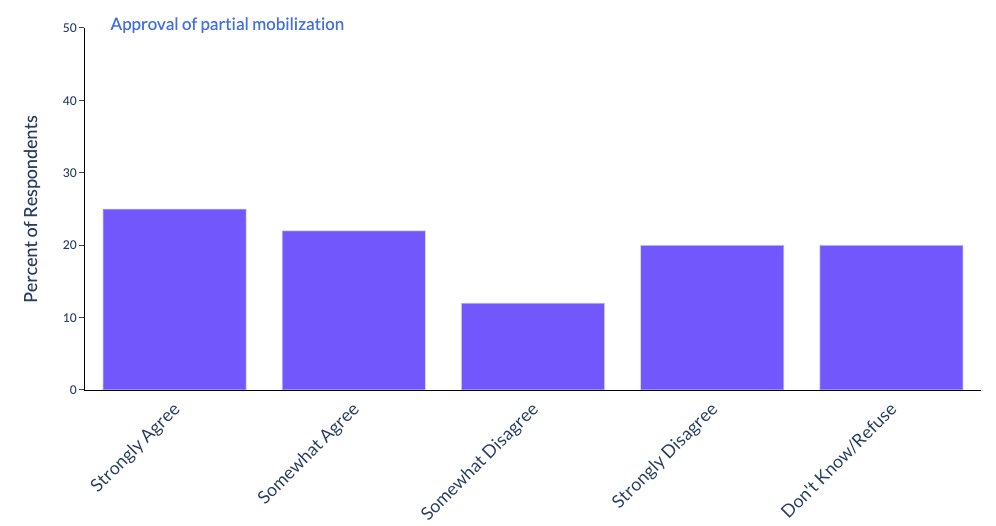
๐จ New data: How are Russians reacting to Putin's declaration of "partial" mobilization in ๐ท๐บ? Support for "partial" mob. has been ~58-59% since 9/21, when the policy was announced (~47% if we include "don't know"s & NAs in denominator). But support is not consolidated. A๐งต: 1/
On 9/21, Putin announced "partial" mobilization of military reservists. That same day, we began asking Russians whether they support Putin's decision. From 9/21-9/23 (today), average support has remained relatively consistent: ~58-59%. 2/
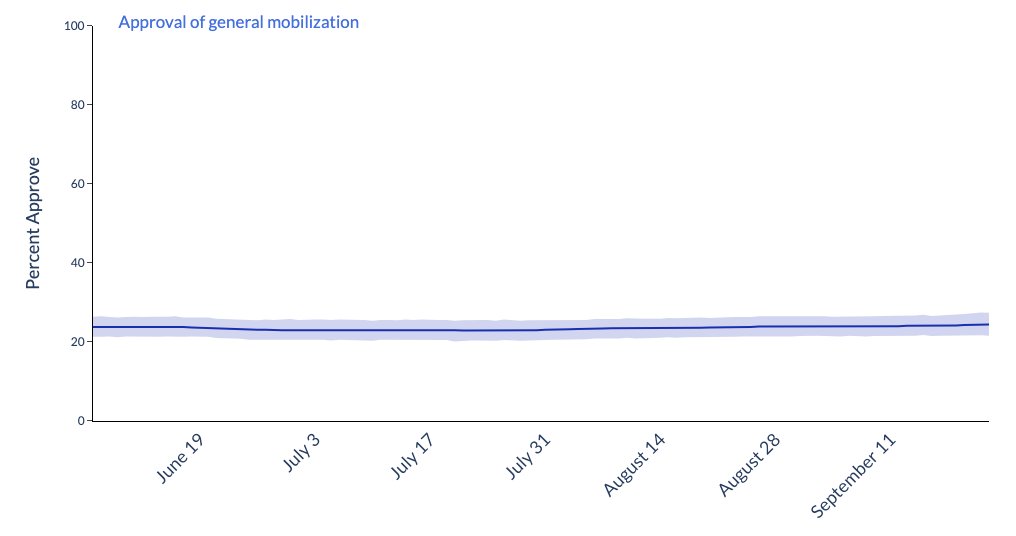
However, the vast majority of Russians are still opposed to general (total) mobilization. We've asked respondents this question regularly since June 6, and support for gen. mob. has remained under 25%. Nor have we seen a substantial increase over the past few days. 3/
], we showed this breakdown along a 4-pt scale. (Note that the time series is weighted differently from the bar chart estimates, resulting in slight differences in %s. Any estimate of national public opinion has a margin of uncertainty.) 4/
These figures suggest that while Russians are substantially more supportive of partial mobilization than general mobilization, there is far from a consensus within the population. 5/
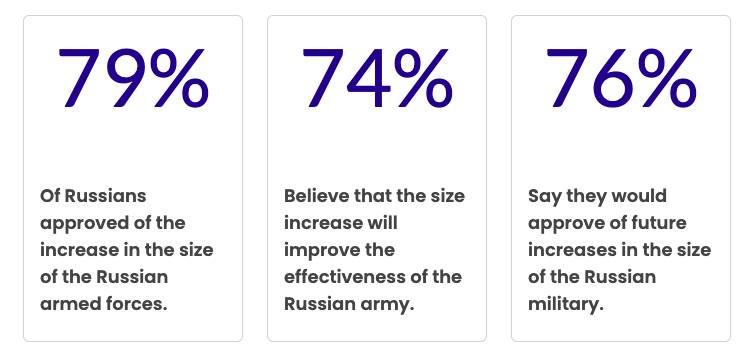
For comparison, note that the vast majority of Russians we surveyed expressed support for Putin's August 25 decree to increase the size of the ๐ท๐บ military. (We asked these questions btwn 8/26 and 9/7, right after the decree was signed.) 6/
Please note that results for partial mobilization are tentative, as we have only surveyed 600 respondents (200/day). We will be monitoring these indicators for changes in the coming days and weeks. For interactive graphs, see our website: russiawatcher.com/mobilization. /END
โข โข โข
Missing some Tweet in this thread? You can try to
force a refresh

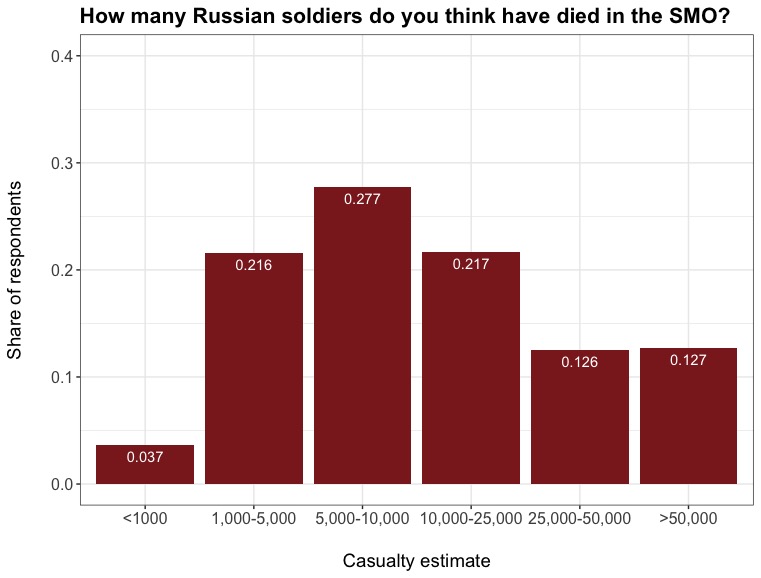
How many ๐ท๐บ soldiers do ordinary Russians think have died in ๐บ๐ฆ? We presented survey respondents w/ 6 different casualty "bands" to choose from. Plurality of respondents (27.7%) say 5-10k ๐ท๐บ troops have died, but 47% think it's >10k. 1/
While we have been asking this question regularly since mid-June, these averages are from the beginning of August to present. 2/
Context: ๐ท๐บ officials rarely speak abt how many troops have been killed in the so-called "special military operation" in ๐บ๐ฆ. The first update in ~6 mo. came on 9/21 from Defense Minister Sergei Shoigu, who claimed that 5,937 ๐ท๐บ soldiers have died: reuters.com/world/europe/rโฆ. 3/
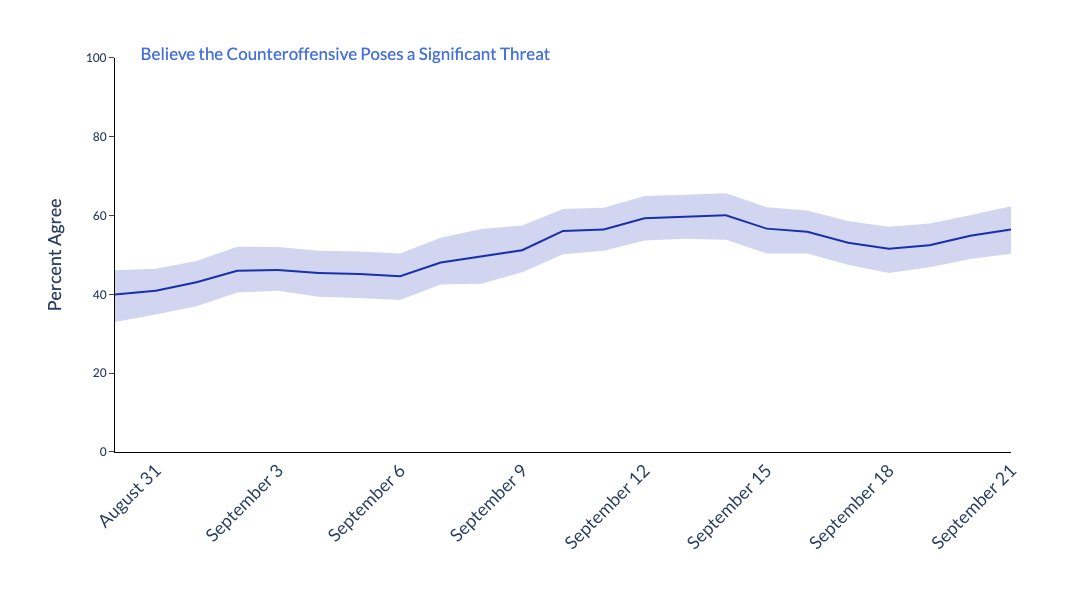
What Russians think about the counteroffensive--PART 3. TL;DR: avg belief that ๐บ๐ฆ mil. actions pose significant threat to ๐ท๐บ forces is on the rise again. Perhaps related to intro of "mobilization" to criminal code on 9/20, then Putin's declaration of "partial" mobilization? 1/
From 9/14-9/18, share of Russians who said ๐บ๐ฆ military actions in S&E pose significant threat to ๐ท๐บ forces has decreased from 60.1% to 51.6%. From 9/18-9/21 (today), % has increased to 56.5%. 2/
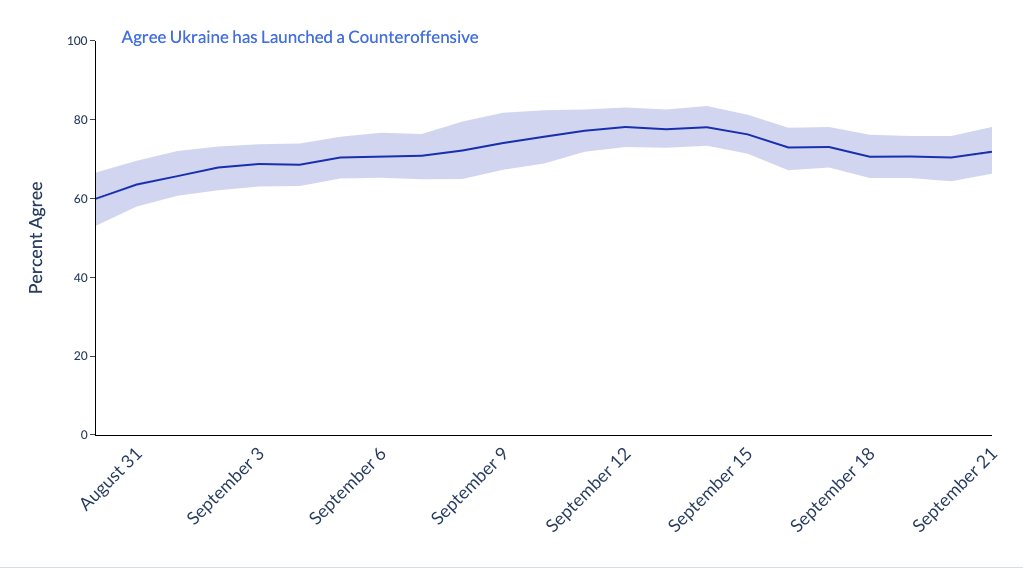
Around 70% of Russians believe that ๐บ๐ฆ has launched a new offensive. The share went up from 60% @ end of Aug, when ๐ท๐บ narrative was still consolidating, to 78.1% on 9/14. Then it began to decrease. Today's (9/12) estimate is 71.9%. 3/
What is the relationship btwn support for the "special military operation" and television consumption in ๐ท๐บ? We found that on average, the more often Russians encounter info abt the SMO on TV, the higher their level of support for the "operation." 1/
This comes as no surprise, given the hawkish rhetoric and propaganda that is regularly broadcast on Russian TV channels--which are both highly popular sources of news and tightly controlled by the state. 2/
In fact, ~62% of our respondents encounter info abt the SMO in Ukraine on television more than once a day. Only ~7% said they never get info on the SMO from TV. [Note that these figures exclude don't know/ NA responses.] 3/
*Do Russians support general mobilization?* Since early June, we've regularly asked respondents to what extent they'd support a general mobilization in ๐ท๐บ to advance the "special military operation" in ๐บ๐ฆ. On avg, ~20% of Russians would support gen. mob., while ~80% oppose. 1/
Men and women tend to show similarly low levels of support for general mobilization: ~22% of women and ~19% of men either "fully support" or "generally support" the policy. 2/
But we see striking differences across age groups: ~39% of respondents aged 18-24 support gen. mob., while a mere 11% of respondents >54 y.o. do. This is surprising, given that younger ppl (men in particular) wld be more likely to be affected by mass conscription. 3/
What do Russians think about Ukrainian counteroffensive? A preview: as ๐ท๐บ state narrative shifted from initial denial to (partial) acknowledgment of ๐บ๐ฆ gains, Russians increasingly (a) believe that an offensive is occurring & (b) view it as a threat. russiawatcher.com/counteroffensiโฆ 1/
At first, ๐ท๐บ media denied that ๐บ๐ฆ offensive was taking place (ria.ru/20220829/khersโฆ). Then they claimed ๐บ๐ฆ had tried but failed to mount an offensive (ria.ru/20220829/nastuโฆ). 2/
Recently, ๐ท๐บ has acknowledged "regrouping" and "temporary successes" of ๐บ๐ฆ mil (radiosputnik.ria.ru/20220912/lnr-1โฆ). As the narrative has shifted, so have Russians' beliefs abt what's going on in ๐บ๐ฆ. 3/
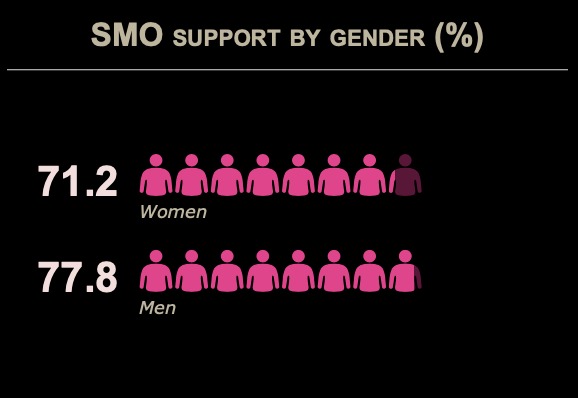
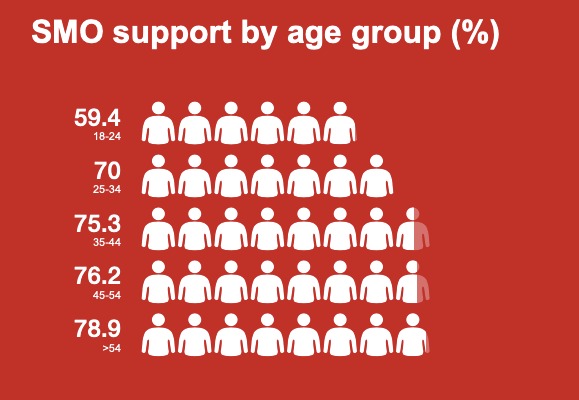
โ๏ธNew blog post: support for the "special military operation" by demographic group. Although majority of Russians (~74% overall) support the SMO, we do see interesting variation across genderโง๏ธ, age๐, and education level๐ฉโ๐. Some basic findings: 1/ russiawatcher.com/war-support-inโฆ
(1) Men support the SMO more than women. On avg, 77.8% of men claim to support SMO, while 71.2% of women do. Women are also more likely to give "don't know" & NA responses: 17.2% compared to 8% for men. 2/
(2) Older people support the SMO more than younger people. Among respondents aged 18-24, support is at 59.4%. For each successive age group, avg level of support is higher. Among respondents > 54 y.o., avg SMO support reaches 78.9%. 3/