
Paul Krugman Profile picture
Sep 24 10 tweets 3 min read
Thinking more about reactions to the Truss/Kwarteng not-a-budget released Friday. While I yield to nobody in my disdain for their embrace of zombie economics, I'm puzzled by all the talk about a looming sterling crisis 1/
Just an aside: I can't be the only one who noticed the parallel between the declaration that a budget wasn't a budget, just a "fiscal event", and Putin's insistence that his war isn't a war, just a "special military operation". No moral equivalence, of course. But wow 2/
But back to sterling. I'm supposed to know something about currency crises — I did invent the academic field! And as far as I know there are two ways a country with a floating exchange rate can have a currency crisis, neither of which seems to apply to the UK 3/
Since the 1990s, most currency crises have involved balance sheet effects: a country (either public or private sector, or both) has large external liabilities in foreign currency. In that case depreciation worsens balance sheets, creating a self-reinforcing downward spiral 4/
That was the story for Asia in the 90s, the Argentine crisis 2001, part of the problem in Turkey now. But while the UK has a lot of external liabilities, they're overwhelmingly sterling-denominated; the UK also has external assets, largely direct investment 5/
The result is that sterling depreciation actually *improves* Britain's net international investment position (the same thing happens to the US). So a balance-sheet currency crisis story doesn't seem to make sense 6/
The other way you can have a currency crisis is if markets believe that you can't or won't service your public debt, and will monetize it instead; this was the story behind the 1926 franc crisis and, I think, the 1976 sterling crisis (which needs revisiting) 7/
But the Bank of England is independent these days, and unlikely to monetize debt. And despite everything, UK debt isn't *that* high by long-run standards 8/
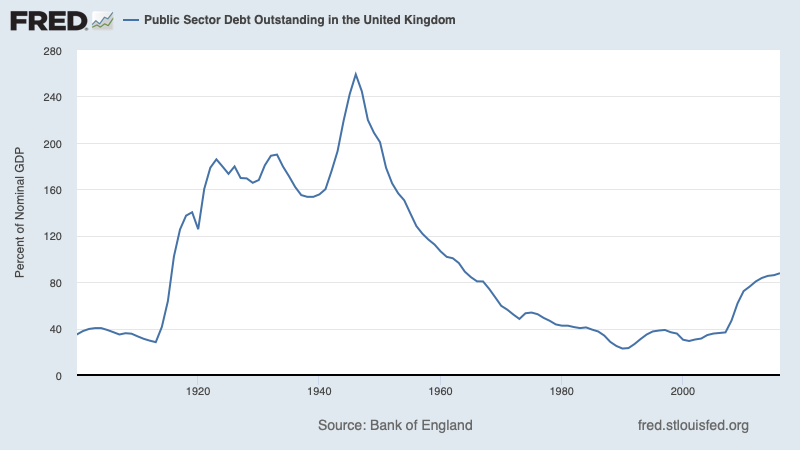
So why did zombie Reaganomics produce currency depreciation, not the excessively *strong* currency caused by the original version? Well, it did say bad things about the competence of the new government 9/
But at a guess, the moron risk premium has now been priced in. I guess I don't see the mechanism for a continuing sterling crisis. What am I missing? 10/

• • •

Missing some Tweet in this thread? You can try to force a refresh

 

Keep Current with Paul Krugman

Paul Krugman Profile picture

Stay in touch and get notified when new unrolls are available from this author!

Read all threads

This Thread may be Removed Anytime!

PDF

Twitter may remove this content at anytime! Save it as PDF for later use!

Try unrolling a thread yourself!

how to unroll video
  1. Follow @ThreadReaderApp to mention us!

  2. From a Twitter thread mention us with a keyword "unroll"
@threadreaderapp unroll

Practice here first or read more on our help page!

More from @paulkrugman

Sep 24
More thoughts about the UK. As I tweeted earlier, while the not-a-budget is stupid and cruel, hard to see a sterling crisis 1/
But, people ask, what about 1976? Suddenly an old crisis has relevance today. And understanding 1976 is harder than may seem obvious at first glance. 2/
That crisis was clearly a budget/sovereign debt crisis manifesting itself in the currency market; reading histories of the time, it was all about public borrowing and fears thereof 3/
Read 9 tweets
Sep 17
Yep. The Great Resignation appears to have been temporary. 1/
I mean, does this look as if prime age adults have exited the work force en masse? 2/
Labor force participation down for >55 — but this is largely aging within this group. Being 69, or even 63, is different from being 56! 3/ bloomberg.com/opinion/articl…
Read 4 tweets
Sep 16
As they say in the Patrick O'Brian novels, I give you joy of your victory! A few FRED-based thoughts on one of Brad's big insights: that the world didn't really break out of the Malthusian trap until 1870 1/
As it happens, my friend FRED includes the Bank of England dataset with estimates of some UK variables going back to the Middle Ages. And it allows me to make a few pictures of real wages versus population 2/
Up through 1600 the world was Malthusian pure and simple. Real wage in 2015 pounds versus population (inverted): just sliding up and down the curve with the rise and fall of plagues 3/
Read 11 tweets
Sep 13
Well, I was getting ready to write about why we shouldn't make too much of the monthly CPI decline. Now need to write about not making too much of the monthly rise 1/
The core inflation number is the one that has people worried. But as I've been saying, that's basically shelter. And these days it's a really problematic indicator of what's happening to underlying inflation. 2/
CPI shelter prices are set to rise for quite a while simply because they reflect trends in newly rented housing with a lag. That's not a critique; there are reasons for doing it the way BLS does. But private indicators suggest that the rent surge is leveling off 3/
Read 4 tweets
Sep 10
Next week I'll be participating in a discussion of inflation policy in the US and Europe. Have a fairly clear picture for the US, I think: economy overheated, but inflation expectations anchored, so we need some cooling but not a Volcker-style era of pain. What about Europe? 1/
My relatively benign view on the US is informed a lot by surveys, like the NY Fed survey; anxiously awaiting Monday release, but last release showed inflation expectations falling — down to 2.3% for 5 years 2/ newyorkfed.org/microeconomics…
The conventional wisdom has been that Europe is fundamentally in better shape — not overheated, so it was just transitory energy prices. But of course the energy price shock is now off the charts. And should we worry about expectations? 3/
Read 6 tweets
Sep 8
So, I'm reading the Ball/Leigh/Mishra paper Jason Furman calls "the scariest economics paper of 2022." It definitely paints an ugly picture. And these are serious guys, not at all permahawks. Their grimness might well be right. But I have questions 1/ brookings.edu/wp-content/upl…
A lot of discussion out there about their use of vacancies to unemployment as a measure of labor market tightness. Indeed, the apparent outward shift in the Beveridge curve is the main driver of their pessimism. What do I think about that? No strong views 2/
Reasonable people on all sides here, and I don't feel that I understand post-Covid labor markets well enough to make a judgment. Put it this way: if we've had enough structural change to massively shift the B curve, we've also had enough to screw up standard measures. So, ??? 3/
Read 8 tweets

Did Thread Reader help you today?

Support us! We are indie developers!


This site is made by just two indie developers on a laptop doing marketing, support and development! Read more about the story.

Become a Premium Member ($3/month or $30/year) and get exclusive features!

Become Premium

Don't want to be a Premium member but still want to support us?

Make a small donation by buying us coffee ($5) or help with server cost ($10)

Donate via Paypal

Or Donate anonymously using crypto!

Ethereum

0xfe58350B80634f60Fa6Dc149a72b4DFbc17D341E copy

Bitcoin

3ATGMxNzCUFzxpMCHL5sWSt4DVtS8UqXpi copy

Thank you for your support!

Follow Us on Twitter!

:(



