So there has been a lot of discussion about the need to give Putin an 'off ramp' (though I know some realists chafe at the wording) for de-escalation.
And I have good news! I have found the off ramp, pictured below. If the Russian army takes that ramp, hostilities should end.
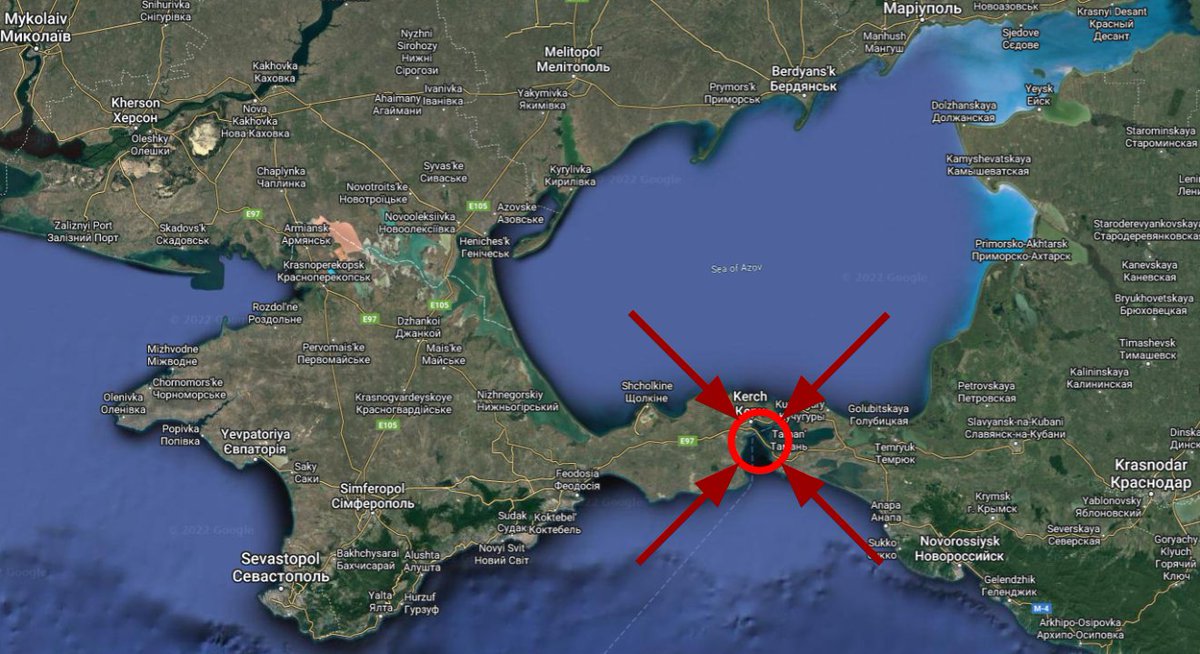
To be a touch less flippant, I think the problem with finding Putin de-escalation options is that he pretty evidently doesn't *want* to de-escalate.
If Putin was looking to trade some gains to hold on to others, there might be a case for negotiations. But he's not doing that!
Instead he's annexing territory he doesn't even control to tie his hands and the hands of any potential successor, to be unable to concede Ukrainian soil currently under the feet of Ukrainian soldiers.
No off-ramp can be useful for a man who wants to be on the highway.
And I think the notion that Ukraine or NATO should preemptively negotiate ourselves out of this or that territory to provide an 'off ramp' is frankly absurd. If Putin wants to try to lock in a favorable peace while his army still exists, he can ask.
To be frank though, a lot of the 'realist' off-ramp talk strikes me as too clever by half, trying to find a way to think away the escalation risk that Putin has created. But one party cannot unilaterally lower the risk, they can only move it around, redistribute it.
And so the existence of the problem - Putin has created a nasty escalation risk scenario - doesn't imply the existence of a solution.
Confront Putin now? Escalation risk now. Don't confront Putin? Escalation+Proliferation risk tomorrow when he does this again, somewhere else.
But I don't think there's a clever policy or way of thinking which removes the bad risk Putin created by invading Ukraine (twice) - you can only mitigate and plan for the risk Putin's behavior creates.
There is no clever solution, only bad and worse options.
• • •
Missing some Tweet in this thread? You can try to
force a refresh

This notion -the Romans had tiers of citizenship based on ethnicity- keeps coming up. I have no idea where from, but it is mostly wrong before 87 BC; entirely wrong afterwards.
Citizenship attached fully regardless of origin; Romans could be snobby bigots but their law was not.
Prior to the Social War (91-87) the Romans did have a category of citizenship sine suffragio ('without votes') which had all the legal rights of citizenship except voting and office holding, usually extended to allied communities in Italy with their own local officials. 2/
Sometimes that was extended as a reward ('here are all the benefits of citizenship, but you can keep your local government'), sometimes as a penalty ('we are extinguishing your polity but not giving you a full say in ours'), but it was community based, not ethnic. 3/
This is simply and obviously wrong in easily demonstrable ways, from the expansiveness of Roman citizenship to the incorporation of Persian elites under Alexander and the Seleucids (however poorly) to obvious things like the numbers of Scots in key posts in the British Empire.
One thing that white nationalists all seem to share is an absolutely astoundingly terrible grasp of history, unable to imagine the - again, quite obvious - fact that people in the past defined racial & ethnic boundaries differently than we do and that those boundaries were fluid.
There were, of course, ethnically exclusive polities in antiquity - the Greek polis is a good example.
They tended to be small, weak and tend to be overrun by more diverse polities (as the Greeks were by the Macedonians and then the Romans).
(Grok has also, unsurprisingly, parroted Musk's own catastrophic misunderstanding of the nature and purpose of Augustus' moral legislation - which was aimed at family's in Rome's tiny sub-2% elite, not at general population.
No surprise there.) 2/
On the point of the evidence - our demographic evidence from antiquity comes mostly from funerary inscriptions and, in Egypt (and really only there) fragmentary census reports.
Both systematically underreport young children, making it impossible to pin down a TFR. 3/
We're not quite to discussing labor in peasant households in my on-going series of pre-modern peasant lifestyles (keeping in mind peasants made up 90+% of the population pre-1750) but functionally all women worked, beginning very young and essentially never 'retiring.'
The core of that work was textile production (discussed here: ), but equally women typically handled childrearing and food preparation and were still expected to be in the fields during periods of peak labor demand (e.g. planting, harvest).acoup.blog/2021/03/05/col…
Worth answering 'on main' & cross-posting from The Good Place.
Victor Davis Hanson's work has been reappraised in 2 ways: the quality of his work substantially changed post-1998, but also the arguments of his early work experienced pushback, which he has largely not answered. 1/
Let's start with the early works, by which we mostly mean Warfare and Agriculture (1983; rev. 1998), Western Way of War (1989) and The Other Greeks (1995).
These, especially WWoW, made substantial impacts when they first appeared, set the 'orthodoxy' on hoplites in the 90s. 2/
Large parts of that WWoW model have come under significant scholarly pressure - @Roelkonijn can sing on this, for he is one of the chief critics here.
Critiques range from the mechanics of battle to the social underpinnings of hoplite warfare, and they're very substantial. 3/
('Enrichment' here is sorting out fissile u-235 (about 0.7% of naturally occurring uranium) from stable u-238 (the other ~99.3%)).
So it sure seems like if you were going to attempt a first-strike against a uranium enrichment program, you'd want to know where the uranium was.
My sense is this has always been one of the chief concerns for why 'deal' might be preferable over 'strike' - if you strike and miss, the uranium vanishes into the vastness of Iran until it reemerges as a successful nuclear test in 6 months, a year, two years.



