David Priess Profile picture
Oct 5, 2022 13 tweets 5 min read Read on X
Hi. It’s the President’s Daily Brief guy again.

I’m here to explain how Mark Meadows’s newly reported remark about presidents and the PDB is woefully wrong—and reveals why he never should’ve been chief of staff in the first place.

Grab a drink. Let’s take a PDB journey.

1/13 Image
First, the remark. In her new book “Confidence Man,” @maggieNYT writes that during the transition Mark Meadows asked Ron Klein, “How many days a week is Vice President Biden gonna want this daily brief?”

Klain was "dumbstruck by the question.”

2/13
penguinrandomhouse.com/books/668293/c…
After Klain said Biden wanted to be briefed every day—saying that was how Biden had done it as vice president—Meadows countered,
"No president ever does that. That’s never happened.”

[This is where your narrator takes a deep breath. And another one. And another one.]

3/13
Let’s look at Trump’s predecessors to show how wrong this is.

And not just to one or two of them.

Let’s go back almost 50 years, to look at how each of the@modern commanders in chief have incorporated the President’s Daily Brief into their schedule each working day.

4/13 Image
Gerald Ford not only read his daily book of secrets with interest each working day, but also took in-person, daily briefings about the PDB from intelligence community officers through his first year in office.

5/13 Image
Jimmy Carter provided ample evidence for history (and to me in interviews) that he read his President’s Daily Brief every working day. He typically marked up his copies, scrawling questions and comments in the margins.

6/13 Image
Ronald Reagan got material from his PDB through briefings every working day with his national security advisor.

He also read it regularly. All six of his national security advisors, and others in his White House, confirmed that for me.

7/13 Image
George H. W. Bush not only read the book of secrets every working day but also welcomed a CIA briefer for a face-to-face briefing on those days that he was in Washington.

8/13 Image
Bill Clinton took in-person briefings irregularly over the course of his two terms but had the book delivered every working day for reading. He and his top advisers told me that he devoured its content.

9/13 Image
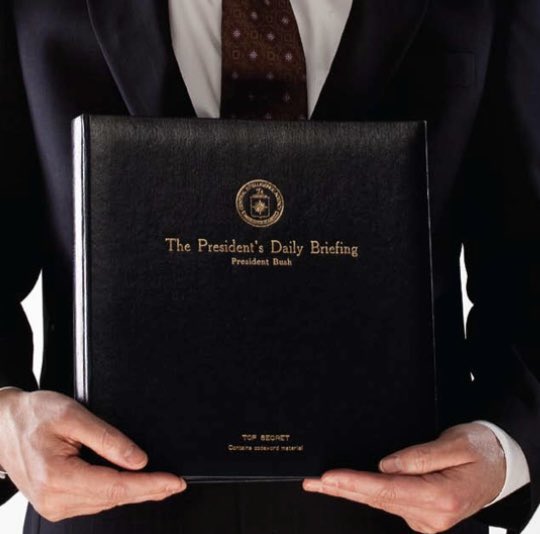
George W. Bush read his PDB carefully, giving it more time on his schedule than any previous president—becoming the first POTUS to take in-person briefings from intelligence officers every working day of his presidency, whether he was in DC or overnighting elsewhere.

10/13 Image
Barack Obama read the PDB (for him, on a very special iPad) alone and talked about it with senior advisors every working day. And then he invited intelligence community briefers in a few times a week to expand upon its content or walk on new items.

11/13 Image
So Meadows’s remark applied to only one recent POTUS: Trump.

That means he was either lying to Klain (maybe to try to reduce Biden’s access to intel) or simply ignorant of other presidents’ experiences. Either option demonstrates he was unfit to serve as chief of staff.

12/13 Image
Interested in more detailed stories of presidents and their relationship with intelligence?

Check out my history of it all—featuring interviews with presidents, vice presidents, CIA directors, and many others:

/end

amazon.com/Presidents-Boo…

• • •

Missing some Tweet in this thread? You can try to force a refresh

 

Keep Current with David Priess

David Priess Profile picture

Stay in touch and get notified when new unrolls are available from this author!

Read all threads

This Thread may be Removed Anytime!

PDF

Twitter may remove this content at anytime! Save it as PDF for later use!

Try unrolling a thread yourself!

how to unroll video
  1. Follow @ThreadReaderApp to mention us!

  2. From a Twitter thread mention us with a keyword "unroll"
@threadreaderapp unroll

Practice here first or read more on our help page!

More from @DavidPriess

Aug 7, 2024
THREAD: 23 years ago today, the best known daily intelligence item in history—the article "Bin Laden is Determined to Strike"—appeared in George W. Bush’s President’s Daily Brief.

Here’s the story of its creation, based on my interviews with its author and intel leaders:

1/12 Image
During the summer of 2001, Director of Central Intelligence George Tenet was telling everyone who would listen that “the system was blinking red.”

The CIA-based Counterterrorist Center (CTC) had been warning for months that al-Qaida seemed primed for a major attack.

2/12
From January 20 to September 10, more than forty pieces in the PDB alone related to Bin Ladin.

In response to such analysis, the president several times asked Michael Morell, his CIA daily intel briefer, about the prospects for an attack in the United States itself.

3/12
Read 12 tweets
Mar 12, 2024
THREAD: Something interesting this way comes in the new US intelligence community annual threat assessment testimony, as briefed to the Senate today.

It’s about Russia. And nukes. And things left unsaid in the submitted text.

Here we go:


1/9c-span.org/video/?534027-…
First of all, if you’re unfamiliar with the long tradition of unclassified worldwide threat briefings to Congress, catch up with this podcast episode I hosted 4+ years ago with Michael Hayden, Jim Clapper, and Andrew McCabe.

Deep experience here:


2/9lawfaremedia.org/article/lawfar…
The Russia section last year had this interesting line: “Moscow will become even more reliant on nuclear, cyber, and space capabilities as it deals with the extensive damage to Russia’s ground forces.”

See here:


3/9odni.gov/files/ODNI/doc…
Read 9 tweets
Mar 5, 2024
THREAD: Speculation has started in earnest about what will happen this year to the tradition of classified intelligence briefings for the major party presidential candidates.

And a lot of what’s being said is wrong, or at least incomplete.

Here’s ground truth —>

1/12
Major-party POTUS candidates have been offered intel briefings during the campaign since 1952.

(Not to be confused with the heavy intel support presidents-elect get—including, since the President’s Daily Brief began in the mid 1960s, a copy of the outgoing POTUS’s PDB.)

2/12
The tradition began in 1952, when President Truman—reflecting on his sudden succession to the presidency in April 1945—offered classified briefings to both candidates (Dwight Eisenhower and Adlai Stevenson) seeking to succeed him.

No statute required it. Just a courtesy.

3/12
Read 12 tweets
Apr 4, 2023
THREAD: Tonight in Fredericton, New Brunswick, at a public event about US presidents and intelligence, I got a question I hadn’t heard in hundreds of engagements on the topic:

“Who are the oddest people to ever show up in a PDB briefing?”

Buckle up. Strange things ahead.

1/9
Usually, for more than half a century, the President’s Daily Brief goes only to POTUS and a close circle of senior national security officials—like vice presidents, national security advisors, secretaries of state and defense, and folks one step removed.

Usually.

2/9
But it ain’t always that way.

The PDB was born in 1964, for Lyndon Johnson—and within a few short years, this most secretive document was going to, among others … Press Secretary Bill Moyers.

3/9
Read 9 tweets
Mar 9, 2023
THREAD: My quick reactions to the U.S. intelligence community’s Annual Threat Testimony, released and briefed to the Senate Intelligence Committee today.

Some surprises, and some disappointments. Let’s go—

1/13
First, appreciate that this annual testimony from intel leaders has a rich history—described in this 2020 episode of the Lawfare Podcast that I hosted with former DNI Jim Clapper, former DCIA and DirNSA @GenMhayden, and former DD/FBI Andy McCabe:

2/13
podcasts.apple.com/us/podcast/the…
Now for this year. Here are things that strike me upon first reading.

First, China. Wow.

More than ever, the PRC isn’t only front and center but interwoven throughout the assessment. And the judgments = blunt.

Don’t believe me? Read it yourself:

3/13
odni.gov/files/ODNI/doc…
Read 13 tweets
Dec 31, 2022
THREAD: As each year ends, I look back at the books I’ve read/re-read or listened to across 12 months.

I’ve read a lot this year—and thought I’d share my list in categories, alphabetically by author within each.

I recommend every one of these books and thank all authors.

1/12
Books I read in 2022 (history, part 1):

Lincoln and the Fight for Peace by @JohnAvlon

SPQR by @wmarybeard

Grant by Ron Chernow

Washington by Ron Chernow

The Cabinet by @lmchervinsky

Behold, America by @sarahchurchwell

The Wrath To Come by @sarahchurchwell

2/12
Books I read in 2022 (history, part 2):

The Craft: How Freemasons Made the Modern World by @JohnDickie1

Lincoln by David Herbert Donald

The Future History of the Arctic by @charlesemmerson

Adams vs. Jefferson by John Ferling

The Field of Blood by @jbf1755

3/12
Read 12 tweets

Did Thread Reader help you today?

Support us! We are indie developers!


This site is made by just two indie developers on a laptop doing marketing, support and development! Read more about the story.

Become a Premium Member ($3/month or $30/year) and get exclusive features!

Become Premium

Don't want to be a Premium member but still want to support us?

Make a small donation by buying us coffee ($5) or help with server cost ($10)

Donate via Paypal

Or Donate anonymously using crypto!

Ethereum

0xfe58350B80634f60Fa6Dc149a72b4DFbc17D341E copy

Bitcoin

3ATGMxNzCUFzxpMCHL5sWSt4DVtS8UqXpi copy

Thank you for your support!

Follow Us!

:(