1/ Did the Crimea bridge explosion happen in the wrong place, and what does this suggest about how it might have been triggered? A 🧵 collecting some thoughts and observations that have been gathering in my mind over the last couple of days.
2/ When I first heard about the bridge explosion, my first thought was that it was in an odd place. This aerial photo shows what I mean. The arrow shows the approximate point of the detonation (which the Russians blame on a truck bomb) and the fuel train that also caught fire. 

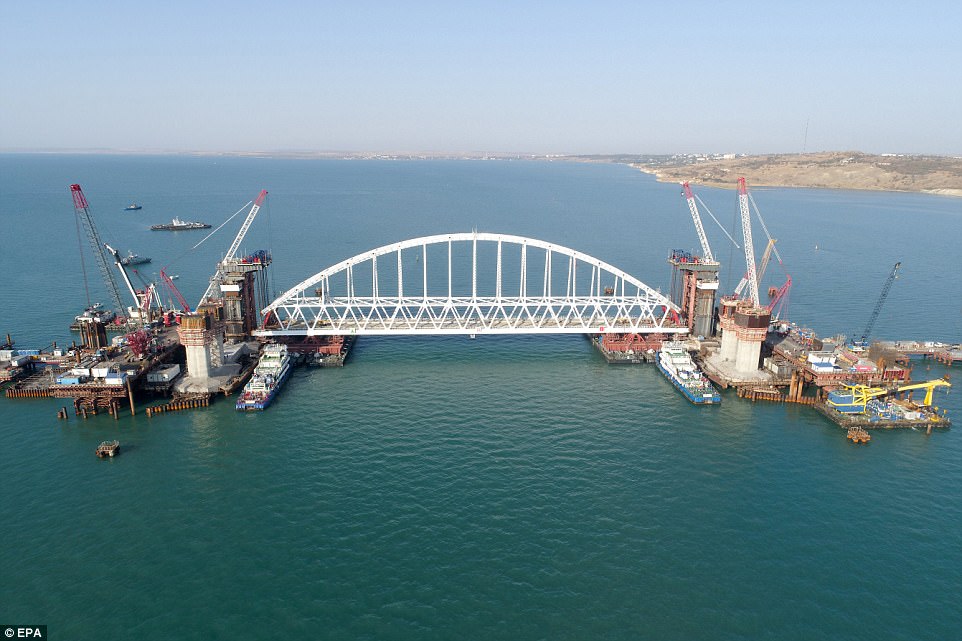
3/ This photo from before the rail bridge was completed is taken from almost the exact spot where the explosion apparently happened – just before the road slopes up to the twin arches over the shipping lane.

4/ The explosion happened in a relatively unimportant section of the bridge – that is, no more important than any other section. As the images show, the segment in question leads up to the arches. There are actually two road decks here, side by side.
5/ The likely failure mechanism is interesting (see the diagram below) – essentially a horizontal collapse resulting from the failure of the span immediately adjacent to the explosion. But the damage could have been far greater on the archway.
https://twitter.com/andrew_barr/status/1579147603467698177
6/ Here's what the road arch looks like. It's 227 m long and stands 35 m above the water. Both rail and road arches were constructed separately and lifted into position. The rail arch weighs 6,000 tons, while the road arch weighs 1,000 tons.
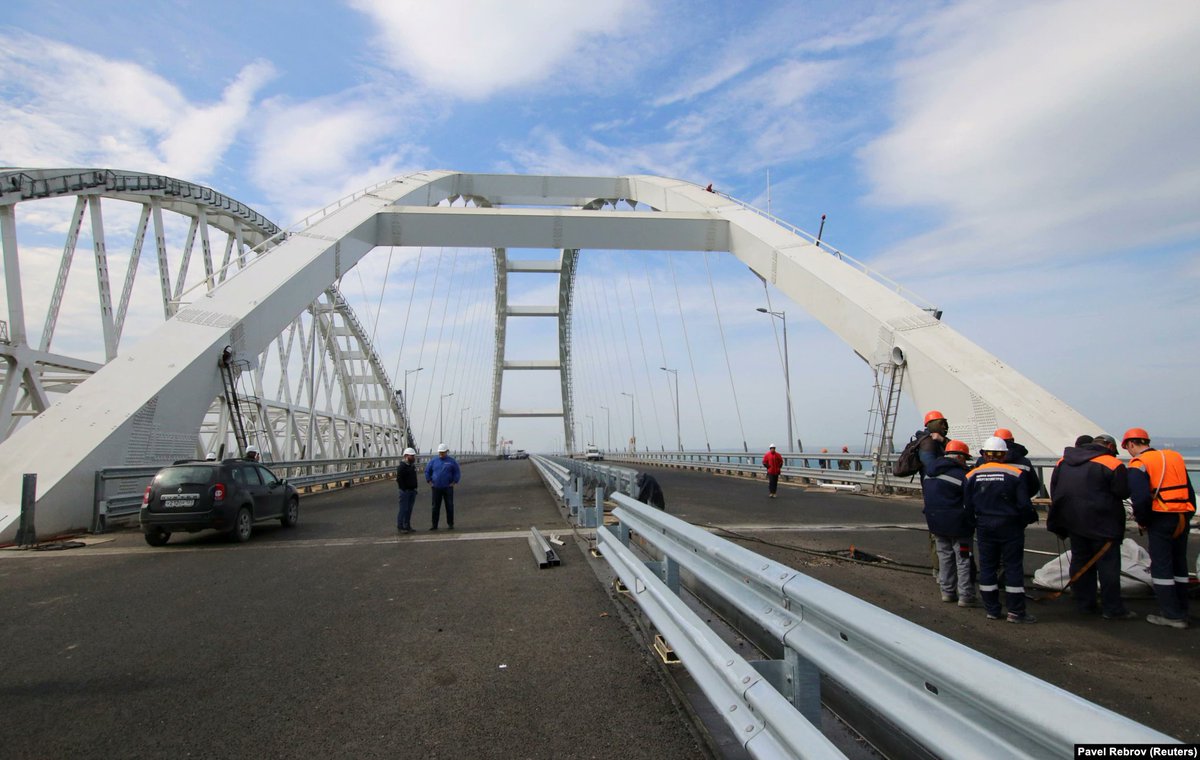
7/ As can be seen from the photo, the road arch is built quite differently from the other spans of the road bridge. Here's how @andrew_barr describes the spans' design:
https://twitter.com/andrew_barr/status/1579147606936420353/
8/ In contrast, the arch is a single deck carrying all four lanes, supported by the massive pillars at each end. The effects of a huge explosion on such a structure would have been quite different from what happened on the beam bridge segments.
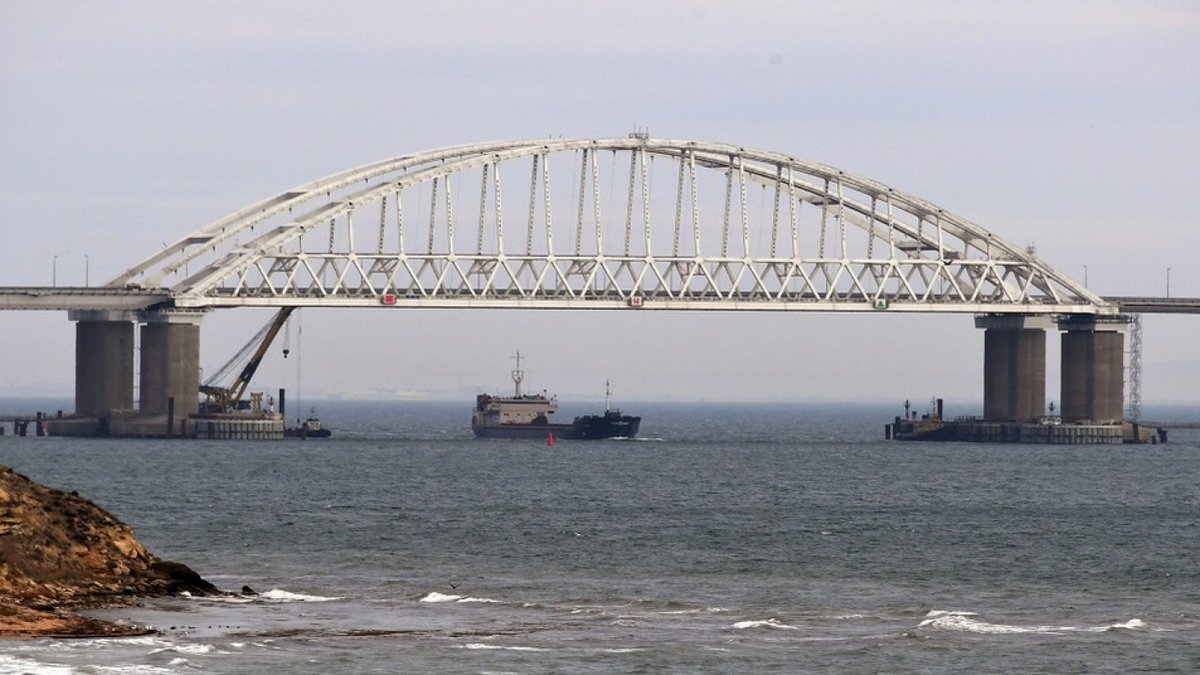
9/ The 227 m span of the arch is of huge importance to shipping. Under it is the only way in and out of the Sea of Azov – all shores of which are now controlled by Russia. If the shipping lane is blocked, all Russian maritime assets in the Sea of Azov are stuck there.
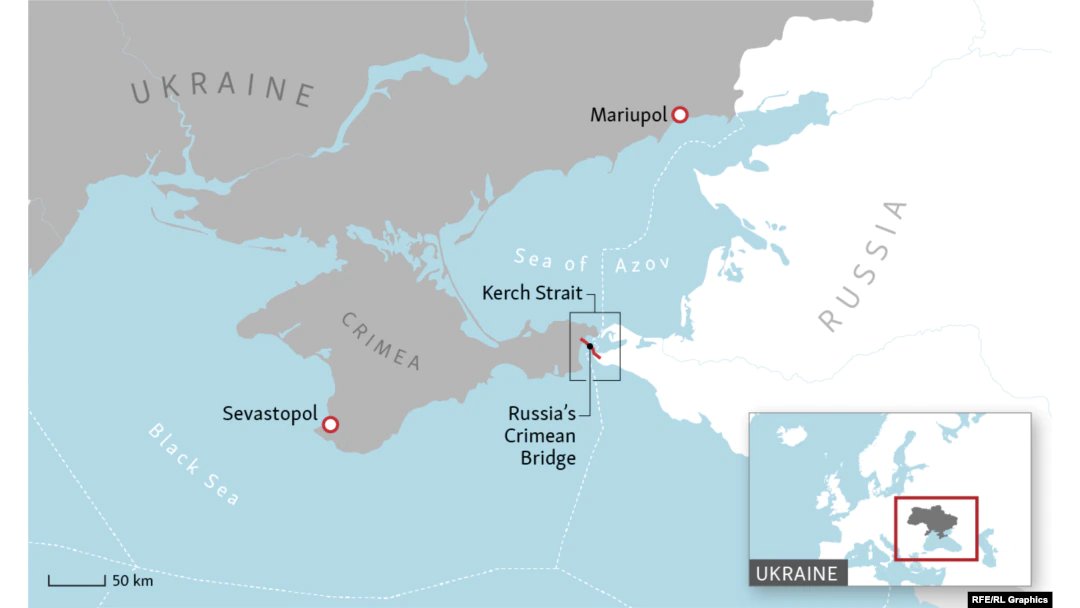
10/ It's worth noting that the Kerch Strait is very shallow – it's only 18 m deep at most. The arches are 45 m high. If you dropped an arch into the water, less than half of its height would be submerged. That would be quite an obstacle to overcome.
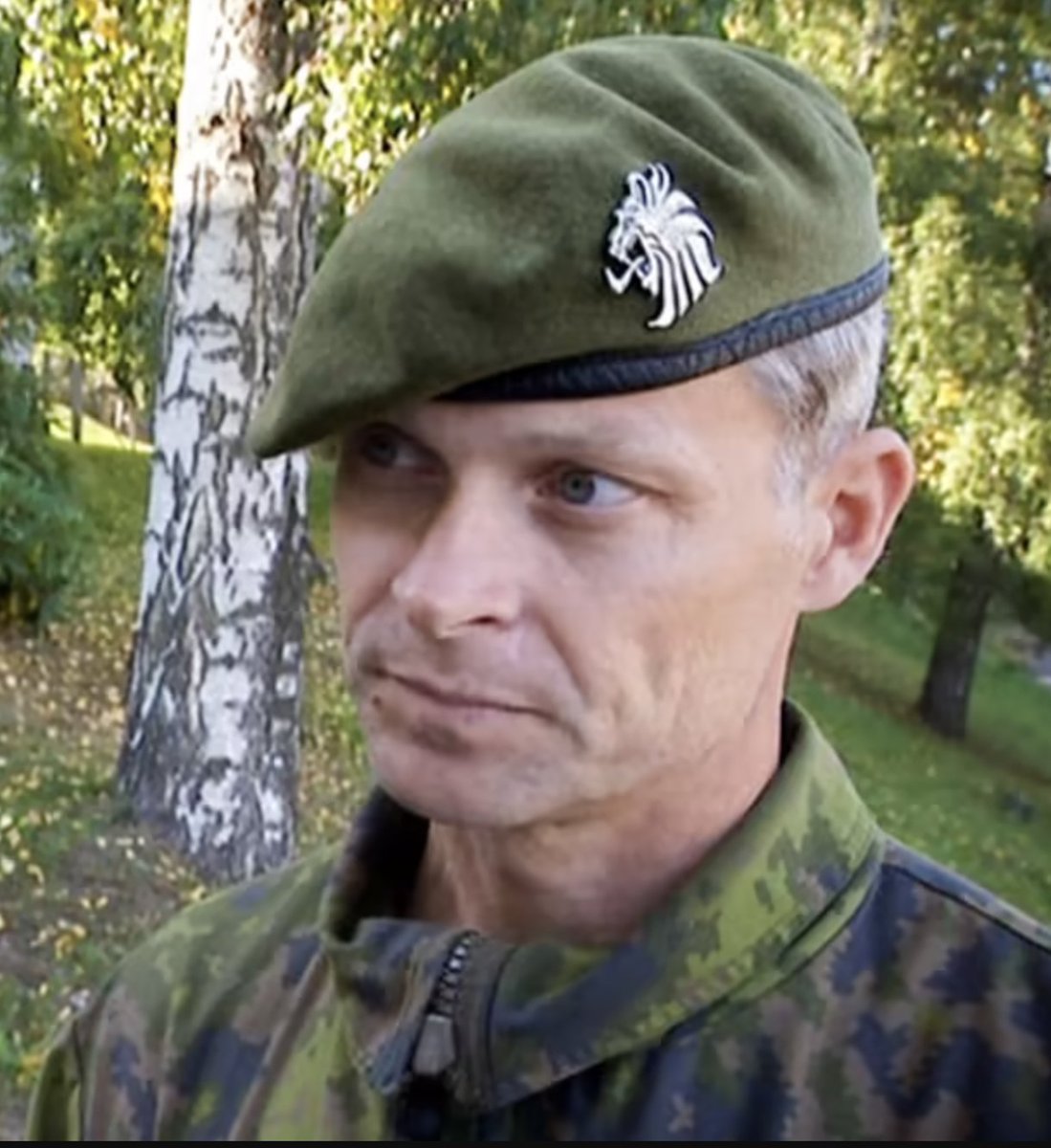
11/ So if you have a truck filled with several tons of explosives, why detonate it on the flat roadway below the arch and not on the arch itself? Logic would suggest that destroying the arch would have had a much bigger impact, blocking shipping as well as the roadway.
12/ Here's where the fuel train comes in. In a new interview by @STTuutiset news agency and published by Finnish public broadcaster Yle, retired explosive ordnance disposal expert Major Mika Tyry offers a fascinating theory.
13/ Tyry suggests that "the aim may have been to blow up the truck and the train next to it at the point where shipping traffic passes under the bridge". However, this may have gone wrong, with the explosion happening before the arch was reached.
14/ Tyry suggests that the train's speed may have been misestimated. He suggests that it was travelling "faster on the bridge than anticipated and the truck would not have been able to catch up in time. Therefore, the truck might have been blown up ahead of time."
15/ I think he's wrong about this – the video suggests that the train was stopped or going very slowly. It was obviously fully laden. I wouldn't expect that a heavy train was moving faster up a slope than a truck that was probably doing at least 80-90 km/h on the level.
16/ But this raises another possibility: that the train wasn't originally a target, but was chosen at the last minute as a target of opportunity by whoever triggered the explosion. Which brings me to my second point: was it a suicide bombing?
17/ Tyry suggests there were several other possible trigger mechanisms apart from the driver: "Trucks are equipped with tracking systems that use satellites to tell them where the vehicle is located."
18/ "In other words, it has been possible [for the Russians] to track and locate with a fair degree of accuracy where the explosives are moving."
19/ Another suggestion is that the explosion was triggered by a following car. But Tyry discounts this: "The risk of being caught [in the blast] would have been high, so I do not believe this is a possibility.
20/ "It is much more likely that the explosives were triggered by a telephone connection, for example."
21/ But if that was the case, then you would have expected the explosion to have been triggered on the arch. The arch's GPS coordinates are known – a GPS-based trigger would likely have detonated in the right spot. (Russian GPS jamming is a possible but unknown variable.)
22/ I think the balance of probabilities is that the truck driver – who was apparently an Azerbaijani, not a Russian – did indeed trigger the explosion, but chose to detonate next to the train in an attempt to magnify the effect of the bomb.
23/ If the decision had been purely that of the Ukrainians who presumably planned the attack, I would have expected them to stick to the likely mission – hitting the arch – and not be distracted by the train. Exploding before then suggests autonomous decision-making.
24/ Assuming this theory is correct, I'd have to agree with Tyry's view: "If Ukraine was behind the explosion, they probably didn't quite succeed in their original plan." It damaged the bridge and inconvenienced the Russians, but not as much as it could have. /end
24/ Assuming this theory is correct, I'd have to agree with Tyry's view: "If Ukraine was behind the explosion, they probably didn't quite succeed in their original plan." The explosion damaged the bridge and inconvienced the Russians, but not as much as it might have. /end
(The original interview with Tyry – in Finnish – is linked below.)
yle.fi/uutiset/74-200…
yle.fi/uutiset/74-200…
(See also some further comments here on Tyry's interview.)
https://twitter.com/ChrisO_wiki/status/1579480666282287104
(And here some comments from me about possible scenarios.)
https://twitter.com/ChrisO_wiki/status/1579244657397354496
Thread continues here, it seems to have got broken along the way:
https://twitter.com/ChrisO_wiki/status/1579511903239688193?t=AvN4l7BGyU-m5CWhMGT2Qg&s=19
• • •
Missing some Tweet in this thread? You can try to
force a refresh