
1/ With the news today that Russia has arrested eight people as suspects for the bombing of the Crimea Bridge on 8 October, I thought it would be useful to try to piece together a full account of the Russian narrative, as I've not yet seen it in Western sources. Long 🧵 follows. 

2/ I'm not endorsing this account – aspects have already been disputed – but it's worth looking at what regional media reports are saying. The Russians say that a truck bomb caused the blast; western experts have endorsed this theory (see below).
https://twitter.com/ChrisO_wiki/status/1579480666282287104
3/ According to the Russians, the cargo was sent from Odesa in Ukraine to Ruse on the Bulgarian border in early August 2022. It travelled via Romania and likely Moldova, sent under a contract with Kyiv-based company Translogistik UA to a company called Baltex Capital SA.
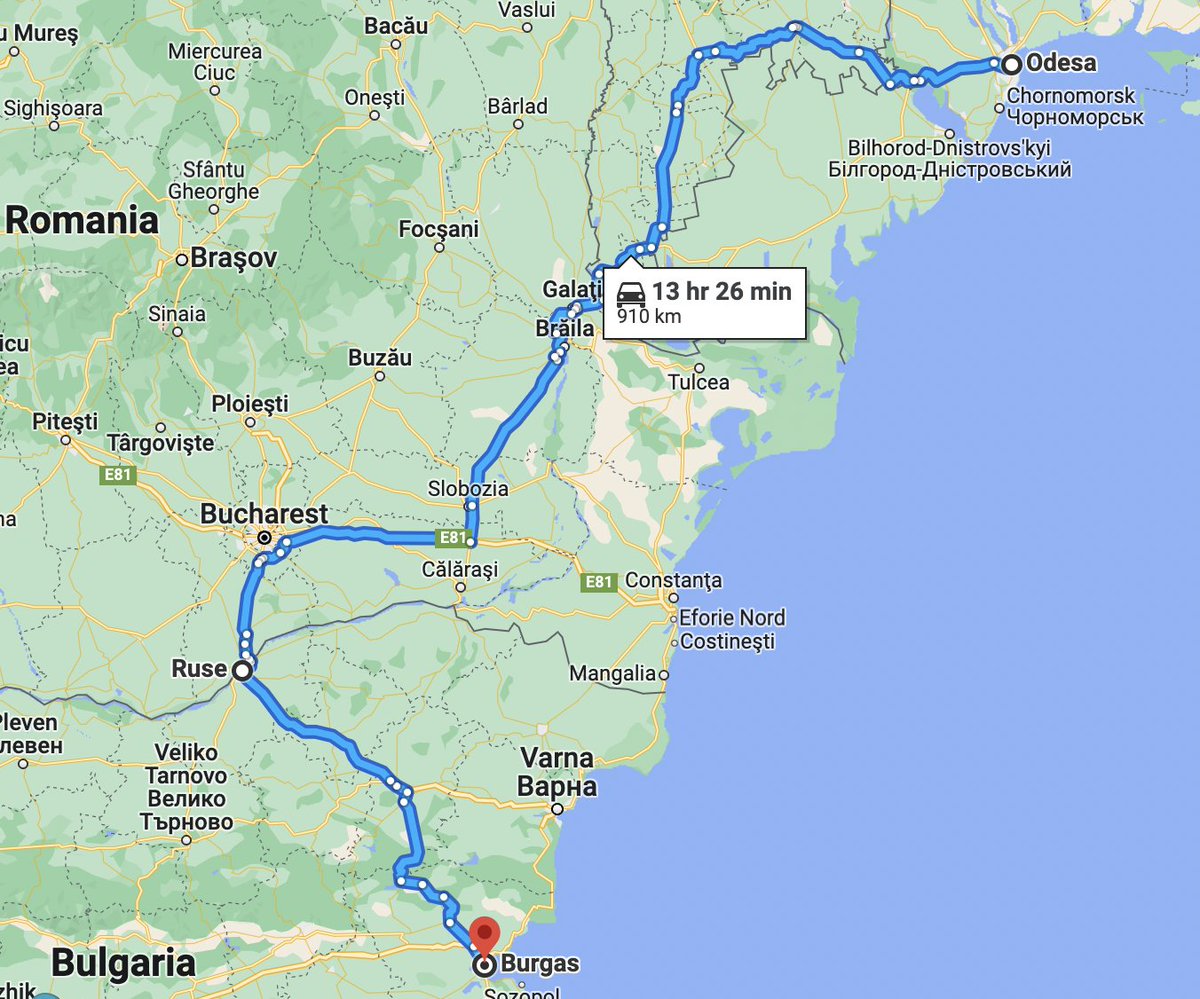
4/ Bulgarian National Radio reports that Baltex is registered in Panama, not Bulgaria. Its customs representatives are a Bulgarian forwarding company called Tivacom. Baltex instructed it to be sent to an Armenian company called Gu AR G Group.
5/ The Bulgarian newspaper Dnevnik reports that the cargo went to the Bulgarian port of Burgas, from where it was shipped by ferry to Poti in Georgia. It arrived there on 26 September.

6/ Armenian media reports say it was driven from Poti to Armenia in a Georgian-registered DAF truck driven by Artur Terjanyan, an Armenian-Georgian citizen. It arrived at the Bagratashen border post at 14:53 on 27 September, where it was inspected and X-rayed.

7/ No irregularities were found. The cargo was then driven to the Alliance Terminal, a customs warehouse on the outskirts of Yerevan, arriving on the same day at 22:46. It remained there temporarily before it was inspected again on 29 September and documents were submitted.

8/ According to the manifest, which the Russians have published, the cargo comprised 22 pallets with a total weight of 22,770 kg (50,200 lb) of Acrylonitrile Butadiene Styrene edge banding (used to finish the sides and ends of wood-based materials), stacked in rolls.
9/ Marked with "Made in China" stickers, the cargo was photographed and inspected by the Armenians. The lamination of one of the rolls of ABS plastic was checked to verify that it was correctly classified according to the trade rules.


10/ I haven't seen any clear explanation for why the truck went to Armenia. It might well be related to the fact that when it entered Armenia, customs checks were done under Eurasian Economic Union (EEU) customs rules, which also cover Russia. Georgia isn't a member.
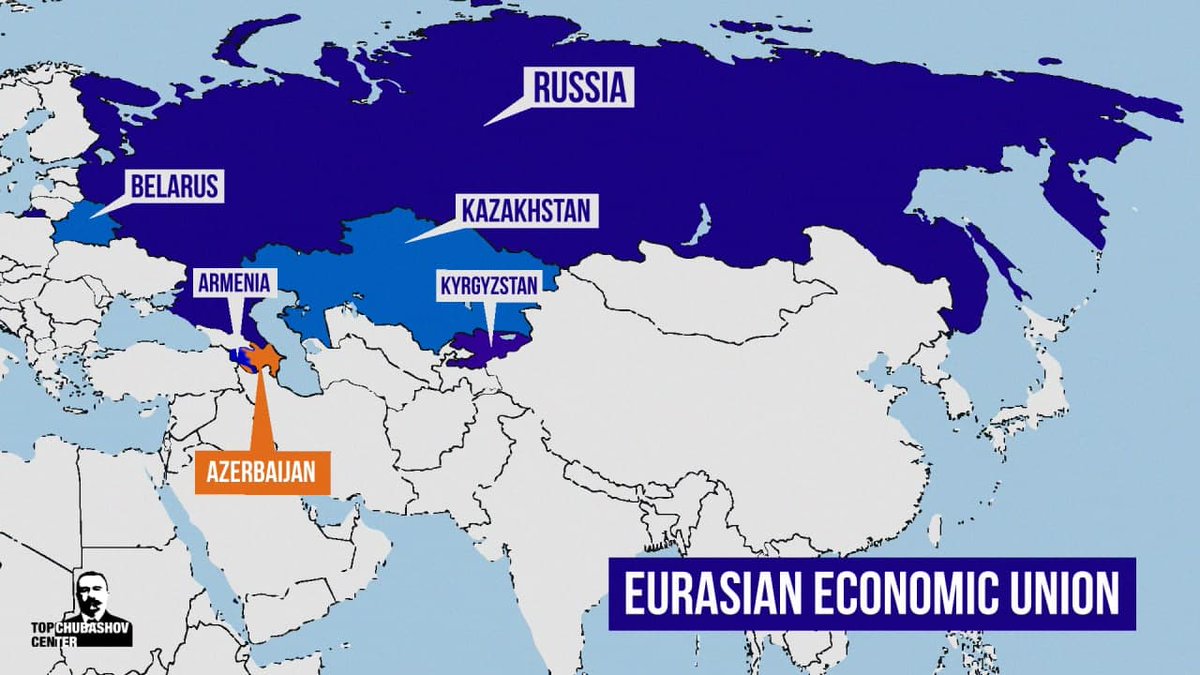
11/ This may have provided a back door route into Russia – checks done at the EEU economic border presumably do not have to be redone at the Russian border if a cargo travels from one EEU country to another.
12/ The Armenian authorities say that the customs service at the Ararat Regional Customs House in Yerevan certified the cargo as being "goods of the EEU" on 30 September and issued a transit declaration. This likely made it easier to bring it into Russia.

13/ While at the Alliance Terminal, according to the Armenians, the truck was under camera surveillance for the whole time. It was neither loaded nor unloaded, nor was anything else added. It left Armenia at 00:38 on 1 October via the Bagratashen border post, again being X-rayed.


14/ The pictures of the truck above and the X-ray images were published by the State Revenue Committee of Armenia on Facebook (link below). The X-ray image was likely made at Bagratashen on either 27 September or 1 October.
facebook.com/petekamutner/p…
facebook.com/petekamutner/p…
15/ Some commentators have misinterpreted this X-ray as showing the alleged bomb truck or have misattributed it as coming from the Russians. The image comes from Armenia and is of the Georgian DAF truck, not the truck that exploded, which was a different model entirely.
16/ Having entered Georgia again, the truck entered Russia at the Verkhniy Lars checkpoint in North Ossetia – the only open border crossing between the two countries. Curiously, it arrived there only on 5 October. What Terjanyan was doing in the intervening 4 days is not stated.

17/ The DAF truck was then driven 434km from Verkhniy Lars to Armavir, a city in Russia's southern Krasnodar Krai region (which lies to the east of Crimea). It arrived at the warehouse of a company called Agro-Business.

18/ The company is reportedly owned by Georgy Azatyan, a native of Makiivka (near Donetsk city in occupied eastern Ukraine), and his father Samvel. Another son, Artyom, is a lawyer in Simferopol in Crimea.

19/ Artyom reportedly called his father to ask him to accept the cargo for a day on behalf of a friend. This was not communicated to Georgy and the cargo arrived unexpectedly on 6 October. It didn't cause a problem as there was plenty of room in the warehouse.
20/ Terjanyan handed the warehouse operator a pile of invoices but they were not read or signed by the receiver. The cargo was unloaded in the warehouse, where it was to remain overnight.
21/ On the same day, Thursday 6 October, the cargo became the subject of a delivery order posted on ATI (), a Russian freight exchange website, by an Ulyanovsk-based company called TEK-34, with a contact listed as 'Oleg'. ati.su

22/ The cargo was listed as a 'container and packaging'. It was to be delivered to Simferopol, Crimea on 7 October (probably not coincidentally, Vladimir Putin's birthday). The named recipient was a non-existent company supposedly based in Crimea.
23/ TEK-34 seems to have a curious history. It reportedly received good customer reviews between 2009–2020, when it was active, but ceased operating at the end of 2020 when it was sold to a man named Oleg Antipov. It was delisted in 2021 for not having a valid legal address.
24/ In March 2022 it 'came back to life', obtaining a legal address and registering for tax and pensions payments. However, it reportedly did not engage in any activity.
25/ Ten minutes after the job was posted on ATI, Azerbaijan-born truck driver Mahir Yusubov accepted it for a fee of 48,000 rubles ($753). It was removed from ATI shortly afterwards. Yusubov had moved from Kazan to Krasnodar two years ago. He was married and had three children.

26/ Prior to taking the job on 6 October, Yusubov had spent all of September driving around the Krasnodar region making deliveries. His movements were recorded on cameras in the region.

27/ On 7 October, Yusubov drove from Kanevskoy in the north of the region to Armavir, arriving at the warehouse at lunchtime. The cargo was loaded onto his truck, an International ProStar with 870,000 km on the clock, using the warehouse's mechanical loader.

28/ Yusubov was last spotted in Armavir at 16:04. Although the contract required him to deliver the cargo to Simferopol on 7 October, he stopped instead at the village of Svetlyi Put about 99 km from the Crimea Bridge, where he was spotted at 23:06. He likely slept in his truck.
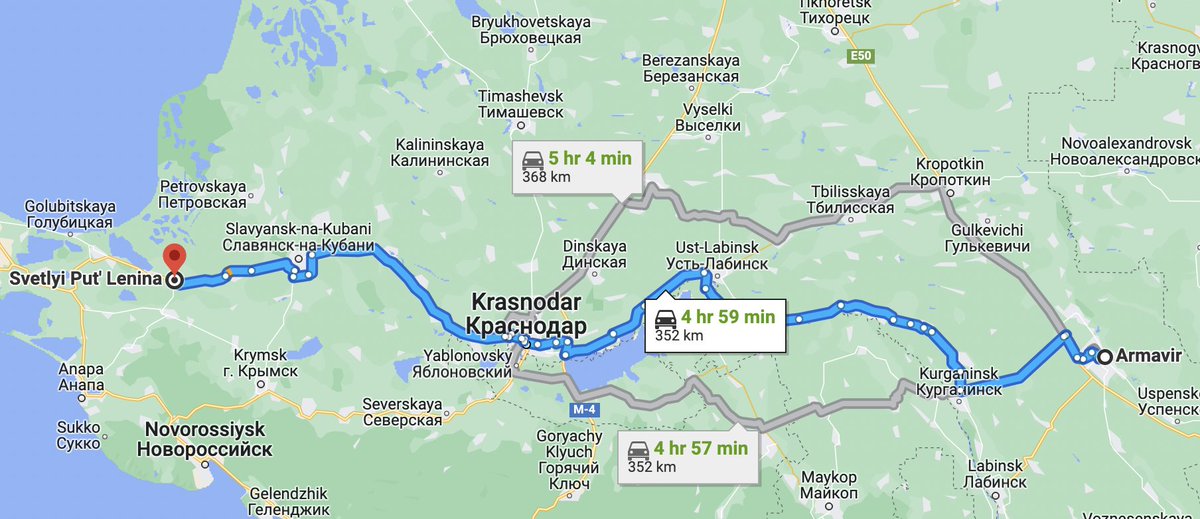
29/ Yusubov was next seen in the village of Strelka, en route to the Crimea Bridge, at 05:00 on 8 October. At 05:52 he crossed onto the bridge, and at 06:03 his truck exploded. /end

Sources:
dnevnik.bg/bulgaria/2022/…
dnevnik.bg/sviat/voinata_…
dnevnik.bg/bulgaria/2022/…
newsarmenia.am/news/armenia/v…
facebook.com/petekamutner/p…
bbc.com/russian/news-6…
vlasti.info/news/50453-sta…
vlasti.info/news/50380-sta…
vlasti.info/news/50388-vod…
vlasti.info/news/50580-v_f…
dnevnik.bg/bulgaria/2022/…
dnevnik.bg/sviat/voinata_…
dnevnik.bg/bulgaria/2022/…
newsarmenia.am/news/armenia/v…
facebook.com/petekamutner/p…
bbc.com/russian/news-6…
vlasti.info/news/50453-sta…
vlasti.info/news/50380-sta…
vlasti.info/news/50388-vod…
vlasti.info/news/50580-v_f…
Summary timeline here:
https://twitter.com/ChrisO_wiki/status/1580464747400794112?s=20&t=MXsZtIfbpNw_5Rky7AQBlw
The reported suspects, according to Russian media:
https://twitter.com/ChrisO_wiki/status/1580599238127329280
CCTV video and annotated stills from the Armenians showing the cargo's passage through their country:
https://twitter.com/ChrisO_wiki/status/1580855214839828481
Further suspects arrested:
https://twitter.com/ChrisO_wiki/status/1582274094745415686?t=Umououo7nDynFTLD9bLjWw&s=19
Supplementary thread apparently confirming how the Ukrainians did it:
https://twitter.com/Osinttechnical/status/1692786220026212654?t=TdqV4uG-ggoa6fvyW12otQ&s=19
Source report for the above: nv.ua/ukr/ukraine/ev…
• • •
Missing some Tweet in this thread? You can try to
force a refresh





