1/THREAD
Have you ever wondered why Pseudomonas aeruginosa smells like grapes 🍇?
The answer relates to the ability of Pseudomonas to cause chronic airway infections and also coincidentally explains certain spoiled wine flavors.
#medtwitter #tweetorial
Have you ever wondered why Pseudomonas aeruginosa smells like grapes 🍇?
The answer relates to the ability of Pseudomonas to cause chronic airway infections and also coincidentally explains certain spoiled wine flavors.
#medtwitter #tweetorial

2/
Pseudomonas was first isolated in 1882 by the French pharmacist Carle Gessard, after he cultured it from the blue-green pus on bandages of injured soldiers.
academic.oup.com/cid/article/6/…
Pseudomonas was first isolated in 1882 by the French pharmacist Carle Gessard, after he cultured it from the blue-green pus on bandages of injured soldiers.
academic.oup.com/cid/article/6/…

3/
It was widely observed that Pseudomonas aeruginosa produces a grape-like smell when growing in cultures or on wounds.
By the 1970s, microbiologists even used this characteristic odor to preliminarily identify Pseudomonas on agar plates.
ncbi.nlm.nih.gov/pmc/articles/P…
It was widely observed that Pseudomonas aeruginosa produces a grape-like smell when growing in cultures or on wounds.
By the 1970s, microbiologists even used this characteristic odor to preliminarily identify Pseudomonas on agar plates.
ncbi.nlm.nih.gov/pmc/articles/P…

4/
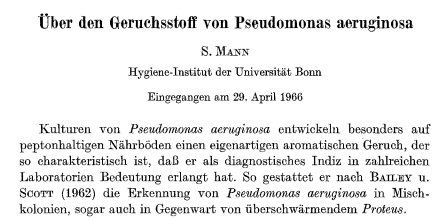
The chemical source of Pseudomonas' grape-like smell was identified by Mann in 1966.
He isolated a compound with a grape-ish odor from 20-day-old plate cultures of P. aeruginosa using thin layer chromatography.
link.springer.com/article/10.100…
The chemical source of Pseudomonas' grape-like smell was identified by Mann in 1966.
He isolated a compound with a grape-ish odor from 20-day-old plate cultures of P. aeruginosa using thin layer chromatography.
link.springer.com/article/10.100…
5/
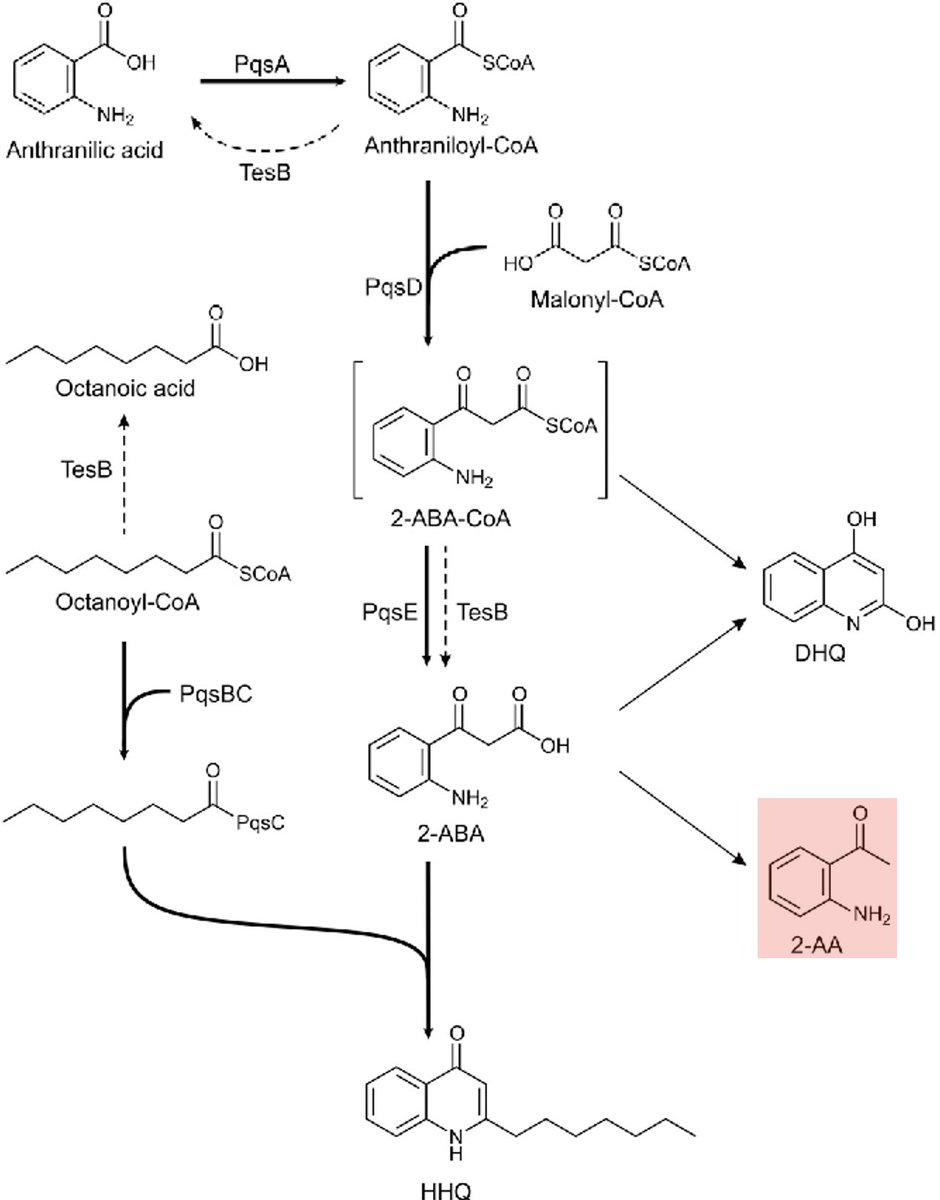
Mann discovered that the source of Pseudomonas' odor is a volatile organic compound called 2-aminoacetophenone (2-AA).
2-AA is a metabolite produced by the bacterium from the tryptophan catabolic pathway and, for whatever reason, smells like grapes.
pubmed.ncbi.nlm.nih.gov/25960261/
Mann discovered that the source of Pseudomonas' odor is a volatile organic compound called 2-aminoacetophenone (2-AA).
2-AA is a metabolite produced by the bacterium from the tryptophan catabolic pathway and, for whatever reason, smells like grapes.
pubmed.ncbi.nlm.nih.gov/25960261/
6/
2-AA has even been studied as a potential biomarker for Pseudomonal airway colonization/infection in cystic fibrosis (CF) patients.
A breath test detecting exhaled 2-AA was 94% sensitive and 69% specific for airway Pseudomonas in a CF cohort.
pubmed.ncbi.nlm.nih.gov/21054900/
2-AA has even been studied as a potential biomarker for Pseudomonal airway colonization/infection in cystic fibrosis (CF) patients.
A breath test detecting exhaled 2-AA was 94% sensitive and 69% specific for airway Pseudomonas in a CF cohort.
pubmed.ncbi.nlm.nih.gov/21054900/

7/
It isn't totally clear whether 2-AA plays a part in the ability of Pseudomonas to be a human pathogen, or if 2-AA is simply a grape-scented metabolite.
But there is evidence that it might contribute to Pseudomonas' ability to cause chronic pulmonary airway infections.
It isn't totally clear whether 2-AA plays a part in the ability of Pseudomonas to be a human pathogen, or if 2-AA is simply a grape-scented metabolite.
But there is evidence that it might contribute to Pseudomonas' ability to cause chronic pulmonary airway infections.
8/
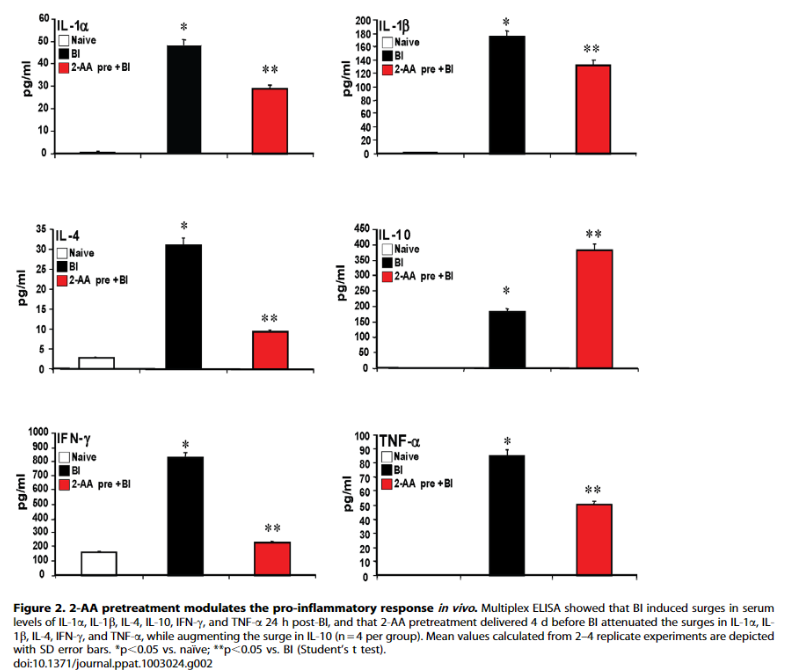
First, 2-AA may actually inhibit the immune response to Pseudomonal infection, allowing it to chronically colonize the airway.
Pre-treatment with 2-AA in mice infected with Pseudomonas led to decreased inflammatory cytokine responses.
pubmed.ncbi.nlm.nih.gov/23166496/
First, 2-AA may actually inhibit the immune response to Pseudomonal infection, allowing it to chronically colonize the airway.
Pre-treatment with 2-AA in mice infected with Pseudomonas led to decreased inflammatory cytokine responses.
pubmed.ncbi.nlm.nih.gov/23166496/
9/
Even more strikingly:
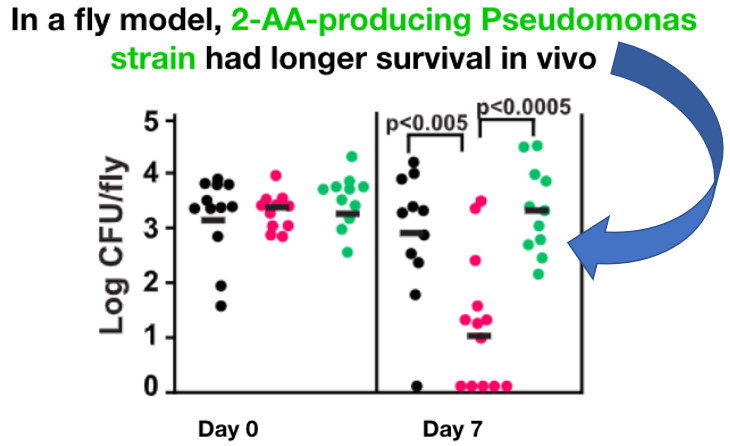
In animal models 2-AA has been shown to modulate genetic expression in Pseudomonas in a way that favors persistent infection (decreased virulence and a longer lifespan).
pubmed.ncbi.nlm.nih.gov/21829370/
Even more strikingly:
In animal models 2-AA has been shown to modulate genetic expression in Pseudomonas in a way that favors persistent infection (decreased virulence and a longer lifespan).
pubmed.ncbi.nlm.nih.gov/21829370/
10/
2-AA's role in chronic Pseudomonal infection is still being worked out.
The current model:
🦠2-AA is released and accumulates in airway biofilms 🦠 This modulates immune response and genetic expression, allowing for chronic infection
pubmed.ncbi.nlm.nih.gov/21829370/
2-AA's role in chronic Pseudomonal infection is still being worked out.
The current model:
🦠2-AA is released and accumulates in airway biofilms 🦠 This modulates immune response and genetic expression, allowing for chronic infection
pubmed.ncbi.nlm.nih.gov/21829370/

11/
Let's conclude with a cool (and surprising) viticultural correlate.
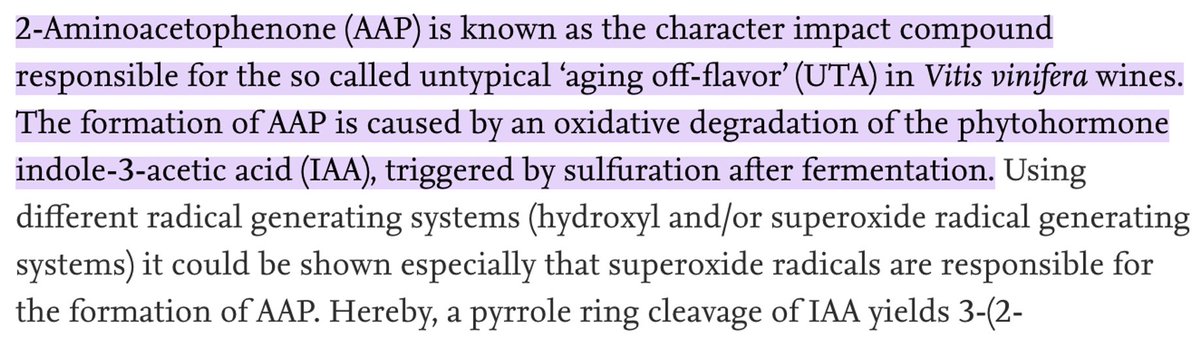
It turns out that 2-Aminoacetophenone (2-AA) is one source of spoiled wine flavor, as an unwanted post-fermentation metabolite from grapes, especially in white wines.
sciencedirect.com/science/articl…
Let's conclude with a cool (and surprising) viticultural correlate.
It turns out that 2-Aminoacetophenone (2-AA) is one source of spoiled wine flavor, as an unwanted post-fermentation metabolite from grapes, especially in white wines.
sciencedirect.com/science/articl…
12/
Wine spoiled by 2-AA has the flavor of "acacia blossom, naphthalene note, furniture polish, fusel alcohol, damp cloth...".
This seems to be a more of a concern for vintners, as they will reject wine spoiled by 2-AA before sending to consumers.
pubmed.ncbi.nlm.nih.gov/17014858/
Wine spoiled by 2-AA has the flavor of "acacia blossom, naphthalene note, furniture polish, fusel alcohol, damp cloth...".
This seems to be a more of a concern for vintners, as they will reject wine spoiled by 2-AA before sending to consumers.
pubmed.ncbi.nlm.nih.gov/17014858/
13/SUMMARY
🍇The characteristic grape odor from Pseudomonas aeruginosa results from 2-aminoacetophenone (2-AA)
🍇2-AA ⬇️ immune responses and ⬆️ the lifespan of Pseudomonas, possibly contributing to chronic airway infection
🍇2-AA also is a source of spoiled white wine flavor
🍇The characteristic grape odor from Pseudomonas aeruginosa results from 2-aminoacetophenone (2-AA)
🍇2-AA ⬇️ immune responses and ⬆️ the lifespan of Pseudomonas, possibly contributing to chronic airway infection
🍇2-AA also is a source of spoiled white wine flavor
• • •
Missing some Tweet in this thread? You can try to
force a refresh