
This is my complete master's guide to tokenomics 👀
I'll break down what the tokenomics of a 500x return #crypto project like $SOL n $AXS look like.
Find this useful? Drop me a like and RT, if there's enough demand I'll turn it into a PDF with more examples 🧵👇
1/54
I'll break down what the tokenomics of a 500x return #crypto project like $SOL n $AXS look like.
Find this useful? Drop me a like and RT, if there's enough demand I'll turn it into a PDF with more examples 🧵👇
1/54
If you don't understand tokenomics you are gambling and you will get rekt.
By the end of this thread, you will be a tokenomics pro that can spot a good #crypto from a sh*tcoin within minutes.
2/54
By the end of this thread, you will be a tokenomics pro that can spot a good #crypto from a sh*tcoin within minutes.
2/54
Basic terminology.
• Supply: Tokens in circulation atm
• Total Supply: Total tokens that will exist
• Market Cap: Total value in $ of tokens in circulation
• Fully Diluted Value (FDV): Total value in $ of total supply
You can find this on CMC or CoinGecko.
3/54
• Supply: Tokens in circulation atm
• Total Supply: Total tokens that will exist
• Market Cap: Total value in $ of tokens in circulation
• Fully Diluted Value (FDV): Total value in $ of total supply
You can find this on CMC or CoinGecko.
3/54

Understanding these terms helps you spot tokenomics issues. If a project has a large difference in supply vs total supply, that's a red flag.
Why?
The theory of supply and demand states that the more of something there is, the less its value.
4/54
Why?
The theory of supply and demand states that the more of something there is, the less its value.
4/54
◆◆ Supply ◆◆
The token below has only 13% of its supply circulating. As the other 90% are released into circulation the value of the token is likely to fall from its current $1 unless there is a massive spike in demand.
Or unless supply growth is slow.
5/54
The token below has only 13% of its supply circulating. As the other 90% are released into circulation the value of the token is likely to fall from its current $1 unless there is a massive spike in demand.
Or unless supply growth is slow.
5/54
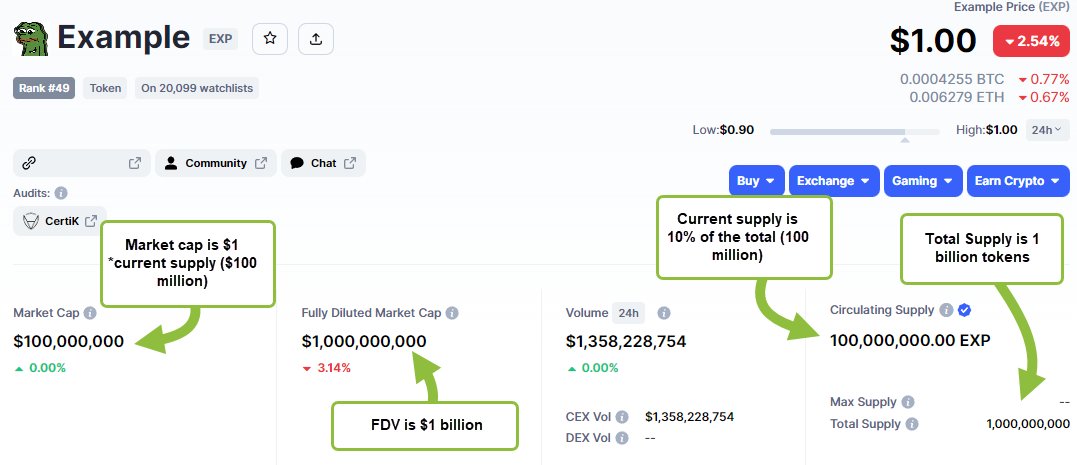
The increase in a token's supply over time is called emissions and the speed of emissions is important.
If the token hits max supply over the next three months the supply increase will be so fast that demand is unlikely to increase with it and the token will lose value.
6/54
If the token hits max supply over the next three months the supply increase will be so fast that demand is unlikely to increase with it and the token will lose value.
6/54
However, if the emissions are slow and max supply won't be hit for ten years, then the supply increase won't have a significant impact on price over the short term.
But where do you check emissions?
7/54
But where do you check emissions?
7/54
You usually find this info in the tokens whitepaper as a table like the ones below. You want to see a nice steady increase over a few years instead of huge spikes or steep increases. Pro tip: Some projects stretch charts out to make increases look steady when they're not 👀
8/54
8/54
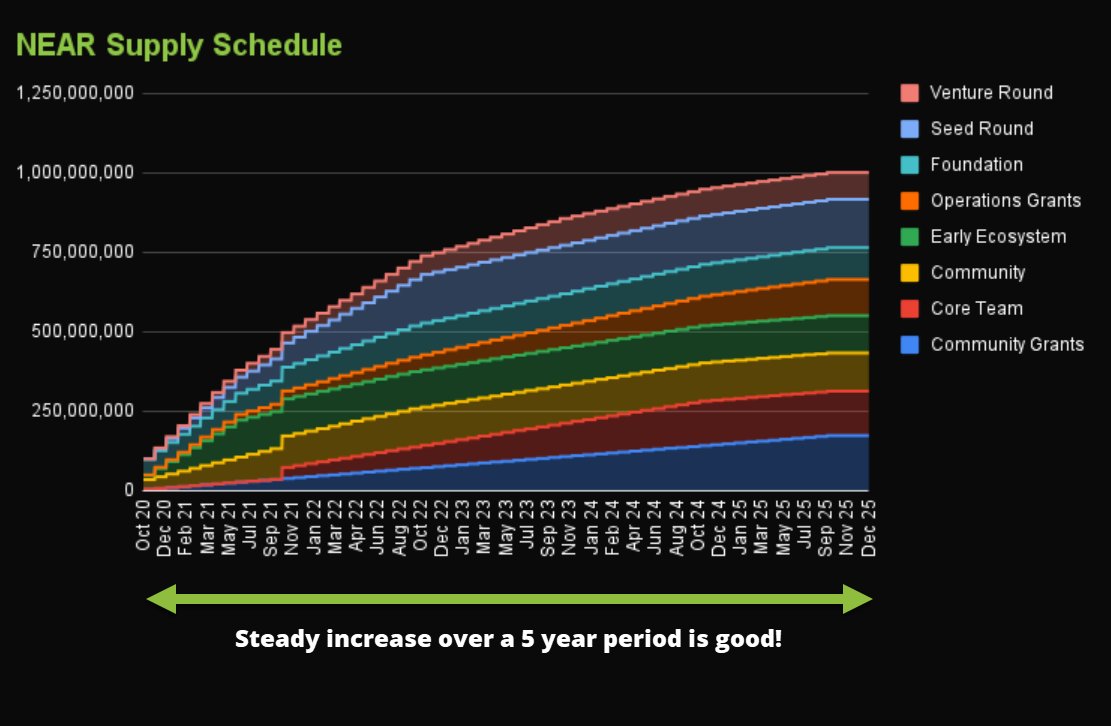
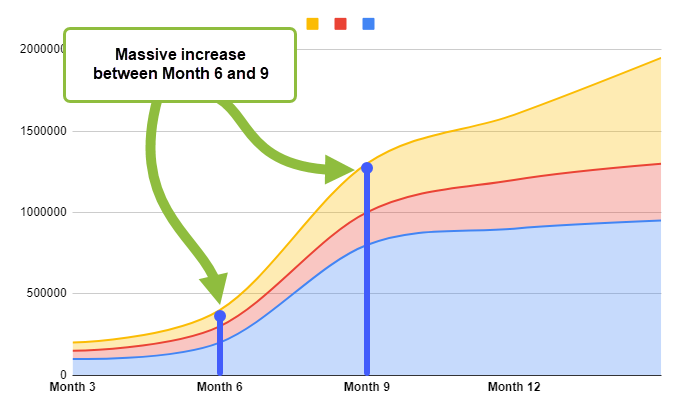

Emissions can come from staking rewards, airdrops, user rewards for using the dapp and of course token unlocks. Unlocks come from allocations given to early investors, the team, treasury and other pots. You can usually find allocations in the whitepaper.
9/54
9/54

Allocation distribution is very important. If, for example, 40% of the supply is allocated to early investors and the unlocks happen over a few months, that's a problem. Early investors are usually motivated sellers since they're often 5x-10x up. Wouldn't you be?
10/54
10/54
Ideal token distribution IMO
Team: 15% or less
Advisors: Less than 10%
Early investors: Less than 25%
Public sale: Less than 10%
Marketing: 10% or less
Ecosystem: At least 10%
Treasury: At least 15%
Liquidity: 20% or less (**more below)
Let's break these down.
11/54
Team: 15% or less
Advisors: Less than 10%
Early investors: Less than 25%
Public sale: Less than 10%
Marketing: 10% or less
Ecosystem: At least 10%
Treasury: At least 15%
Liquidity: 20% or less (**more below)
Let's break these down.
11/54

-- Team --
How much the core team gets. I like to see them give themselves less than 15%. Any more and I question their motives.
-- Advisors --
They provide expert advice/guidance to projects and are rewarded with tokens. I want to see less than 10% combined go to them.
12/54
How much the core team gets. I like to see them give themselves less than 15%. Any more and I question their motives.
-- Advisors --
They provide expert advice/guidance to projects and are rewarded with tokens. I want to see less than 10% combined go to them.
12/54
-- Early Investor Rounds --
Usually referred to as seed, VC, private, strategic, KOL or angel rounds. These are usually early investors with big money. I don’t want to see more than 25% allocated to them. Over 20% is a red flag over 25% is almost always a no-go.
13/54
Usually referred to as seed, VC, private, strategic, KOL or angel rounds. These are usually early investors with big money. I don’t want to see more than 25% allocated to them. Over 20% is a red flag over 25% is almost always a no-go.
13/54
-- Public Sale --
This is the ICO/IEO price. Often sold through launchpads to early investors who don't have big money. I like to see no more than 10%. More than 10% is usually a dealbreaker.
14/54
This is the ICO/IEO price. Often sold through launchpads to early investors who don't have big money. I like to see no more than 10%. More than 10% is usually a dealbreaker.
14/54
-- Marketing --
This is the general marketing budget. I like to see 10% or less dedicated to marketing. While marketing is important, dedicating too much to it may not leave enough for the project itself.
15/54
This is the general marketing budget. I like to see 10% or less dedicated to marketing. While marketing is important, dedicating too much to it may not leave enough for the project itself.
15/54
-- Ecosystem --
This is what the community gets through staking, yield farming, airdrops, rewards etc. I like to see at least 10% here. Many projects will have 20% or even more, which is good. Any project that gives to its community is doing things right.
16/54
This is what the community gets through staking, yield farming, airdrops, rewards etc. I like to see at least 10% here. Many projects will have 20% or even more, which is good. Any project that gives to its community is doing things right.
16/54
-- Treasury --
This is essential working capital for the project for things like paying employees, securing partnerships and day-to-day expenses. I like to see over 15% here because working capital is important and running out of funds means the project dies.
17/54
This is essential working capital for the project for things like paying employees, securing partnerships and day-to-day expenses. I like to see over 15% here because working capital is important and running out of funds means the project dies.
17/54
-- Liquidity --
Tokens given to DEXs/CEXs for liquidity. Some projects need more liquidity than others. As long as liquidity is locked for 2+ years it doesn't matter if up to 20% goes there.
18/54
Tokens given to DEXs/CEXs for liquidity. Some projects need more liquidity than others. As long as liquidity is locked for 2+ years it doesn't matter if up to 20% goes there.
18/54
-- Other --
Above are the main distribution pots some projects may have others. For example, some projects have a foundation structure so they allocate tokens to the foundation which then does things like giving grants to projects on the ecosystem.
19/54
Above are the main distribution pots some projects may have others. For example, some projects have a foundation structure so they allocate tokens to the foundation which then does things like giving grants to projects on the ecosystem.
19/54
Next is vesting, which is how tokens are distributed to each of the parties above.
If all tokens were distributed right away then everyone could dump and the project doesn’t stand a chance. So the parties receive X amount every X months until all are distributed.
20/54
If all tokens were distributed right away then everyone could dump and the project doesn’t stand a chance. So the parties receive X amount every X months until all are distributed.
20/54
There are a few terms you need to know here.
• TGE: This means token generation event, this is essentially the day the token is released.
• Cliff periods: This is the amount of time that passes before vesting begins to be released.
21/54
• TGE: This means token generation event, this is essentially the day the token is released.
• Cliff periods: This is the amount of time that passes before vesting begins to be released.
21/54
Vesting is a balancing act since projects cannot have strict vesting because nobody will want to invest, while lenient vesting means early investors dump a large number of tokens early on and crash prices.
Over the years vesting has improved in crypto.
22/54
Over the years vesting has improved in crypto.
22/54
You can see a projects vesting schedule on their whitepaper.
The key things you want to look for when assessing vesting is <10% released at TGE for early investors, cliffs of at least three months and allocation distribution over a few years.
23/54
The key things you want to look for when assessing vesting is <10% released at TGE for early investors, cliffs of at least three months and allocation distribution over a few years.
23/54
The key with vesting is slow n steady increases in token distribution and no sudden spikes, especially not for early investors. Examples below:
24/54
24/54


◆◆ Demand ◆◆
So we've thoroughly covered supply, let's look at demand. Here are the most common forms of demand for tokens.
• Incentives for holding
• Store of value
• Community
• Utility
Let's break each of these down.
25/54
So we've thoroughly covered supply, let's look at demand. Here are the most common forms of demand for tokens.
• Incentives for holding
• Store of value
• Community
• Utility
Let's break each of these down.
25/54
-- Incentives For Holding --
Arguably the most important driver for demand. If holding the token benefits the holder by rewarding staking APY or yield farming the demand increases.
As long as the APY earned is comparable or higher to competitors and it's viewed as safe.
26/54
Arguably the most important driver for demand. If holding the token benefits the holder by rewarding staking APY or yield farming the demand increases.
As long as the APY earned is comparable or higher to competitors and it's viewed as safe.
26/54
-- Store of Value --
Another driver for demand is that the crypto is a store of value. It is hard to argue that many cryptos outside of $BTC are a store of value but it is a driver for demand so it's worth noting.
27/54
Another driver for demand is that the crypto is a store of value. It is hard to argue that many cryptos outside of $BTC are a store of value but it is a driver for demand so it's worth noting.
27/54
-- Community --
A strong community can drive demand. Meme coins are proof of this. Most of them have no utility, no staking APY and are certainly not a store of value but they hold value and even do a 1000x based almost entirely on having a strong community.
28/54
A strong community can drive demand. Meme coins are proof of this. Most of them have no utility, no staking APY and are certainly not a store of value but they hold value and even do a 1000x based almost entirely on having a strong community.
28/54
-- Utility --
Last but not least utility. If holding the token provides some sort of utility like a blockchain's native token allowing you to make transactions on that chain it creates demand.
29/54
Last but not least utility. If holding the token provides some sort of utility like a blockchain's native token allowing you to make transactions on that chain it creates demand.
29/54
-- Who Want's It? --
Another important question is who is holding and what are their motives. This is a hard question to answer and it requires researching wallets and getting involved in the community but it can give you valuable insights.
30/54
Another important question is who is holding and what are their motives. This is a hard question to answer and it requires researching wallets and getting involved in the community but it can give you valuable insights.
30/54
For example, if big bag holders are smart money - like VCs - I would play it safe because their selling could impact price in a big way.
They also usually have inside information so they will sell before you can react if they need to.
31/54
They also usually have inside information so they will sell before you can react if they need to.
31/54
Many people think VCs are always early investors so they're vested.
Not true, VCs sometimes buy on the open market like you so they might be big holders even if they aren't listed as official backers. You can often find this out by looking at big-holder wallets.
32/54
Not true, VCs sometimes buy on the open market like you so they might be big holders even if they aren't listed as official backers. You can often find this out by looking at big-holder wallets.
32/54
If holders are dumb money then you can be a little more relaxed as dumb money is usually driven by fear and greed so predicting their moves is easier. Again meme coins are an example of this.
In general, the best strategy for both is to take partial profit regularly.
33/54
In general, the best strategy for both is to take partial profit regularly.
33/54
-- Demand Summary --
When assessing tokenomics you want to look at drivers for demand. The best tokens have at least two if not three of the drivers listed above.
If I see incentives for holding + utility + a strong community, I am interested!
34/54
When assessing tokenomics you want to look at drivers for demand. The best tokens have at least two if not three of the drivers listed above.
If I see incentives for holding + utility + a strong community, I am interested!
34/54
◆◆ Value Accrual ◆◆
This is how the token will gain value over time. It ties into demand but it's best to split it off when researching tokenomics. Here are the main ones:
• Deflation
• Locking mechanism
• Utility expansion
• APY and yield
Let's break these down.
35/54
This is how the token will gain value over time. It ties into demand but it's best to split it off when researching tokenomics. Here are the main ones:
• Deflation
• Locking mechanism
• Utility expansion
• APY and yield
Let's break these down.
35/54
-- Deflation --
Deflation is decreasing the supply of a token and it's commonly achieved by burning a percentage of transaction fees or periodically buying back and burning large amounts of tokens.
Reducing supply usually increases demand so deflation is good!
36/54
Deflation is decreasing the supply of a token and it's commonly achieved by burning a percentage of transaction fees or periodically buying back and burning large amounts of tokens.
Reducing supply usually increases demand so deflation is good!
36/54
-- Locking Mechanism --
Locking is a way to force people to hold on to a token. This is usually incentivised by providing higher APY if you lock your tokens in for a few months.
Locking is an extremely powerful value accrual mechanism because it guarantees holders.
37/54
Locking is a way to force people to hold on to a token. This is usually incentivised by providing higher APY if you lock your tokens in for a few months.
Locking is an extremely powerful value accrual mechanism because it guarantees holders.
37/54
Also, locked tokens are technically not in circulation so this can lead to a supply shock. This is where the amount of tokens in circulation becomes so low that it cannot meet demand.
Locking mechanisms are great, as long as investors are willing to lock their tokens!
38/54
Locking mechanisms are great, as long as investors are willing to lock their tokens!
38/54
-- Utility Expansion --
This is when a token gains more utility over time. You usually find this information by looking at the project's roadmap. If their roadmap shows that they will add utility over time it could correspond to an increase in value.
39/54
This is when a token gains more utility over time. You usually find this information by looking at the project's roadmap. If their roadmap shows that they will add utility over time it could correspond to an increase in value.
39/54
-- APY, APR and Yield --
A final note on APY and yield. While this can certainly be a driver for value accrual high APY can also lead to quick supply increases which reduce demand.
Quick Tip: APY is compounding your gains whilst APR does not.
40/54
A final note on APY and yield. While this can certainly be a driver for value accrual high APY can also lead to quick supply increases which reduce demand.
Quick Tip: APY is compounding your gains whilst APR does not.
40/54
What is too high? It changes from project to project. The key point is if you see 30% APR don't assume the project will do well because of APR. The high APR could actually be what kills the project.
Although, these high APR projects are generally good for quick flips 😉
41/54
Although, these high APR projects are generally good for quick flips 😉
41/54
An example of a token with great value accrual is GMX. You get 19% APR for staking but it's paid out in eGMX (escrowed GMX) which you need to vest for 1 year to fully unlock. The vesting means stakers can't dump their earnings right away and create sell pressure.
42/54
42/54
The vesting also reduces inflation as GMX is not immediately released once rewarded to stakers and is instead vested over 1 year.
I am doing a deep-dive thread on GMX soon with a special focus on its tokenomics.
43/54
I am doing a deep-dive thread on GMX soon with a special focus on its tokenomics.
43/54
◆◆ Inflation Control, Holders & Locks ◆◆
Like the GMX example above, good value accrual is built on three things.
1. Low inflation or even deflation
2. Encouraging users to hold
3. Locking tokens up
If a token gets these three things right it's off to a great start.
44/54
Like the GMX example above, good value accrual is built on three things.
1. Low inflation or even deflation
2. Encouraging users to hold
3. Locking tokens up
If a token gets these three things right it's off to a great start.
44/54
The problem is that these things often conflict with each other.
• High APY can lead to inflation and sell pressure without a control mechanism.
• Encouraging holders is hard without high APY
• Long lockups often discourage users holding
It's a trilemma.
45/54
• High APY can lead to inflation and sell pressure without a control mechanism.
• Encouraging holders is hard without high APY
• Long lockups often discourage users holding
It's a trilemma.
45/54
Tokens that can find a balance where users are rewarded with enough APY to hold and accept locks while simultaneously not causing out-of-control inflation and sell pressure often do well.
But remember, APY is not the only way to encourage holding:
46/54
But remember, APY is not the only way to encourage holding:
46/54
Some projects use community (and brainwashing) to encourage holding. Like some useless meme coins that people mindlessly buy and hold "for the memes" despite rampant inflation and no utility.
You can profit from these too, over the short term.
47/54
You can profit from these too, over the short term.
47/54
▪ Exceptions ▪
Tokenomics need to be assessed on a case-by-case basis. For example, if a token has 10% of its supply in circulation with 90% unreleased on the surface it looks like the supply increase will destroy value.
But I might still invest. Why?
48/54
Tokenomics need to be assessed on a case-by-case basis. For example, if a token has 10% of its supply in circulation with 90% unreleased on the surface it looks like the supply increase will destroy value.
But I might still invest. Why?
48/54
Well if the supply increase is happening over 10 years, the project has a strong community, great incentives for holding, it's deflationary and it has massive utility expansion I can look past the steep supply increase.
49/54
49/54
Another example would be if 30% of tokens are given to early investors. I said earlier that I would steer clear of a token that does this.
But what if early investors have a 9-month cliff and then their tokens are distributed over 5 years? Not as big a deal right?
50/54
But what if early investors have a 9-month cliff and then their tokens are distributed over 5 years? Not as big a deal right?
50/54
The point is that there is no one size fits all approach. While in 99% of cases I wouldn't touch a token with a huge supply increase incoming or one that gives a huge percentage of supply to early investors exceptions can be made on a case-by-case basis.
51/54
51/54
▪ How to Tokenomics ▪
Exceptions aside when assessing tokenomics you want to look for:
• A finite supply that is preferably deflationary.
• Strong demand from things like incentivised holding, community and utility.
• Value accrual mechanisms (deflation, APY etc)
52/54
Exceptions aside when assessing tokenomics you want to look for:
• A finite supply that is preferably deflationary.
• Strong demand from things like incentivised holding, community and utility.
• Value accrual mechanisms (deflation, APY etc)
52/54
Almost everything you need to research a token's tokenomics will be in its whitepaper or website.
If you cannot find the info join their telegram or discord and ask on there. Although a project not being open with tokenomics info is a red flag!
53/54
If you cannot find the info join their telegram or discord and ask on there. Although a project not being open with tokenomics info is a red flag!
53/54
I hope you've found this thread helpful. If you did, click the tweet below and then give it a like and a retweet 😘
54/54
54/54
https://twitter.com/LadyofCrypto1/status/1582778600725483520
• • •
Missing some Tweet in this thread? You can try to
force a refresh






