

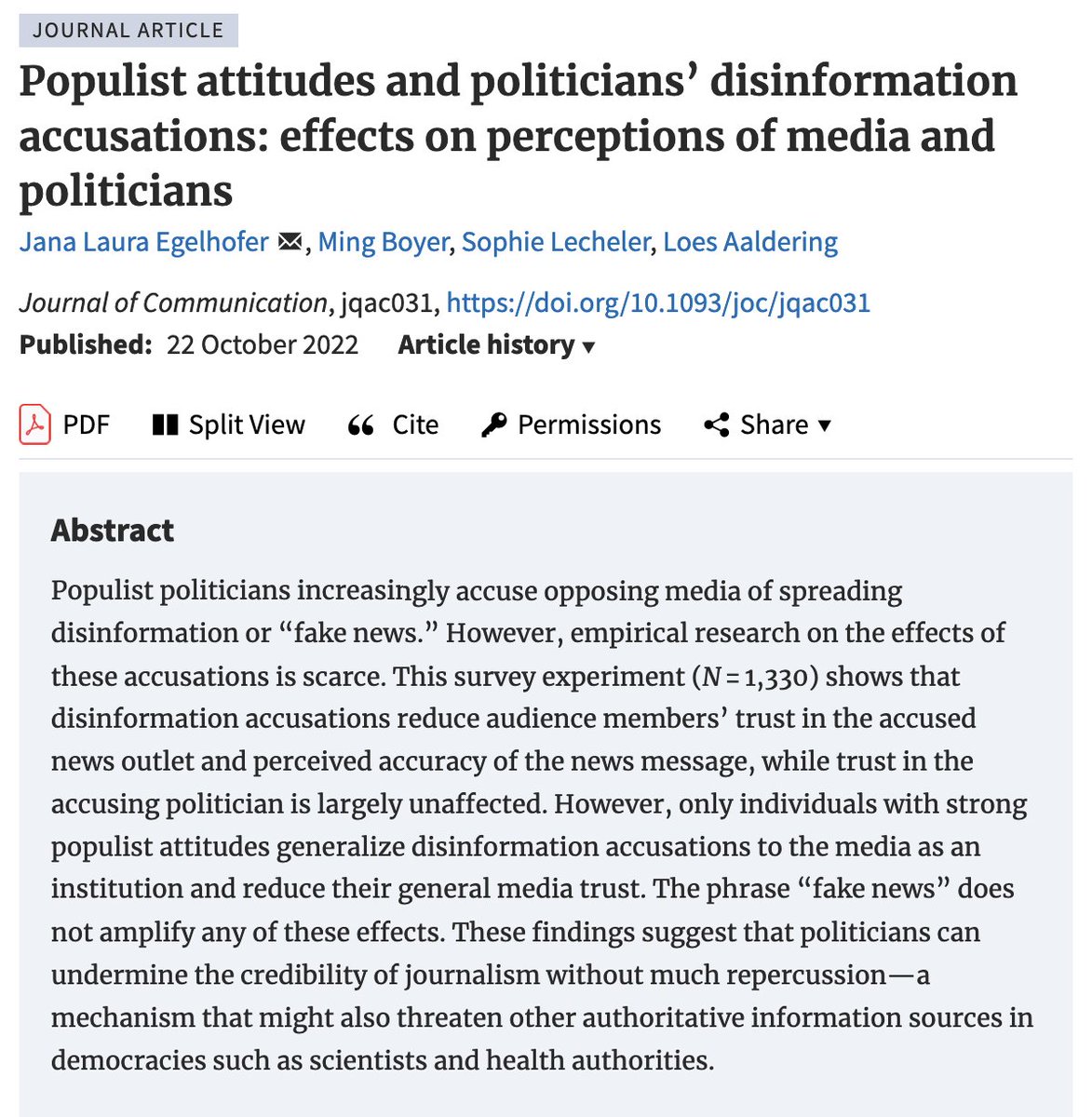
🥳 Excited to see this out in @Journal_Of_Comm: in this paper, @BoyerMing, @solecheler, Loes Aaldering, (@VU_PSPA) and I test the effects of politicians' disinformation accusations (including or excluding the phrase "fake news") against news media 🧵👇
@polcom_vienna @IPKW_univie
@polcom_vienna @IPKW_univie
We exposed participants to a fictional politician’s Twitter page. In both experimental conditions, the tweets contained disinformation accusations: Condition 1 included the phrase “fake news,” and Condition 2 did not.
1) We find that exposure to disinformation accusations reduces specific media trust (trust in the accused news outlet) and the perceived accuracy of the discredited news message.
2) Furthermore, we find a moderation effect of populist attitudes on general media trust -> only citizens with strong populist attitudes generalize these accusations to the media as an institution and reduce their general media trust.
3) Moreover, our results indicate that while citizens feel that politicians who use disinformation accusations want to manipulate them, this does not affect how trustworthy they perceive them.
4) Finally, we do not find any differences for any of our tested dependent variables between the disinformation accusations including or excluding the term “fake news.” -> "fake news" accusations do not seem to be more powerful than accusations not using this buzzword
Importantly, further research is needed to understand the effects of repeated exposure and to replicate the findings in the context of other issues and different partisan actors. 👉 full #openaccess paper here: doi.org/10.1093/joc/jq…
• • •
Missing some Tweet in this thread? You can try to
force a refresh




