David Fishman Profile picture
Nov 14, 2022 12 tweets 3 min read Read on X
A big milestone for China's offshore wind that I missed a few weeks ago: Shandong's first GRID PARITY offshore wind project (500MW) was connected to the grid.

This means the offshore wind power is generated at a unit cost level competitive with coal-fired power.

Quick 🧵 A crane vessel next to an offshore wind turbine.
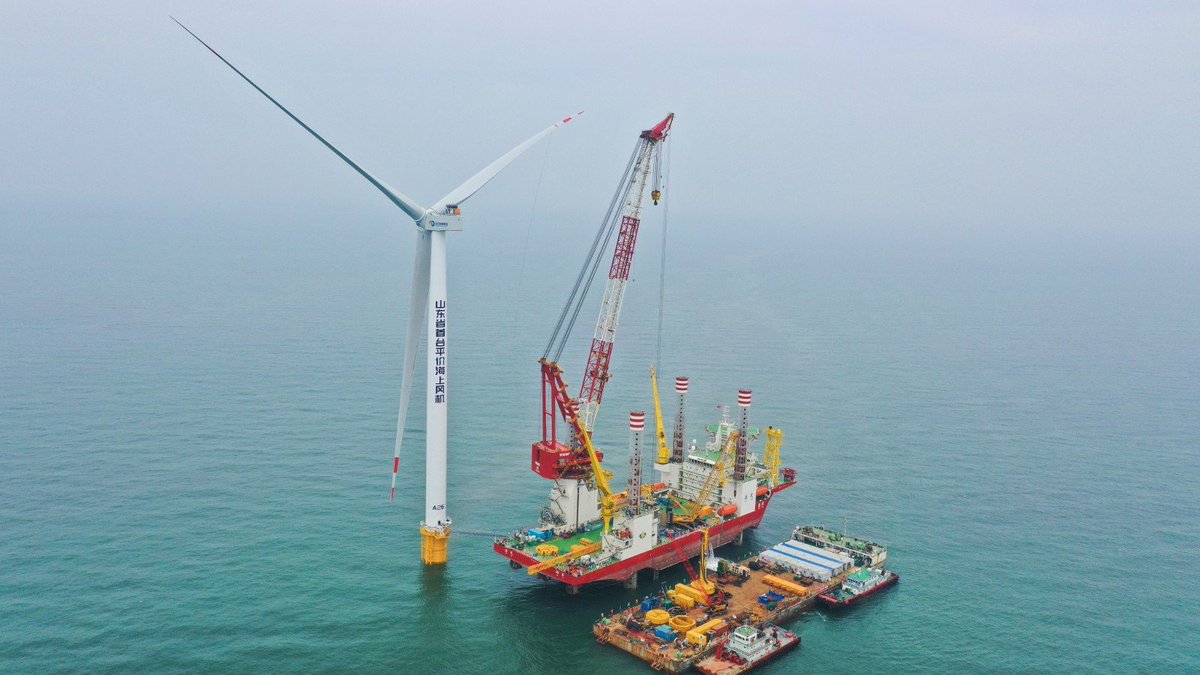
According to the news, the Shandong Bozhong project achieved an LCOE of 400 RMB/MWh, (USD 56.90) basically at the same level as the Shandong base coal price (394.9 RMB/MWh).

It represents a huge, HUGE decline in construction costs for offshore wind in the past few years.
For contrast, the average LCOE of the already-existing offshore wind in China is around 790 RMB/MWh, nearly twice as much as this new project. These projects were built a few years ago, during the subsidy era.

In 2010, offshore wind cost per MWh in China was well over 1000 RMB.
Major factors for LCOE decline:

-Improvements in turbine blades, esp. length, allowing them to generate more power, more cost-effectively.

-Decrease in construction costs due to experience, economies of scale. Big cost drops for crane vessels, maritime labor, maritime cables.
Offshore wind is particularly important for the long-term decarbonization plans of China's industrialized coastal provinces like Shandong, Jiangsu, Zhejiang, Guangdong precisely because they lack onshore land for deployment of solar or wind (or land usage fees are sky-high).
For now, some of these provinces have been able to keep their renewable capacity growth strong via mass deployment of rooftop solar (particularly Shandong, which leads the nation).

But the available rooftops will eventually run out, while the growth in demand will not.
That's what makes control and mastery of offshore wind development costs so important for China.

It's major part of the equation for coastal provinces securing low-carbon power at reasonable prices (via their preferred in-province investment, not via cross-province imports).
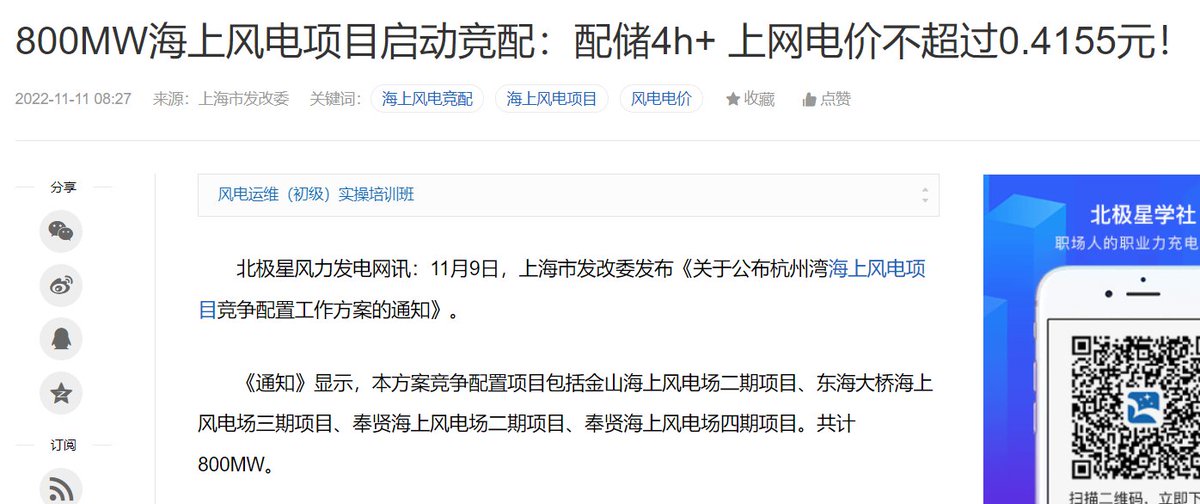
For instance, here's Shanghai a few days ago, soliciting tenders to build an 800 MW offshore wind farm PLUS STORAGE at an unit cost no higher than the Shanghai coal base price of 415.5 RMB/MWh.

This would have been impossible just a few years ago.

news.bjx.com.cn/html/20221111/… A screenshot of the news story headline from BJX
Here's the link to the announcement from the Energy Administration of Shandong.

Lots of nerdy technical details about tons of carbon offset, # of turbines, etc.

nyj.shandong.gov.cn/art/2022/11/2/…
Well yes demand growth actually WILL run out someday, but way after the available rooftops do.
*Important note*

Although this project claims to have achieved an LCOE of 400 RMB/MWh, which is nearly level with the coal-fired base price in Shandong, I was unaware that Shandong offers a provincial capacity subsidy for offshore wind constructed from 2022-2024.
Thus, it should be inappropriate to refer to this project as "grid-parity". Although it will sell its power into the open markets with no subsidy on volume, it most likely had a one-off capacity subsidy at *construction* of 800CNY/kW.
hat tip to @MhehedZherting for the correction

• • •

Missing some Tweet in this thread? You can try to force a refresh

 

Keep Current with David Fishman

David Fishman Profile picture

Stay in touch and get notified when new unrolls are available from this author!

Read all threads

This Thread may be Removed Anytime!

PDF

Twitter may remove this content at anytime! Save it as PDF for later use!

Try unrolling a thread yourself!

how to unroll video
  1. Follow @ThreadReaderApp to mention us!

  2. From a Twitter thread mention us with a keyword "unroll"
@threadreaderapp unroll

Practice here first or read more on our help page!

More from @pretentiouswhat

Jan 12
On China's Clean Energy "Morality":

There's an emerging "acceptable" way to talk about China's cleantech push: that it's less driven by altruistic intentions on climate change, and more driven by self-interest like economics, energy security, and pollution control. 🧵
mea culpa: I contributed to this narrative in the past to make it more palatable in media interviews. It's an easy one for China-skeptical editors and readers to accept: that this "good behavior" on climate issues is driven by self-interest that happens to be socially beneficial.

So many times, to so many people, I said things like: "what does it matter what the motivation is, as long as it works?" I wanted to emphasize the positive outcomes and so I embraced a convenient narrative that helped me get there.

Of course this works, but it's only half-true. Which uncharitably means it's also half-false. Here's why...
1. Motives are multi-dimensional

Chinese policymakers DO care about combatting climate change. If they didn't, there would be no 2025 peaking coal target or 2030 peaking emissions goal. There would be no impetus to pursue thermal batteries, next-gen nuclear, advanced geothermal, or expensive and complex hydropower facilities. Coal is abundant and domestic. If they ONLY cared about economics and national security, the policy could just be "forever coal".

Chinese policymakers aren't yet willing to trade energy abundance or affordability to move faster on emissions. But that's different from not caring.
Read 7 tweets
Jan 3
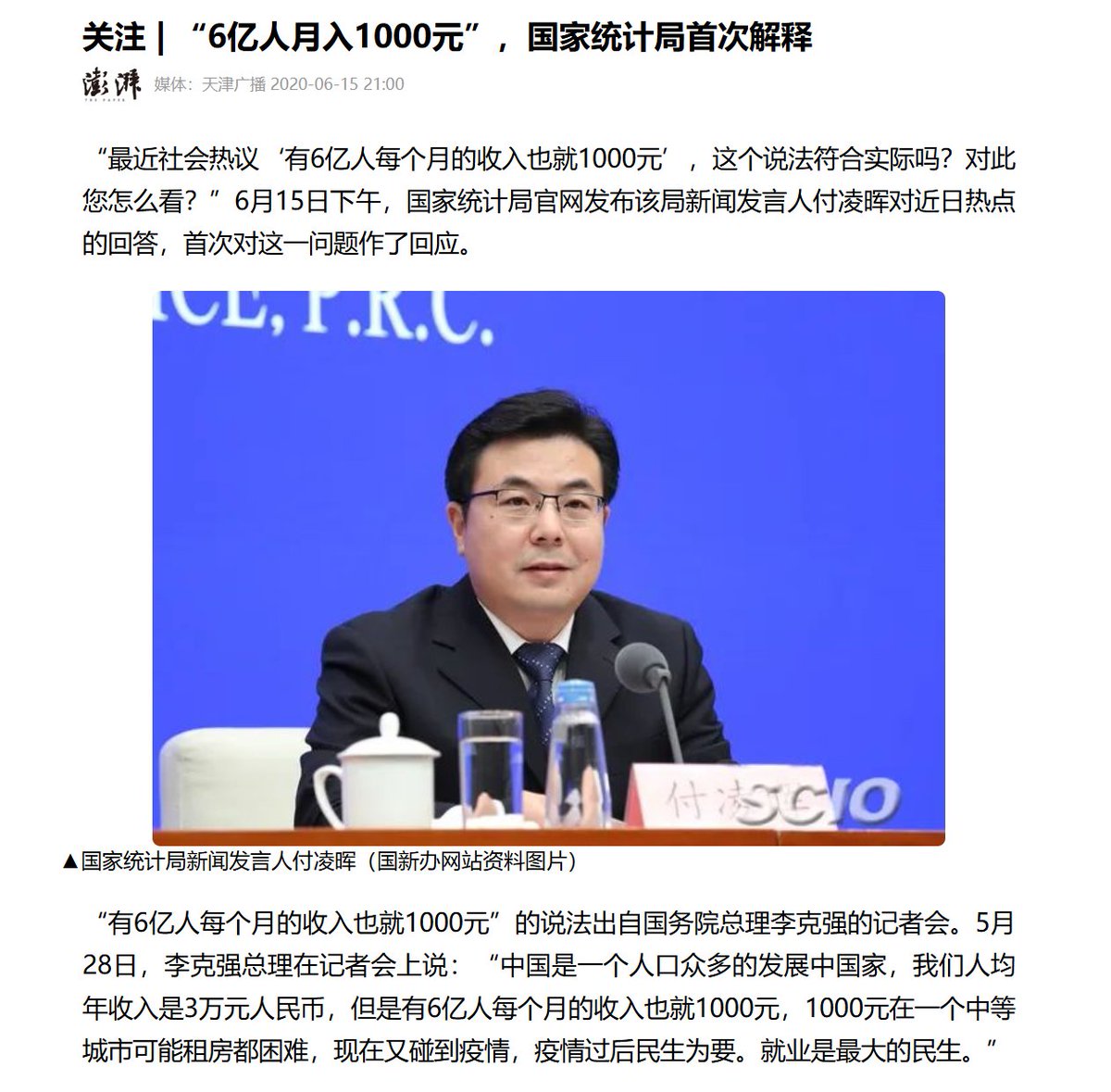
Did Li Keqiang really say 600 million Chinese people earn <1000 CNY a month?

No, not quite. That comment is widely misunderstood, as explained in this paywalled article from The Economist.

If you don't subscribe, I'll summarize in a thread.🧵
economist.com/finance-and-ec…
So where did this number come from?

In May 2020, then-Premier Li Keqiang famously said:

"...人均年收入是3万元人民币,但是有6亿人每个月的收入也就1000元, 1000元在一个中等城市可能租房都困难..."

"Our average annual income is 30,000 CNY, but China has 600m people with a monthly income of just 1000 yuan. You can't even rent in a mid-sized city for that much".

That's the phrase that was widely misunderstood, with Li's unfortunate framing adding to the confusion. It got a lot of attention both within and outside of China.
china.huanqiu.com/article/3yQjRY…
The main issue is: Li was citing NBS data for per-capita disposable income, not wages. It's a simple average of the disposable income by population for the bottom two quintiles (40%) in 2020, including rural elderly, children, and not-working dependents, i.e., many people outside the formal labor system - or who don't work at all. They are all part of households but their contribution to disposable income is 0 (or close to it).

The NBS clarified Li's comments two weeks later - that it's a statistical average, not a count for wage earners.

The Economist article included this example:
"Imagine a country of ten people, where the bottom four earn $1, $2, $3 and $4 a day, respectively. Their income per person is $2.50. But only two of them live on less than this amount."

The situation for China's bottom quintile is even more exaggerated than this. There are 100s of millions of children and elderly (especially rural) with zero or near-zero formal income. The minimum rural pension is just ~200 CNY/month.Image
Read 8 tweets
Dec 29, 2025
China’s New Play for Mid-Duration Energy Storage: Carnot Batteries

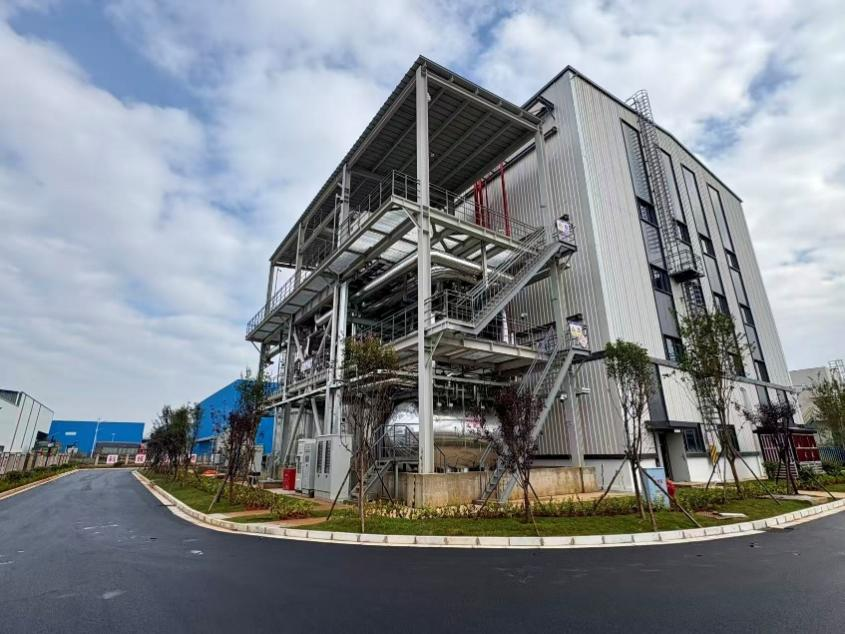
On December 25, State Power Investment Corporation (SPIC), announced its prototype “Chunuo” thermal storage system had passed expert review and met its performance targets.

What is it and why does it matter? 🧵 Image from Sina Caijing
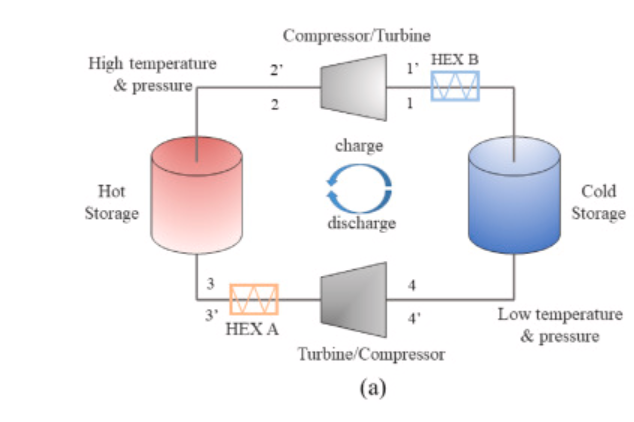
A Carnot battery, also called a pumped thermal energy storage (PTES), is an energy storage system that converts electricity to heat and cold, then converts it back to power when needed.

Instead of using chemical reactions like lithium-ion batteries, it relies on thermodynamics. Image from Wikipedia
For a quick primer on the science: here's the basic principle of thermal energy storage technology (sorry in advance if this short description doesn't capture all the nuances):

During the charging phase, electricity is used to run a heat pump that compresses a working fluid. This compression makes the fluid very hot and that heat is transferred via heat exchangers into a “hot tank” filled with a thermal storage medium like molten salts.

After giving up its heat, the still-compressed, now-ambient temperature working fluid is fed through an expander, which makes it very cold. That cold is then transferred via heat exchanger to a "cold tank" filled with a mixture that retains cold well, like alcohol-water (a "eutectic mixture", for the nerds).

When the grid needs power, the system reverses the process: the working fluid re-absorbs heat from the hot tank, expands through a turbine, and converts thermal energy to electricity, dumping any remaining heat into the cold tank.

In recent years, it has become popular to call this thermal battery concept a Carnot battery, named after Nicolas Léonard Sadi Carnot, the French "father of thermodynamics". He laid out Carnot's Theorem - which deals with the maximum efficiency of heat engines - as early as 1824 (when he was just 28). Carnot's Theorem is today understood as a direct implication of the second law of thermodynamics which was only fully described ~30 years after Carnot.

Thanks to the second law of thermodynamics, the bigger the temperature difference between the hot and cold tanks, the more energy you can extract.Image from ScienceDirect article Liang et al (2022): https://www.sciencedirect.com/science/article/abs/pii/S1364032122003823
Read 12 tweets
Dec 27, 2025
The only thing OP should regret is misleading his followers with his clunky charts and sloppy, unsophisticated analysis.

He has sadly ignored more tactful efforts to correct these issues, so enough is enough. Time to be blunt...

Let's break it down in a long thread.🧵
1. The Premise is Flawed

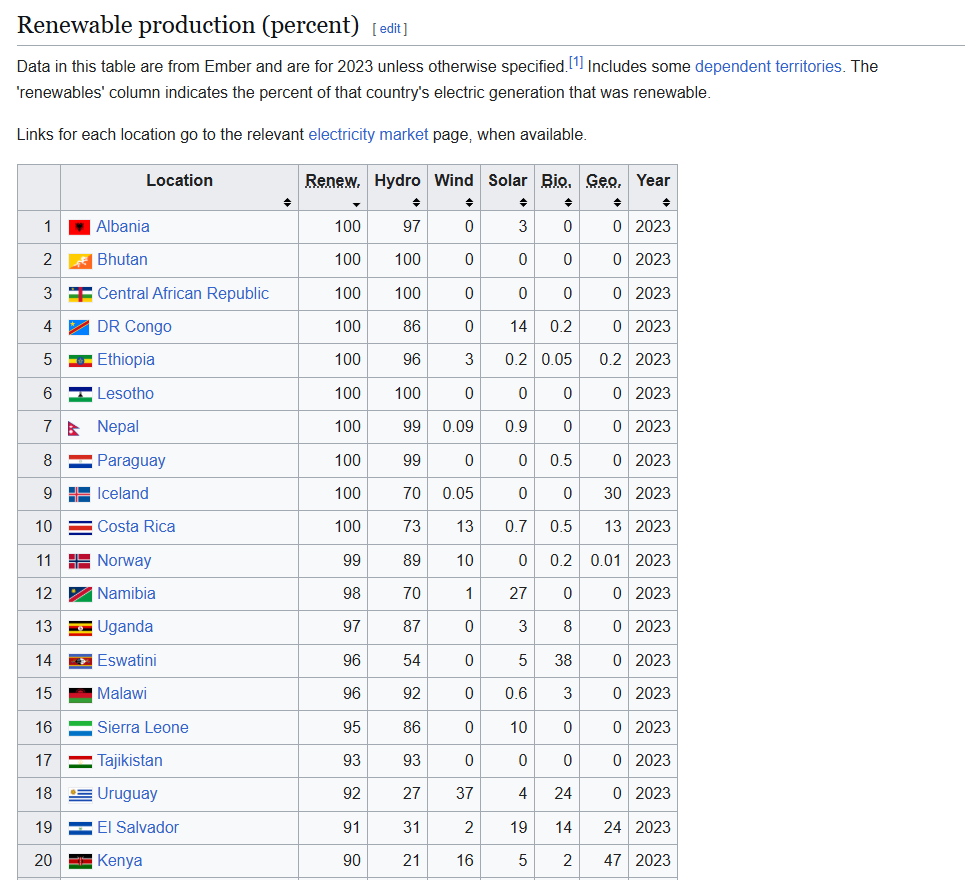
If we must go about assigning a silly label like "green superpower" (which IMO is really just vanity contest clickbait pretending to be analysis) then it's too narrow to define "green superpower" by what percentage of a country's power comes from renewables. This is immediately obvious when we look at the list of countries that lead the world in % of power from renewable energy today - see any superpowers in there? It's lovely to be blessed with abundant hydropower or geothermal resources, but that hardly drives global change.

China, at around 36% renewables (and rising of course) both installs more than the rest of the world combined, and exports the technology to green the power sectors of developing nations globally. If we must have this conversation, then it should acknowledge absolute volume and international impact, where China is clearly dominant...Image
2. Erroneous Analysis and Data

OP's post says "Two-thirds of electricity in China is from thermal plants...that's coal".

This is incorrect on several accounts. First, "thermal" in the monthly NBS pressers includes coal, gas, and renewables like biomass. Coal is the lion's share, but no, it's not ALL coal. So that's already a problem.

Next, the NBS monthly datasets do not report full power generation (全口径) across the whole economy, only generators "at-scale" (规模以上) which excludes small wind and solar (like rooftop solar, which is half the solar). Thus, it's impossible to calculate from this data series what percentage of power generation is coal without many assumptions. You must estimate, or wait for the quarterly data dumps or the annual statistics yearbook.

I'm not the first person to point this issue out. But OP has either ignored or dismissed everyone else who's pointed it out so far, so it must be repeated. His conduct on this point so far is a poor reflection on his integrity.

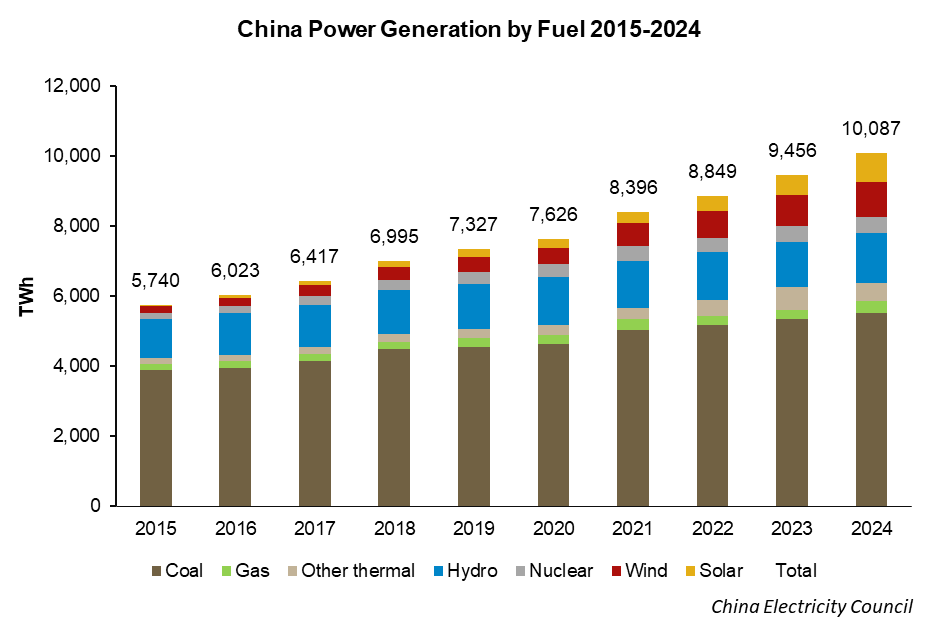
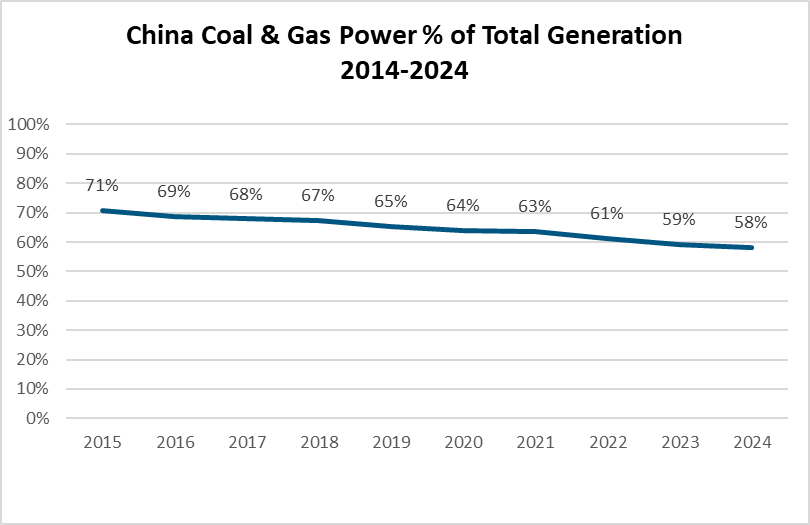
In the 2024 annual statistic yearbook published by China Electricity Council (CEC), coal comprised 54.8% of generation at the end of 2024, with gas-fired power adding another 2.6%. These numbers have been falling steadily for a decade and will fall again this year. So...the numbers don't lie, unless you're looking at the wrong numbers. 🧐Image
Image
Read 12 tweets
Nov 18, 2025
This post going viral reminded me of an interesting bit I read recently about "rising superstars" in China among the ranks of young cadres.

To be considered a high-flyer superstar, you need to be advancing through China's political ranks at a VERY advanced pace. Let's look. 🧵
The best way to measure "rapid advancement" is not necessarily by the title they currently hold, but the rank within the state civil service system vs. their age.

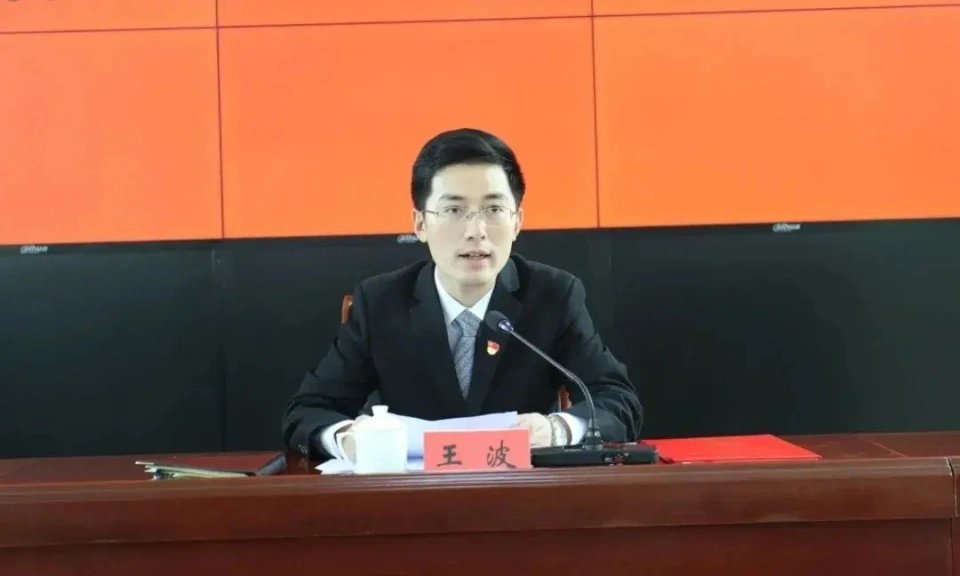
For instance, this is Mr. Wang Bo, currently one of 7 vice-mayors of Longyan City, Fujian. He is just 38 years old. Image
Wang is the most junior of Longyan's 7 vice-mayors, undoubtedly, but to be in this position at all (a vice mayor of a regular prefecture-level city) means he will have achieved 副厅级, or "Deputy-Bureau Director Level" in China's civil service ranks.

That is an insanely rapid career progression for someone of his age, indicating a combination of oustanding talent AND oustanding personal connections/savvy choice of political patron. You can't advance this rapidly without both.
Read 9 tweets
Nov 9, 2025
My newest essay on Feeling the Stones comes from Linfen, Shanxi, which was infamously declared "the most polluted city in the world" by the World Bank in 2006.

But I had a different reason for visiting: I wanted to assess life in China's "most median city".🧵

(link at end) Image
If you've followed me for a while, you'll know that for 3+ years now, I've protested the over-sampling of opinions from China's 1st-tier cities and pursued this idea of capturing China's "median zeitgest" from smaller cities.

This 2022 trip started it:
Later in 2022, I also established this second "founding principle" for the writing on my newsletter: I want to do my best to capture the perspectives of "median people" too, rather than the cultural, academic, or financial elites we normally hear from.

Read 13 tweets

Did Thread Reader help you today?

Support us! We are indie developers!


This site is made by just two indie developers on a laptop doing marketing, support and development! Read more about the story.

Become a Premium Member ($3/month or $30/year) and get exclusive features!

Become Premium

Don't want to be a Premium member but still want to support us?

Make a small donation by buying us coffee ($5) or help with server cost ($10)

Donate via Paypal

Or Donate anonymously using crypto!

Ethereum

0xfe58350B80634f60Fa6Dc149a72b4DFbc17D341E copy

Bitcoin

3ATGMxNzCUFzxpMCHL5sWSt4DVtS8UqXpi copy

Thank you for your support!

Follow Us!

:(