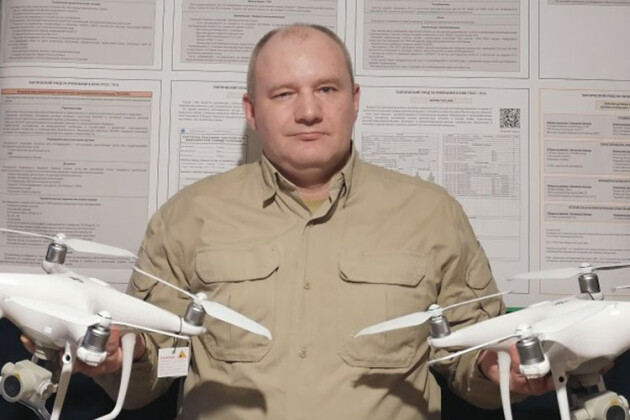
1/ QUICK THREAD on Ukraine war (drones, combat, mobilization) from the director of "Veche", one of Russia's non-government orgs that provide assistance to the soldiers. Main points below: veche-info.ru/news/9453 
2/ There is a thesis that the lion's share of drones used by soldiers are supplied by humanitarian orgs. Is that true? Many experts say that our military-industrial complex has "missed" small drones. Yes - the bulk of small UAVs are supplied by volunteers, including our org.
3/ "The problem with the (quadcopter) drone is the fact that these are consumable products, and the life of a drone on the front line is very short - literally a few weeks from the first flight to its destruction."
4/ "This is true even if the drone is piloted by a trained operator. And if the operator has not had the appropriate training, does not have relevant combat experience, then this is 1-2 sorties - and the drone will be lost."
5/ "But at the same time, it is necessary to clearly understand the whole story with drones, and its not exactly true that our Armed Forces were not ready for the very appearance of this type of weapon."
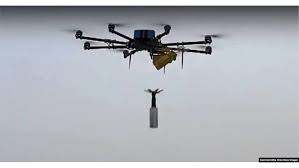
6/ "We are witnessing a unique situation - the first mass use of small drones in history. I agree that up to this point, small drones have been used in various military conflicts, for example, in Syria, Yemen, and during the military conflict of 2014-2022 in the Donbass..."
7/ "Our military-industrial complex periodically paid attention to this, but it either did not have resources, or did not have direct orders from the government (to mass produce small drones). As a result, our military-industrial complex was engaged..."
8/ "...in the production of heavier drones with a narrower specialization, such as Orlans, Zala Aero products and the like."
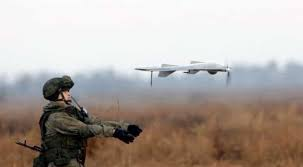
9/ "They (Russian military drones) just have a different purpose, are more narrowly specialized, are more expensive and require a different attitude to their use. Do small drones exist in the US Army? No, they don't exist there in larger numbers either."
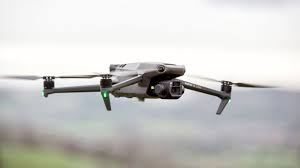
10/ "Their (American) military-industrial complex missed this (drone) moment in the same way, and by and large, none of the modern armies of the world was ready for the Mavic phenomenon."
11/ "To say that only we missed that is fundamentally wrong. The bottom line is that there was no such massive drone as the Mavic in any army, and not a single military even imagined that it would be needed in such volumes."

12/ "To what extent has this war changed the idea of small drones - should we expect them to appear in all armies now? Speaking philosophically, this war has changed many views on the Armed Forces, not only in terms of drones, but also in terms of command and control..."
13/ "...Flaws in the organization of communications, high-precision weapons became visible. I'll give you an example. For example, the American HIMARS themselves are rather mediocre multiple launch rocket systems, they don’t shoot well, they don’t hit so far..."
14/ "...but when satellite-guided precision munitions are used in this system, it turns from mediocrity into a first-class tool for suppressing and destroying enemy rear lines. All this works when it can hit the given targets with high accuracy."
15/ "We also have similar systems, like Uragan and Smerch, which have precision-guided munitions, satellite guidance, and so on. The problem is that the Americans, in addition to high-precision guidance, have a satellite reconnaissance complex. It allows real-time tracking..."
16/ "...of targets on the surface of the earth. We have the components of multi-domain integration, communications and control, but, unfortunately, the components of multi-spectral spatial reconnaissance have not been given due attention."
17/ "We thought that the Americans were spending crazy money, sawing the budgets into some kind of meaningless toys. But we proudly open the 1980s ground force combat manual and everything is "fine" with us. But it turned out that these gadgets actually work."
18/ "It suddenly became obvious that our army also needed them. This is also a matter of worldview. It is necessary that generations of officers, generals, those who promote military science, change their worldview in terms of applying new modern technologies."
19/ "We need gadgets that allow us to increase the effectiveness of conventional weapons, the speed of information processing, and combat control. Old weapons that could no longer be upgraded and effectively used, once equipped with "gadgets", can be very effective."
20/ "In this sense, the war made it possible to look at these approaches with different eyes, to show that those approaches that dominated military science and the military-industrial complex for decades turned out to be outdated and inappropriate."
21/ "Now it is necessary to develop new solutions that will allow Russian Armed Forces, our military-industrial complex to come together, and to rethink the national security."
22/ "At the moment, the Ukrainian military retreated to other positions in Donetsk. We need to understand that for 8 years, huge fortified areas have been dug and hollowed out there, which have to be stormed into with great difficulty."
23/ "To do this faster, we need to condense the front line, and for this we need to mobilize not just 300,000, but 700,000 or even a million people. In this case, we can say that we will form "shock fists" and use these forces to burn through the enemy’s defenses."
24/ "Another issue is resources. The mobilization that we have carried out, 300,000 people, will make it possible to plug holes in the front line and create certain resources. But all the same, this is not enough to conduct active offensive operations on a 1,200-kilometer front."
25/ "There, we need a million people. And this is only on this front line - we still have the Baltics, the Far East, and the North. Finland joined NATO, so the mobilization is needed not for 300K, but 2 million people, if we want to resolve the issue quickly and efficiently."
26/ "In general, our military must provide the fighter with uniforms, equipment, and armor protection in accordance with the norms. All this is spelled out in the current legislation, determined by orders of the Ministry of Defense."
27/ "A mobilized or conscript soldier must receive a set of uniforms, summer and winter, underwear, a summer and winter hat, body armor and helmet. This is the minimum level that the state should provide for the conscript and the mobilized."
28/ "But in that nomenclature of things, much is missing. The state-issued first-aid kit is not the best of those that could be useful in combat conditions. Commercial enterprises produce first-aid kits with a more necessary medicines designed for a wider range of care."
29/ "I would advise you to pay attention to communications, because traditionally (I can’t say why) our army is always bad with them. Buying some kind of radio station, albeit an analog one, is probably helpful in this conflict."
30/ Many comments in this thread are echoed by actions from other Russians who are now forming separate development and acquisition pipelines to deliver needed weapons and equipment to the front - see thread below:
https://twitter.com/SamBendett/status/1591425089245151232
31/ Case in point about the mass use of DJI Mavics in this war:
https://twitter.com/RALee85/status/1595732208010072064
• • •
Missing some Tweet in this thread? You can try to
force a refresh