How to infer metastable brain waves:
For a whole brain model, one needs to reduce the high dimensional behaviour of local neural populations to a few variables, typically mean firing rates of excitatory and inhibitory neurons 
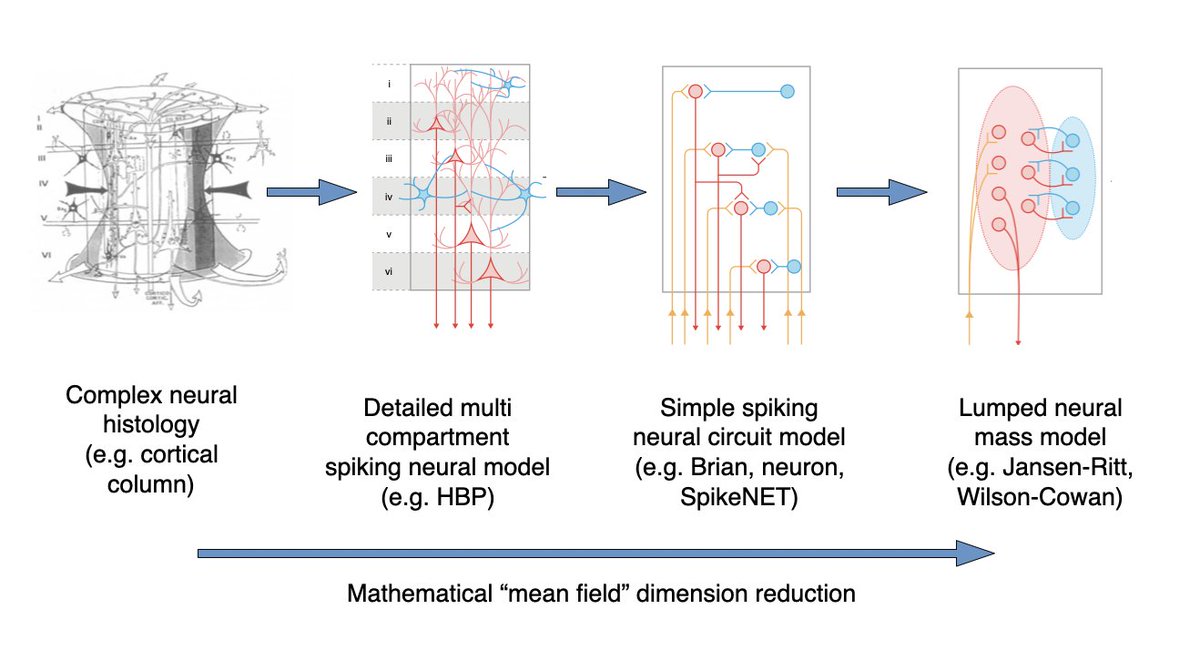
Nothing unusual about this so-called mean field reduction, employed all over the place in complex systems + based on simple assumptions of weakening correlations over increasing system size

Here we use a conductance-based mean field model of a small patch of cortex
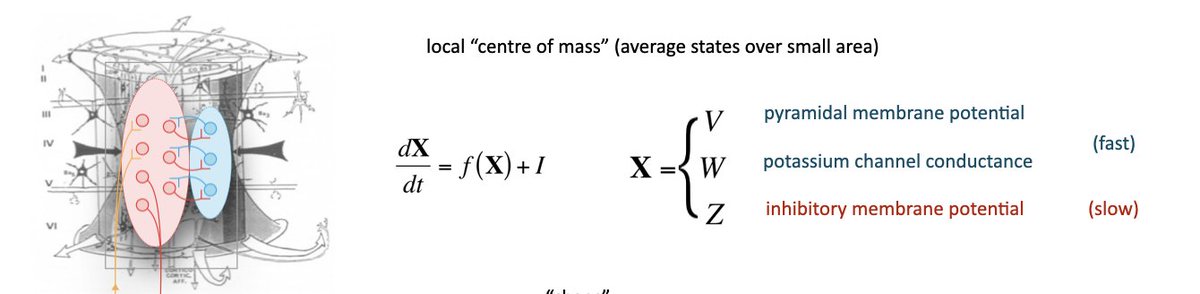
Tune the parameters of your mean field model to values consistent with their known physiological settings and observe the ensuing local population dynamics
Cover the cortex with these local mean field population models and couple them together via long-range anatomical connections (i.e. through the connectome)

Large-scale waves of varying patterns (breathers, travelling waves, spirals) spontaneously emerge across a broad sweep of parameter values and biologically human connectomes
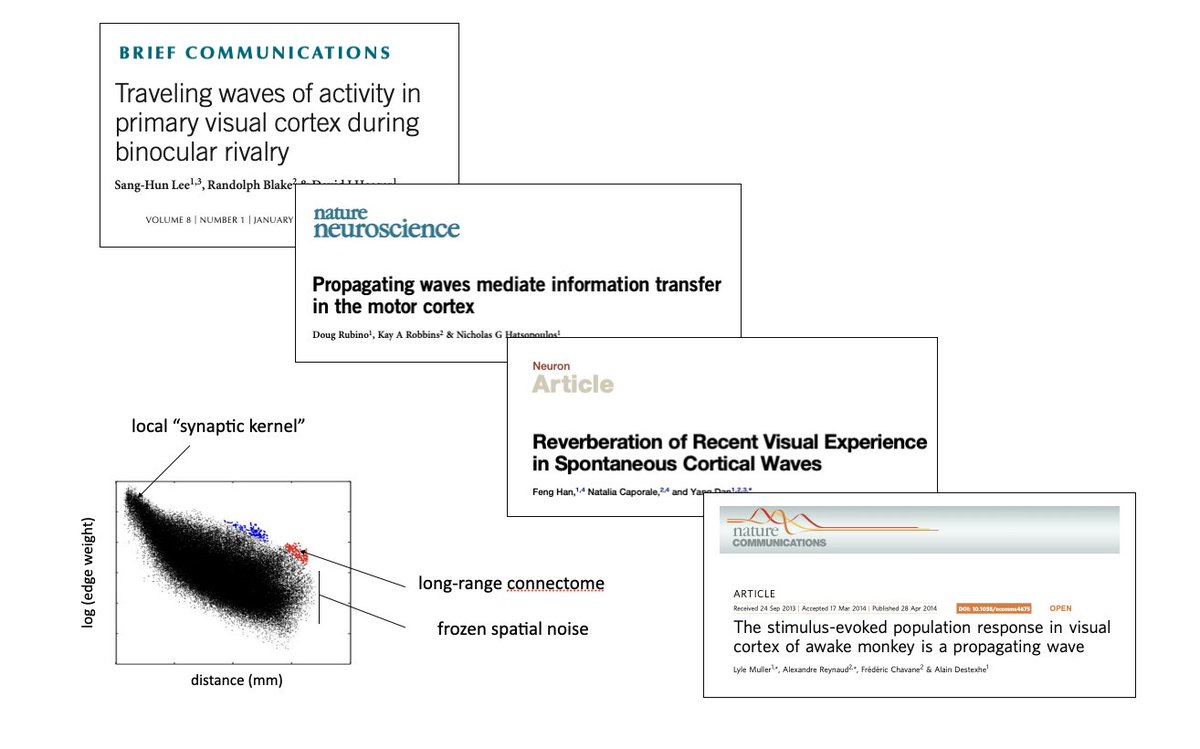
Cortical waves occur across species, functions, conscious states, regions, and data modalities
The excitable nature of neuronal activity plus the strongly distance-dependent nature of cortical connection density is a sufficient cause for these
The excitable nature of neuronal activity plus the strongly distance-dependent nature of cortical connection density is a sufficient cause for these
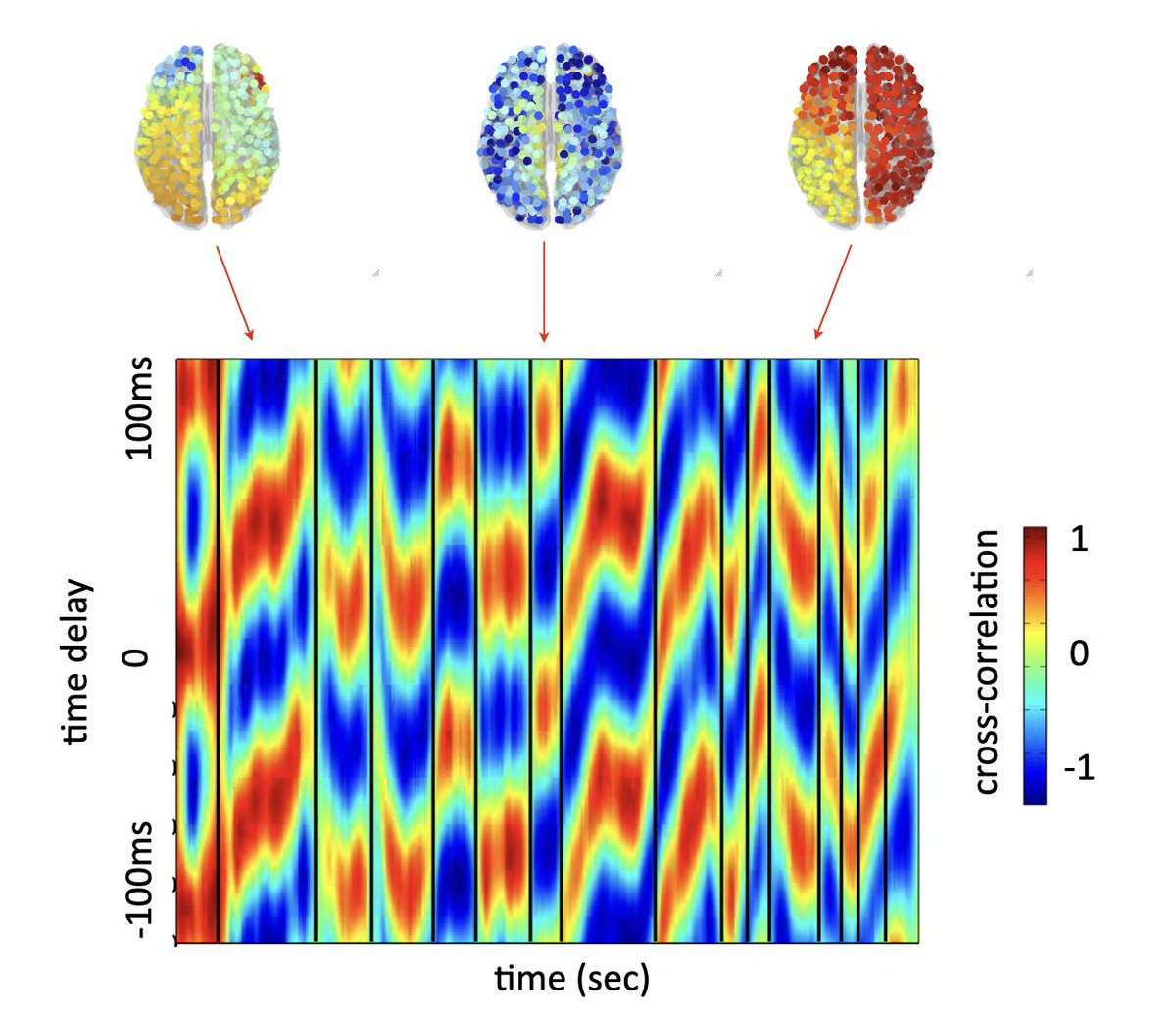
Whole-brain wave patterns in this model are briefly stable, before collapsing with replacement by a new whole brain pattern
Extract an order parameter (a measure of large-scale low entropy) shows a natural partition of these dynamics into brief "metastable" states
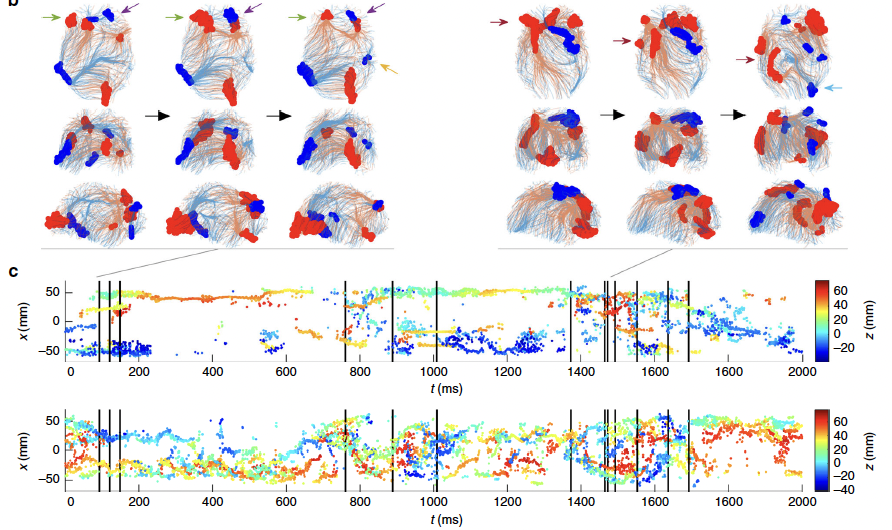
To visualise these dynamics, use the Hilbert transform to extract local phase vectors from each node, then techniques from optic flows to find the underlying dynamic streamlines
These flow from sources, spirals, nodes & sinks, forming an underlying dynamic scaffold
These flow from sources, spirals, nodes & sinks, forming an underlying dynamic scaffold
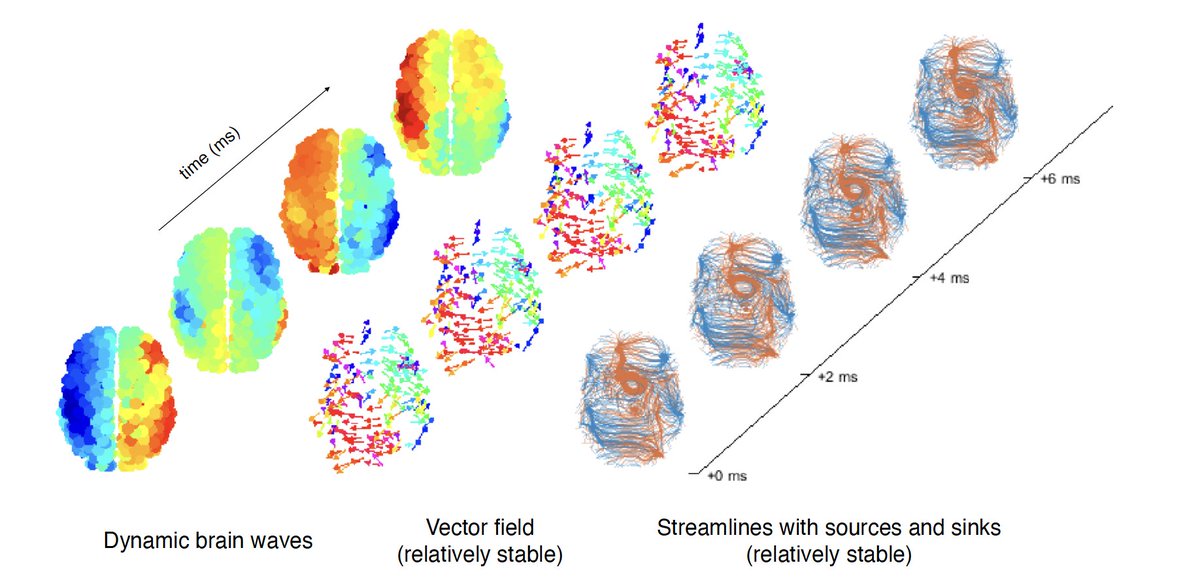
Boom! A sort of spatiotemporal turbulence
Collisions between transiently stable fixed points, saddles + rotors (spirals) yield the metastable transitions observed in the order parameter
Collisions between transiently stable fixed points, saddles + rotors (spirals) yield the metastable transitions observed in the order parameter
Recurrence plots (top left, which detect recurring patterns in spatiotemporal data) benchmarked against phase randomized surrogate data (top right) reveal a relatively small repertoire of such metastable states
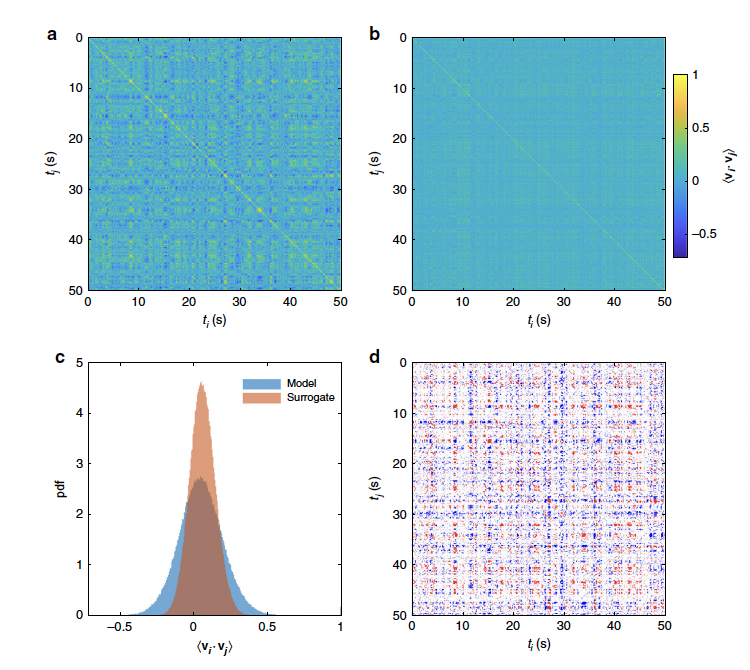
While basically every step here involves debatable assumptions, the key principle is the collapse of the brain's extraordinarily high dimension onto a relatively low dimensional & metastable dynamic manifold: This core process does not depend upon specific details
There is a long history of cortical waves - read our effort (& references to others' work) here:
nature.com/articles/s4146…
Download the sample connectome and simulate these models here: bdtoolbox.org
Cudos to my former post-docs James Roberts + Leo Gollo
nature.com/articles/s4146…
Download the sample connectome and simulate these models here: bdtoolbox.org
Cudos to my former post-docs James Roberts + Leo Gollo
You can pull apart some of the underlying assumptions (& the source material by those who founded the field) here:
nature.com/articles/nn.44…
Plus a recent link between neuronal biophysics (e.g. neuromodulation) + these large-scale models here:
nature.com/articles/s4159…
nature.com/articles/nn.44…
Plus a recent link between neuronal biophysics (e.g. neuromodulation) + these large-scale models here:
nature.com/articles/s4159…
Thanks for everyone's interest in this work! Since the paper was published, the code has been migrated across to github:
github.com/brain-modellin…
.... and the optic flows analysis is here:
github.com/brain-modellin…
github.com/brain-modellin…
.... and the optic flows analysis is here:
github.com/brain-modellin…
• • •
Missing some Tweet in this thread? You can try to
force a refresh