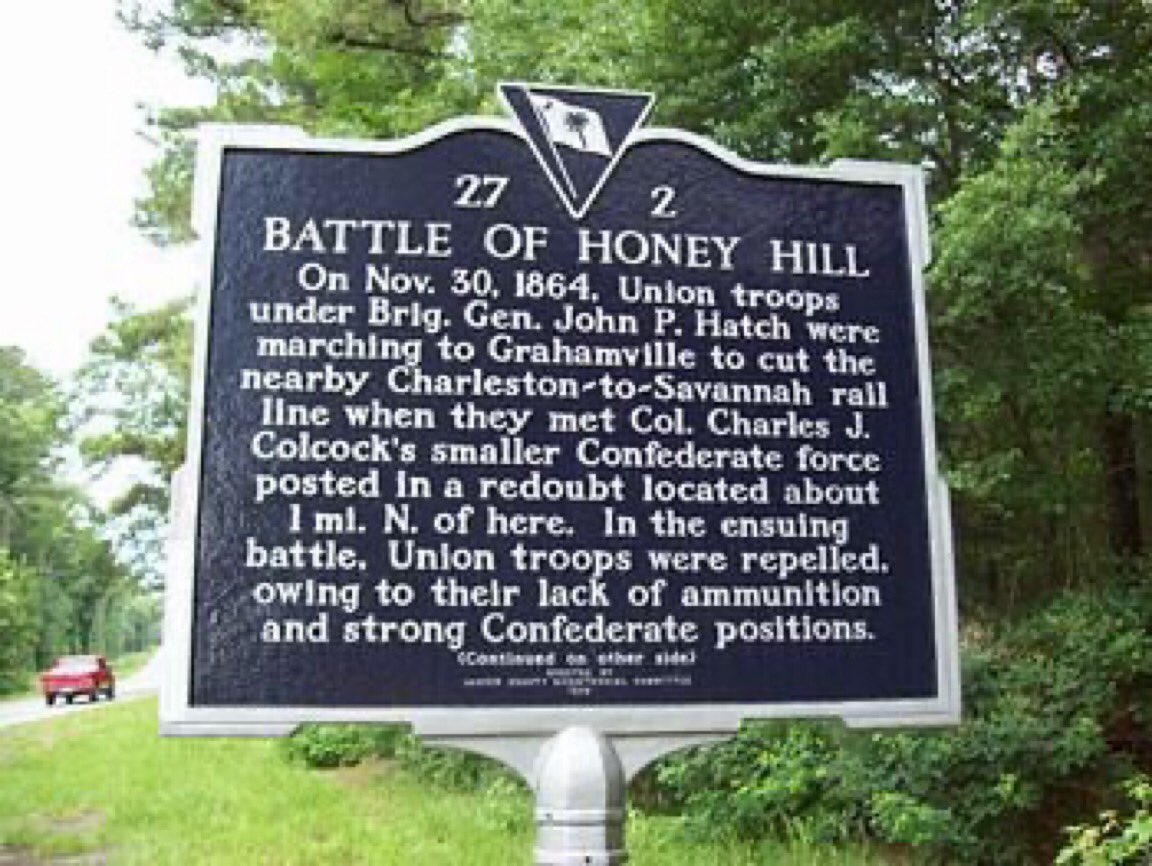
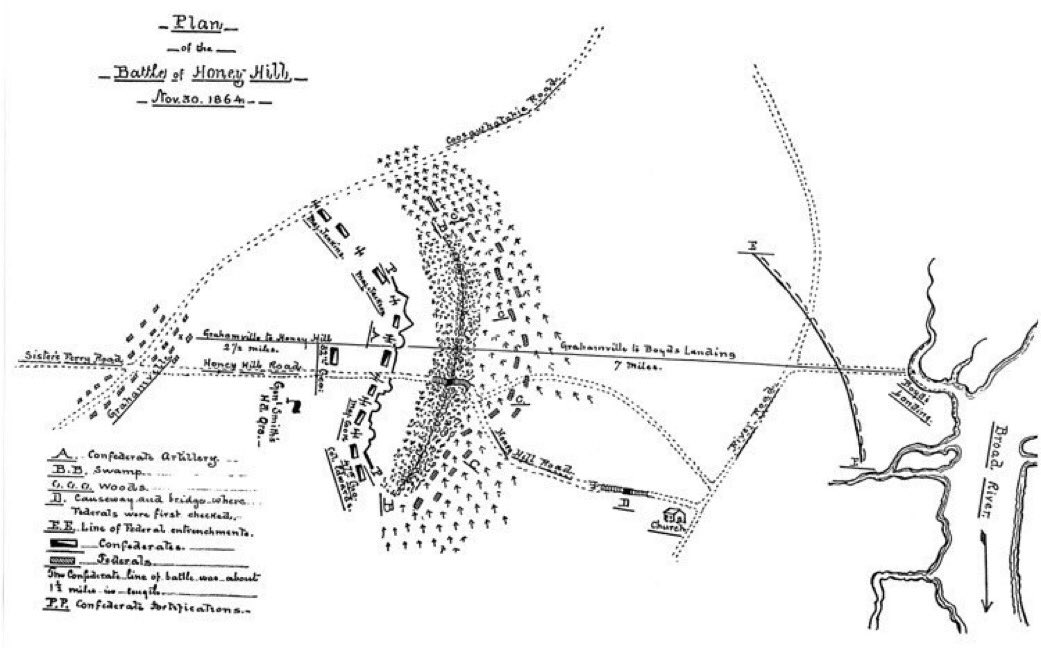
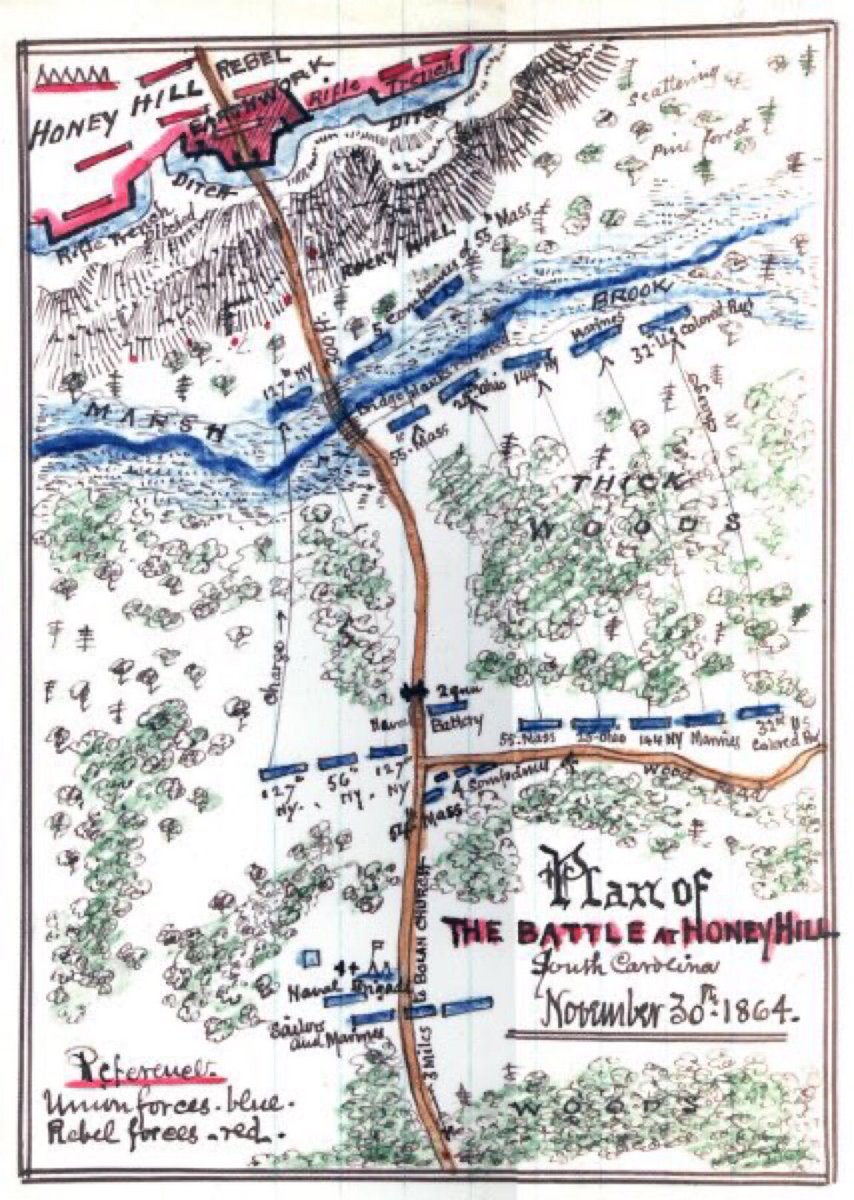
The Battle of Honey Hill was fought #OTD in 1864. It was part of an expedition along the coast to cut the Charleston & Savannah Railroad in support of General William Sherman's March To The Sea. #CivilWar 🧵
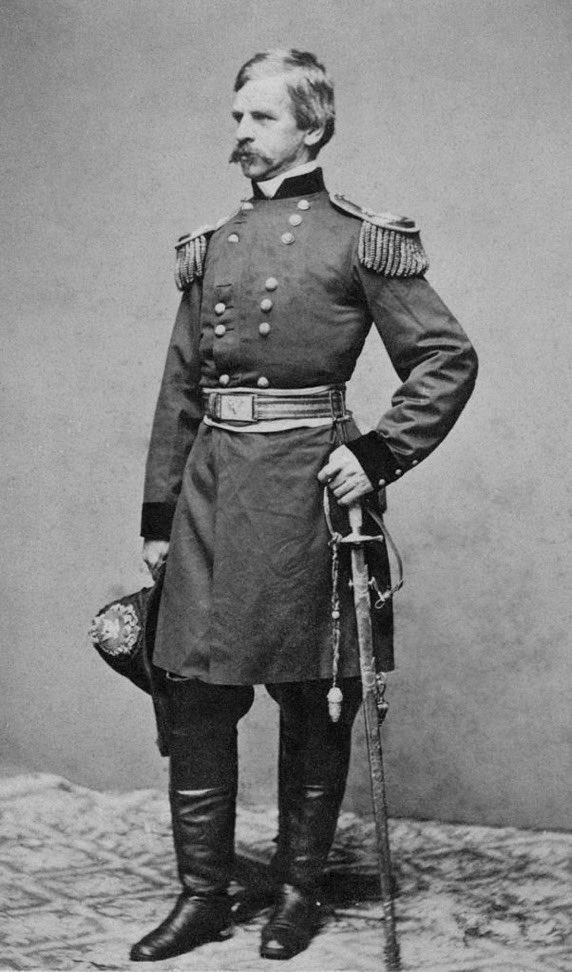
The @USArmy force was commanded by General John Porter Hatch, an 1845 graduate of West Point. His men landed northwest of Beaufort, SC and marched toward the railroad near Grahamsville.
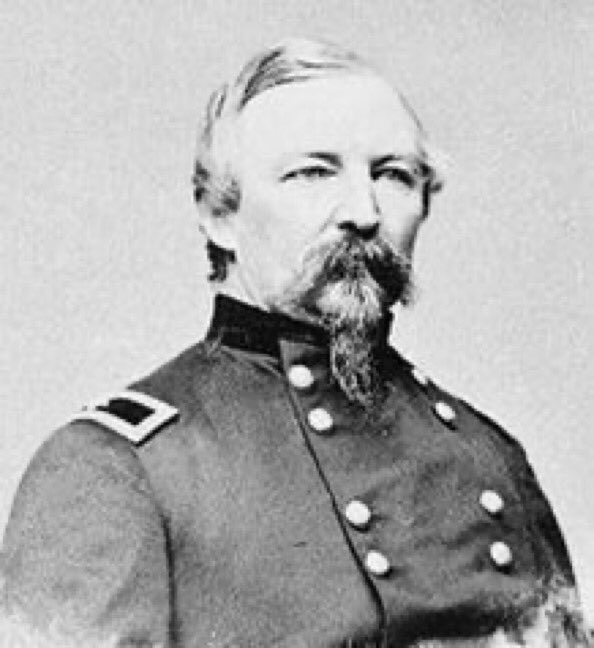
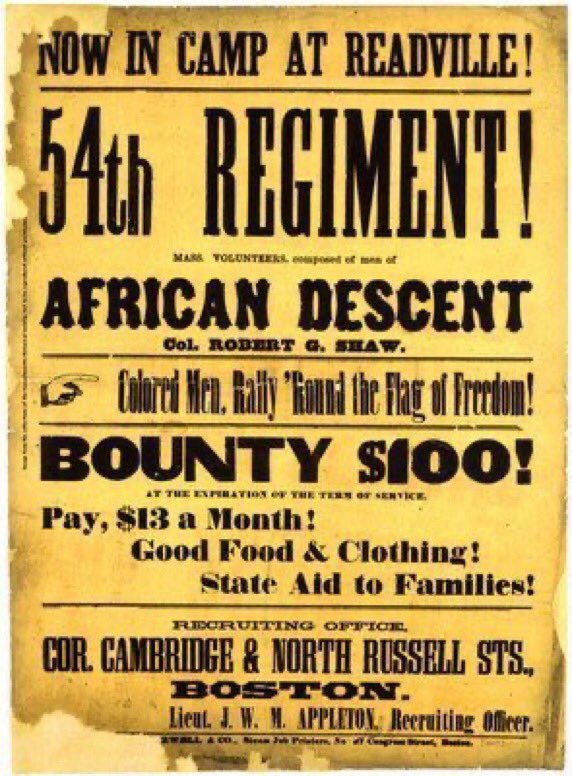
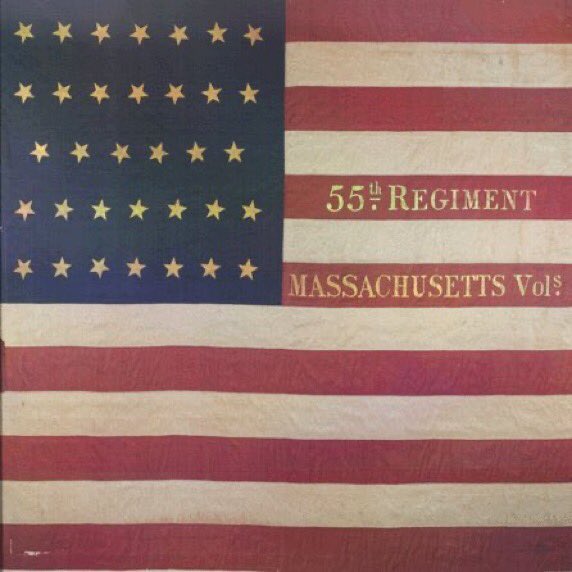
Hatch encountered a force of confederate troops blocking the road. A brigade of U.S. Colored Troops under Colonel Alfred S. Hartwell made several assaults against the rebel line. The 54th & 55th Massachusetts Volunteer Infantry Regiments were part of the brigade.
The assaults were ineffective, and Hatch had to withdraw his men to their transports that night. They suffered almost 750 casualties, but proved again that Black troops would fight courageously when given the opportunity.
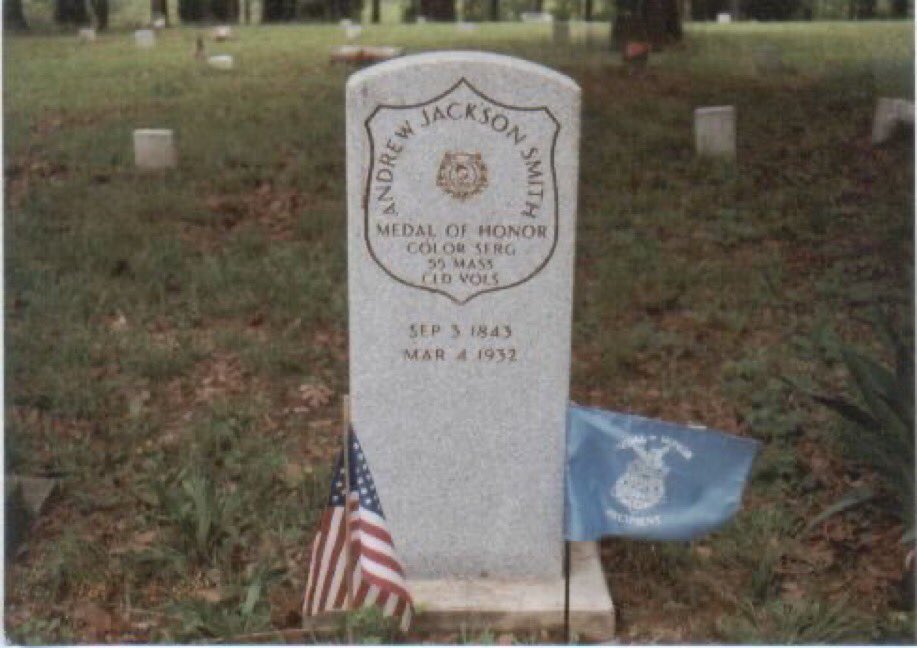
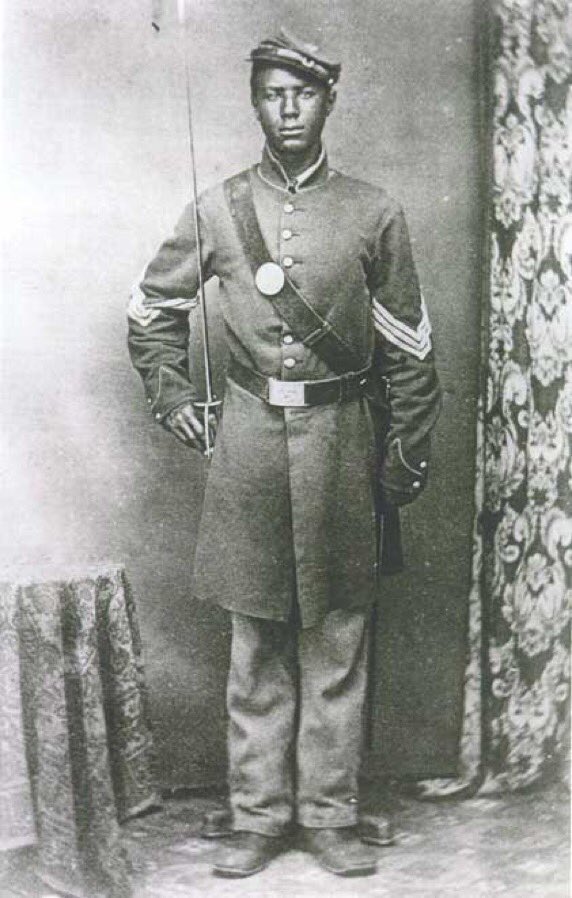
During the battle, Andrew Jackson Smith of the 55th Massachusetts retrieved the regimental colors after the color sergeant fell, and carried them for the remainder of the battle. He was later awarded the Medal of Honor, 137 years after the battle in which he earned it. @MohMuseum
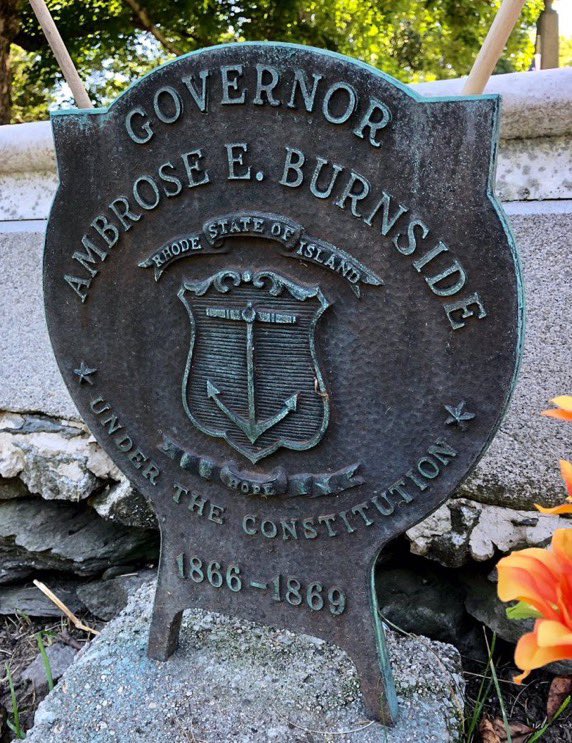
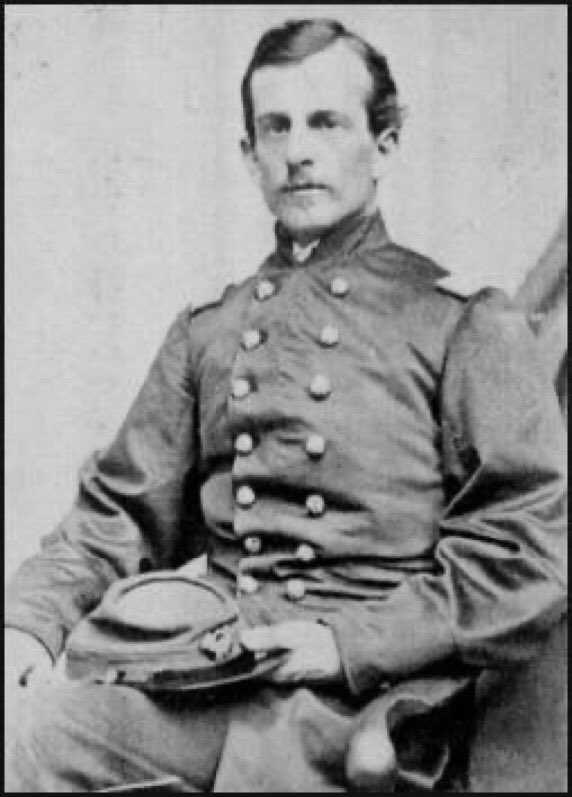
General Ambrose Burnside was born #OTD in 1824. A one time commander of the Army of the Potomac, Burnside was a genial man but a subpar commander. He entered politics after the #CivilWar, becoming Governor of Rhode Island and a U.S. Senator from that state.🧵
As a young officer, Burnside had been engaged to a woman named Charlotte “Lottie” Moon, but she left him at the altar by proclaiming “No siree Bob!” to the minister’s question of whether she took Burnside to be her husband. She later became a confederate spy.
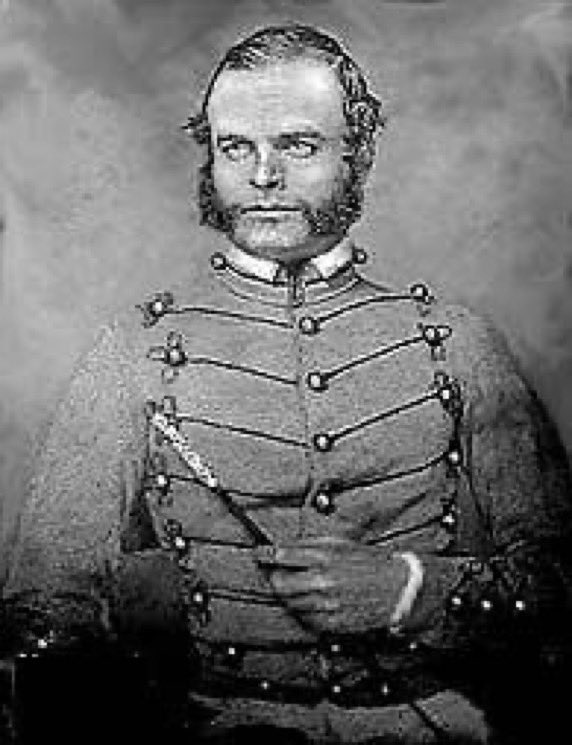
Burnside left two more lasting legacies. First, he wore such unusual whiskers that they began to be commonly called “burnsides”, which later evolved into the word “sideburns”. The second was his election as the first president of the National Rifle Association.
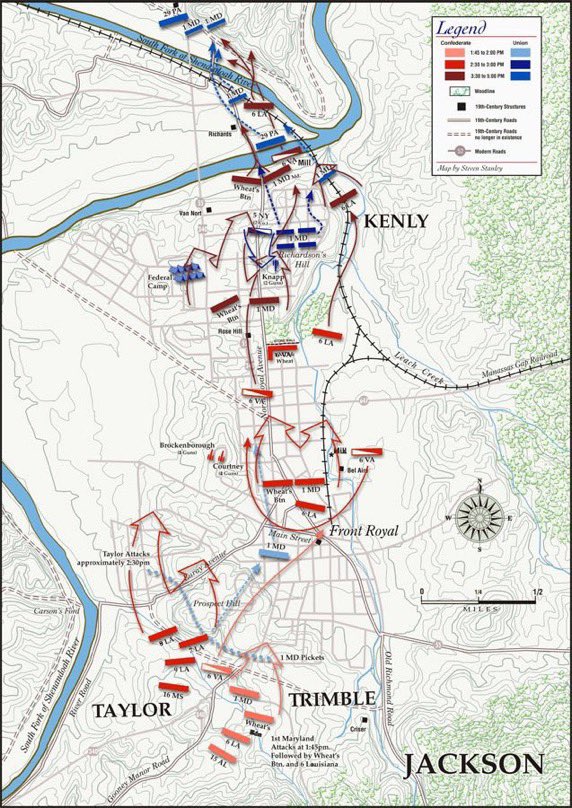
The Battle of Front Royal, VA, was fought #OTD in 1862. The engagement was part of Thomas Jackson’s campaign in the Shenandoah Valley, capturing supplies and tying up @USArmy units from reinforcing General George McClellan’s offensive against Richmond. #CivilWar🧵
General Nathaniel Banks commanded 9,000 men in the Valley, and concentrated near Strasbourg. A smaller force of about 1,000 under Colonel John Kenly held Front Royal, which Jackson approached on the morning of May 23rd.
Jackson had more than three times as many men as Kenly, and used the rest of his force well to cut off mountain passes and prevent U.S. reinforcements, including Banks’ main body, from reaching Front Royal.
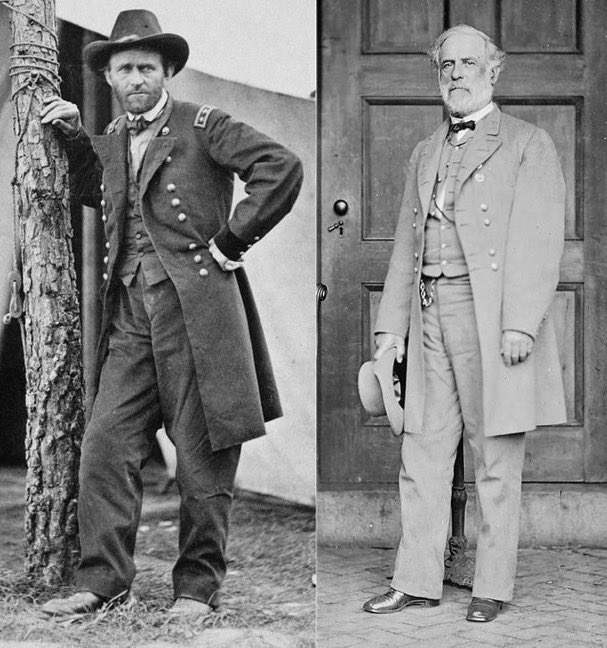
The Battle of North Anna began #OTD in 1864. Part of General @USGrantNPS's Overland Campaign, the battle was actually a series of engagements between parts of The Army of the Potomac and Robert E. Lee's Army of Northern Virginia. #CivilWar🧵
After Grant was unable to defeat Lee at the two-week long Battle of Spotsylvania Court House, he met with his commanders and determined to move the army around Lee's flank to the south, hoping again to draw him into a full-scale battle on open ground.
Lee, with interior lines of movement, was able to shift his army southward and arrive at the North Anna River before Grant. Once across, Lee didn't have his men entrench, not knowing if Grant intended to confront them there. This gave Grant's two lead Corps an opportunity.
The War Department issued General Order No. 143 #OTD in 1863. It created the Bureau of Colored Troops and authorized the organization, recruitment and training of the United States Colored Troops for service in the #CivilWar, replacing the state level units created to that point.
Representative Preston Brooks beat Senator Charles Sumner with a cane on the floor of the US Senate #OTD in 1856. The violent attack is considered a key turning point in the breakdown of discussion between abolitionists and pro-slavery groups in the years before the #CivilWar.🧵
Two days earlier, Sumner had given a lengthy speech critical of slaveholders and of the politicians responsible for the Kansas-Nebraska Act of 1854, including Brooks' cousin, Senator Andrew Butler.
Brooks was enraged at the insult to his family. After consulting with two colleagues, Reps. Laurence Keitt and Henry Edmundson, Brooks determined that Sumner was not worthy of challenging to an honorable duel, and instead determined to humiliate him by beating him publicly.
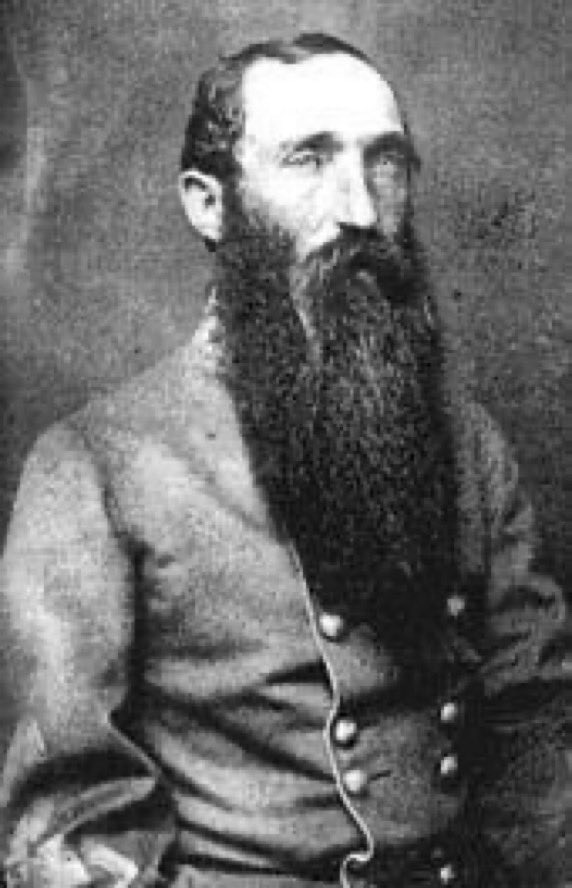
Albert Gallatin Jenkins died #OTD in 1864. Born in 1830 to wealthy parents on a plantation in Cabell County, near what is now Huntington, WV, Jenkins attended @marshallu and graduated from @wjcollege in 1848 before completing a law degree at @Harvard_Law in 1850.🧵
He opened a law practice in Charleston, WV, and was elected as a Democrat to the US House of Representatives in 1856, and again in 1858. Upon his father's death, he inherited his plantation, Green Bottom, in 1859.
At the outbreak of the #CivilWar, despite coming from the part of Virginia that separated and remained loyal to the United States, Jenkins elected to resign from Congress and raise troops for the confederate army. He became commander of the 8th Virginia Cavalry.