1/ QUICK THEAD that continues the topic of Russia’s dependence on Chinese and imported comments for domestic quadcopter production - additional comments from CAST, one of Russia’s main defense think tanks. More below: https://t.co/j4ll3rf5FR
2/ “The accusations of "copying" are strange enough in themselves, since at the current stage this should be considered rather a plus. The mania of the domestic defense industry for the invention of "unparalleled" products is quite often harmful…”
3/ “…and in many cases copying the best and most developed foreign designs and concepts would be much more profitable. The Chinese themselves, as you know, are not at all shy about this, actively copying everything they can.”
4/ “Therefore, the use of a mass-produced quadcopter common model as a prototype, especially under tight deadlines, if it was, deserves approval, not censure.”
5/ “The main criticism was caused by the "inflated" price of "Dobrynya" drone in comparison with mass-produced Chinese drones in this class. We will only point out that the requirement to produce products at the "Chinese" price in itself is simply not serious.”
6/ “No one can now compete with the Chinese "world factory" in terms of production efficiency. It is precisely because of the low cost of production in China that the industry of the whole world is moving to China, including from the most developed countries.”
7/ “The domestic and foreign markets for Chinese drone manufacturers, and therefore their production volumes, are so colossal that no Russian manufacturer can even dream of them.”
8/ “Wishes for Russian manufacturers to work with Chinese efficiency and cost are a complete utopia. Small-scale (compared to Chinese volumes) production of anything in Russia will always be obviously more expensive than in China.”
9/ “Let us also note that in general there is an unfounded myth about the supposedly low cost of defense products in Russia. In fact, taking into account the fact that the defense industry of the Russian Federation is fully affected by…”
10/ “…all the problems of domestic material production, which is generally inefficient and expensive by world standards, with a narrow market, there can be no talk of any special cheapness of military equipment and weapons in the Russian Federation.”
11/ “Such an anomaly of the relative cheapness of military production existed in the planned economy of the USSR (and then in the form of a "Soviet traces" in the 1990s and early 2000s), but miracles do not happen…”
12/ “…this cheapness was compensated by the high cost, inefficiency and deficits in other sectors of the Soviet economic system that actually subsidized the Soviet defense industry.”
13/ “Today, Almaz-Antey is required to mass-produce such drones in the thousands per month, without interruptions in supply and without significant and long-term external investment in production. "Almaz-Antey" claims that it has already organized all this.”
14/ “Any claims can be made not against Almaz-Antey, but against the highest authorities, who have not been able since the spring to carry out a genuine mobilization of state and private industry for truly mass development and production of small drones.”
15/ “We need hundreds of models of small drones and loitering munitions that could be produced at hundreds of enterprises/firms, selecting the best and most viable samples - just like in the World War 1 when such production could solve the problem of producing artillery shells”
16/ “Any realist should understand that in this case, 99% of manufacturers would have either the drones themselves or their components from the same Aliexpress. Therefore, Almaz-Antey's initiative deserves every possible encouragement, not attacks.” t.me/bmpd_cast/14027
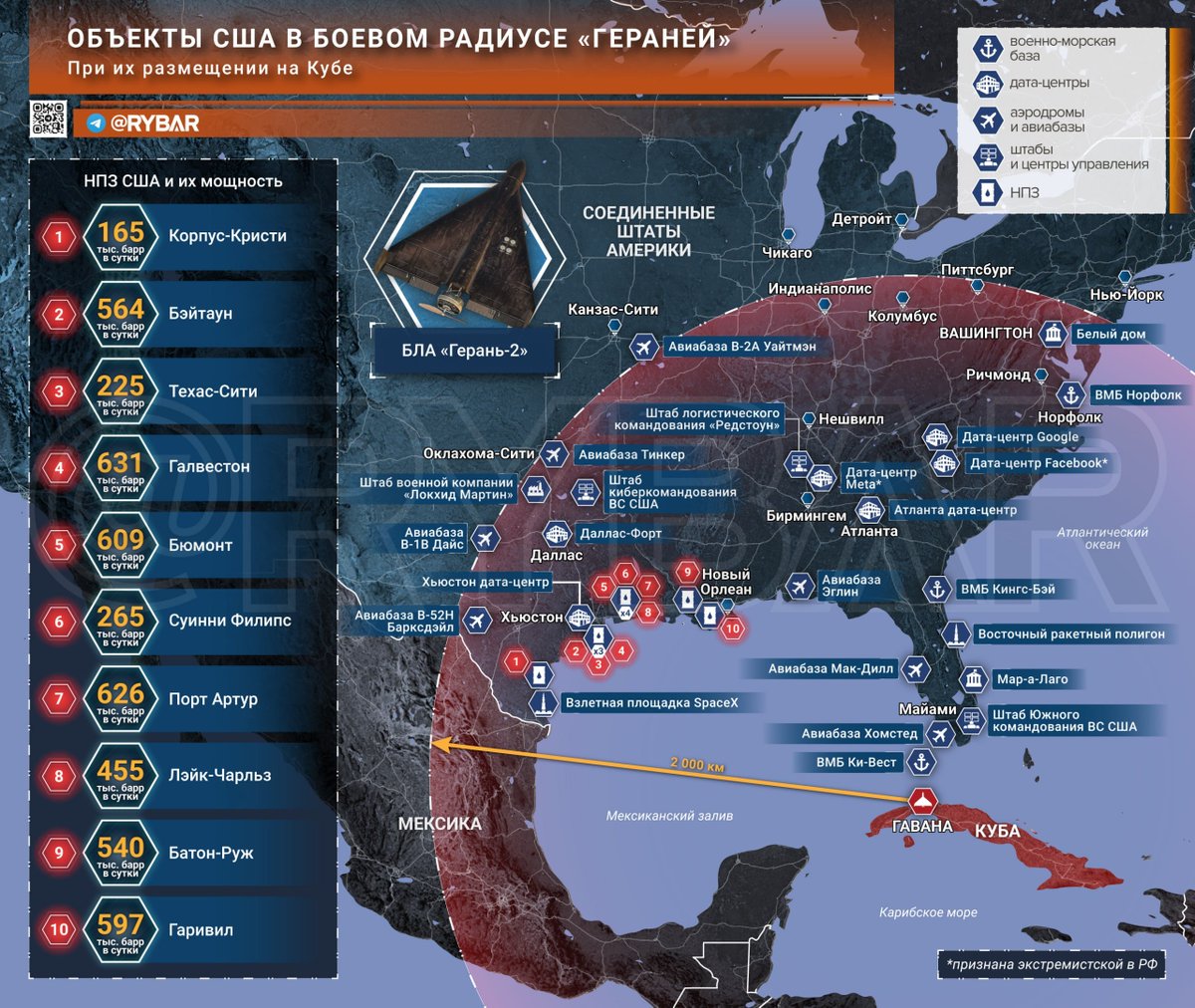
1/ QUICK TAKE: Russia's Rybar, an active pro-Kremlin TG channel, is at it again - "What if "Geran-2 drones were launched at America from Cuba?": "Given the current US actions, the main question is not whether the US will strike Cuba, but when and how." t.me/rybar/77101x.com/sambendett/sta…
2/ "Cuba, along with Venezuela and Nicaragua, has been an anti-American stronghold in the Caribbean region, and after the overthrow of Maduro, US interest has increased. But what will the Cubans do in the event of a conflict?"
3/ "Let's hypothetically imagine that Havana decides to fight back against the Americans and wants to wage war. And this is where the now familiar "Geran" attack drones could come to the rescue. What targets could be threatened if these UAVs were deployed?"
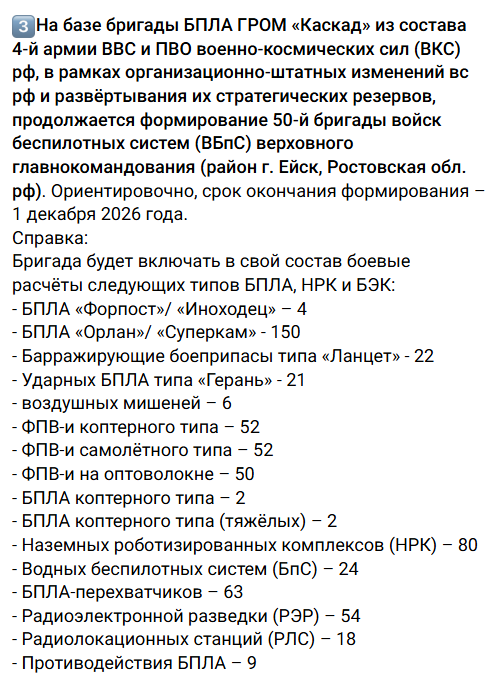
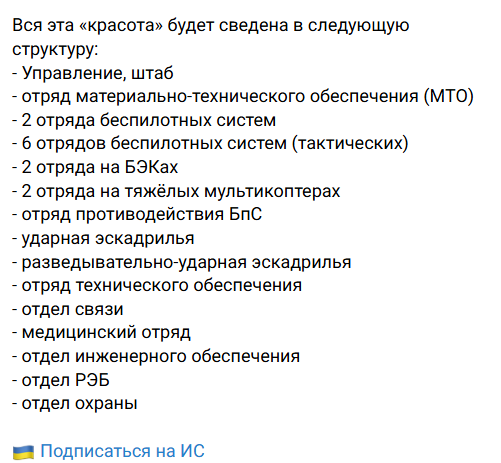
1/ QUICK TAKE from a Ukrainian mil blogger on the formation of Russia's 50th Unmanned Systems Forces Brigade in Yeysk area, Rostov region. Its estimated active date is December 1, 2026. The brigade has the following units: t.me/zvizdecmanhust…
2/ The brigade will include the following number of UAV, UGV and USV crews:
- Forpost/Inokhodets UAVs – 4
- Orlan/Supercam UAVs - 150
- Lancet loitering munitions - 22
- Geran-type attack UAVs - 21
- aerial targets – 6
- FPV quadcopter type – 52
- FPV fixed-wing type – 52
1/ THREAD on the impact of the Ukraine combat on the Russian capacity to fight the emerging warfare style, described by Ruslan Pukhov, director of the Moscow-based Center for Analysis of Strategies and Technologies (CAST). Main points below: kommersant.ru/doc/8380069x.com/sambendett/sta…
2/ "The events of the war in Ukraine have demonstrated a fundamentally new form of large-scale military conflict, characterized by a shift from the "mechanized warfare" of the industrial era to "drone warfare," or "digital" ("information") warfare of the post-industrial era."
3/ "In fact, we are now witnessing a new revolution in military affairs – the "drone revolution," and it is clear that this revolution will continue to develop and deepen, as the possibilities for expanding "drone warfare" clearly outweigh the possibilities and prospects for overcoming it."
1/ THREAD: Now that the Rus MOD has signaled that the Unmanned Systems Forces (USF) are established, here is a take from Rus mil commentators on what USF can mean for the larger force - main points translated in this thread below. t.me/gvZapad/17121x.com/sambendett/sta…
2/ "People: Without developing human potential, nothing will work. We need to change approaches, constantly improve UxS training, and, once again, learn to value the personnel in whom we've invested so much time and money. The quality of work improves with experience."
3/ "Mistakes are inevitable, and people must be unafraid to make them if progress is to be high-quality. We can't send drone operators to assault units, as some commanders do. Otherwise, the whole process becomes meaningless. Plugging (tactical) holes on the battlefield is a consequence of many problems."
1/ THREAD on the new "digital warfare" as seen in Ukraine, described Russia's Gen(ret) Yuri Baluyevsky, former Chief of the General Staff in 2004-2008, and Ruslan Pukhov, director of the Moscow-based Center for Analysis of Strategies and Technologies (CAST). Main points below: globalaffairs.ru/articles/czifr…
2/ "There's every reason to believe that the "digital warfare" process will continue to expand and deepen, as the potential for escalating "drone warfare" exceeds the ability to effectively counter this type of weaponry."
3/ "The miniaturization and cost reduction of componentry, along with the development of networked solutions (specifically networked ones; the trendy artificial intelligence will likely remain a secondary factor for a long time to come) are leading to combat operations..."
Ukraine's @Textyorgua_Eng on the gray zone in the war - an area that stretches 25-30 km, and as much as 40km, "a chaotic kill zone riddled with trenches, dugouts, mines and rubble, constantly monitored and hit by drones, with both sides using a wide range of weapons." texty.org.ua/projects/11592…
The rotation in this gray zone is a difficult and dangerous: "Pickup trucks take the infantry 1–7 km to the trenches/dugouts. Then the guys walk the rest of the way, carrying 20–40 kg of stuff: ammo, gear, water, food, and tactical electronic warfare equipment."
"Sometimes UGVs are used for logistics and evac on the front lines. This type of technology is still in its infancy, and there are many problems with UGVs. But often they are the last straw that people grab onto when they need to make an important delivery or pick up a wounded soldier."