In today's #vatnik soup, I'll start an introduction about the Russian information operations (an activity that tries to affect the public opinion and behavior of a society), disinformation and propaganda.
This topic is a broad issue and I'll do it over several threads.
1/10
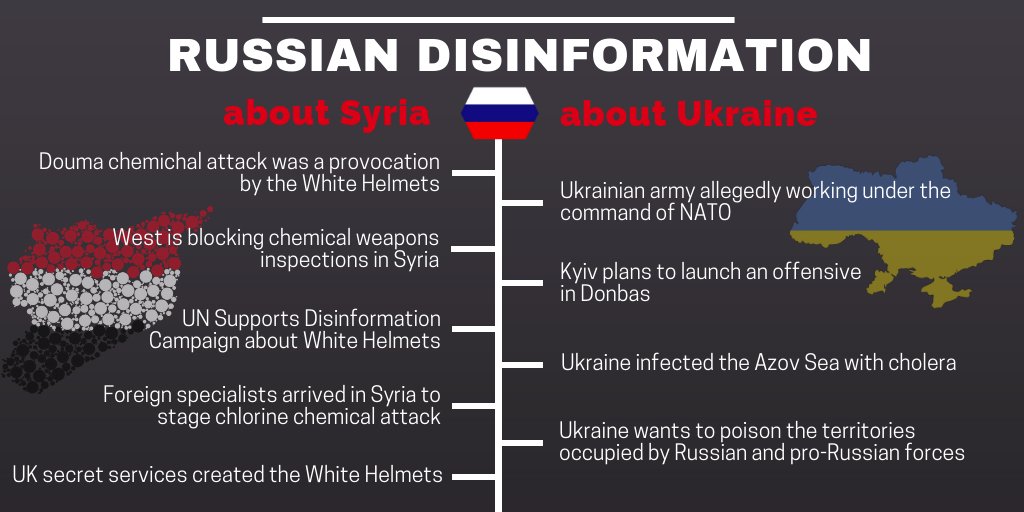
The Russian model of disinformation dates back to KGB days. KGB defector Yuri Bezmenov explained already in 1985 the idea of "ideological subversion" or "active measures" as an overt and open operation of manipulation of public opinion.
2/10
Bezmenov said that Russian "active measures" can be divided into 4 stages: 1) demoralization, 2) destabilization, 3) crisis, and finally 4) normalization.
I can highly recommend watching this interview of Bezmenov as it's still very topical:
3/10
The general model for info ops is as follows: 1) sowing fears, 2) fueling mistrust, and finally 3) offering salvation.
Let's use COVID-19 as an example: at the beginning of the pandemic, Russian disinformation was outlining that COVID is highly lethal ...
4/10

... and that you can't trust the government on anything they say. This same idea was then shifted to vaccinations. This disinfo campaign is still going strong: web.archive.org/web/2022091413…
Finally, Russia offered a "salvation" with their own Sputnik V vaccine.
5/10
In this regard their propaganda was a total failure: it backfired, spread inside Russia and large portion of Russians skipped the vaccines altogether. In Lithuania, most of the COVID deaths were among the Russian speaking population who became victims of Russian disinfo.
6/10
Another example of a successful info op in the West were the 2016 US elections. Russia's "Project Lakhta" interfered with democratic election process with huge amount of disinformation, spreading mistrust and uncertainty in the society: justice.gov/opa/pr/russian…
7/10
Troll farm IRA founder Yevgeny Prigozhin denied their involvement and even sued people who suggested this,but in Nov,'22 he admitted that "We have interfered (in U.S. elections), we are interfering and we will continue to interfere. [..] in our own way, as we know how to do."8/10
Trump was the perfect candidate for Russia: his businesses were in Russia & he was conducting the Russian disinformation model, "firehose of falsehood" perfectly: Based on Washington Post's research, Trump made over 30 000 false or misleading statements during his presidency.9/10
The legacy of his pro-Putin politics can still be seen in the US with politicians like QAnon & Pizzagate advocate Marjorie Taylor Greene (@RepMTG) and agitator and a laughingstock Jackson Hinkle (@jacksonhinklle).
Stay tuned for part two!
10/10
• • •
Missing some Tweet in this thread? You can try to
force a refresh

In this 8th Debunk of the Day, we’ll discuss complaints about US financing of NATO, in particular how the US allegedly pays for European defense, leading to calls for a US withdrawal from the Alliance — which would only make it easier for Putin to invade more countries.
1/7
NATO by itself costs peanuts. In fact, the core of NATO is a principle, an agreement, that ideally costs nothing. The main cost is defense spending, which the US is eagerly doing anyway: Trump has just announced a 50% increase in military spending for his “Department of War”. 2/7
To sow division and thereby weaken the Alliance, vatniks deliberately mix up different figures, such as contributions to the NATO common budget, with defense spending. And US military spending has been huge by the sheer fact that the US is the world’s largest economy.
In today’s Vatnik Soup, we’ll talk about why we’re doing this: why we think Ukraine is so important and why we believe that souping vatniks and debunking their propaganda narratives is so crucial to counter Russia’s & their allies’ wars of aggression and achieve real peace.
1/20
War is expensive, and Russia is not a rich country that could afford this: Hospitals? Roads? Plumbing? No: everything into terror and destruction.
But not only that. There is a 2nd item in the Russian state budget that remains strong no matter what:
Manufacturing support for that terror and destruction. Propaganda. Vatniks. “Innocent” travel bloggers. “Independent” journalists. “Patriotic” politicians. Russia spends hundreds of billions of rubles a year ($5 billion) on this, and that kind of money buys you A LOT of BS.
In this second (and possibly last) Basiji Soup, we’ll explore how the Islamic Republic of Iran has prepared for a conflict with the US and Israel. We won’t cover the military aspects, but another kind of war — information warfare.
1/20
In the 1st Basiji Soup, we souped the Islamic Republic, its disinformation operations, its hypocrisy, its support of terrorism including Russia’s, its (one-sided?) relationship with Putin, and the mass protests against it that started two months ago:
The Internet blackout has been crucial in allowing the regime to cover up its massacre of the protesters and especially the scope of it, making it difficult to assess the number of victims. They went to great lengths to jam Starlink, after having made its use illegal.
In this 7th Debunk of the Day, we’ll expose the “Chickenhawk” fallacy. The chickenhawk accusation or the “go to the front!” imperative is a dishonest attempt to silence anyone supporting Ukraine by pushing them to go fight. A barely hidden death wish, as it’s always uttered… 1/5
…with zero regard for who you are or what your personal circumstances might be — you could already be there, on your way there, a veteran, or unable to fight. More broadly, not everyone can or should be a soldier, just as not everyone can or should be a policeman or a nurse. 2/5
Yet a society still needs those things to be done, and the fact that not everyone can go to medical school or fight crime does not mean that we have to surrender to invaders and criminals, nor that we cannot all have an opinion on healthcare. 3/5
In this 6th Debunk of the Day, we’ll talk about a complex and controversial topic: conscription. It is used by vatniks to attack Ukraine for drafting men to fight, while conveniently ignoring the alternative, including the horrors of conscription into the Russian army. 1/8
Military obligations are a reality in many countries, from the most peaceful democracies to the most tyrannical dictatorships — unless you have “bone spurs”. Some argue it is a necessity for defense against invading armies, especially for small countries. 2/8
Others point out that it goes against individual rights or that a professional army is better. And Zelenskyy might agree: he did in fact end conscription. But then a full-scale invasion happened: exactly why many nations, including the US, still keep some form of draft. 3/8
In today’s Vatnik Soup, we’ll introduce the International Olympic Committee (IOC) @Olympics . It’s mostly known for organizing sporting events, and for being supposed to foster the Olympic ideal while actually submitting to dictators.
1/15
The International Olympic Committee (IOC) was founded in 1894 in Paris by Pierre de Coubertin with a noble goal: promote peace through sports. Politics out, sportsmanship in: sounds great in theory.
2/15
But in practice, the IOC has a long history of accommodating authoritarian regimes, always in the name of “neutrality,” “dialogue,” and “keeping sports separate from politics”, usually not in a particularly consistent or moral way.