Jeff Gilchrist Profile picture
Dec 10, 2022 27 tweets 9 min read Read on X
Toilets, wastewater COVID-19, RSV, and Influenza all increasing

This thread will be wastewater related, looking at new variants, levels, and what happens in the air after you flush that wastewater down the toilet with some cool video/graphics. 🧵1/ Image of aerosol plumes over a flushed toilet.
The wastewater levels in Ottawa, Canada are increasing for all measures ( ). RSV and Influenza A levels continue to increase which means even more pressure will be put on the hospitals that are already overwhelmed. 2/ covid.gilchrist.ca/Ottawa.html
Graphs showing increasing RSV and Influenza A wastewater levels in Ottawa, Canada
To make matters worse, COVID-19 levels have started increasing again. You can see in the graph that levels never actually returned to low levels but are on the rise again ( ). 3/ covid.gilchrist.ca/Ottawa.html
Graphs showing increasing COVID-19 wastewater levels in Ottawa, Canada
What might be making the difference now? New Omicron BQ based variants have rapidly been increasing in Ontario and as of 10 days ago already made up more than 40% of sequenced cases ( ). Graphs by @Mike_Honey_ 4/ app.powerbi.com/view?r=eyJrIjo…
Graph showing increasing levels of BQ.* variants in Ontario
The BQ.1 Typhon and BQ.1.1 Cerberus variants specifically have overtaken all the other circulating variants in Ontario and are much more immune evasive than previous variants. 5/ Graph showing increasing levels of BQ.1 and BQ.1.1 variants now dominant in Ontario
If wastewater levels are going up again it could be because more people are susceptible to this newer variant and is being more easily transmitted amongst people, even those that have been previously infected. 6/
Speaking of wastewater, a very cool study used lasers to actually see and measure the aerosol plumes that come out of toilets when you flush ( ). H/T: @yaneerbaryam 7/ nature.com/articles/s4159…
Image of aerosol plumes over a flushed toilet.
Aerosols can transmit infectious diseases including COVID-19, influenza and likely most respiratory viruses and even Strep bacteria has airborne spread ( ). H/T: @ELHopkins 8/thelancet.com/journals/lanmi…
When you flush a toilet, it releases plumes of tiny water aerosols into the air around you which can spread pathogens from human waste and expose people in public washrooms to contagious disease ( ). 9/ theconversation.com/toilets-spew-i…
Image of aerosol plume over a flushed toilet.
A typical commercial toilet generates a strong upward jet of air with velocities exceeding 2m/sec rapidly carrying particles up to 1.5m (5 feet) above the bowl within 8 seconds of the start of the flush which you can see in this video ( ). 10/
Toilet bowl water contaminated by feces can have pathogen concentrations that persist after dozens of flushes but it is still an open question as to how much of a transmission risk toilet aerosol plumes present. 11/
Particle size matters, the smaller aerosols can stay floating in the air for sometimes hours. Particles smaller than 5 microns can be breathed directly into your lower respiratory tract and those 6-12 microns can deposit in the upper airways ( ). 12/thelancet.com/journals/lanre…
The study measured a massive increase in particles smaller than 2.5 microns with most particles being less than 1 micron. 13/
Over the bowl (Loc 1 and 2 in diagram) particle counts increased more than 10x pre-flush rates and decreased afterwards, while 1.5m away from the bowl the particle count increase was lower but remained constant after flushing ( ). 14/ nature.com/articles/s4159…
Charts of aerosol particle size measurements from various locations.
While the visible aerosols in the video (5-10 microns) scatter more light from the lasers, they also captured the dimmer light scattered by smaller aerosols which found they move within the same envelope as the larger ones ( ). 15/ nature.com/articles/s4159…
Image showing small aerosol particles staying within plume with larger droplets fall quickly outside of plume.
Most interesting is they show large droplets follow ballistic trajectories, remain outside the aerosol plume envelope and drop quickly. Yet another blow to droplet theory being a significant contributor to transmission <darn laws of physics>. 16/
Closing the lid before flushing helps but does not completely eliminate plumes as there are still large gaps of space between the lid and the bowl when closed and many commercial toilets do not have lids at all. 17/
The researchers suggest that UV disinfection systems and better ventilation could help mitigate exposure to aerosol plumes in the bathroom. The next time you visit a public washroom, think of all the aerosolized human waste you are breathing in if you aren't wearing a mask... 18/
A lot of people have been saying to close the toilet lid first which doesn't stop the aerosols coming out and contaminates the underside of the lid that people touch as pointed out by this comment ( ). 19/
As @rnaguru points out, each pathogen is different, and so far studies haven't found much infectious COVID-19 particles in urine or feces so while the risk is not zero it may be very low. This may not be the case for other viruses/pathogens though ( ). 20/
But you will still want to wear your mask in public bathrooms to at least protect yourself from respiratory aerosols from the other people using the bathroom who may be infected (COVID, RSV, Influenza, etc...). 21/
It is not just breathing in aerosols released from flushing toilets that people need to worry about, but bacteria that gets deposited on your hands from hot-air hand dryers ( ). 22/ cnbc.com/2022/12/19/how…
Image showing person drying their hands using a hot air dryer in a bathroom
A study before the pandemic found that test plates exposed to bathroom air for 2 minutes with hand dryers off averaged < 1 bacteria colony while plates exposed to hand dryer air for 30 seconds averaged 18-60 colonies ( ). 23/journals.asm.org/doi/10.1128/AE…
When researchers swabbed the interior hand dryer nozzle, they found surfaces had minimal bacterial levels so they added HEPA filters to the hand dryers which reduced bacterial deposition by 4x. 24/
This implies the bacteria was coming from the bathroom air so just after washing your hands you get pathogens deposited on them right after again. 25/
Health experts recommended using paper towels to dry their hands instead and remind everyone that acquiring infection from direct contact with other people is much more likely than from drying your hands. 26/
This study found during contact tracing that someone got infected after using a shared bathroom 40 minutes after the index case left. A good example of it isn't just the people currently there in a public bathroom you need to worry about ( … ). 27/icjournal.org/DOIx.php?id=10…

• • •

Missing some Tweet in this thread? You can try to force a refresh

 

Keep Current with Jeff Gilchrist

Jeff Gilchrist Profile picture

Stay in touch and get notified when new unrolls are available from this author!

Read all threads

This Thread may be Removed Anytime!

PDF

Twitter may remove this content at anytime! Save it as PDF for later use!

Try unrolling a thread yourself!

how to unroll video
  1. Follow @ThreadReaderApp to mention us!

  2. From a Twitter thread mention us with a keyword "unroll"
@threadreaderapp unroll

Practice here first or read more on our help page!

More from @jeffgilchrist

Jun 1
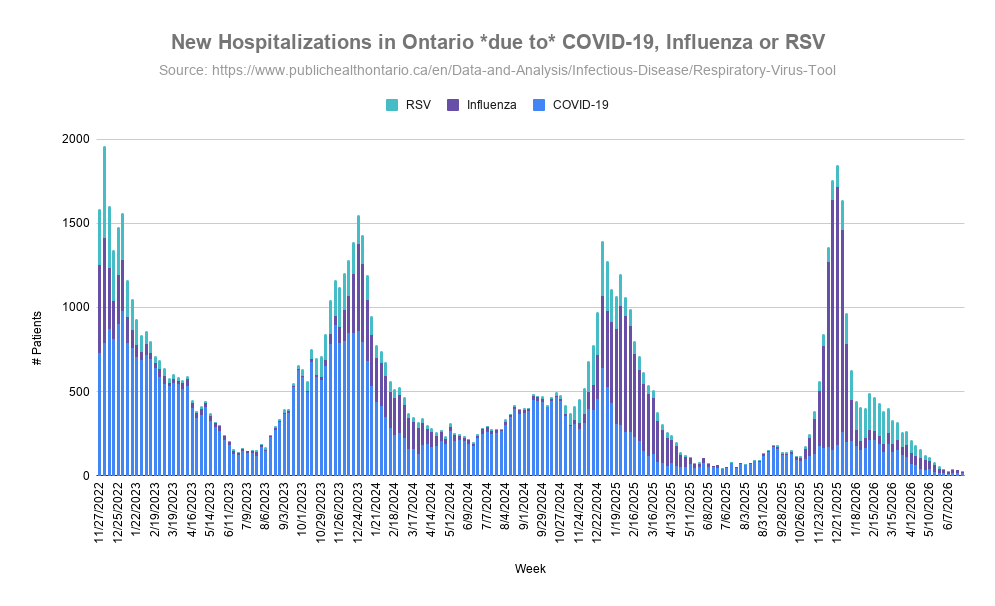
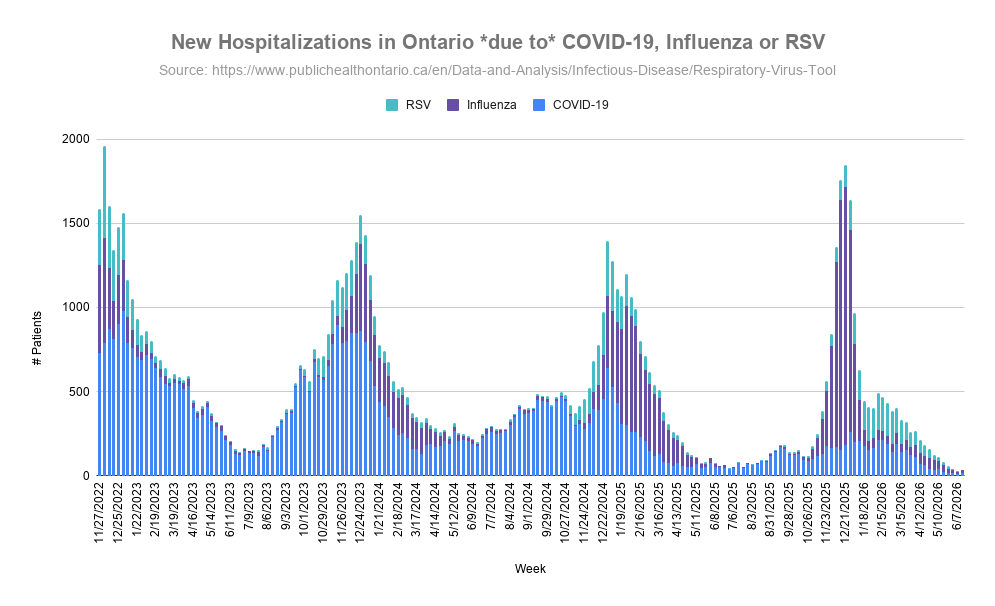
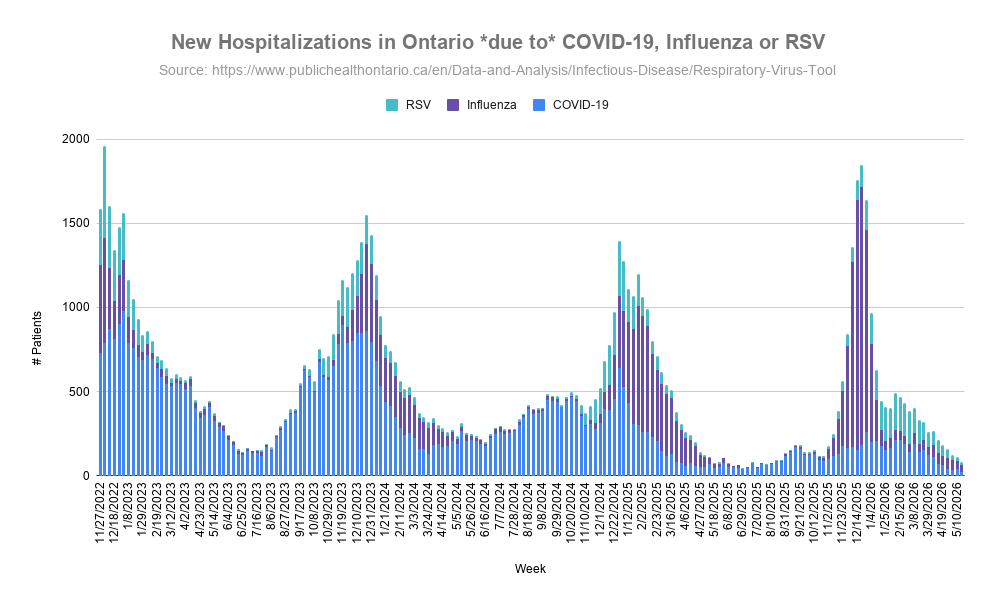
*** Ontario Virus Update | June 1 ***

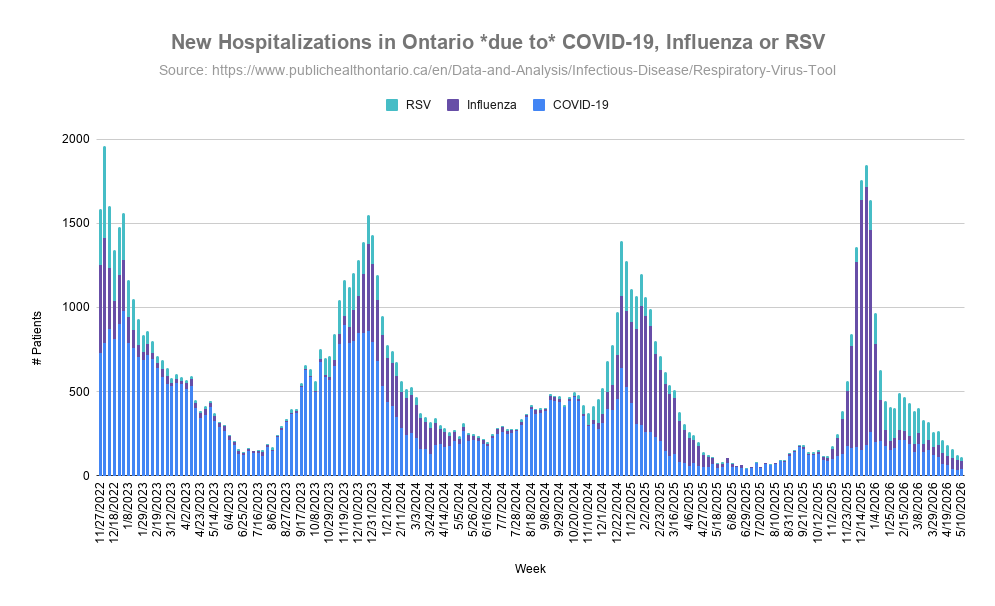
Hospitalizations due to COVID have decreased from 38 to 21 in the last update. Influenza hospitalizations decreased from 51 to 44 and RSV decreased from 20 to 18 so moving in the right direction but still not finished for the season yet. 1/ This stacked bar chart displays weekly new hospitalizations in Ontario specifically attributed to COVID-19, Influenza, and RSV. The data tracks the fluctuating volume of patients over time, highlighting seasonal surges and the relative contribution of each respiratory virus to the overall healthcare burden.
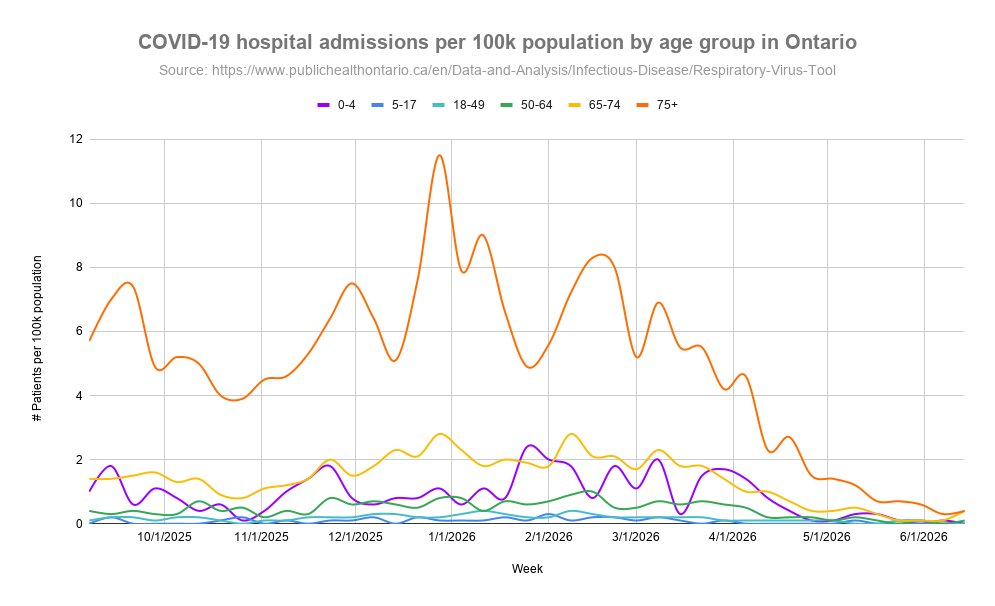
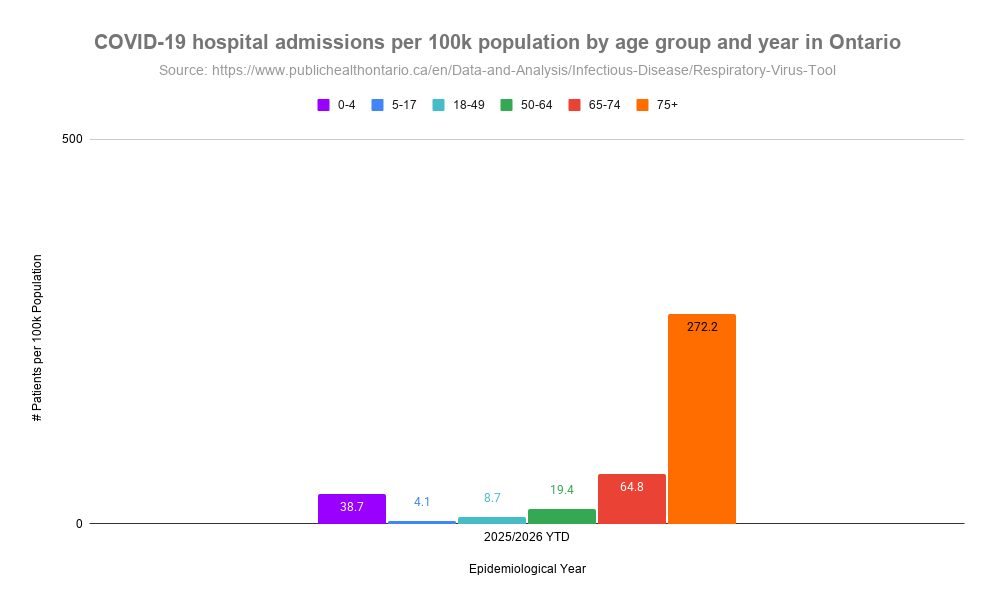
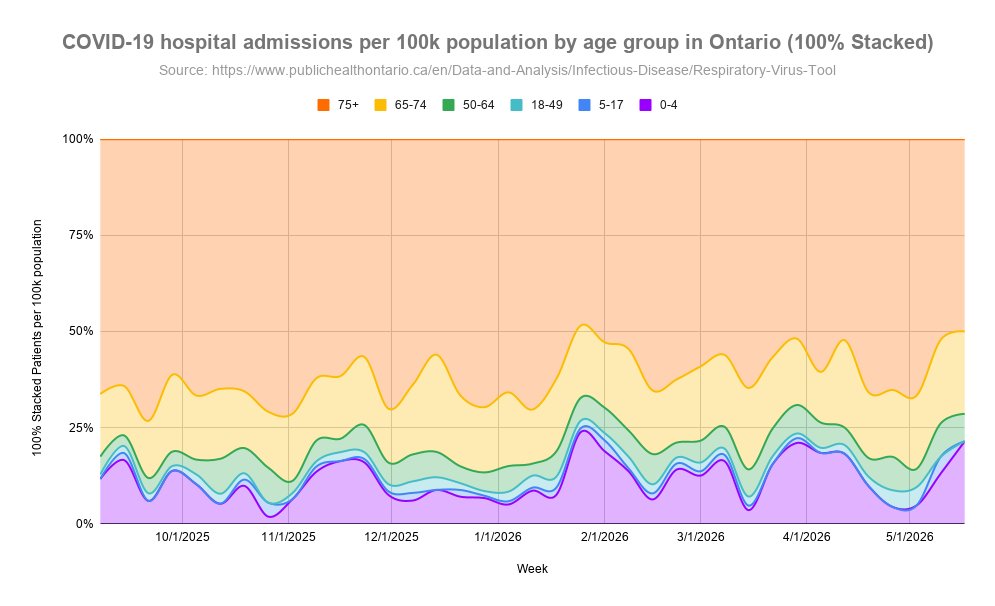
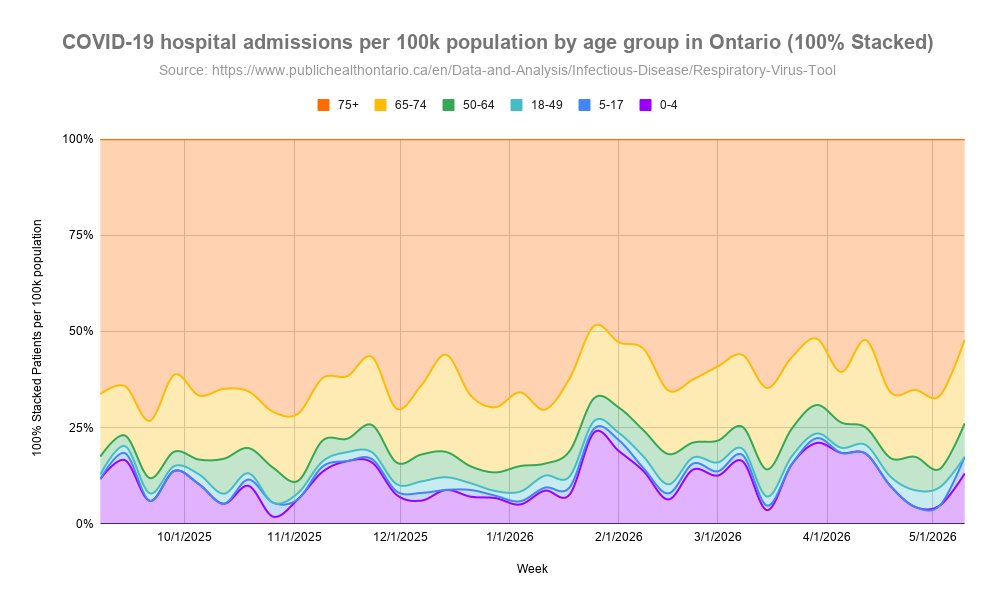
Looking at age groups, those age 75+ had the highest rates of hospitalization due to COVID but decreased since last update. Tied for second place are the 0-4 and 65-74 age groups. 2/ This 100% stacked area chart illustrates the weekly proportion of COVID-19 hospital admissions per 100,000 population in Ontario across different age groups. The graph visualizes how the relative distribution of hospitalizations shifts over time among demographics ranging from infants to seniors aged 75 and older.
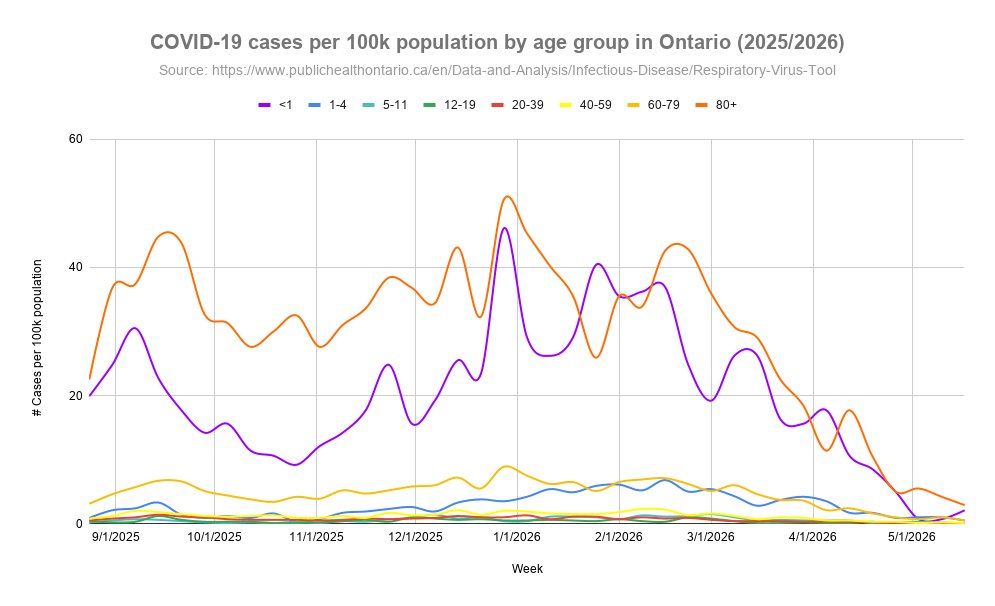
COVID case rates decreased across most age groups this past update except for age <1 which had a significant increase and almost matching the same levels as age 80+. The 1-4 and 60-79 age groups currently have the same rates. 3/ This multi-line graph tracks the weekly rate of COVID-19 cases per 100,000 population in Ontario, categorized by various age groups from infants to seniors aged 80 and older. The data trends highlight the fluctuations in infection rates across different demographics over the year.
Read 10 tweets
May 30
Filtering the air may help prevent your own infection from becoming more severe

If everyone in a household becomes infected with the same virus, does it help to isolate from each other and can you be a danger to yourself? Read on to find out...🧵1/

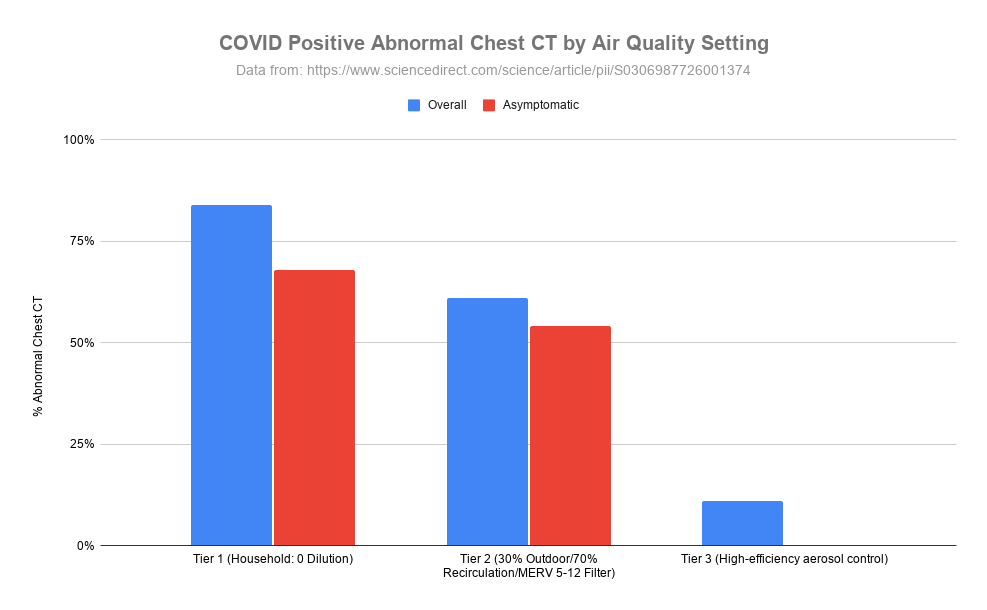
#AirQuality #IAQ #Ventilation This grouped bar chart, titled "COVID Positive Abnormal Chest CT by Air Quality Setting", displays the percentage of abnormal chest CT scans among COVID-positive patients across three different tiers of air quality control. The graph compares overall and asymptomatic cases, illustrating a clear downward trend in the percentage of abnormal scans as air filtration and ventilation efficiency improve from household levels to high-efficiency aerosol control.
An interesting hypothesis-generating study was published recently that asked if an infected person's condition can become even worse by re-inhaling their own virus particles ( ). 2/sciencedirect.com/science/articl…
Is a transition from a milder upper respiratory tract infection (runny nose, sore throat) to a more severe lower respiratory tract infection like pneumonia is significantly driven by the physical mechanism of inhaling virus containing aerosols deep into the lungs? 3/
Read 26 tweets
May 24
*** Ontario Virus Update | May 24 ***

Hospitalizations due to COVID have increased from 34 to 38 in the last update. Influenza hospitalizations decreased from 57 to 51 and RSV decreased from 33 to 20. 🧵1/

#Ontario #Virus #COVID #RSV #Influenza #Hospital This stacked bar chart displays weekly new hospitalizations in Ontario specifically attributed to COVID-19, Influenza, and RSV. The data tracks the fluctuating volume of patients over time, highlighting seasonal surges and the relative contribution of each respiratory virus to the overall healthcare burden.
Looking at age groups, those age 75+ had the highest rates of hospitalization due to COVID but decreased since last update. Second place is age 65-74 which increased, and third place is age 0-4 which also increased. 2/ This 100% stacked area chart illustrates the weekly proportion of COVID-19 hospital admissions per 100,000 population in Ontario across different age groups. The graph visualizes how the relative distribution of hospitalizations shifts over time among demographics ranging from infants to seniors aged 75 and older.
COVID case rates were fairly stable across age groups this past update except for age 80+ which had a significant decrease but still maintain the highest rates. The 0-4 and 60-79 age groups currently have similar rates. 3/ This multi-line graph tracks the weekly rate of COVID-19 cases per 100,000 population in Ontario, categorized by various age groups from infants to seniors aged 80 and older. The data trends highlight the fluctuations in infection rates across different demographics over the year.
Read 10 tweets
May 10
*** Ontario Variant Update | May 10 ***

In Ontario, the NB.1.8.1.* "Nimbus" variant family shot to 74.7% of sequenced genomes from COVID tests while the XFG.* "Stratus" family dropped to 15.8% and the BA.3.2 "Cicada" family decreased below 10% again.🧵1/
#Ontario #COVID #Variant This multi-line chart tracks the lineage frequency of various COVID-19 variant families in Ontario over time, based on sequenced genome samples. The graph illustrates the changing prevalence of specific variant families, showing how different lineages compete and evolve as the dominant strains within the province.
Ontario released another month of sequencing data by age and we continue to see high ratios of Cicada in children with another 51 BA.3.2.2.* sequences out of 617 new sequences ( ). 2/publichealthontario.ca/-/media/docume…
With 126 Cicada sequences from 1,828 total, we see children still have the highest proportion which decreases after age 5-11 as age increases with significant drops from age 60+. 3/ This bar chart illustrates the percentage of the BA.3.2.* Cicada COVID-19 variant lineage among different age groups in Ontario over a designated time period. The graph visualizes the relative prevalence of the lineage across demographics, highlighting how the variant is distributed from young children to seniors aged 80 and older.
Read 11 tweets
Apr 28
*** Ontario Variant Update | Apr 28 ***

There was some competition for variant dominance during the month of March but the NB.1.8.1.* "Nimbus" family currently holds first place with 49.5% while the XFG.* "Stratus" family sits at 38.1% of sequenced genomes from COVID tests. 🧵1/ This multi-line chart tracks the lineage frequency of various COVID-19 variant families in Ontario over time, based on sequenced genome samples. The graph illustrates the changing prevalence of specific variant families, showing how different lineages compete and evolve as the dominant strains within the province.
The BA.3.2 "Cicada" family has been slowing climbing and now above 10%. 2/
Looking at specific variants, RC.5 Nimbus currently holds first place at 13.4%, SH.1 Nimbus is a close second at 13.3%, RC.6 Nimbus is making a comeback at 11.3%, XFG.1.1.2 Stratus is at 8.2%, RT.2 Cicada at 7.2%, PQ.2.1 Nimbus at 5.2%, and RE.1.2 Cicada at 2.1%. 3/ This multi-line chart tracks the lineage frequency of emerging COVID-19 subvariants in Ontario over time, based on genomic sequencing data. The graph visualizes the shifting percentage of total cases represented by each specific lineage, highlighting the growth and competition of various viral strains.
Read 10 tweets
Apr 13
*** Ontario Virus & Variant Update | Apr 13 ***

Hospitalizations due to COVID have gone down from 153 to 123 in the last update. Influenza hospitalizations decreased from 59 to 47 and RSV decreased from 110 to 85. 🧵1/

#Ontario #Virus #Variant #COVID #RSV #Influenza #Hospital Graph of New hospitalizations in Ontario due to COVID, Influenza or RSV.
Looking at age groups, those age 75+ had the highest rates of hospitalization due to COVID but decreased since last update. Second place is age 0-4 and their levels are currently increasing while age 65-74 has the third highest rate and also decreased since last update. 2/ Graph of New hospitalization rate in Ontario due to COVID by age group (100% Stacked).
The youngest age group 0-4 currently have a hospitalization rate due to COVID that are 17x higher than age 5-17, 17x higher than age 18-49, and 2.8x higher than adults 50-64. 3/
Read 25 tweets

Did Thread Reader help you today?

Support us! We are indie developers!


This site is made by just two indie developers on a laptop doing marketing, support and development! Read more about the story.

Become a Premium Member ($3/month or $30/year) and get exclusive features!

Become Premium

Don't want to be a Premium member but still want to support us?

Make a small donation by buying us coffee ($5) or help with server cost ($10)

Donate via Paypal

Or Donate anonymously using crypto!

Ethereum

0xfe58350B80634f60Fa6Dc149a72b4DFbc17D341E copy

Bitcoin

3ATGMxNzCUFzxpMCHL5sWSt4DVtS8UqXpi copy

Thank you for your support!

Follow Us!

:(