John Ridge Profile picture
Dec 13 18 tweets 6 min read
Sigh, looks like I need to explain cruise missile guidance and route planning again. The word "turns" is somewhat misleading in this context and the phrase "demanding on the guidance system" lacks technical meaning. A 🧵with some context and explanations. 1/18
Below is a previous short 🧵I did on the subject to clear up similar misconceptions. 2/18
Most modern cruise missiles (CMs) do not simply follow a straight flight path from their launch platform to their target. Rather, they follow pre-defined mission-specific flight paths. Historically, a specific route was necessary to ensure precise guidance of the munition. 3/18
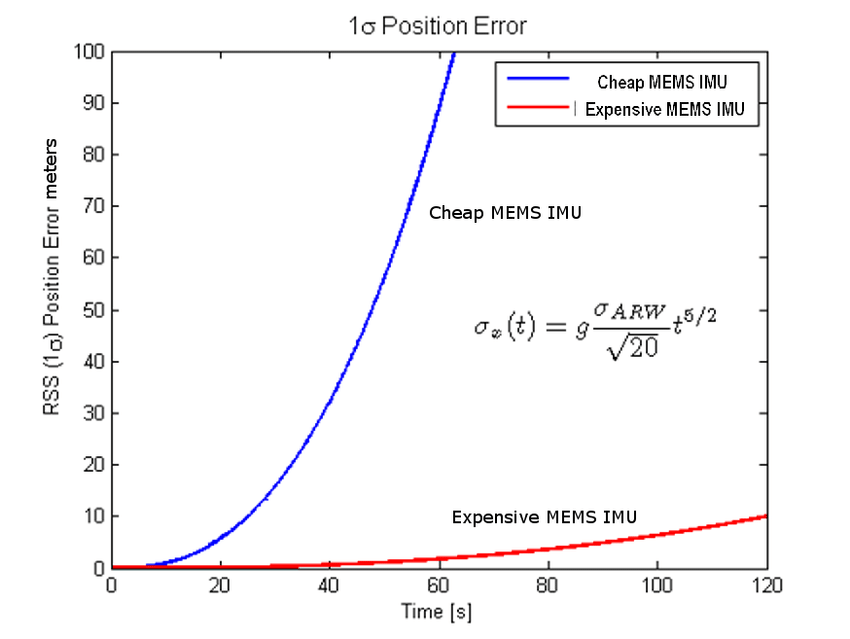
All inertial navigation systems (INS), which are the basis of most CM's guidance systems, suffer from position error/drift that increases quadratically with flight time due to measurement error in its sensors. It is necessary to have some way to correct this error. 4/18 Image
This was first achieved via terrain contour mapping (TERCOM), which uses a radar altimeter to continually compute the relative terrain elevation beneath the missile and compare it to a pre-loaded map. These TERCOM position fixes are then used to periodically update the INS. 5/18 Image
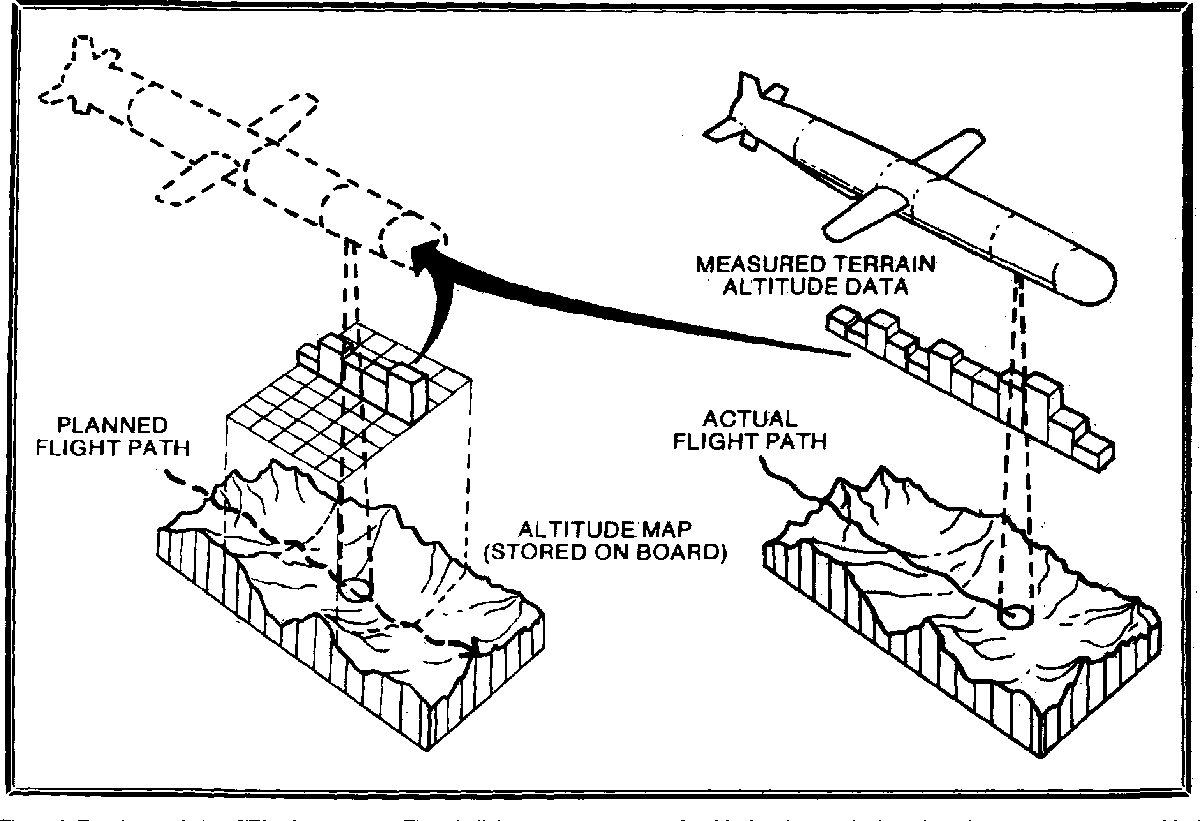
Thus, a specific pre-planned flight path is needed to generate a corresponding terrain elevation map. This concept would be further developed into what is known as digital scene mapping area correlator (DSMAC) guidance. 6/18 Image
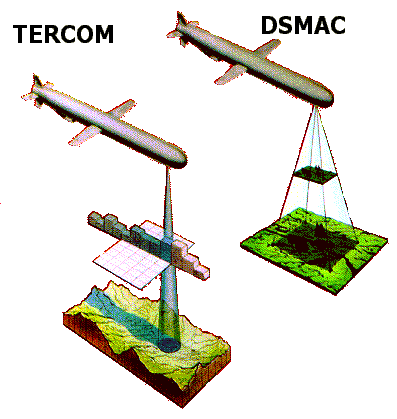
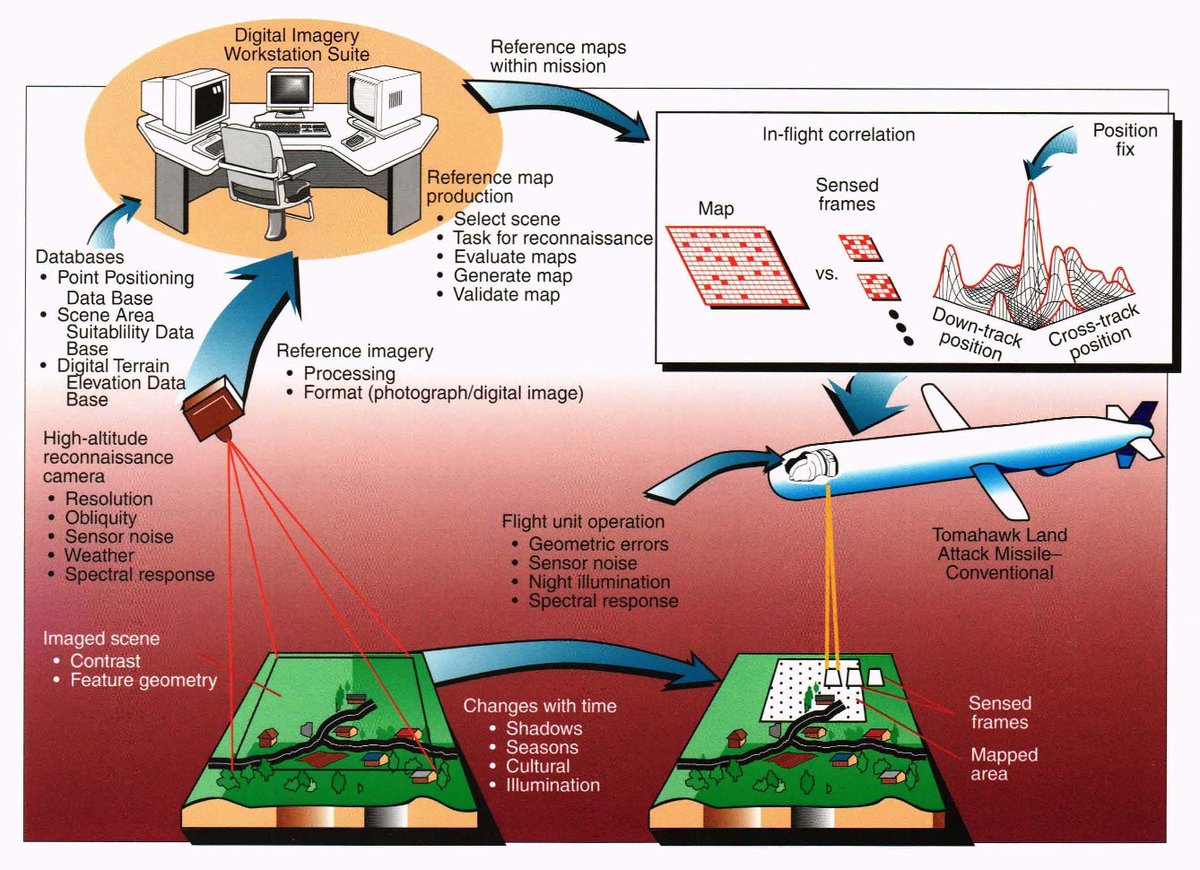
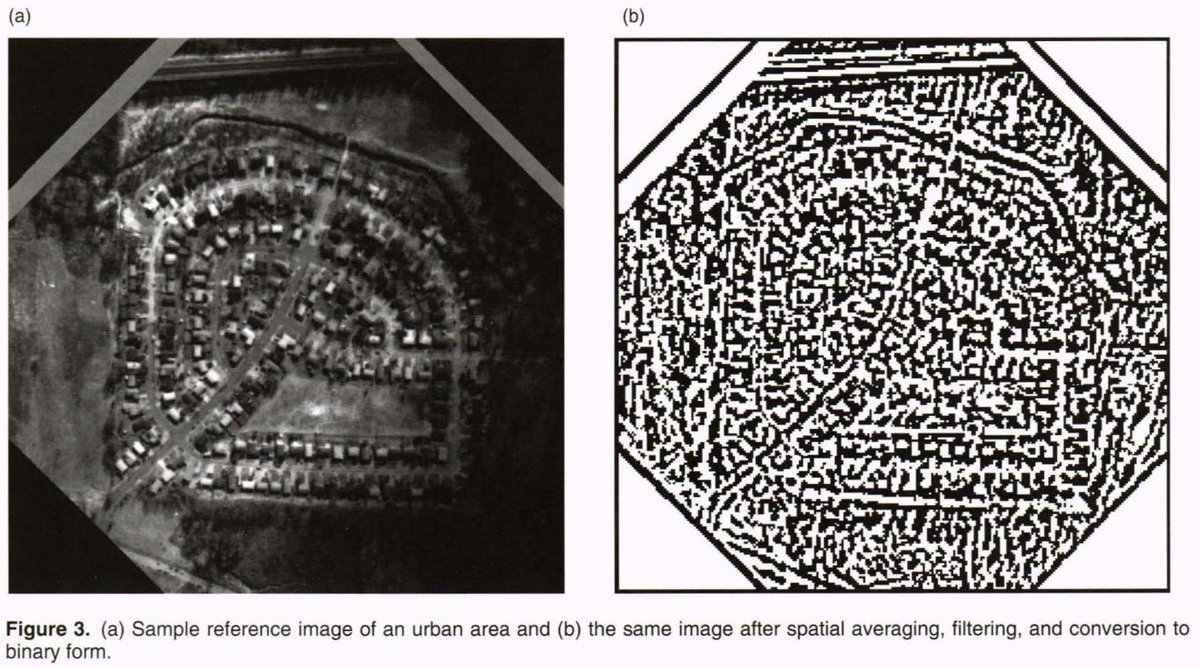
Like TERCOM, DSMAC provides position fixes to update the INS. However, rather than measuring terrain elevation, DSMAC measures terrain features. This is usually implemented as an optical camera that continually images the terrain beneath the missile. 7/18 ImageImage
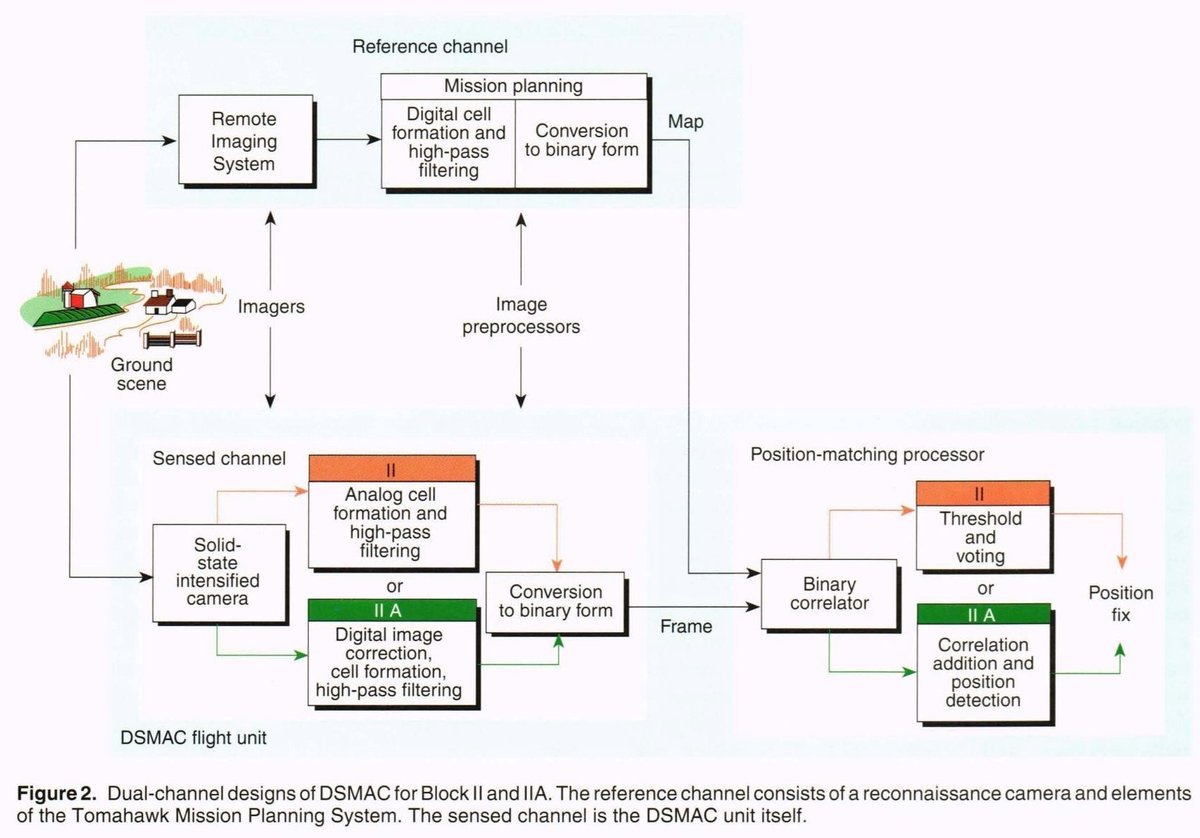
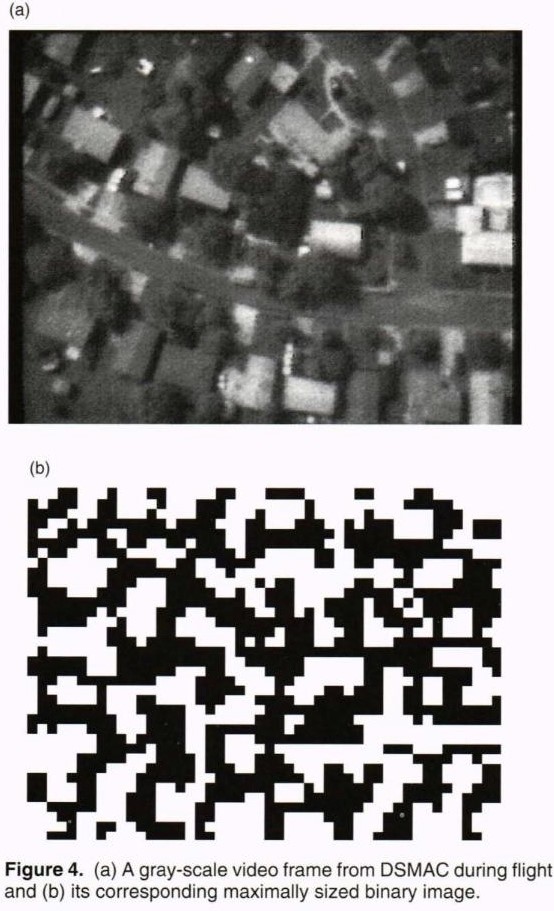
These images are processed and converted into binary contrast images that are then compared to a corresponding pre-loaded binary terrain feature map to compute a position fix. These reference maps are usually generated from imagery collected by reconnaissance satellites. 8/18 ImageImage
Though usually implemented in the optical band, infrared and radio frequency implementations do exist as well. Additionally, some modern DSMAC packages only provide terminal guidance near the target, relying on GNSS and TERCOM for mid-course position fixes instead. 9/18
Finally we get to global navigation satellite system (GNSS) guidance. GNSS uses timing and position signals received from a satellite constellation in Earth orbit (e.g. GPS, GLONASS, Galileo, or BeiDou) to generate a position fix. 10/18 Image
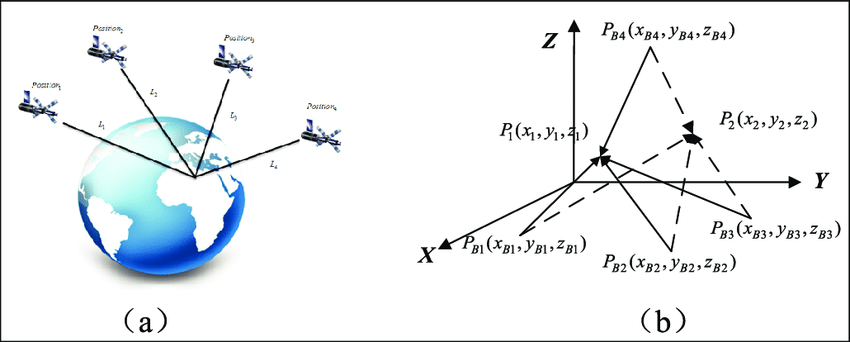
It is only with the advent of GNSS that it became possible to provide accurate CM guidance without relying on a pre-defined mission-specific flight path. Route planning still has enormous practical significance however. 11/18
Besides GNSS, most CMs still use TERCOM and/or DSMAC to enhance precision and ensure their ability to operate in a GNSS-denied environment. TERCOM in particular enables a CM to safely cruise at lower altitudes allowing to more easily fly under the horizon of hostile radar. 12/18 Image
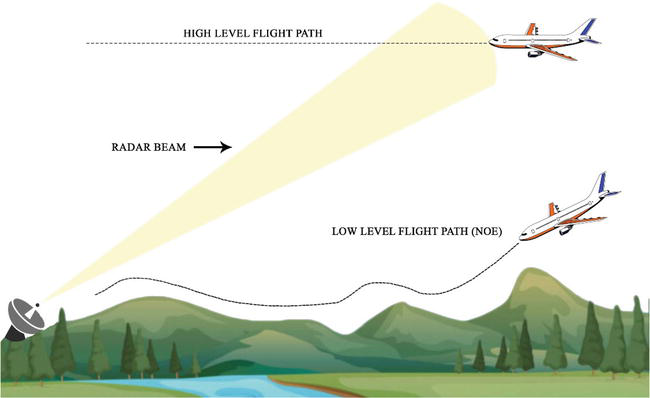
Moreover, the ability to follow to a mission-specific flight path is itself a significant capability. A non-linear flight path degrades the ability of hostile air defenses (AD) to predict the missile's approach vector and enables avoidance of known hostile AD sites. 13/18
Additionally, it enables individual missiles to approach a target from very different directions, making it easier to overwhelm and saturate hostile AD assets. For this reason, many CMs feature GNSS waypoints to enable mission-specific routes without TERCOM/DSMAC. 14/18 Image
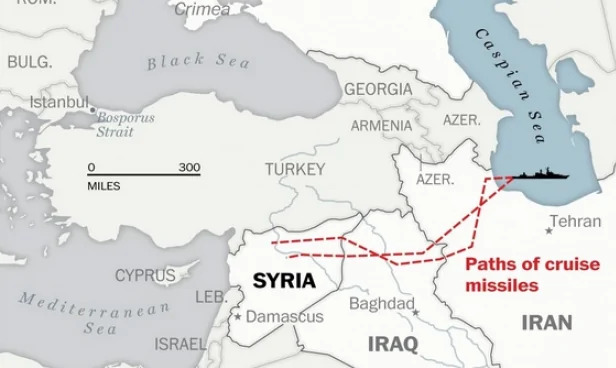
Reports that 🇷🇺 CMs went from making "2 turns" to 40 at present are likely best interpreted as indications of initially sloppy route planning with very simple fight paths. This squares with the notion that 🇷🇺 grossly underestimated 🇺🇦's AD network at the invasion's outset. 15/18
I would also push back on the idea that more complex flight paths are "more demanding" on the guidance system. Aside from memory issues storing maps/waypoints for more complex and thus longer flight paths, I don't see why there would necessarily be an impact on performance. 16/18
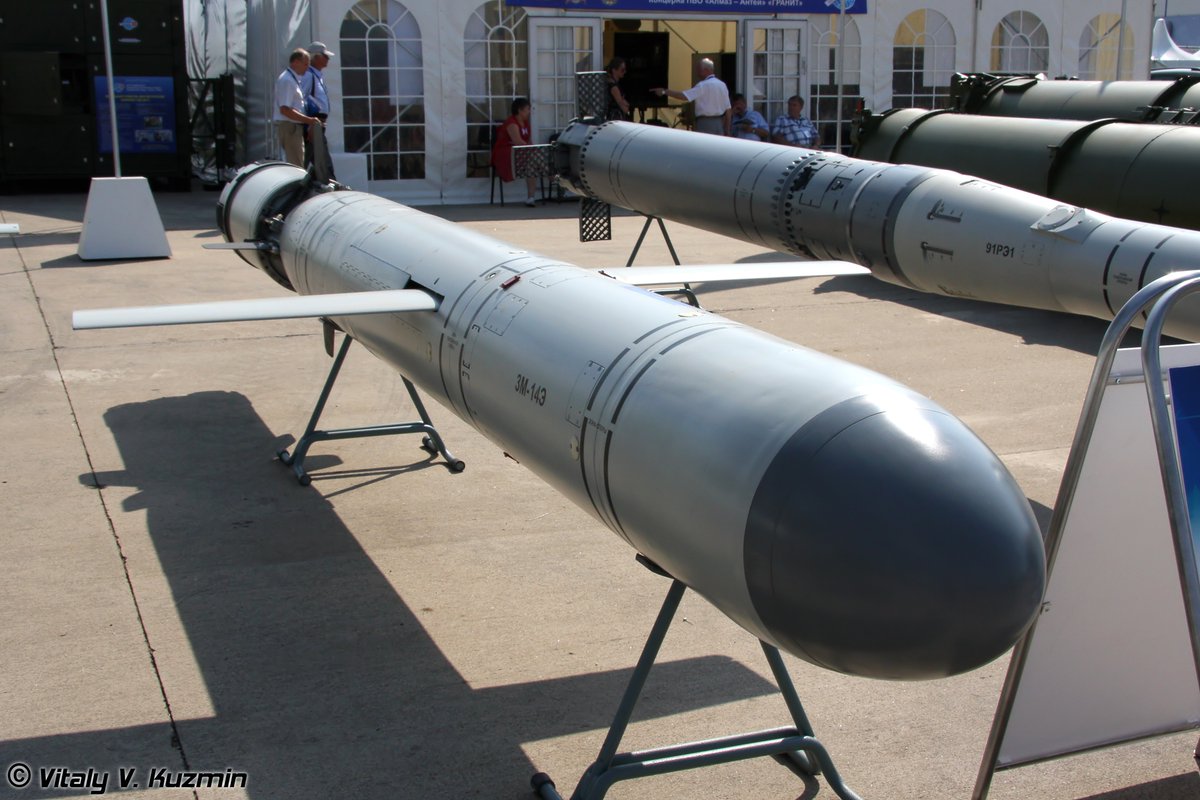
If the published ranges for these CMs are even remotely accurate, then I would be very surprised if 🇷🇺 is having storage issues. Their design ranges vastly exceed the ranges they currently being used at. 17/18 Image
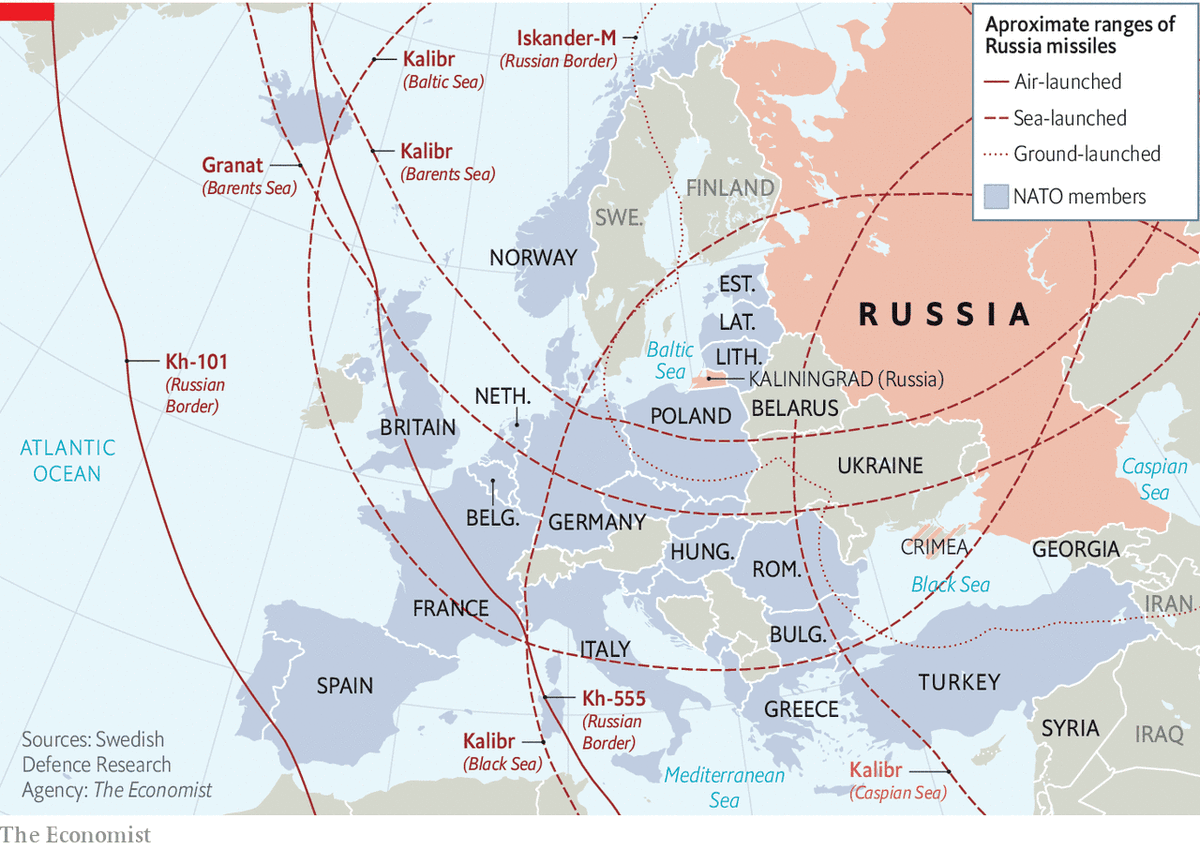
I suspect that the main impact may be on the time and labor needed to generate and simulate the flight paths for the individual missiles before a strike. This @the_ins_ru piece has some fantastic details concerning the 🇷🇺 route planning process. 18/18
theins.ru/en/politics/25…

• • •

Missing some Tweet in this thread? You can try to force a refresh

 

Keep Current with John Ridge

John Ridge Profile picture

Stay in touch and get notified when new unrolls are available from this author!

Read all threads

This Thread may be Removed Anytime!

PDF

Twitter may remove this content at anytime! Save it as PDF for later use!

Try unrolling a thread yourself!

how to unroll video
  1. Follow @ThreadReaderApp to mention us!

  2. From a Twitter thread mention us with a keyword "unroll"
@threadreaderapp unroll

Practice here first or read more on our help page!

More from @John_A_Ridge

Dec 5
RE: the Saky debate. I recommend avoiding drawing hasty conclusions regarding the availability of ATACMS. 🇺🇦 has received at least 13 M270 MLRS from 🇬🇧, 🇩🇪, and 🇫🇷. Unless they have been similarly modified, the 🇬🇧 M270B1, 🇩🇪 MARS II, and 🇫🇷 LRU should all support ATACMS. 1/3
🇺🇦 received a number of M270B1s in July and MARS II in August (unknown if they arrived before or after Saky). This piece also explicitly highlights that there are a number of other nations potentially willing to provide ATACMS to 🇺🇦. 2/3
Given this, ATACMS definitely remains an element of the possibility space of munitions used to carry out the Saky strike. Unfortunately, this article doesn't bring us much closer to an answer either way. It does, however, constrain the sequence of events if it was ATACMS. 3/3
Read 4 tweets
Dec 2
This is very interesting. AFAIK, the Kh-55SM, like the original Kh-55, was only designed to deliver a nuclear warhead and no conventional warhead was designed. These images indicate that this missile was fitted with an inert warhead. 1/4
This is another example of what was observed with the previous Kh-55 wreckage. 🇷🇺 is likely using these inert munitions as makeshift decoys to saturate and distract 🇺🇦 air defenses with the aim of enhancing the efficacy of their massed standoff strikes. 2/4 Inert warhead recovered from the wreckage of a previous Kh-5
It remains unclear if these decoy munitions have been modified in any other ways to improve their performance as decoys. The most logical modification would be the inclusion of an electronic countermeasures (ECM) package. Thus, the contents of future wreckage bear watching. 3/4
Read 4 tweets
Dec 1
Reports that 🇷🇺 Kh-22s are exploding mid-flight are the least surprising news I've heard all war. A 🧵with some thoughts. 1/13
The Kh-22 [AS-4 Kitchen] is a supersonic air-launched cruise missile originally developed as an anti-shipping missile. First entering service in 1962, it is the oldest standoff munition in 🇷🇺 inventory. Production is estimated to have ceased around 1988. 2/13 ImageImage
The Kh-22 is carried exclusively by 🇷🇺 Tu-22M3 [Backfire-C] strategic bombers. The Tu-22M3 can carry up to 3 Kh-22s, though it is common for them to carry one or two at a time. 3/13 ImageImage
Read 13 tweets
Nov 27
Missiles of Ukraine I - Sapsan
OTRK (Operational-Tactical Missile System) "Sapsan" [peregrine in 🇺🇦] is a prospective single-stage, solid-fuel, short-range ballistic missile system. It has been under development in various forms since the mid-90s under a variety of names. 1/46 ImageImage
For clarity, Sapsan currently refers to the domestic variant, while "Hrim-2" ["thunder" in 🇺🇦] refers to the reduced range (MCTR compliant) export version. It’s also been referred to as "Grom" ["thunder" in 🇷🇺] or "Grim," a corruption of Hrim. 2/46
There is a profound asymmetry between 🇷🇺’s ability to strike targets in 🇺🇦 and 🇺🇦’s ability to strike targets in occupied 🇺🇦 territory and 🇷🇺. This asymmetry is a grave threat to both 🇺🇦’s war effort and its people that must be urgently addressed. 3/46 Approximate range circles f...
Read 47 tweets
Nov 22
A 🧵with some detailed takeaways from this infographic and some of my thoughts:
0/n
A) No numbers are provided for Iskander-K (9M728/9M729 [SS-C-7/SS-C-8]) ground-launched cruise missiles (GLCMs), the Kh-59 [AS-13 Kingbolt/AS-18 Kazoo] air-to-surface missiles, or the Tochka-U [SS-21 Scarab-B] ballistic missiles (BMs).
1/15 Iskander-K (9M728/9M729) [SS-C-7/SS-C-8] Transporter Erector9M728 [SS-C-7]Kh-59MK [AS-13 Kingbolt/AS-18 Kazoo]Tochka-U [SS-21 Scarab-C]
B) 🇷🇺 is averaging production of 26-28 units of cruise missiles per month (50/50 Kh-101 [AS-23 Kodiak] and 3M-14T/K Kalibr [SS-N-30A])
C) 🇷🇺 is averaging production of ~5 units of Iskander-M [SS-26 Stone] BMs per month. This is consistent with other independent estimates.
2/15 Kh-101 [AS-23 Kodiak] Air-Launched Cruise MissileIskander-M [SS-26 Stone] Short-Range Ballistic Missile3M-14 Kalibr (SS-N-30A) Sea-Launched Cruise Missile
Read 16 tweets
Oct 12
A brief 🧵 on the Kerch Bridge strike as much has been speculated on the method of the strike.
1/7) There are two real possibilities: a vehicle-borne IED (VBIED) or a tactical ballistic missile (TBM). Most seem to have concluded it was a VBIED and totally dismissed a TBM Image
2/7) This conclusion is extremely problematic. First, it is certain that 🇺🇦 possess TBMs with a range of at least 300 km (either ATACMS or Sapsan/Hrim-2) as demonstrated by the Saky airfield strike. I challenge anyone to explain the need to use a VBIED when 🇺🇦 has TBMs Image
3/7) Second, please explain how a moving VBIED would be remotely tracked at night and detonated. Cell/satphone service in the area is not guaranteed on top of any 🇷🇺 electronic warfare. Not to mention having to assemble a 2-5,000 kg bomb in 🇷🇺 and get it past inspection
Read 7 tweets

Did Thread Reader help you today?

Support us! We are indie developers!


This site is made by just two indie developers on a laptop doing marketing, support and development! Read more about the story.

Become a Premium Member ($3/month or $30/year) and get exclusive features!

Become Premium

Don't want to be a Premium member but still want to support us?

Make a small donation by buying us coffee ($5) or help with server cost ($10)

Donate via Paypal

Or Donate anonymously using crypto!

Ethereum

0xfe58350B80634f60Fa6Dc149a72b4DFbc17D341E copy

Bitcoin

3ATGMxNzCUFzxpMCHL5sWSt4DVtS8UqXpi copy

Thank you for your support!

Follow Us on Twitter!

:(