

This is your annual reminder that "Die Hard" is the perfect Christmas movie...for understanding how Americans view international politics.
[THREAD]
[THREAD]

Honestly, the entire "Die Hard" series is great for learning about how American's perceive the world.
For instance, want to understand gold & USA's centrality to the global economy? Watch "Die Hard with a Vengeance!"
https://twitter.com/ProfPaulPoast/status/1459872524930531332
Or consider how "Die Hard 2" captured a key concern of the "Drug War": that the global drug trade could directly undermine US security.
And don't forget how "Live Free or Die Hard" (released in 2007) was all about cyber-warfare posing a threat to the US economy.
As for the original Die Hard, it captures the anxieties associated with US "global leadership" during the late Cold War era.
Those anxieties were:
1) relative economic decline
2) Vietnam syndrome
3) Terrorism
Let's look at each one (and what DIE HARD has to say about them)
Those anxieties were:
1) relative economic decline
2) Vietnam syndrome
3) Terrorism
Let's look at each one (and what DIE HARD has to say about them)
(1) RELATIVE ECONOMIC DECLINE
The 1980s witnessed the peak of Anti-Japanese economic anxiety in the United States.
The 1980s witnessed the peak of Anti-Japanese economic anxiety in the United States.

Consider the best-seller "Japan as Number 1", published in 1979...
amazon.com/Japan-Number-O…
amazon.com/Japan-Number-O…
...or, near the end of the decade, this @JamesFallows @TheAtlantic article
theatlantic.com/magazine/archi…
theatlantic.com/magazine/archi…
Such anxieties fed a trade war between the United States and Japan Image
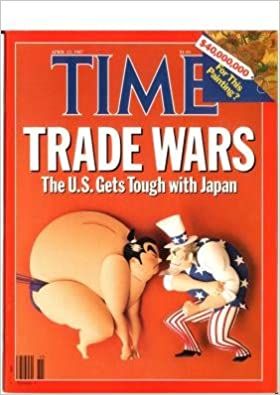
An excellent summary of "Japanophobia" in the 1980s, and the racism underpinning it, is offered by MJ Heale in this @jnlamstudies piece.
cambridge.org/core/journals/…
cambridge.org/core/journals/…
In DIE HARD, "Nakatomi tower" owned by the Japanese Nakatomi Corporation -- the setting of the entire film -- symbolizes all of this.
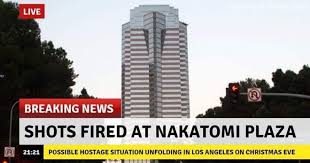
Indeed, it is notable that the John McClane's (the hero) personal life is being undone by his inability to handle that his wife, Holly, took a job with this Japanese company.
(2) VIETNAM SYNDROME
The film alludes to the folly of American militarism.
The film alludes to the folly of American militarism.
The phrase "Vietnam Syndrome" is in reference to the USA losing in Vietnam after a long, protracted conflict (US combat troops withdrew in 1973)
voanews.com/a/last-united-…
voanews.com/a/last-united-…
The "syndrome" is an aversion in the American public to military intervention.
brookings.edu/blog/up-front/…
brookings.edu/blog/up-front/…
Of course, this hadn't stopped the US from Using military forces. But the scale was limited...
politico.com/story/2017/10/…
politico.com/story/2017/10/…
...or entailed heavy proxy support (as captured in "Charlie Wilson's War")...
...unless you don't count John -- that name again -- Rambo (Note: Rambo III was released the same year as DIE HARD).
In Die Hard, American government/military hubris is captured by the FBI agents...
... who are keen to use force (even if it means "collateral damage").
BTW: if the Vietnam tie-in wasn't clear enough, note the "Saigon" reference.
BTW: if the Vietnam tie-in wasn't clear enough, note the "Saigon" reference.
But like the American experience with Saigon itself, it doesn't end well for them.
(3) TERRORISM
The 1980s witnessed the heightened concern over international terrorism as a security threat.
The 1980s witnessed the heightened concern over international terrorism as a security threat.
See, for example, Pan Am flight 73 (in 1986)...
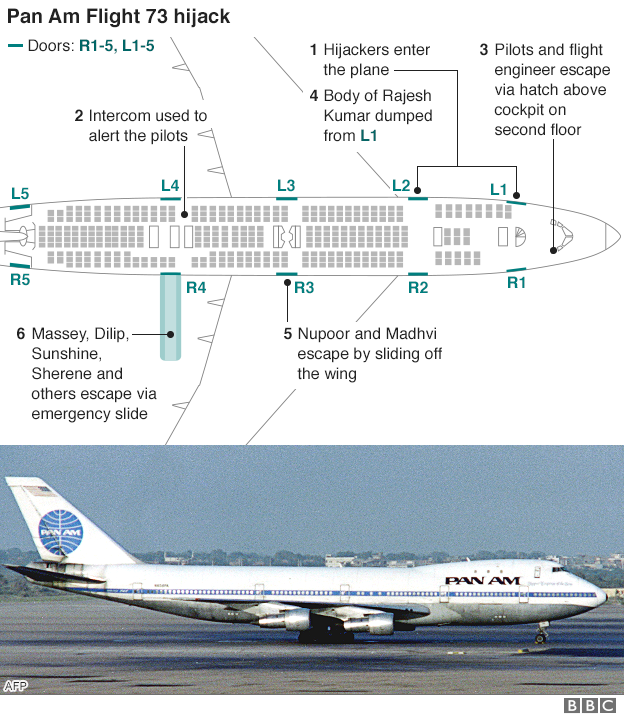
..and the PAN AM flight 103 bombing would take place in late 1988.

Incidents and fatalities of international terrorism had been rising since the early 1970s (at least according to the data on such incidents, which can be seen 👇)
ourworldindata.org/terrorism
ourworldindata.org/terrorism
The emergence of terrorism was challenging for American hegemony because, unlike the predictability of the Soviet Threat (i.e. missile balance or tank placements), terrorism could strike from anywhere without warning.
In DIE HARD, it's notable that the main "terrorist", Hans Gruber, comes from West Germany (associated with the Volksfrei movement), a US @NATO ally: perhaps capturing concerns about the complexities of US Cold War alliances.
And he drops references to other terrorist groups: New Provo front, Liberte de Quebec, and Asian Dawn
But it turns out that he's just a thief...an exceptional thief!
Making Gruber a thief rather than a terrorist is, in a sense, cathartic to Americans: his motivation is money, which seems more understandable, not ideological, which is scarier.
Though, as Jack Gibbs wrote in @ASR_Journal at the time, drawing a distinction between terrorism and robbery is obscure.
jstor.org/stable/2095609
jstor.org/stable/2095609
AND YET, despite exploring these anxieities, DIE HARD, through it's main character, captures the pop-culture ethos of "American exceptionalism": John Wayne, Rambo, Marshal Dillon, & Roy Rogers
So if you want to give your students (or yourself) a perspective on the anxieties associated with "global leadership", you can do worse than have them watch the "Quintessential American Action Movie" that is also a Christmas Movie!
[END]
theguardian.com/film/2018/jul/…
[END]
theguardian.com/film/2018/jul/…
• • •
Missing some Tweet in this thread? You can try to
force a refresh






