Nick Gerli Profile picture
Dec 31, 2022 5 tweets 2 min read Read on X
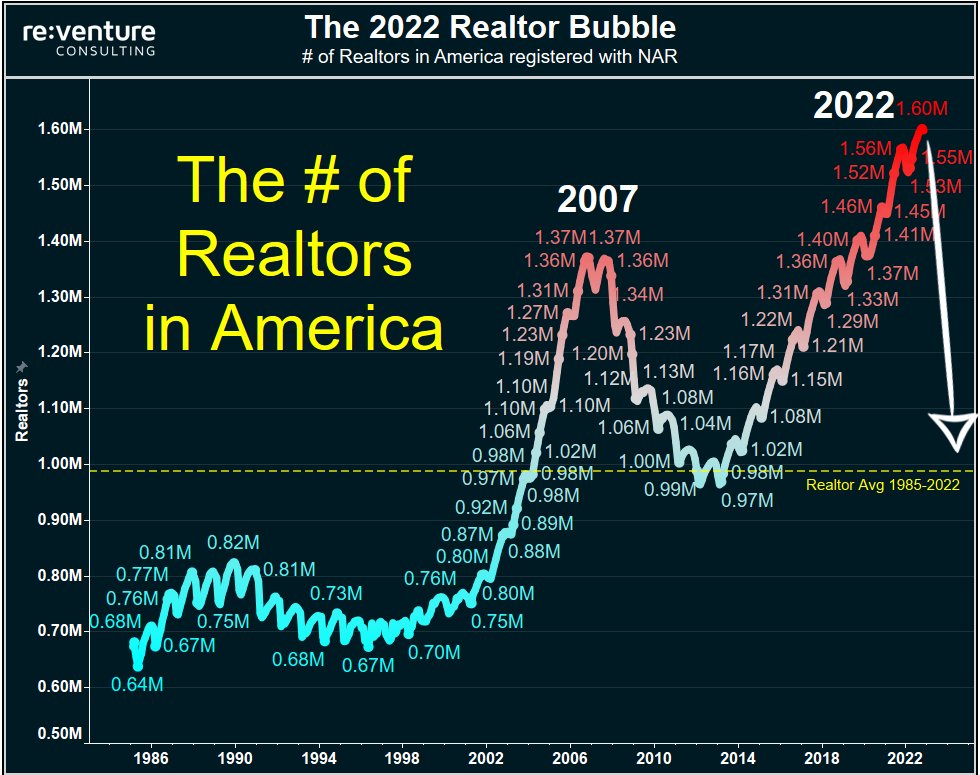
There's too many Realtors.

1.6 Million currently registered with NAR. That's higher than 2007 Bubble.

📉30% of Realtors will likely quit during this Housing Crash. Once that happens, you'll know bottom is approaching. Image
Consider this:

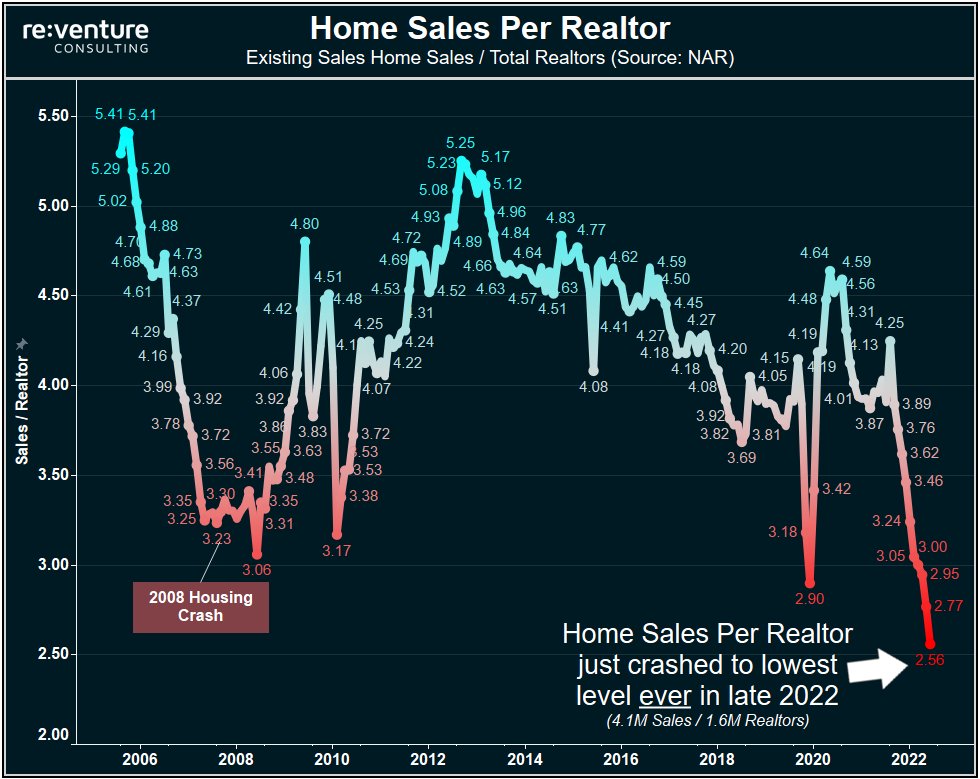
Home Sales / Realtor collapsed to lowest level on record in 2022.

Even lower than the depths of the 2008 Housing Crash.

(Source: NAR) Image
The Housing Bubble has popped, but the Bubble mentality has NOT.

1.6 Million Realtors are still "holding on", thinking the Housing Market will improve in 2023.

History says it won't.
But watch out for when these Realtors inevitably quit in 2023.

When they quit, it will likely coincide with investors/flippers/stubborn sellers "quitting" as well.

And that's when you'll see inventory/listings really explode.
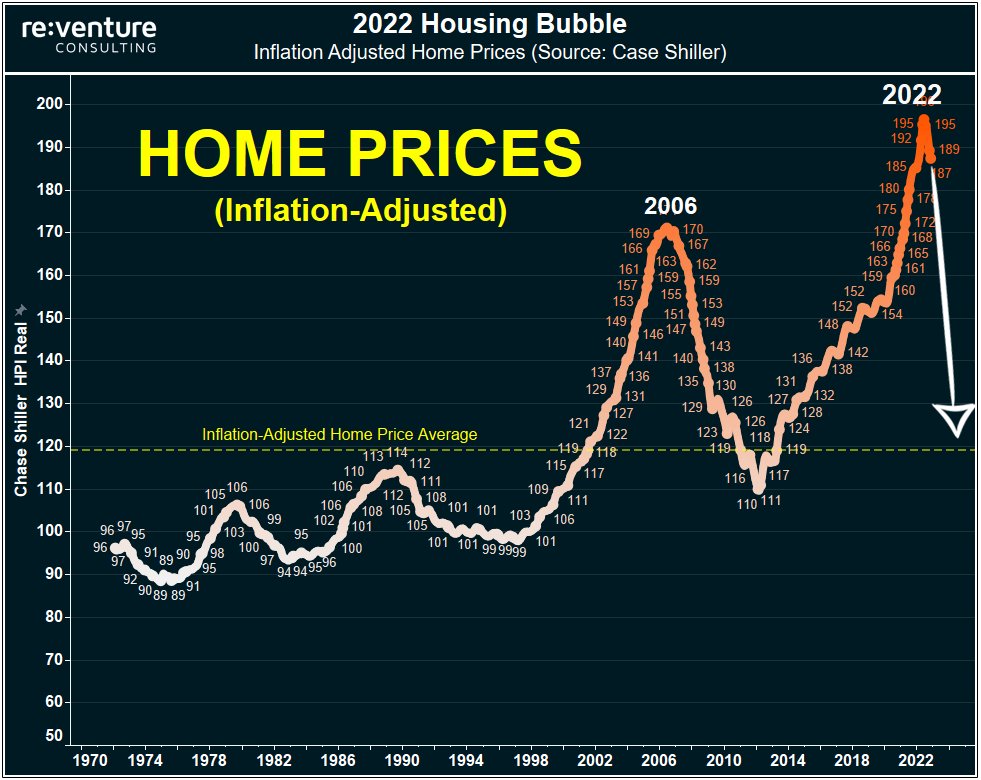
And remember folks: despite recent price decline, we're still in the BIGGEST BUBBLE EVER in Housing.

Inflation-adjusted home prices STILL above 2006 Levels.

(Funny how similar this graph looks to the Realtor graph) Image
• • •

Missing some Tweet in this thread? You can try to force a refresh

 

Keep Current with Nick Gerli

Nick Gerli Profile picture

Stay in touch and get notified when new unrolls are available from this author!

Read all threads

This Thread may be Removed Anytime!

PDF

Twitter may remove this content at anytime! Save it as PDF for later use!

Try unrolling a thread yourself!

how to unroll video
  1. Follow @ThreadReaderApp to mention us!

  2. From a Twitter thread mention us with a keyword "unroll"
@threadreaderapp unroll

Practice here first or read more on our help page!

More from @nickgerli1

Jan 21
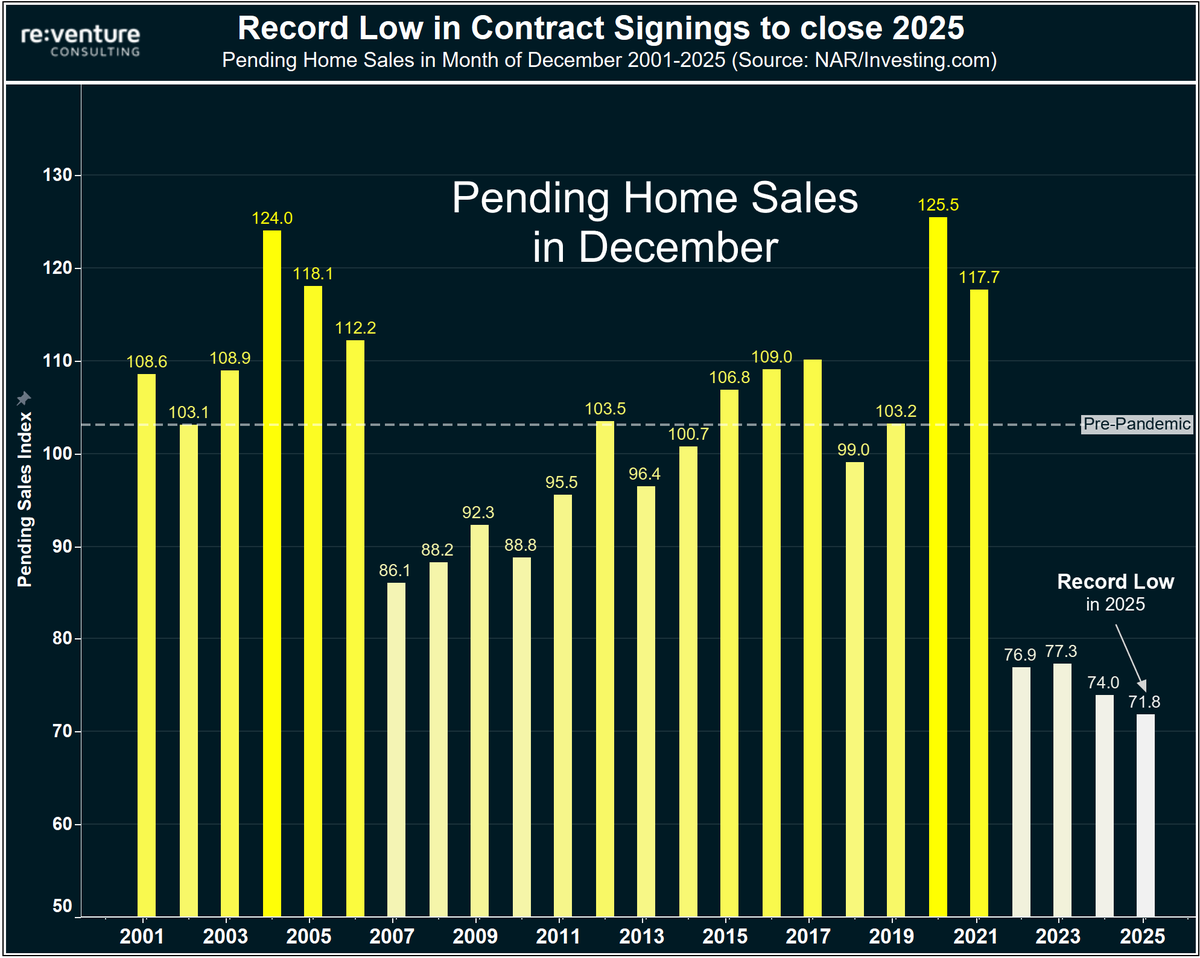
Dec 2025 was the worst December on record for homebuyer demand.

NAR's pending sale index fell to 71.8.

Down 30% from pre-pandemic norms on contract signings. (and still dropping from last year's already historically low levels).

Indicating 2026 is going to get off to a rough start on closings and buyer interest.

The only way out is lower prices.Image
1) I'd like to remind everyone that we've now had 7 rate cuts since August 2024.

Back then the Fed Funds was at 5.25-5.50%.

Now it's at 3.50-3.75%.

And buyer demand is still dropping.
2) Moreover - Mortgage Rates are down about 100 basis points from where they were last year (6.1% v 7.1%).

So, affordability has improved incrementally.
Read 21 tweets
Jan 13
Florida condo crash happening in real-time.

Seller cut price to $256k.

Back in 2022, it was valued at over $1 million.

75% haircut in 3 years. And 50% over the last 10 years.

This condo building was built in the 1970s, and apparently has huge deferred maintenance and repairs. So existing condo owners / new buyers are getting stuck with the bill.

($326k special assessment on this unit, also needs renovation. So the buyer's all-in cost is probably closer to $700k).

In this ZIP code, condo values have dropped about 10% in aggregate the last 3 years. But clearly some units, in older buildings with huge assessments, are getting hit much worse than market average.Image
1) condos are an interesting asset class, because if you are in the wrong building, at the wrong time, the declines in value can be immense.

This condo would have likely sold for close to $900k-1 million in 2021/22.

Now its listed for $256k.
2) This is because in its building in Downtown St. Pete they found $45 million in needed repairs.

The building was built in 1975. And post-Surfside collapse, many of these older properties are being caught up on deferred repairs from the last couple of decades. Image
Read 6 tweets
Jan 9
Multifamily vacancy rates are skyrocketing in Sun Belt Markets.

Apartmentlist is reporting we're now at the highest multifamily vacancy since 2017. And rent cuts are getting deep.

Austin is #1, at -21%.
Fort Myers, CoSprings, Phoenix, North Port, Raleigh, San Antonio, Atlanta, Denver, Lakeland, and Orlando are all at -10% or bigger.

Now - many of these markets had big rental rate run-ups after the pandemic, so rents can still appear expensive to some renters.

But they're officially getting more affordable, and rents will likely drop further in 2026 given the big surge in vacancies over the last couple of years.Image
1) A different way to view this data is by comparison today's rents to pre-pandemic.

San Francisco rents are up YoY, but basically flat from pre-pandemic, due to how much they dropped in 2020-21.

Austin rents are now also basically flat with pre-pandemic, up only 2.2%, due to how much they have dropped.

A host of other markets - San Antonio, Denver, San Jose, New Orleans, Minneapolis, CoSprings, and Houston - has rents up 10% from pre-pandemic.Image
2) If rent growth is only 10-15% over 6 years, that is not so good, as underlying inflation has been much higher than that.

Wages are up 25% or so in the same span.

Property taxes and insurance are up by much more.

So in many markets, rents are failing to keep up with wage growth and inflation.
Read 4 tweets
Jan 4
Something big just happened in the U.S. Housing Market.

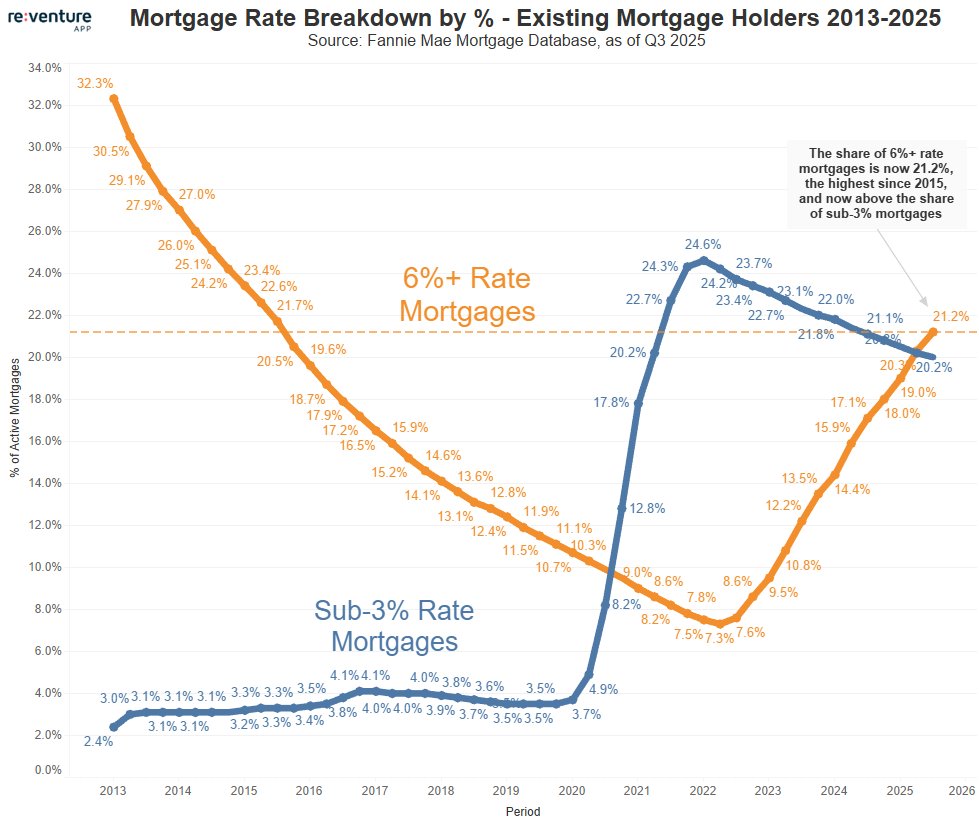
As of the end of 2025, there are now more 6%+ rate mortgage holders than sub-3%.

Meaning that the dreaded Mortgage Rate "Lock-In" Effect is fading.

Since more existing owners have a higher rate, that means more have a payment and rate closer to "market", which means there will be more incentive to sell - which is actually good news.

The 6%+ mortgage share is now 21.2%, the highest level since 2015, and nearly triple the pandemic low.

This is happening because even in today's depressed sales and refinance environment, each year about 5-6 million Americans take out a new mortgage, now at 6%+ rates.

Expect more upward pressure on new listings and inventory in future years as a result.Image
1) The one thing keeping inventory constrained, even in the midst of its rebound from the pandemic, has been sellers delisting homes.

And other sellers electing not to list, because they want to keep their low rate.

Now that this mortgage lock-in effect is gradually fading away, it will structurally unlock more supply, and should push inventory up further in 2026 and beyond.
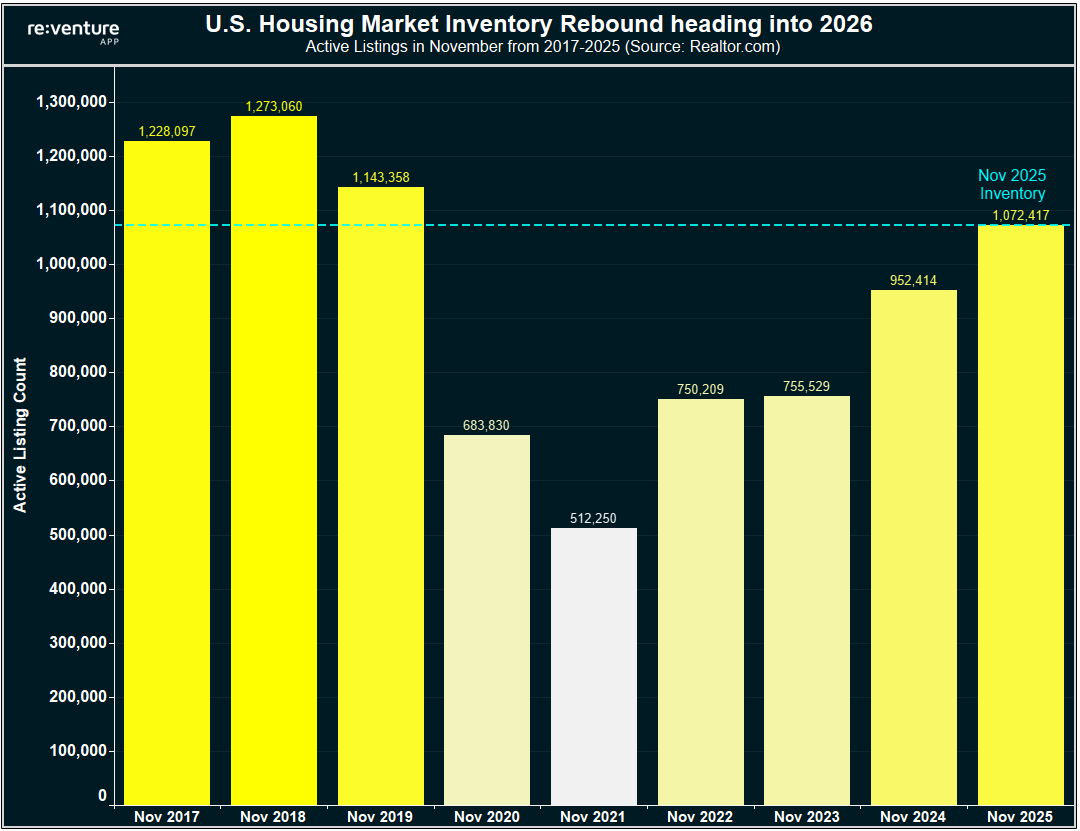
2) Now the already good news is that inventory has grown sigificantly in the last 3 years.

We're now up to 1.1 million listings on the market, as of November 2025, according to Realtor.com, nearly back to pre-pandemic.

Much of this inventory growth is in the South, where prices are now dropping.

But could we see this inventory figure get to say 1.3 or 1.4 million next year, which would be the highest national inventory in over a decade?Image
Read 15 tweets
Jan 1
Austin TX is now back to pre-pandemic apartment rents.

Down 21% from peak in summer of 2022.

$1,636/month --> $1,288/month

(I'm now even seeing 2BRs in some apartments at sub-$1,000)

This rental correction is due to a sharp drop in migration/demand, combined with a surge of new apartment development.

At this point, Austin has its cheapest rents on record relative to income.Image
1) Here's an example of what's out there now.

2BRs going for $950.

This is a complex which is off I-35. A 9-minute drive to the Domain according to Google Maps.

$470 per bedroom. Image
2) The miraculous thing about this is that Austin, despite the slowdown in migration, is still a demographic beast when it comes to growth.

It's 5-year population growth rate from 2019-2024 is 14.3%.

Which is easily #1 among other large metros.

(Note: it's interesting how every high population growth market during pandemic is now seeing declining values. The boom/bust cycle is real).Image
Read 10 tweets
Jan 1
U.S. homebuyer demand is near the lowest level on record.

And there's one reason why: horrendous affordability.

Right now, U.S. homebuyers need to pay 39% of their gross income in order to afford to buy a house entering 2026.

And obviously, no one wants to do that. As a result, sales demand has plummeted to the lowest level in 40 years (only 4.7% of occupied homes sold in 2025 - the lowest since 1982).

Historically, you can see these trends are negatively correlated. Mortgage costs go up, sales velocity down, and vice versa.

Note: the single-biggest determinant of Mortgage Costs is actually not Mortgage Rates. It's prices. Prices going up 50% crushes affordability more than rates going from 4 to 6%.

Lower prices will bring down the Mortgage Cost burden, and allow for more home sales.Image
1) if we want to re-stimulate the housing market, and make the American dream accessible again, it all comes down bringing down Mortgage Costs and making the housing market more affordable again.

This is what will bring buyers back.
2) But once again, it's not about mortgage rates.

As you can see - a 50% increase in mortgage rates only causes mortgage costs to go up 19%.

While a 50% increase in prices causes mortgage costs to go up 50%.

It's about prices. Always has, always will. Image
Read 10 tweets

Did Thread Reader help you today?

Support us! We are indie developers!


This site is made by just two indie developers on a laptop doing marketing, support and development! Read more about the story.

Become a Premium Member ($3/month or $30/year) and get exclusive features!

Become Premium

Don't want to be a Premium member but still want to support us?

Make a small donation by buying us coffee ($5) or help with server cost ($10)

Donate via Paypal

Or Donate anonymously using crypto!

Ethereum

0xfe58350B80634f60Fa6Dc149a72b4DFbc17D341E copy

Bitcoin

3ATGMxNzCUFzxpMCHL5sWSt4DVtS8UqXpi copy

Thank you for your support!

Follow Us!

:(