Jeff Gilchrist Profile picture
Jan 1, 2023 17 tweets 7 min read Read on X
Tutorial: How to share long threads from Twitter more easily with others.

Are there really long threads on Twitter you would rather read on a single web page and easily share with others who don't use Twitter? 🧵1/ Image of unrolled thread by Jeff Gilchrist using PingThread
I'm notorious for writing very long threads but in a few easy steps you can find or create easy to share web links for others. The services mentioned here only work for tweets with more than 1 thread and less than 6 months old. 2/
You can use a thread unrolling service such as Thread Reader ( threadreaderapp.com ) and PingThread ( pingthread.com ). 3/
Note, long threads will have tweets after 31 and 61 hidden unless you click on "Show replies" to reveal the additional tweets, so the unrolling service will also show all the tweets on on page, even those. 4/
It is possible to unroll threads from outside of Twitter on their website or by replying to a Twitter thread you like and this tutorial will show you both methods. 5/

Using their website:
1) Go to: pingthread.com Image showing website of PingThread service.

2) Copy the link to the Twitter thread and paste it into the website as shown and then click on the "Find Thread" button. 6/ Image showing Twitter thread URL pasted into Find Thread box

3) Wait for the thread to be processed, and PingThread will then show you the one-page unrolled version. You can now copy the website address (URL) and share that with someone else (see red arrow in image). 7/ Image showing newly created unrolled thread page and where t
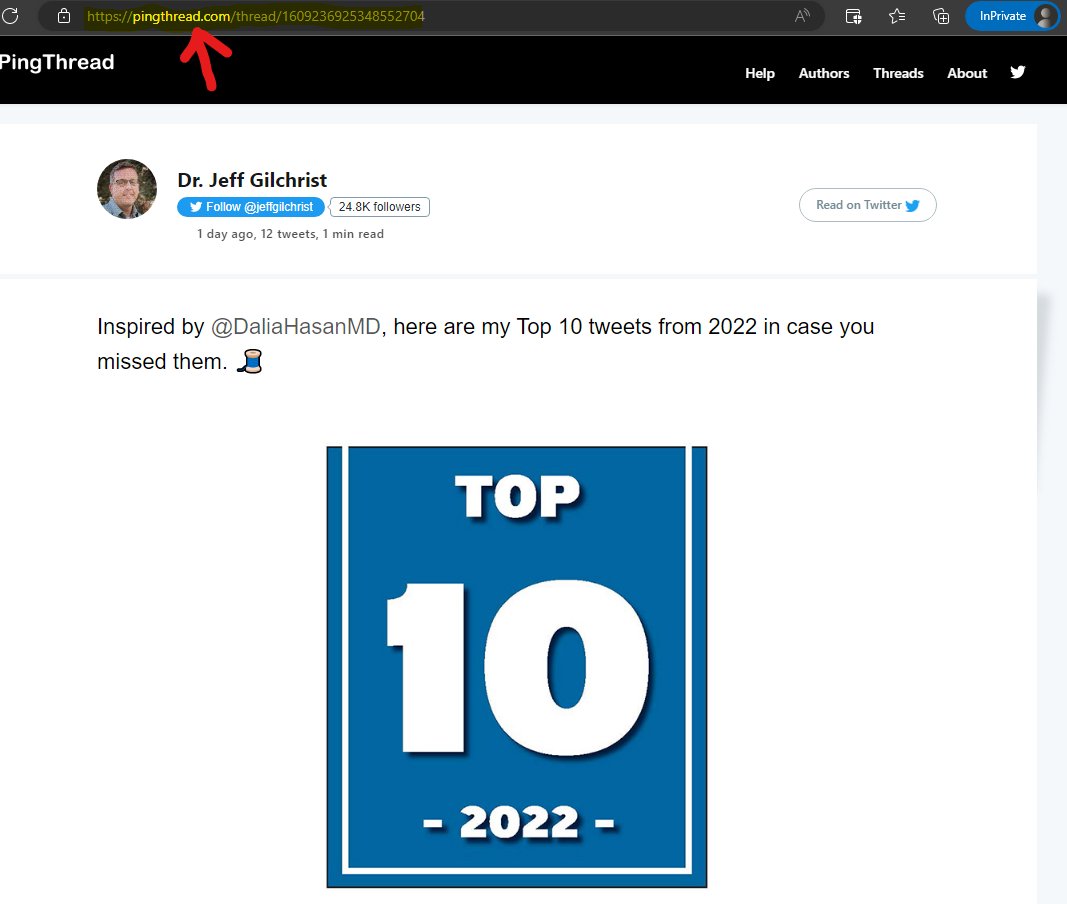
You can scroll down the web page and see all of the tweets unrolled into one web page. We have converted this Tweet ( ) into this unrolled web page ( pingthread.com/thread/1609236… ). Note how the tweet # is identical on both website addresses. 8/
Unrolling from inside Twitter:
1) Open the thread in Twitter that you would like to unroll into a one page web version.

2) Reply to any tweet in the thready tagging the service of your choice (as seen in photo) 9/:
@threadreaderapp unroll
or
@PingThread unroll Image showing text used to reply in a thread to activate unr

3) The unrolling service will reply to your tweet with a link to the one-page unrolled web version which in this example is 10/: threadreaderapp.com/thread/1609236… Image showing response from unrolling service which provides

4) Click on the link or copy and paste it to share with others. They will be able to scroll through all the tweets on one page unrolled together. 11/ Image showing web page of unrolled version of Twitter thread

Try out the website method or tweet replying method on this thread if you want to practice, then you can use these for any long Twitter threads you find that you want to share or read more easily. 12/
Sometimes other people have already unrolled threads from authors and you can find other interesting tweets by them visiting the author page on these services. 13/
For me that is by typing in the user's Twitter ID instead of a link to one of their tweets like shown in the image, which will bring you here 14/: threadreaderapp.com/user/jeffgilch… Image showing how to search for unrolled threads by a specif

This doesn't show all the tweets the author has written, but just the ones that people have asked the unrolling service to process ( pingthread.com/author/jeffgil… ). 15/ Image showing all unrolled threads by a specific Twitter aut

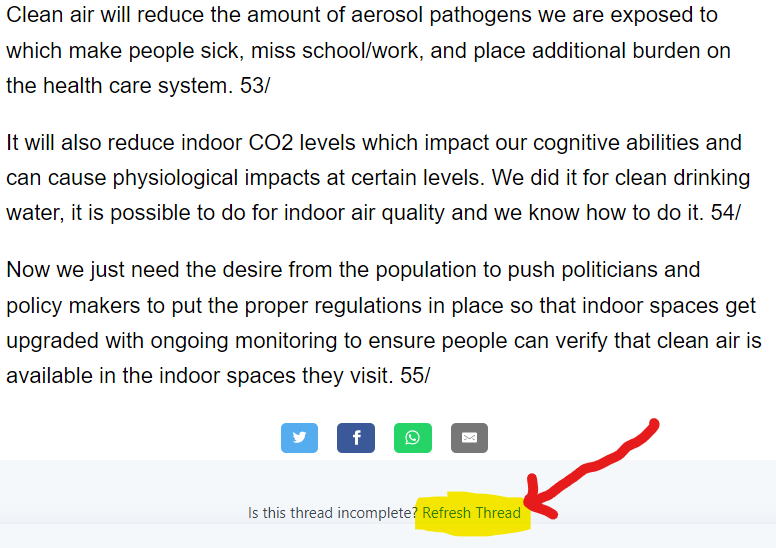
If a Twitter author has gone back and added additional tweets to their thread later on, you can ask the unrolling service to refresh the thread and include the new ones by going to the bottom of the web page of the unrolled thread and clicking on "Refresh Thread". 16/
You can find the 1 page unrolled version of this long thread here: pingthread.com/thread/1609623…

• • •

Missing some Tweet in this thread? You can try to force a refresh

 

Keep Current with Jeff Gilchrist

Jeff Gilchrist Profile picture

Stay in touch and get notified when new unrolls are available from this author!

Read all threads

This Thread may be Removed Anytime!

PDF

Twitter may remove this content at anytime! Save it as PDF for later use!

Try unrolling a thread yourself!

how to unroll video
  1. Follow @ThreadReaderApp to mention us!

  2. From a Twitter thread mention us with a keyword "unroll"
@threadreaderapp unroll

Practice here first or read more on our help page!

More from @jeffgilchrist

Mar 22
*** Ontario COVID Hospitalization Rates by Age ***

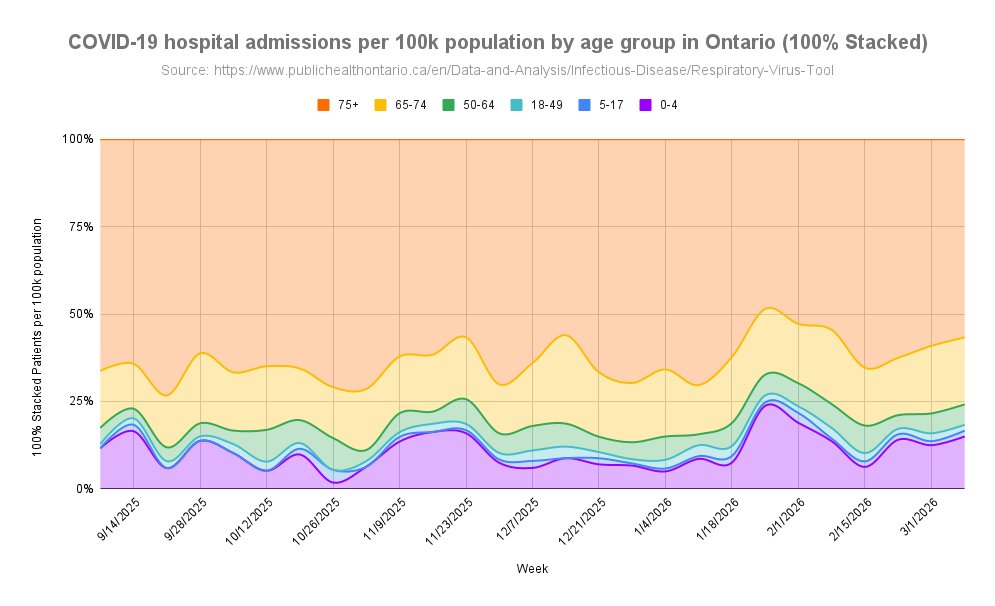
Data is now available for hospital admissions due to COVID by age group going back to Oct 2021. This provides interesting insights into how much children have been impacted with serious infections compared to adults. 🧵1/ Graph of New hospitalization rate in Ontario due to COVID by age group (100% Stacked).
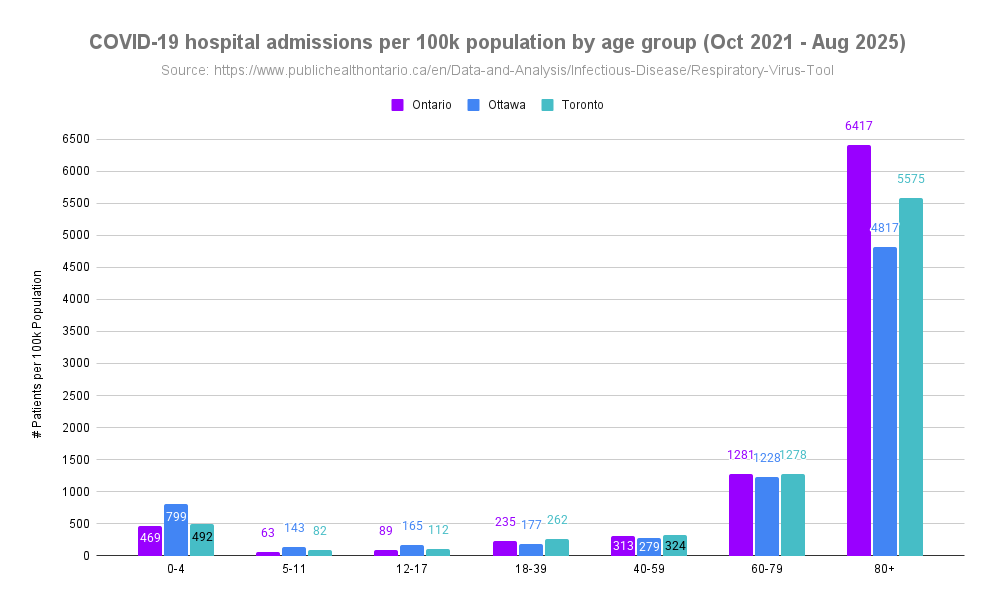
Chart of COVID hospital admissions per 100k population by age group from Oct. 2021 to Aug. 2025 in Ontario, Ottawa, and Toronto.
We have heard from many sources throughout the pandemic that COVID isn't serious in children or they are not impacted as much as adults with some people still claiming this today. 2/
What about today, with lower circulation happening more recently and not the huge waves seen in the past, is anyone even being hospitalized for COVID anymore? The most recent update (week of March 8, 2026) there were 188 people hospitalized in Ontario due to COVID. 3/
Read 20 tweets
Mar 14
*** Ontario Virus & Variant Update | Mar 14 ***

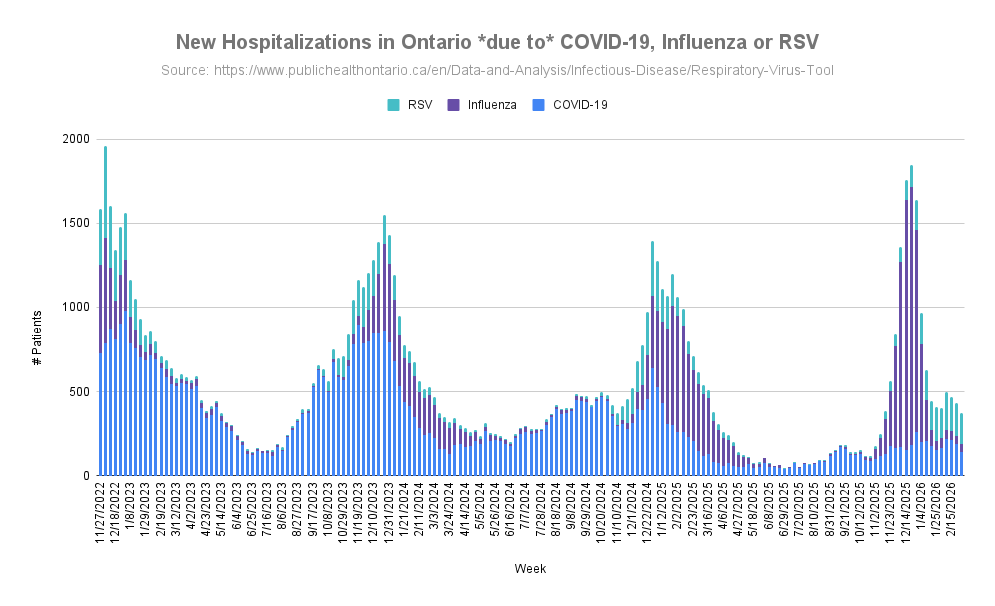
Hospitalizations due to COVID have gone down from 190 to 138 in the last update. Influenza hospitalizations remained stable around 49 and RSV decreased slightly from 194 to 184. 🧵1/

#Ontario #Virus #Variant #COVID #RSV #Influenza Graph of New hospitalizations in Ontario due to COVID, Influenza or RSV.
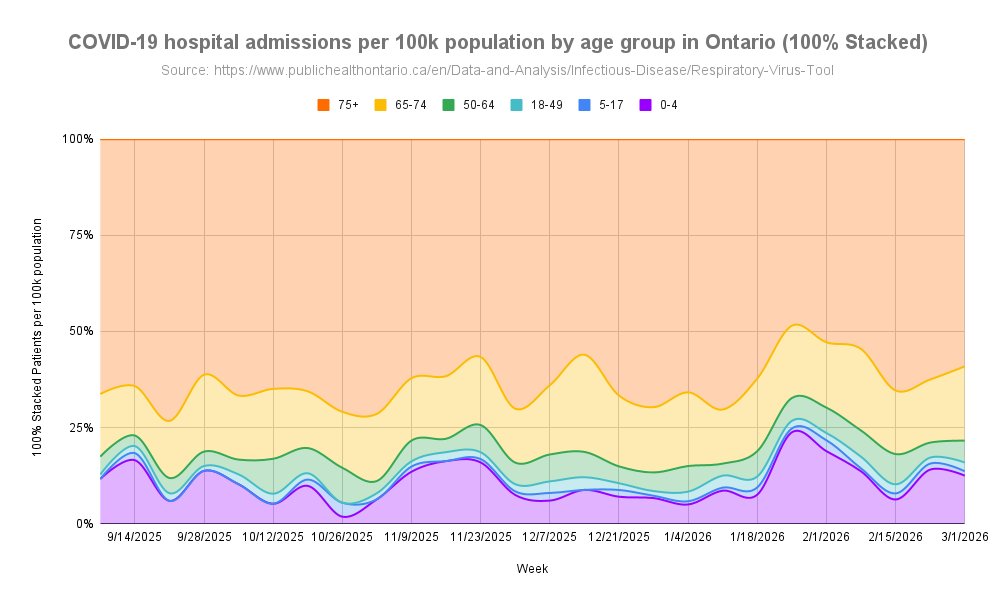
Looking at age groups, those age 75+ had the highest rates of hospitalization due to COVID but decreased since last update. Second place is age 65-74 and their levels are currently decreasing while age 0-4 has the third highest rate and also decreased since last update. 2/ Graph of New hospitalization rate in Ontario due to COVID by age group (100% Stacked).
The youngest age group 0-4 currently have a hospitalization rate due to COVID that are 11x higher than age 5-17, 5.5x higher than age 18-49, and 2x higher than adults 50-64. 3/
Read 16 tweets
Jan 11
*** Ontario Virus & Variant Update | Jan 11 ***

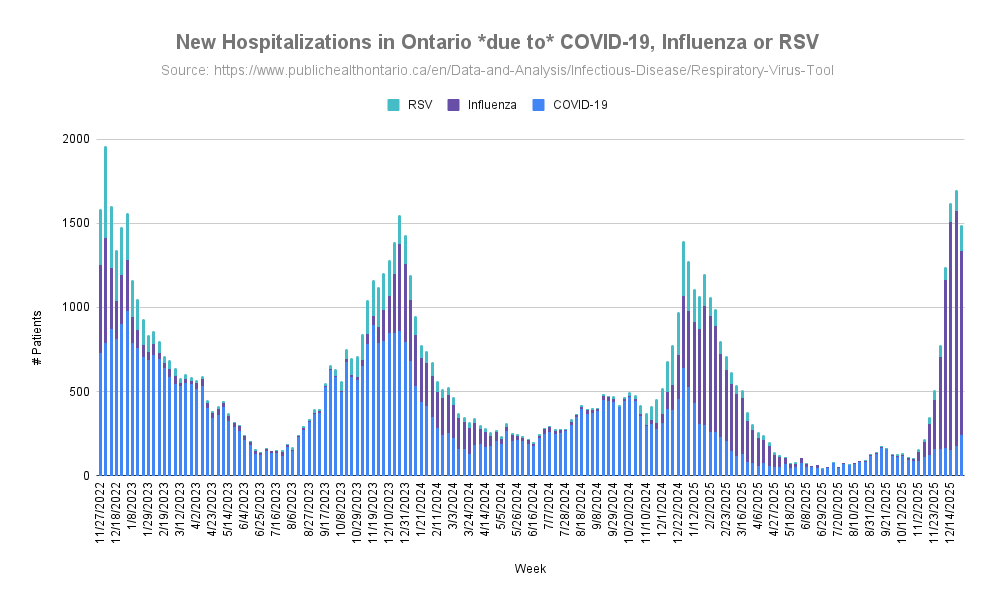
Hospitalizations due to COVID increased from 176 to 241 in the last update. Influenza hospitalizations have start dropping from the peak of 1,400 to 1,095 with RSV increasing from 121 to 156. 🧵1/ Graph of New hospitalizations in Ontario due to COVID, Influenza or RSV.
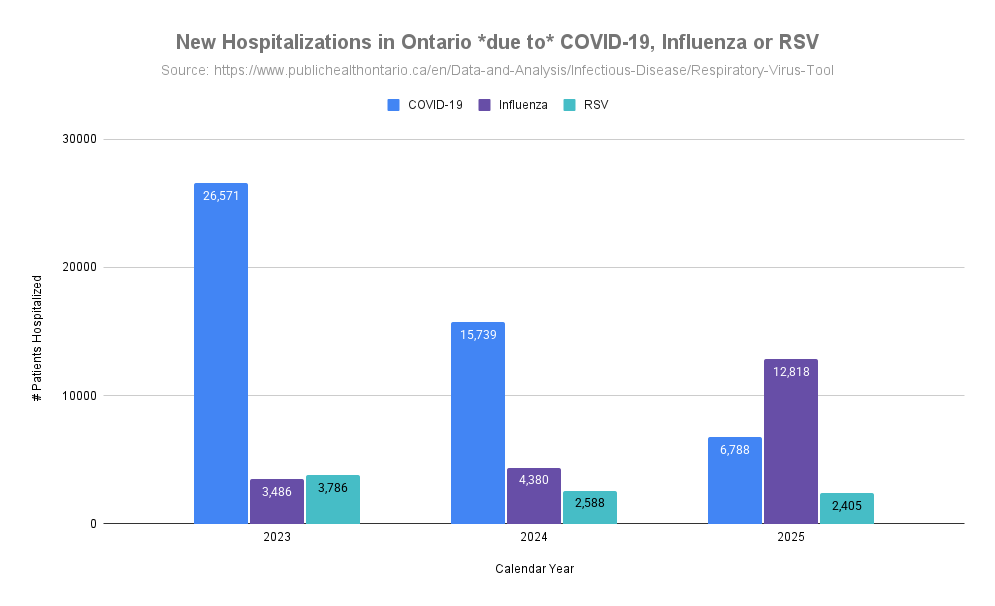
Looking back over the past few years, new hospitalizations for RSV have remained pretty stable the last two years around 2,500 and a decrease from 2023, while COVID has been significantly dropping each year, 26,571 in 2023 to 15,739 in 2024 to 6,788 in 2025. 2/ Graph of New hospitalizations in Ontario due to COVID, Influenza or RSV, grouped by calendar year.
Influenza has been doing the opposite, increasing significantly each year from 3,486, to 4,380 in 2024, to 12,818 in 2025. 3/
Read 13 tweets
Oct 25, 2025
How does various mask fit compare to filter the air and protect you or others?

Most masks, even baggy blue procedure masks use filtering material that can filter 95%+ of particles that pass through it, but the key is "pass through it". 🧵1/ Bar chart titled “Equivalent Exposure Time to Unmasked Person.” The chart compares how long different masks/respirators extend the equivalent exposure time relative to being unmasked. The x-axis shows unmasked infection times of 1, 5, and 10 minutes. The y-axis shows equivalent masked exposure time, ranging up to 5000 minutes. Seven mask types are represented by colored bars: - Procedure mask (loose fit, FF=2) - Ear loop mask (tight fit, FF=6) - Vertical bifold headband mask (FF=30) - N95 headband masks with fit factors of 100, 200, and 500 Key pattern: higher fit factor masks dramatically ...
Protection mostly depends on how well that mask fits your specific face and one that does not fit well, much of the air you breathe will go around the filter material and filter 0% of those particles. 2/
There has been a chart going around recently that talks about "Time it takes to transmit an infectious dose of COVID-19" which is misleading if you don't understand all of the details of how that table was made and what each component means. 3/
Read 25 tweets
Oct 19, 2025
** Ontario Variant Update (to Oct. 3, 2025) **

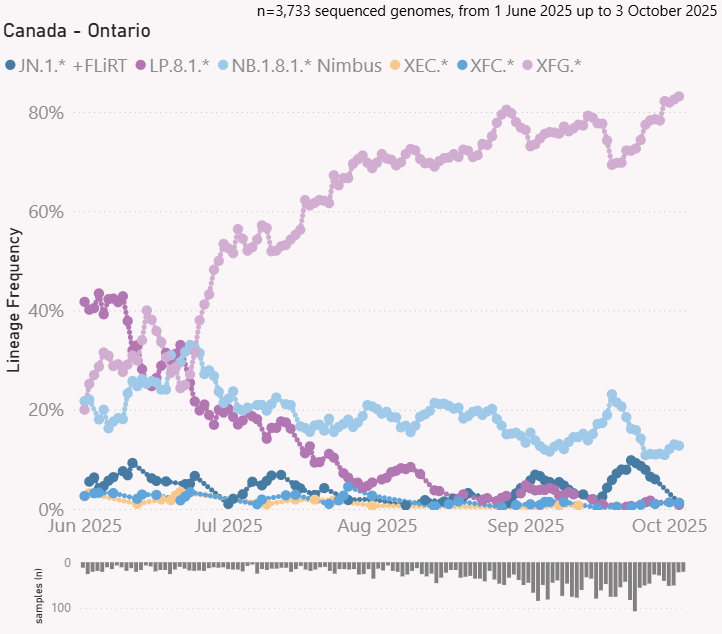
The XFG.* "Stratus" family is accounting for 83% while the next closest variant family NB.1.8.1.* "Nimbus" is 12.8% of sequenced genomes from COVID tests. 🧵1/ Line graph showing COVID-19 variant family frequencies in Ontario, Canada, from June to October 2025, based on 3,722 sequenced genomes.
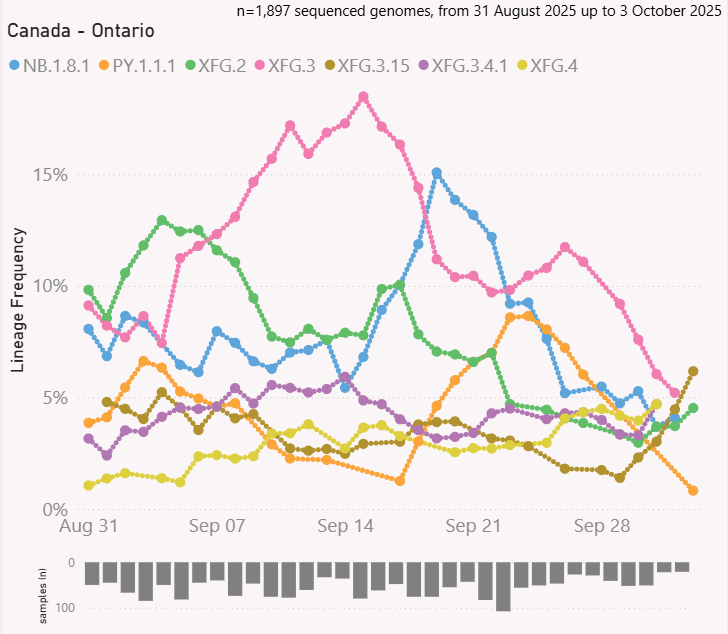
Looking at specific variants, XFG.3 has dropped considerably and its descendent XFG.3.15 now takes first place at 6.2%, followed by XFG.3 at 5.2% and XFG.2 at 4.5%. 2/ Line graph showing specific COVID-19 variant frequencies in Ontario, Canada, from June to October 2025, based on 3,722 sequenced genomes.
It looks like PY.1.1.1 was trying to make a run for the top in mid-September but has decreased significantly. PY.1.1.1 is a descendant of LF.7 while the XFG variant is a recombination of LF.7 and LP.8.1.2 so they would share some mutations in common. 3/
Read 10 tweets
Sep 9, 2025
*** Ontario Variant Update (to: Aug. 16, 2025) ***

Ontario COVID sequence updates have been more frequent over the past month with the XFG.* "Stratus" family of variants now at 74% of sequences, NB.1.8.1.* "Nimbus" at 22% and LP.8.1.* down to 3%. #Variants #XFG #Stratus 🧵1/ Line graph showing COVID-19 variant frequencies in Ontario, Canada, from May to mid August 2025, based on 1,772 sequenced genomes. The XFG.* Stratus variant rises sharply to dominate over 70% by August. Other variants, including FLiRT and LP.8.1.*, decline over the same period, while NB.1.8.1.* Nimbus remains steady around 20% and several minor variants remain at low levels.
Looking at specific variants as of mid August, XFG.5.1 is most prevalent at 13%, NB.1.8.1 in second at 10%, XFG.2 in third at 8.6% and XFG.3 in fourth at 7.4%. 2/ Line graph showing COVID-19 variant frequencies in Ontario from 5 July to 16 August 2025, based on 750 sequenced genomes. Seven variants are tracked: NB.1.8.1, XFG.2, XFG.3, XFG.3.4.1, XFG.3.1, XFG.4.1, and XFG.5.1. Frequencies range from 0% to about 14%, with some variants rising, others falling, and some fluctuating over time. A bar chart below shows the number of samples collected on each date.
LP.8.1 is what this fall's Japan Novavax vaccine and the mRNA vaccines are designed for which is now almost gone and typical of how these things work with vaccine manufacturing timing while Novavax is providing the previous year's JN.1 vaccine formula for the USA again. 3/
Read 18 tweets

Did Thread Reader help you today?

Support us! We are indie developers!


This site is made by just two indie developers on a laptop doing marketing, support and development! Read more about the story.

Become a Premium Member ($3/month or $30/year) and get exclusive features!

Become Premium

Don't want to be a Premium member but still want to support us?

Make a small donation by buying us coffee ($5) or help with server cost ($10)

Donate via Paypal

Or Donate anonymously using crypto!

Ethereum

0xfe58350B80634f60Fa6Dc149a72b4DFbc17D341E copy

Bitcoin

3ATGMxNzCUFzxpMCHL5sWSt4DVtS8UqXpi copy

Thank you for your support!

Follow Us!

:(