🚨 @Karpathy predicted the power of the "LLM Wiki." Google just formalized it.
Meet Open Knowledge Format (OKF): a vendor-neutral standard for giving foundation models the curated context they need.
I can genuinely see this replacing Notion, Obsidian, or traditional wikis for developer teams, and the reason comes down to bookkeeping.
Traditional wikis fail because humans inevitably abandon the tedious work of updating them.
As Andrej Karpathy pointed out recently, LLMs don't get bored.
They don't forget to update a cross-reference, and they can touch 15 files in a single pass.
OKF standardizes the interoperability layer so agents can actually do that heavy lifting autonomously.
Because the format is minimally opinionated, it doesn't dictate what you write, it just dictates how it's structured. You get:
→ Human-readable documents that live right alongside your code in version control
→ Cross-links that map out complex entity relationships without needing a graph database
→ A system that survives moving between different tools and organizations
There is no complex compression scheme.
No central registry.
If you can cat a file, you can read it.
If you can git clone a repo, you can deploy it.
This is how we stop rebuilding context pipelines from scratch every time a new model drops.
🚨 Karpathy’s new set-up is the ultimate self-improving second brain, and it takes zero manual editing 🤯
It acts as a living AI knowledge base that actually heals itself.
Let me break it down.
Instead of relying on complex RAG, the LLM pulls raw research directly into an @Obsidian Markdown wiki. It completely takes over:
✦ Index creation
✦ System linting
✦ Native Q&A routing
The core process is beautifully simple:
→ You dump raw sources into a folder
→ The LLM auto-compiles an indexed .md wiki
→ You ask complex questions
→ It generates outputs (Marp slides, matplotlib plots) and files them back in
The big-picture implication of this is just wild.
When agents maintain their own memory layer, they don’t need massive, expensive context limits.
They really just need two things:
→ Clean file organization
→ The ability to query their own indexes
Forget stuffing everything into one giant prompt.
This approach is way cheaper, highly scalable... and 100% inspectable!
Wow. Insanely fast turnaround from @himanshustwts!
A full breakdown of @karpathy’s self-improving wiki framework,
walking through every stage from ingestion to what comes next 👀
@himanshustwts @karpathy Omar took a v. similar approach with @Obsidian
THIS is the wildest open-source project I’ve seen this month.
We were all hyped about @karpathy's autoresearch project automating the experiment loop a few weeks ago.
(ICYMI → github.com/karpathy/autor…)
But a bunch of folks just took it ten steps further and automated the entire scientific method end-to-end.
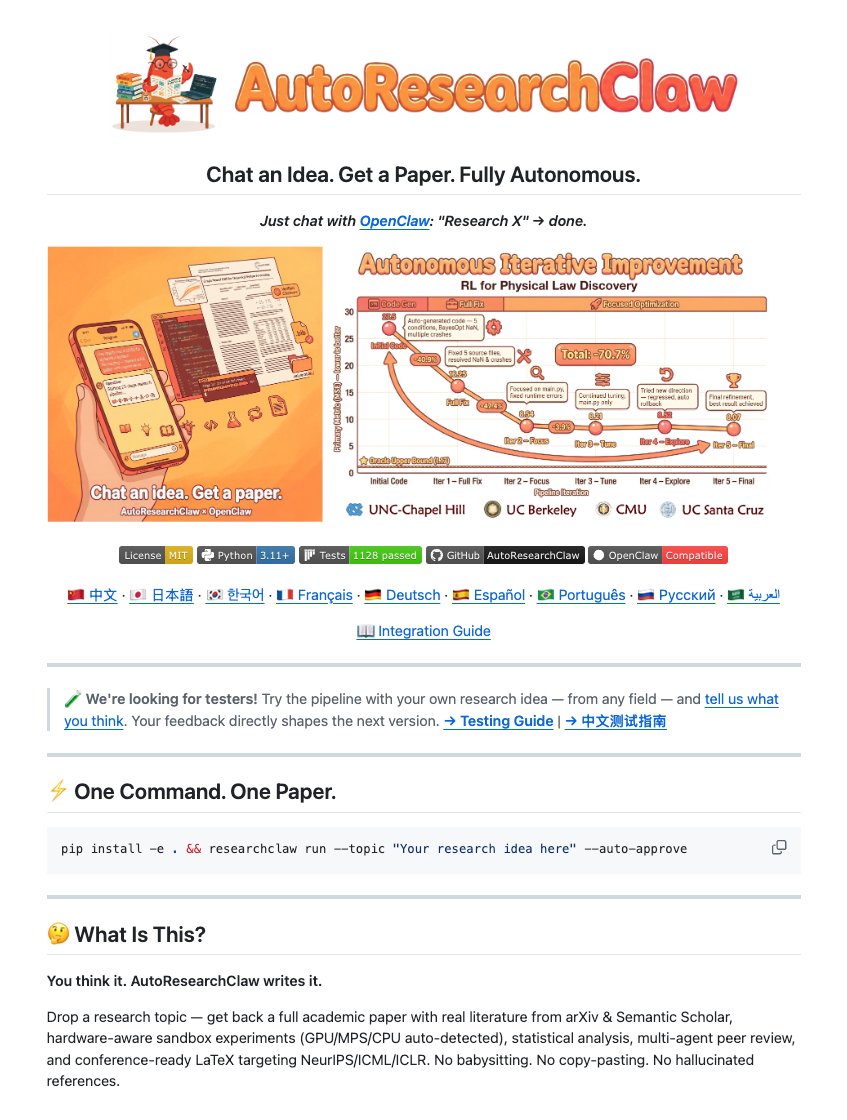
It's called AutoResearchClaw, and it's fully open-source.
You pass it a single CLI command with a raw idea, and it completely takes over 🤯
The 23-stage loop they designed is insane:
✦ First, it handles the literature review.
- It searches arXiv and Semantic Scholar for real papers
- Cross-references them against DataCite and CrossRef.
- No fake papers make it through.
✦ Second, it runs the sandbox.
- It generates the code from scratch.
- If the code breaks, it self-heals.
- You don't have to step in.
✦ Finally, it writes the paper.
- It structures 5,000+ words into Introduction, Related Work, Method, and Experiments.
- Formats the math, generates the comparison charts,
- Then wraps the whole thing in official ICML or ICLR LaTeX templates.
You can set it to pause for human approval, or you can just pass the --auto-approve flag and walk away.
What it spits out at the end:
→ Full academic paper draft
→ Conference-grade .tex files
→ Verified, hallucination-free citations
→ All experiment scripts and sandbox results
This is what autonomous AI agents actually look like in 2026.