
I read a lot of Covid research.
See my pinned tweet for the angle I view it from.
I don't understand all the research, but here's what I do understand:
Specialists representing every bodily function are completely freaked out by what SARS-CoV-2 is damaging in their area.
🔥👇
See my pinned tweet for the angle I view it from.
I don't understand all the research, but here's what I do understand:
Specialists representing every bodily function are completely freaked out by what SARS-CoV-2 is damaging in their area.
🔥👇
I don't just mean specialists in one area like 'the heart'.
'The heart' is just one organ, but there are a thousand* biological processes that keep the heart functioning.
'The heart' is just one organ, but there are a thousand* biological processes that keep the heart functioning.
Specialists in these individual biological processes are freaked out by how SARS-CoV-2 puts these processes (just in the heart) off balance.
Like gusts of sidewind knocking a cyclist more and more off balance until
So a hundred specialists on a hundred biological processes of the heart are freaking out, and the same is happening with experts in vascular disease.
They're spotting this damage, and that damage, this process and that function.
There are dozens of problems being spotted in the liver.
And the kidneys, and your, for lack of a better term, immune system.
And the kidneys, and your, for lack of a better term, immune system.
And in your blood.
YOUR BLOOD.
Your life blood.
YOUR BLOOD.
Your life blood.
And in your brain.
You like your brain, don't you?
You like your brain, don't you?
And to your bones, and eyes, and ears and joints and teeth and gut.
I almost forgot lungs.
I almost forgot lungs.
About this point, someone normally replies "sources".
I'm saying water is wet.
We're standing in the rain.
And you're asking for sources.
We're standing in the rain.
And you're asking for sources.
There's a torrent of sources.
A tsunami.
An avalanche.
A swarm.
A plague.
A tsunami.
An avalanche.
A swarm.
A plague.
You want sources?
You have mankind's greatest technological marvel in your hand, and you use it to get the opinion of a sociologist who is paid by the new york times to keep everyone calm.
You have mankind's greatest technological marvel in your hand, and you use it to get the opinion of a sociologist who is paid by the new york times to keep everyone calm.
Do you know the prefix 'dys'?
It basically means 'off balance'.
Use Google's search engine.
Write ' Covid dys ' into the search bar, wait a moment, then look at the autocomplete suggestions.
It basically means 'off balance'.
Use Google's search engine.
Write ' Covid dys ' into the search bar, wait a moment, then look at the autocomplete suggestions.

Pick one.
Scroll through, pick a paper.
Scroll through, pick a paper.
Do you know the prefix 'hypo'?
It means low.
Do the same again.
It means low.
Do the same again.

Do 'hyper' meaning high.

I would say do the prefix 'a', meaning 'without' but that search just thinks you're saying the letter A.
So that one doesn't work.
So that one doesn't work.
Do 'haemo', meaning 'to do with blood'.

And 'immuno'.
And 'rena'.
And 'neuro'.
And 'vascula'
And 'rena'.
And 'neuro'.
And 'vascula'

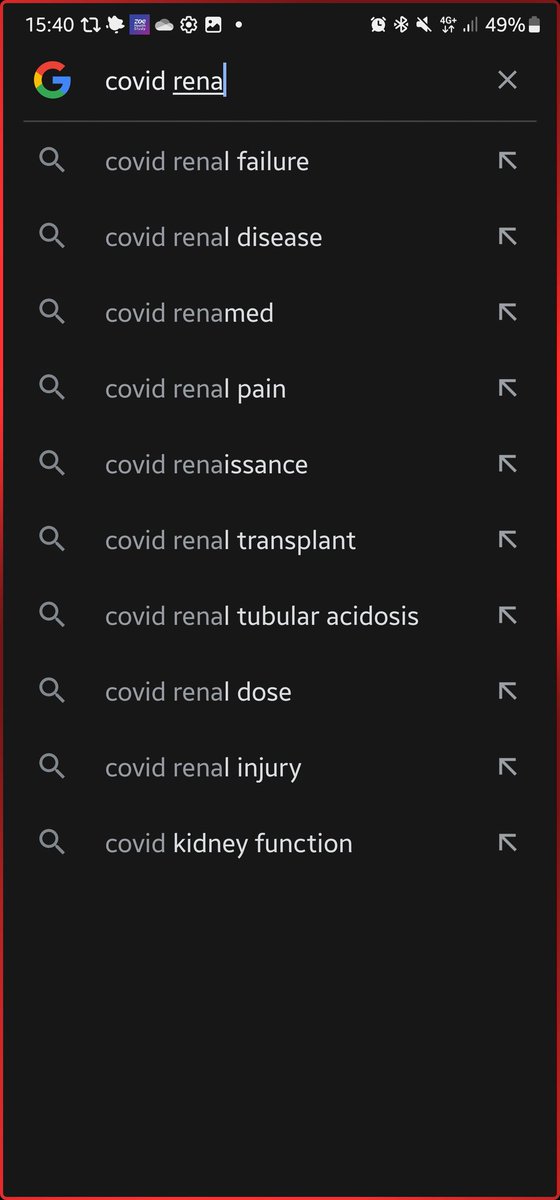


The individual specialists are freaking out because Covid is doing this **in their backyard**, and they fully understand the significance of what this means to the health of the whole body.
But they're so busy freaking out about hypogammaglobulinemia that they don't even know that the neuro dude next door is freaking out about plasma levels of glial fibrillary acidic protein.
But I'm a tern.
And I'm floating over the neighbourhood looking down at thousands of specialists each screaming about their own backyard.
And I'm floating over the neighbourhood looking down at thousands of specialists each screaming about their own backyard.
What does all this stuff mean?
Am I writing this just to scare you?
Am I writing this so you'll follow me or think I'm great?
No you fricking idiot.
You're driving over a cliff, and I'm just pointing it out.
Am I writing this just to scare you?
Am I writing this so you'll follow me or think I'm great?
No you fricking idiot.
You're driving over a cliff, and I'm just pointing it out.
What's it going to mean?
I think if we keep catching Covid endlessly it's going to mean shorter, sicker, more unconfortable, harder, more painful, more inconvenient, more unpredictable lives.
Significantly so.
For everyone.
I think if we keep catching Covid endlessly it's going to mean shorter, sicker, more unconfortable, harder, more painful, more inconvenient, more unpredictable lives.
Significantly so.
For everyone.
We need to stop giving each other Covid.
Why aren't the governments saying anything?
Great question.
Great question.
Great question.
For the zoom in to one single area of damage:
https://twitter.com/1goodtern/status/1616383075738439680?t=vKAl3CQw6eAkl5Xrtu0aRw&s=19
• • •
Missing some Tweet in this thread? You can try to
force a refresh





