Big revelations this week about balloons spying on US. These aren't really revelations. Two years ago I laid out exactly this was happening, why it was happening, its historical precedent, that it was directly conflated with UAP, and that was a big problem thedrive.com/the-war-zone/4…
And no, this does not explain all UAP, not at all, as the piece states clearly in its opening. I believe there are unexplained instances that deserve all the scrutiny we can hope the US gov is finally giving them...
But as the piece laid out, our adversaries have used our stigmas toward UFOs against us and yes the government was way behind the curve in realizing any of this or at least willing to confront it. Even the basic structure of the DoD's now real UAP office is laid out in the post..
What I can say, is that the balloon thing is more widespread, not UAP, clear balloons with payloads where they should not be. The drone thing is another layer that is perhaps more troubling. But this is not new, now it's catch-up time, but this recent series of events are...
a good thing. Nobody was harmed and now this reality will have to be dealt with, as will the fact that UAP are being conflated with what is actually a very real and pressing security threat. The damage already done is likely very severe. But now we can close the gap, finally...
And work to better separate truly unexplainable events from those that are actually very low-end technology that is so simple it is somewhat alien based on our established defensive posture. And above all else, getting rid of this totally fucked stigma about reporting...
things in the sky, in space, on or below the oceans, that are unusual, especially by our military personnel. The next major capability leap by an adversary could look very alien or even be disguised as such. Choosing to be blind to what's coming over the horizon due to...
crazy pop-culture stigmas is maybe the most absurd military strategy of all time. But that has been the case and we have paid the price. And no, the powers that be don't want to advertise that they don't control the airspace they are tasked with controlling, but here we are...
we can change that and considering what we spend on national security a year, and that this is all defensive in nature, everyone should be onboard for doing so. Balloons are just one aspect of this of course, but they move so slow and have a small signature, they can be...
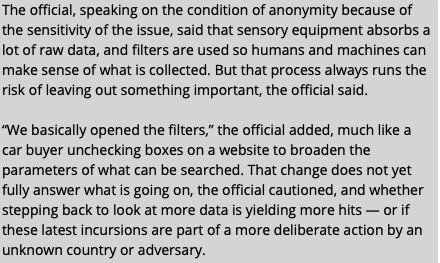
hard to spot, not just within a sensor's technological capabilities, but often times slow objects like that are filtered out deliberately. Finally, I think there is a lack of training on recognizing the presence of electronic warfare, or maybe there had been. That needs to change
It's hard to make people listen. There is so much noise out there, true signals are hard to recognize, especially in the media space. But the DoD needs to change how it looks at threats overall and how it acts on them. Huge programs reign supreme, these are often focused on...
fighting the last war, not what's coming and focus on traditional capabilities, not confronting asymmetric ones or even leveraging them to your advantage. We saw this same reality with drones, I screamed about it for years as many of you know, now, once again, it's catch-up time.
The enemy knows you have superior traditional capabilities, while they will work toward parity if possible, or numerical advantage, they will also work in parallel to exploit the holes in your strategy using far more attainable asymmetric capabilities...
We now live in an age where long-range precision-guided weaponry is democratized. Barrier to entry is very low. We are still not prepared to deal with it. So, call all this a big trial balloon. It may not be sexy, it may not give someone another star on their lapel or a...
a top-paying job at a huge defense contractor, but countering these low-end capabilities & having the creativity to recognize them before they become a problem, & the agency to do something about it, is key to our future national security. Let's learn these lessons while we can.
As always thank you for reading and excuse any typos (long week). I am going to share some critical supporting work that has been published since this piece on the use of balloons and the UAP conflation issue.
This is our most recent in a long series of pieces on these events that build on eachother. Make sure to click through the rabbit hole of links.
thedrive.com/the-war-zone/m…
thedrive.com/the-war-zone/m…
key one here:
thedrive.com/the-war-zone/4…
thedrive.com/the-war-zone/4…
• • •
Missing some Tweet in this thread? You can try to
force a refresh