I wanted to do a thread about operating mortars and a thread about tank ammunition... but can't, because before those two I have to do a thread 🧵about rifled and smoothbore barrels.
All NATO mortars (except for one) and all NATO 120mm tank guns (except for one) use
1/20
All NATO mortars (except for one) and all NATO 120mm tank guns (except for one) use
1/20
smoothbore barrels. This one mortar and this one tank use a rifled barrel, just like all NATO assault rifles, machine guns, auto cannons, recoilless rifles (photo: Carl Gustaf barrel), gatling guns, 105mm tank guns, howitzers, etc.
(Note: Shotguns use smoothbore barrels).
2/n
(Note: Shotguns use smoothbore barrels).
2/n

Why rifling? Well, you want the bullets, rounds, and projectiles to hit the intended target, therefore you have to stabilize them during flight. There are two ways to do that:
• rifled -> spin-stabilized
• smoothbore -> fin-stabilized
Fin-stabilized is obviously the much
3/n
• rifled -> spin-stabilized
• smoothbore -> fin-stabilized
Fin-stabilized is obviously the much
3/n
more ancient way to stabilize a projectile during flight... but spin stabilization is actually more precise.
There is a ton of physics needed to explain this in detail... which isn't as much fun as watching NFL players throw perfect passes, because they spin the ball and not
4/n
There is a ton of physics needed to explain this in detail... which isn't as much fun as watching NFL players throw perfect passes, because they spin the ball and not
4/n
as much fun explaining how artillery uses spin to smite the enemy.
This is the barrel of an M777 howitzer. The rifling isn't random - it's aligned to the ammunition that will be fired from this barrel. You want the projectile or bullet to fly through the air tip first, with
5/n
This is the barrel of an M777 howitzer. The rifling isn't random - it's aligned to the ammunition that will be fired from this barrel. You want the projectile or bullet to fly through the air tip first, with
5/n

too much or too little spin the projectile will wobble and crash.
Spin rate also vastly differs between calibers - i.e. a 5.56mm M4 Carbine fired bullet will spin around 5,200 times per second, while a 155mm M777 howitzer fired projectile will spin about 250 times per second.
6/n
Spin rate also vastly differs between calibers - i.e. a 5.56mm M4 Carbine fired bullet will spin around 5,200 times per second, while a 155mm M777 howitzer fired projectile will spin about 250 times per second.
6/n
But not just the caliber, the weight and length of the projectile, the length of the barrel, the amount of propellant, etc. are used when calculating the twist rate of a barrel, because the barrel's grooves exert torque on the projectiles passing through the barrel & thus
7/n
7/n

impart a spin on the projectile's longitudinal axis, which stabilizes the projectiles longitudinally through conservation of angular momentum.
For smaller calibers, like NATO's bullets, the projectile's diameter is actually larger than most people know as the caliber is
8/n
For smaller calibers, like NATO's bullets, the projectile's diameter is actually larger than most people know as the caliber is
8/n

actually the land diameter. I.e.
• NATO 5.56mm bullets are actually 5.70mm
• NATO 7.62mm bullets are actually 7.82mm
When the bullet is fired its jacket (usually copper) is deformed: this engages the rifling, which imparts the spin AND obturates the barrel to prevent the
9/n
• NATO 5.56mm bullets are actually 5.70mm
• NATO 7.62mm bullets are actually 7.82mm
When the bullet is fired its jacket (usually copper) is deformed: this engages the rifling, which imparts the spin AND obturates the barrel to prevent the
9/n

propellant gas to blow by the bullet. Every bullet coming out of a barrel has distinct rifling grooves imparted by the barrel's rifling.
But what works with bullets you don't want to use for explosive filled projectiles... well, first because they are explosive filled and
10/n
But what works with bullets you don't want to use for explosive filled projectiles... well, first because they are explosive filled and
10/n
you don't want them to be deformed.
Secondly having the entire body of a 155mm projectile engage the rifling would wear out the rifling in no time.
Thirdly scratches and grooves on the projectile will mess with its aerodynamics and when firing a shell 20+ km any deviation in
11/n
Secondly having the entire body of a 155mm projectile engage the rifling would wear out the rifling in no time.
Thirdly scratches and grooves on the projectile will mess with its aerodynamics and when firing a shell 20+ km any deviation in
11/n
aerodynamics will result in missing the target.
Therefore explosive filled projectiles have a driving band (also called rotating band). That band is usually copper or copper alloys.
Some projectiles also have a obturating band made from plastic or nylon.
12/n
Therefore explosive filled projectiles have a driving band (also called rotating band). That band is usually copper or copper alloys.
Some projectiles also have a obturating band made from plastic or nylon.
12/n

Smaller calibers, like i.e. the 30×173mm ammo for the A-10 Thunderbolt II's GAU-8/A Avenger cannon use plastic driving bands for obturation and to engage the rifling.
But artillery (and rifled tank cannons) use metal driving bands.
13/n
But artillery (and rifled tank cannons) use metal driving bands.
13/n


Driving bands and obturators are protected by a cover during transport. Obviously you have to to remove that after you screwed in the fuze and before you fire the projectile.
14/n
14/n


Once you're ready to fire the projectile is rammed into the cannon, past the charge chamber and into the barrel with the driving band wedged into the forcing cone between charge chamber and barrel.
You better ram the projectile hard into the cone or it will slide back out.
15/n
You better ram the projectile hard into the cone or it will slide back out.
15/n
Once you fire the projectile the driving band will deform, seal the barrel and engage the rifling.
And your projectile is on its way - with the driving band cleary showing the grooves imparted by the barrel's rifling.
16/n
And your projectile is on its way - with the driving band cleary showing the grooves imparted by the barrel's rifling.
16/n
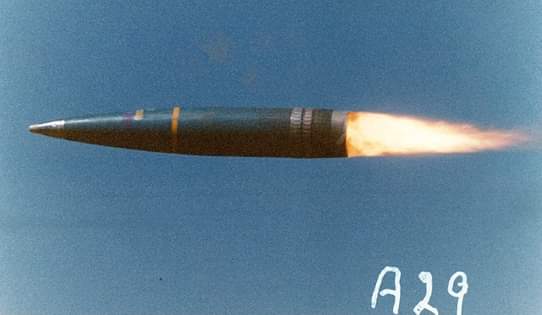
The spin also serves a second purpose: to ensure fuzes are not armed prematurely fuzes (especially point detonating) included a Setback Lock (Red) and a Spin Lock (Blue), which armed the fuze once certain acceleration and spin values were achieved.
I use past tense, as today
17/n
I use past tense, as today
17/n

the mechanical locks are being replaced by MEMS chips.
And now to the M982 Excalibur precision guided munition, which as you can see, does not have a driving band.
There is a plastic obturating ring, which will engage the rifling, but in the Excalibur projectile only the
18/n
And now to the M982 Excalibur precision guided munition, which as you can see, does not have a driving band.
There is a plastic obturating ring, which will engage the rifling, but in the Excalibur projectile only the
18/n

base bleed section spins... and at a very low rate, as once Excalibur reaches the apogee of its flight it deploys fins and glides to its target as a fin-stabilized projectile.
This video shows first a high explosive projectile & then two Excalibur projectiles in flight.
19/n
This video shows first a high explosive projectile & then two Excalibur projectiles in flight.
19/n
This was my (hopefully understandable) thread about rifled barrels and spin-stabilization.
Tomorrow we will hear a lot about smoothbore barrels and fin-stabilization, when I post my threads about mortars and tank guns.
20/20
Tomorrow we will hear a lot about smoothbore barrels and fin-stabilization, when I post my threads about mortars and tank guns.
20/20

• • •
Missing some Tweet in this thread? You can try to
force a refresh