Tank ammo thread 🧵:
All current Western tanks (except for Challenger 2) use 120mm smoothbore tank guns:
120mm/ L44 cannon:
🇩🇪 Leopard 2 (up to A5)
🇺🇸 M1A1, M1A2 Abrams
🇰🇷 K1A1, K1A2
🇯🇵 Type 90, Type 10
🇮🇹 Ariete
🇮🇱 Merkava III, Merkava IV
120mm/ L52 cannon:
🇫🇷 Leclerc
1/28
All current Western tanks (except for Challenger 2) use 120mm smoothbore tank guns:
120mm/ L44 cannon:
🇩🇪 Leopard 2 (up to A5)
🇺🇸 M1A1, M1A2 Abrams
🇰🇷 K1A1, K1A2
🇯🇵 Type 90, Type 10
🇮🇹 Ariete
🇮🇱 Merkava III, Merkava IV
120mm/ L52 cannon:
🇫🇷 Leclerc
1/28


120mm/ L55 cannon:
🇩🇪 Leopard 2 (since A6)
🇰🇷 K2 Black Panther
🇹🇷 Altay
🇬🇧 Challenger 3
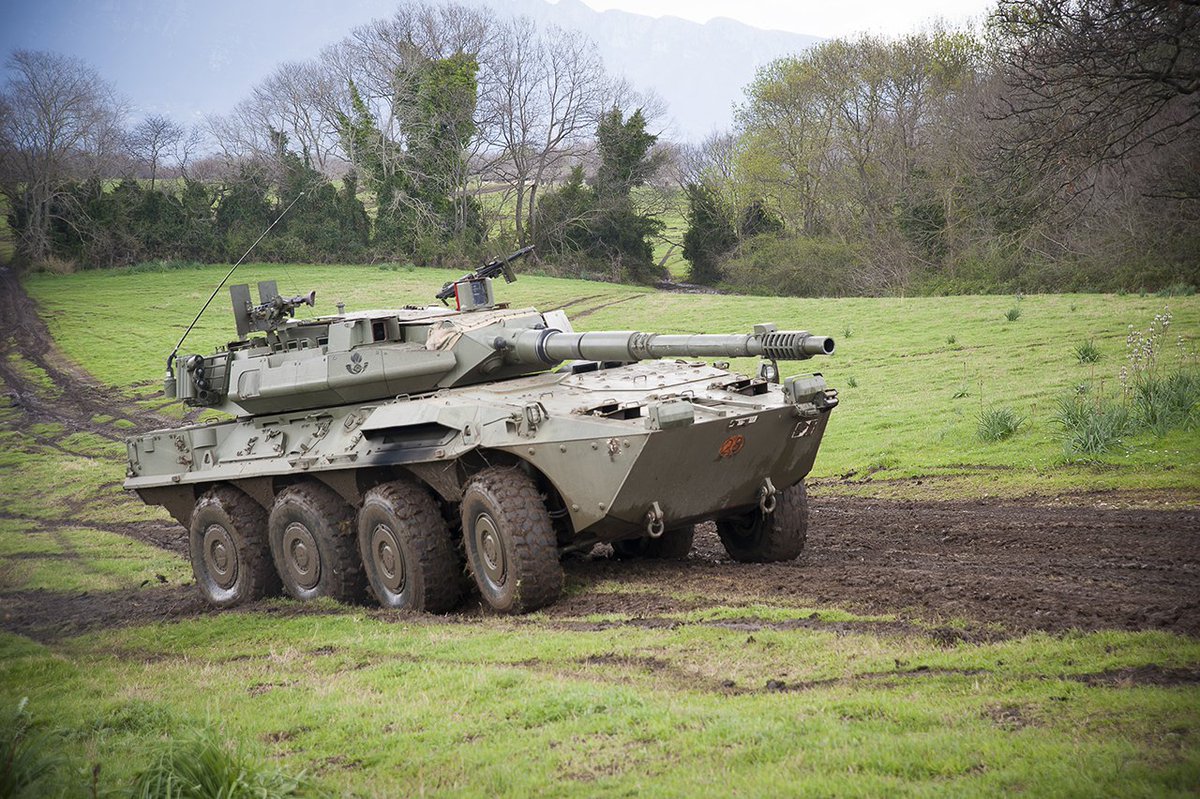
Older Western tanks (i.e. Leopard 1, M60 Patton, K1, Merkava I/II) use rifled 105mm cannons, as do current Western fire support vehicles (Centauro, M1128 MGS, Type 16, Griffin II).
2/n
🇩🇪 Leopard 2 (since A6)
🇰🇷 K2 Black Panther
🇹🇷 Altay
🇬🇧 Challenger 3
Older Western tanks (i.e. Leopard 1, M60 Patton, K1, Merkava I/II) use rifled 105mm cannons, as do current Western fire support vehicles (Centauro, M1128 MGS, Type 16, Griffin II).
2/n


The only outliers to this rule (older tanks use 105mm rifled - modern tanks use 120mm smoothbore) are the British Army's Chieftain (left), Challenger 1, and Challenger 2 (right) tanks, which use 120mm rifled guns.
Rifled guns spin-stabilize projectiles, while smoothbore guns
3/n
Rifled guns spin-stabilize projectiles, while smoothbore guns
3/n


use fin-stabilized projectiles. If you're are not familiar with these terms, please read my recent thread about the difference between rifeld and smoothbore barrels and the different types of projectile stabilization:
4/n
4/n
https://mobile.twitter.com/noclador/status/1624559430816747521
To understand why NATO began to use smoothbore barrels, we have to look at the three types of modern anti-tank ammunition, which are depicted in this photo of Leopard 1 anti-tank ammo:
• APDS (superseded by APFSDS)
• HEAT (the two rounds in the center)
• HESH (or HEP)
5/n
• APDS (superseded by APFSDS)
• HEAT (the two rounds in the center)
• HESH (or HEP)
5/n

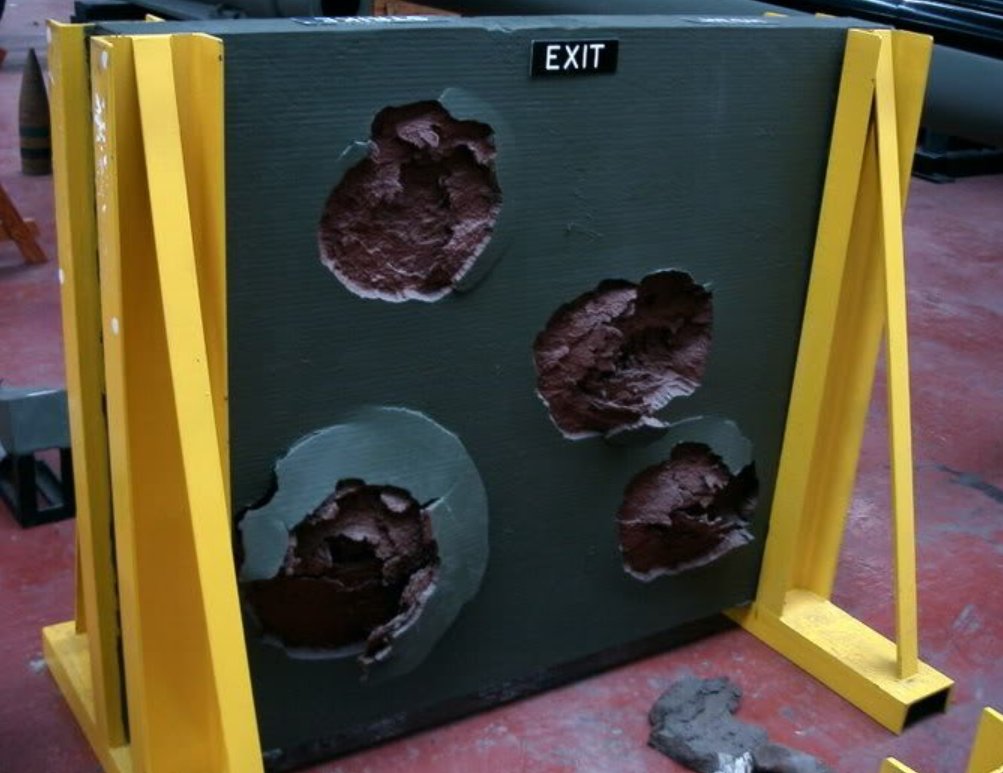
HESH/HEP or High Explosive Squash Head/High Explosive Plastic rounds are not designed to penetrate armor. HESH rounds have a thin metal hull and are filled with a plastic explosive, which upon impact will be squashed against the enemy armor before being detonated by the fuze
6/n
6/n

located at the rear of the round. The detonation creates a shockwave that passes through the armor and creates supersonic metal spall (splinters) inside the enemy vehicle.
Left: impact outside the tank
Right: spalling inside the tank
7/n
Left: impact outside the tank
Right: spalling inside the tank
7/n


It's the same physical principle as Newton's Cradle.
Due to their thin shells HESH rounds are fired at low muzzle velocities of 650-750m/s. HESH rounds are ideal for rifled guns as the spin-stabilization's centrifugal forces help create a more effective explosive patch.
8/n
Due to their thin shells HESH rounds are fired at low muzzle velocities of 650-750m/s. HESH rounds are ideal for rifled guns as the spin-stabilization's centrifugal forces help create a more effective explosive patch.
8/n
HESH rounds are most effective against metal armor, but since the late Cold War armored vehicles use composite armor with layers of metal, plastics, and ceramics, and often also include spaced armor (= empty space between armor layers), which neutralizes HESH rounds.
9/n
9/n
Explosive reactive armor (ERA, i.e the bricks on this Ukrainian tank) also reduce the effectiveness of HESH. As all modern armored vehicles use spall liners HESH is now obsolete in tank warfare.
HESH is still used by Fire Support Vehicles to breach concrete obstacles.
10/n
HESH is still used by Fire Support Vehicles to breach concrete obstacles.
10/n

HEAT or High Explosive Anti-Tank rounds use a explosively formed penetrator to defeat enemy armor.
This penetrator is formed by explosively collapsing a thin, conical, metal liner into a Mach 25 fast metal jet, which penetrates the armor.
This video compares HESH & HEAT.
11/n
This penetrator is formed by explosively collapsing a thin, conical, metal liner into a Mach 25 fast metal jet, which penetrates the armor.
This video compares HESH & HEAT.
11/n
HEAT rounds are less effective when fired from a rifled barrel as the spinning disperses the metal jet.
HEAT rounds are most effective when detonated at a specific distance to the target, hence the protruding tip with the trigger that makes HEAT rounds easy to recognize.
12/n
HEAT rounds are most effective when detonated at a specific distance to the target, hence the protruding tip with the trigger that makes HEAT rounds easy to recognize.
12/n

The larger the diameter of a HEAT round the deeper the penetration, but a larger diameter reduces the round's accuracy at longer distances.
HEAT rounds are also used in other short to medium range anti-tank weapons like PARM 2, Panzerfaust 3, Carl Gustaf, etc.
13/n
HEAT rounds are also used in other short to medium range anti-tank weapons like PARM 2, Panzerfaust 3, Carl Gustaf, etc.
13/n


Slat armor, spaced armor, the ceramics and plastics in composite armor reduce the effectiveness of HEAT rounds, while explosive reactive armor almost always neutralizes them.
HEAT rounds can be fired from rifled barrels, but to be effective the explosion of the charge has to
14/n
HEAT rounds can be fired from rifled barrels, but to be effective the explosion of the charge has to
14/n
impart an opposite spin on the jet. This can be achieved by the shape of the liner or by manipulating its crystalline structure.
Once the armor has been penetrated splinters and spall of the hypersonic jet will injure or kill the tank crew.
Photo: at the top HEAT impacts
15/n
Once the armor has been penetrated splinters and spall of the hypersonic jet will injure or kill the tank crew.
Photo: at the top HEAT impacts
15/n

This brings us to the most used and effective anti-tank munition:
• APDS - Armour-piercing discarding sabot (if spin stabilized)
• APFSDS - Armour-piercing fin-stabilized discarding sabot (if fin stabilized - pictured)
16/n
• APDS - Armour-piercing discarding sabot (if spin stabilized)
• APFSDS - Armour-piercing fin-stabilized discarding sabot (if fin stabilized - pictured)
16/n

Both consist of a sub-caliber kinetic energy penetrator surrounded by a sabot, which is propels the round through the barrel and is discarded once the round has left the barrel.
ASDS and APFSDS do not contain any explosive and their penetration energy comes from the firing
17/n
ASDS and APFSDS do not contain any explosive and their penetration energy comes from the firing
17/n
of the tank gun. This means higher muzzle velocities result in better effects on the target.
Rifled barrels (left) decrease muzzle velocity by 20-30% and require bigger charges to achieve the same kinetic energy as smoothbore barrels (right). Bigger charges increase wear.
18/n
Rifled barrels (left) decrease muzzle velocity by 20-30% and require bigger charges to achieve the same kinetic energy as smoothbore barrels (right). Bigger charges increase wear.
18/n


In short: smoothbore guns punch harder & last longer.
With the Challenger 3 update the Challenger 2, the last Western tank with a rifled barrel, will receive a new turret with a 120mm/ L55 smoothbore barrel.
Btw. L55 is the length of the barrel: 120mm × 55 = 6.6 meter.
19/n
With the Challenger 3 update the Challenger 2, the last Western tank with a rifled barrel, will receive a new turret with a 120mm/ L55 smoothbore barrel.
Btw. L55 is the length of the barrel: 120mm × 55 = 6.6 meter.
19/n

The longer the barrel the longer and higher the peak pressure from the propellant, which results in higher velocities.
Kinetic energy penetrators exit smoothbore barrels at around Mach 5 (1,650-1,800 m/s - depending on barrel length, propellant, penetrator density & length)
20/n
Kinetic energy penetrators exit smoothbore barrels at around Mach 5 (1,650-1,800 m/s - depending on barrel length, propellant, penetrator density & length)
20/n
Btw. never stand in front of a tank - the three discarded sabot pieces fly and are deadly for 200m. One sabot piece of the APFSDS round this Australian M1A1 just fired hit the ground in front of the tank.
21/n
21/n

Simplified: harder, longer, denser penetrates deeper and so all Western APFSDS penetrators are made from Depleted Uranium and Tungsten.
APFSDS training rounds, like the ones this Challenger 2 fires, are made from cheaper alloys and have a much reduced penetration power.
22/n
APFSDS training rounds, like the ones this Challenger 2 fires, are made from cheaper alloys and have a much reduced penetration power.
22/n
When an APFSDS round hits an enemy tank the armor and penetrator behave like fluids (I massively simplify the physics here) and the penetrator will "flow" through the armor.
Once the armor is penetrated splinters and spall will annihilate the tank crew.
23/n
Once the armor is penetrated splinters and spall will annihilate the tank crew.
23/n

russian tanks are defenseless against Western APFSDS rounds. Not even active protection systems can stop them.
However Western tanks have extremely dense armor, which will stop russian APFSDS rounds. (The denser the armor the easier to defeat APFSDS - hence the M1A2 Abrams
24/n
However Western tanks have extremely dense armor, which will stop russian APFSDS rounds. (The denser the armor the easier to defeat APFSDS - hence the M1A2 Abrams
24/n

has layers of Depleted Uranium armor).
120mm smoothbore guns firing APFSDS are ideal to defeat tanks - 105mm rifled guns firing HESH & Anti-Personnel rounds are useful to support infantry & can ambush enemy tanks from the side with HEAT & APFSDS rounds (Photo: Leopard 1A5)
25/n
120mm smoothbore guns firing APFSDS are ideal to defeat tanks - 105mm rifled guns firing HESH & Anti-Personnel rounds are useful to support infantry & can ambush enemy tanks from the side with HEAT & APFSDS rounds (Photo: Leopard 1A5)
25/n

Therefore Leopard 1A5 are still very useful for Ukraine, as long as they are not used in frontal attacks against russian T-80 and T-90.
Challenger 2 tanks can defeat all russian tanks and are impenetrable to russian projectiles, as are Leopard 2A6 and M1A2 Abrams, whose
26/n
Challenger 2 tanks can defeat all russian tanks and are impenetrable to russian projectiles, as are Leopard 2A6 and M1A2 Abrams, whose
26/n
APFSDS rounds will penetrate the front armor and exit the rear of russian tanks.
Western tanks never miss due to their superb optics, gun stabilization & fire control systems, which automatically fire rounds in a ballistic curve to compensate for gravity as seen in this pic.
27/n
Western tanks never miss due to their superb optics, gun stabilization & fire control systems, which automatically fire rounds in a ballistic curve to compensate for gravity as seen in this pic.
27/n

And in this video you see an M1A2 Abrams tank driving around the range as the gun stabilization keeps the gun aimed at the target no matter how the tank moves.
Western tanks are as superior to russian tanks, as an F-35 is superior to Mig-21.
28/end
Western tanks are as superior to russian tanks, as an F-35 is superior to Mig-21.
28/end
I created a short "PS" thread to address questions that came up in the comments to this thread. Check it out:
https://twitter.com/noclador/status/1625971515119337472
• • •
Missing some Tweet in this thread? You can try to
force a refresh