The Feb 26-Mar 4 Canadian COVID Forecast and associated data are now live.
SEVERE: NB, NS
VERY HIGH: CAN, BC, MB, QC, SK
HIGH: AB, North, ON, PEI
ELEVATED: NL
About 1 in 43 people is currently infected in Canada.
Data, weekly report here: covid19resources.ca/covid-hazard-i…
SEVERE: NB, NS
VERY HIGH: CAN, BC, MB, QC, SK
HIGH: AB, North, ON, PEI
ELEVATED: NL
About 1 in 43 people is currently infected in Canada.
Data, weekly report here: covid19resources.ca/covid-hazard-i…

Here's the link to the folder where you can find downloadable png and jpeg versions of all our graphics.
Shortform graphics are available in English et en francais.
Longform en francais a venir.
drive.google.com/drive/folders/…
Shortform graphics are available in English et en francais.
Longform en francais a venir.
drive.google.com/drive/folders/…
And here's where you can sign up to join any of our free, evening, anonymous (if you want) kitchen table-style Zoom discussions with scientists.
Remember: No question is too small. No question is silly. YOU matter, and we're here to provide support.
covid19resources.ca/discussions/
Remember: No question is too small. No question is silly. YOU matter, and we're here to provide support.
covid19resources.ca/discussions/
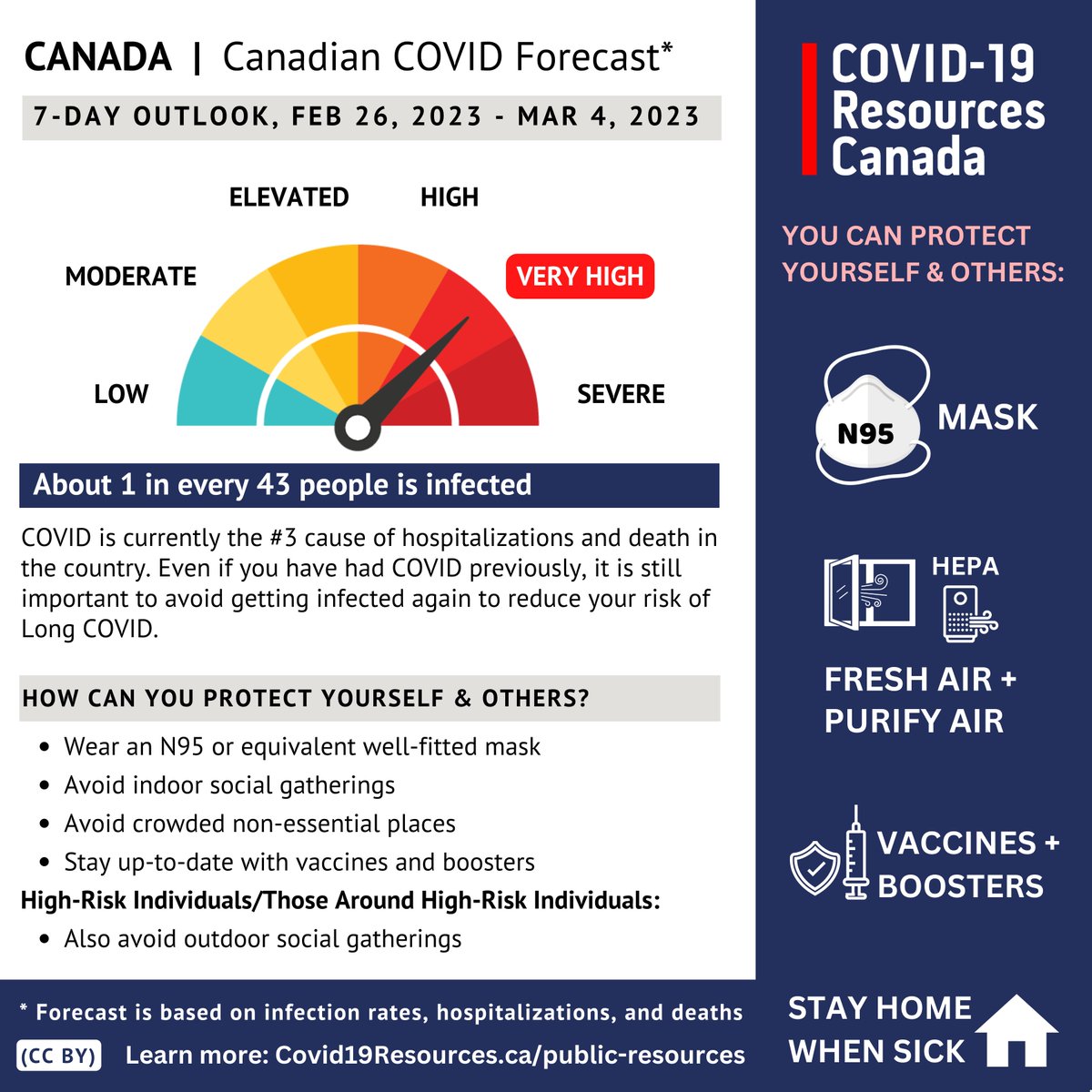
Canadian COVID Forecast Feb 26-Mar 4, 2023
CANADA
VERY HIGH
About 1 in every 43 people is infected.
HOW TO HELP:
Mask, get your booster, avoid non-essential indoor public places, social gatherings.
Higher risk: also avoid outdoor social gatherings.
CANADA
VERY HIGH
About 1 in every 43 people is infected.
HOW TO HELP:
Mask, get your booster, avoid non-essential indoor public places, social gatherings.
Higher risk: also avoid outdoor social gatherings.
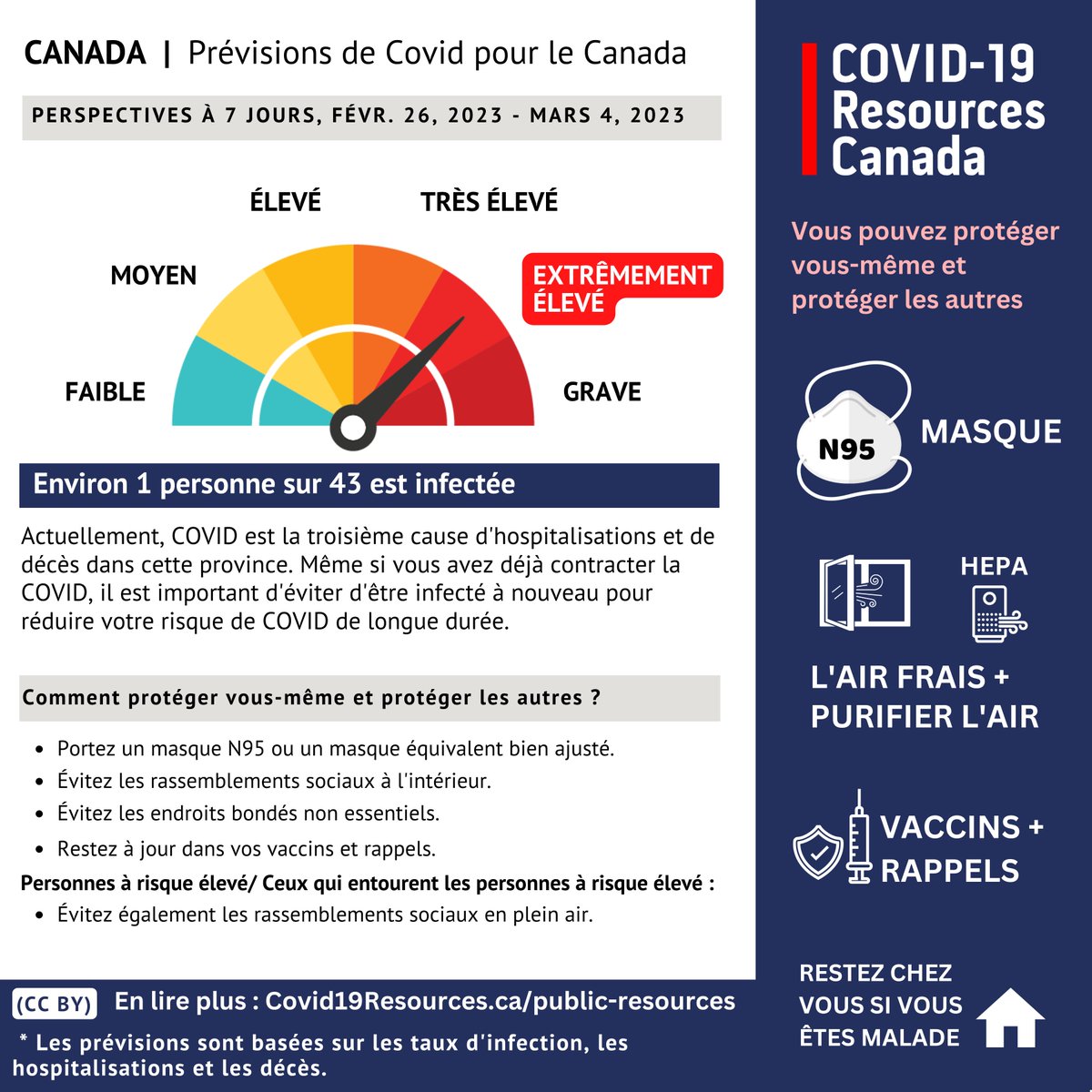
Prévisions COVID 26 fév-4 mars/23
CANADA
EXTRÊMEMENT ÉLEVÉ
~1 personne sur 43 est infectée
Portez un masque, faites votre rappel, évitez lieux publics intérieurs non essentiels, rassemblements sociaux
Risque plus élevé : évitez également rassemblements sociaux en plein air
CANADA
EXTRÊMEMENT ÉLEVÉ
~1 personne sur 43 est infectée
Portez un masque, faites votre rappel, évitez lieux publics intérieurs non essentiels, rassemblements sociaux
Risque plus élevé : évitez également rassemblements sociaux en plein air
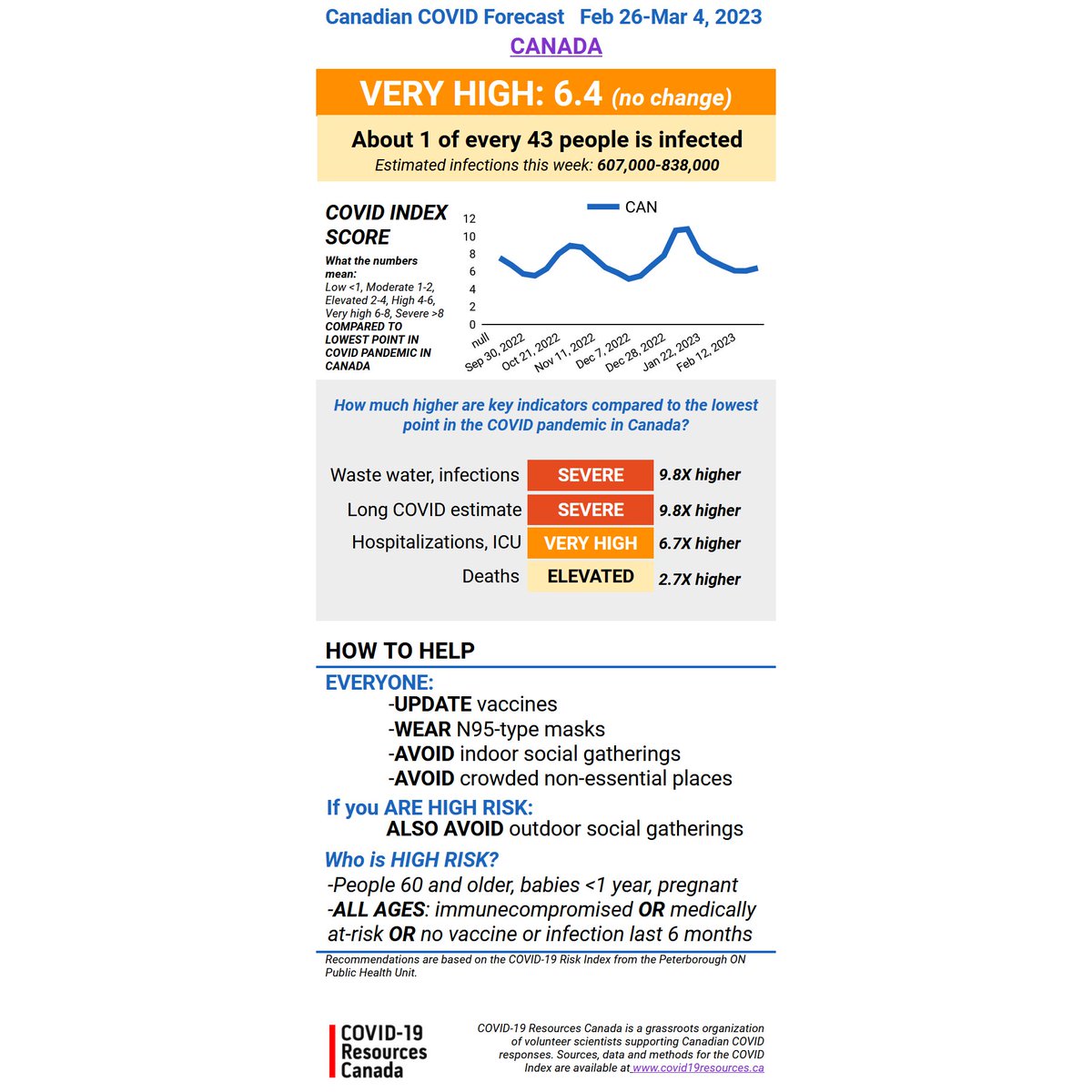
Canadian COVID Forecast Feb 26-Mar 4, 2023
CANADA
VERY HIGH
About 1 in every 43 people infected
Compared to lowest point of pandemic in Canada:
🟡Waste water, infections, long COVID cases ~10X higher
🟡Hospitalizations ~7X higher
🟡Deaths ~3X higher
CANADA
VERY HIGH
About 1 in every 43 people infected
Compared to lowest point of pandemic in Canada:
🟡Waste water, infections, long COVID cases ~10X higher
🟡Hospitalizations ~7X higher
🟡Deaths ~3X higher
CANADA: Feb 26-Mar 4
About 1 in 43 people are infected this week.
You can help:
1. Stay home if sick
2. Avoid crowded non-essential places
3. Mask to protect others (and yourself)
4. Offer to help people at higher risk with things like essential shopping.
5. Update vaccine
About 1 in 43 people are infected this week.
You can help:
1. Stay home if sick
2. Avoid crowded non-essential places
3. Mask to protect others (and yourself)
4. Offer to help people at higher risk with things like essential shopping.
5. Update vaccine
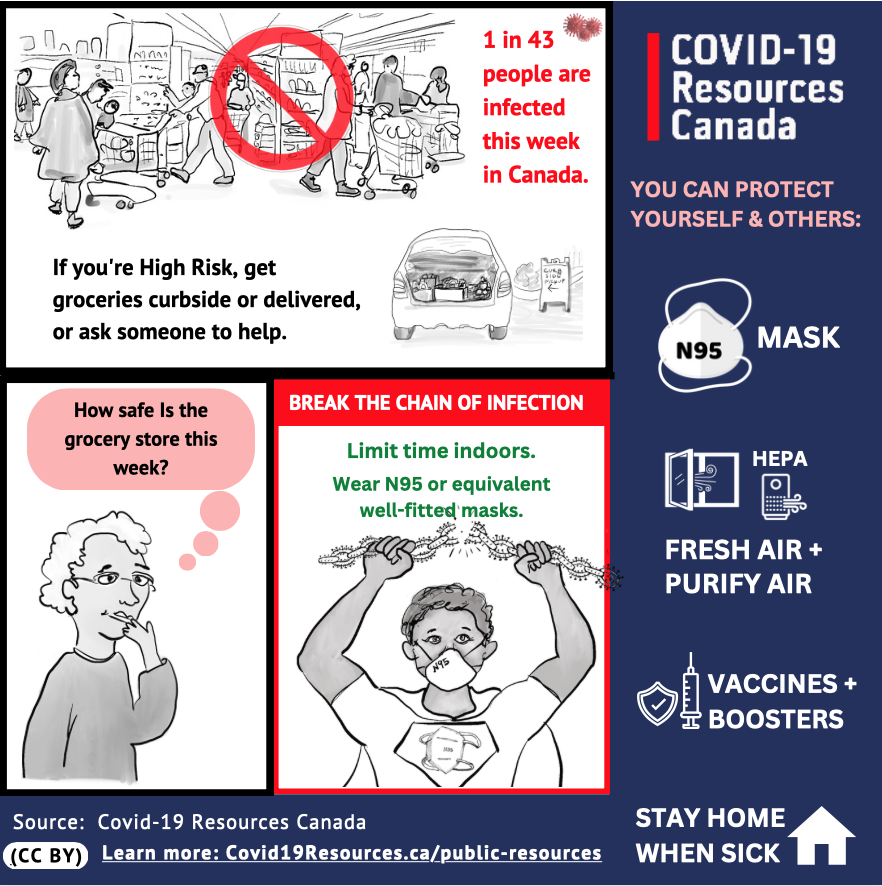
Canadian COVID Forecast Feb 26-Mar 4, 2023
NEWFOUNDLAND AND LABRADOR
ELEVATED
About 1 in every 106 people is infected.
HOW TO HELP:
Mask, get your booster, avoid non-essential indoor public places, social gatherings.
Higher risk: also avoid outdoor social gatherings.
NEWFOUNDLAND AND LABRADOR
ELEVATED
About 1 in every 106 people is infected.
HOW TO HELP:
Mask, get your booster, avoid non-essential indoor public places, social gatherings.
Higher risk: also avoid outdoor social gatherings.
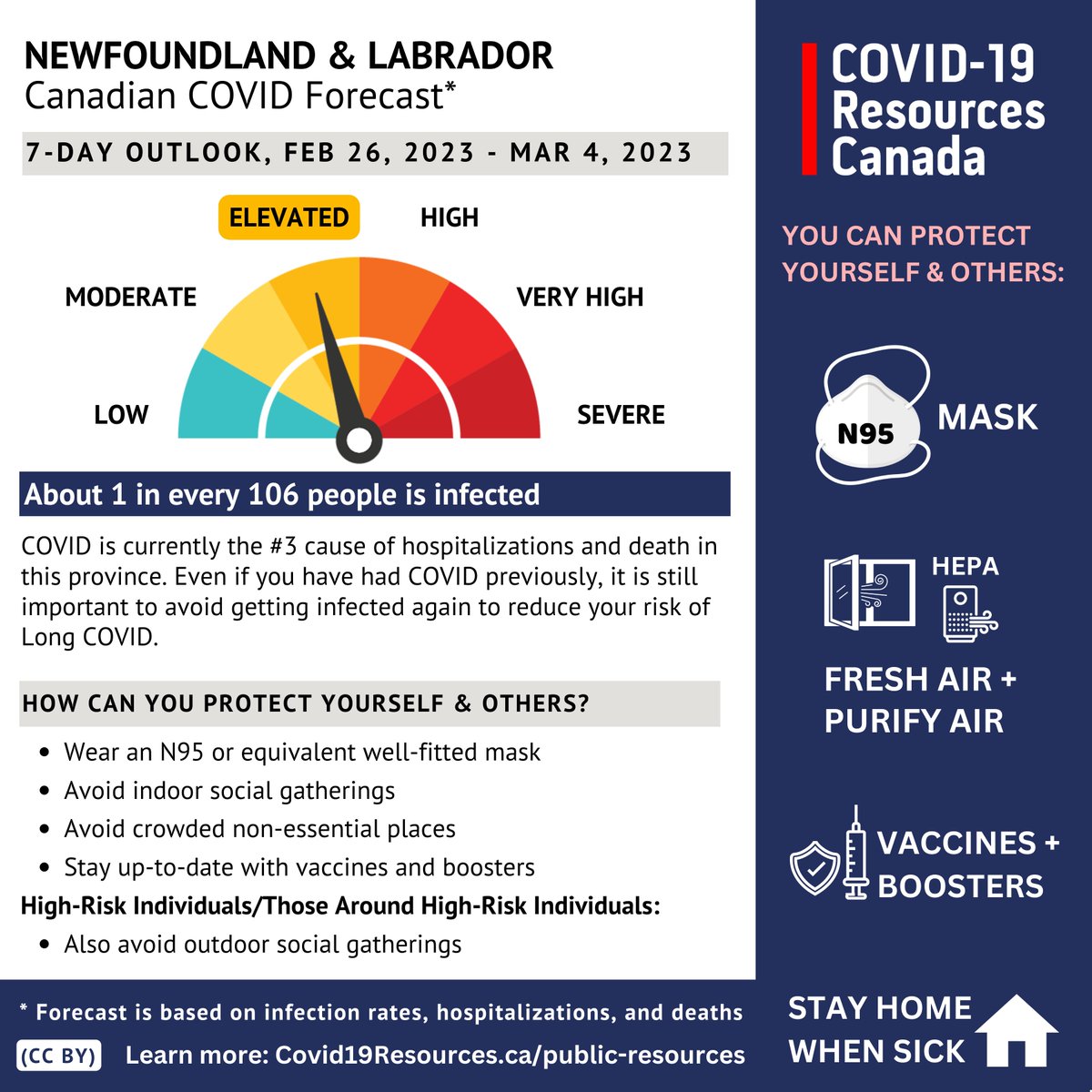
Canadian COVID Forecast Feb 26-Mar 4, 2023
NEWFOUNDLAND AND LABRADOR
ELEVATED
About 1 in every 106 people is infected.
HOW TO HELP:
Mask, get your booster, avoid non-essential indoor public places, social gatherings.
Higher risk: also avoid outdoor social gatherings.
NEWFOUNDLAND AND LABRADOR
ELEVATED
About 1 in every 106 people is infected.
HOW TO HELP:
Mask, get your booster, avoid non-essential indoor public places, social gatherings.
Higher risk: also avoid outdoor social gatherings.

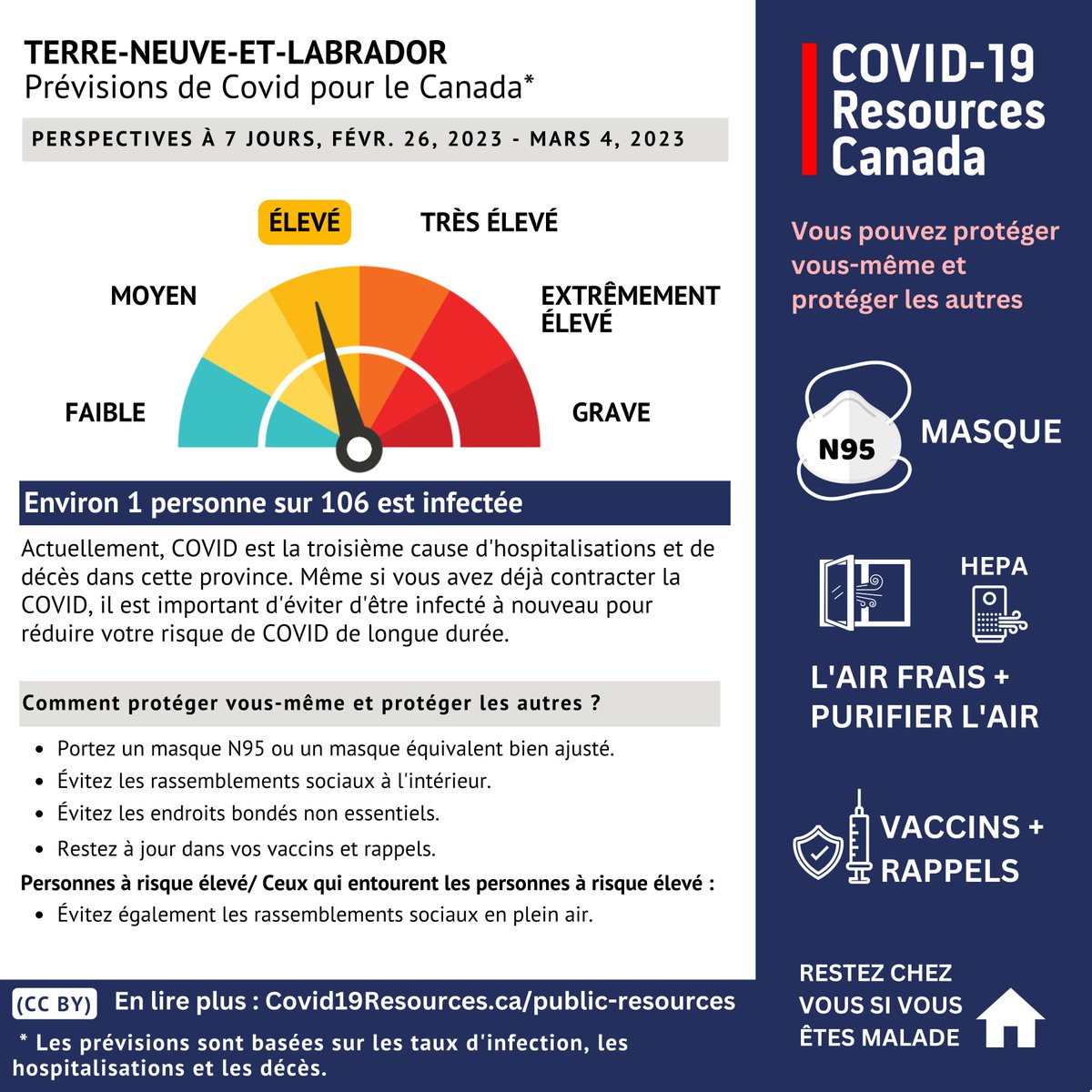
Prévisions COVID 26 fév-4 mars/23
TERRE NEUVE LABRADOR
ÉLEVÉ
~1 personne sur 106 est infectée
Portez un masque, faites votre rappel, évitez lieux publics intérieurs non essentiels, rassemblements sociaux
Risque plus élevé : évitez également rassemblements sociaux en plein air
TERRE NEUVE LABRADOR
ÉLEVÉ
~1 personne sur 106 est infectée
Portez un masque, faites votre rappel, évitez lieux publics intérieurs non essentiels, rassemblements sociaux
Risque plus élevé : évitez également rassemblements sociaux en plein air
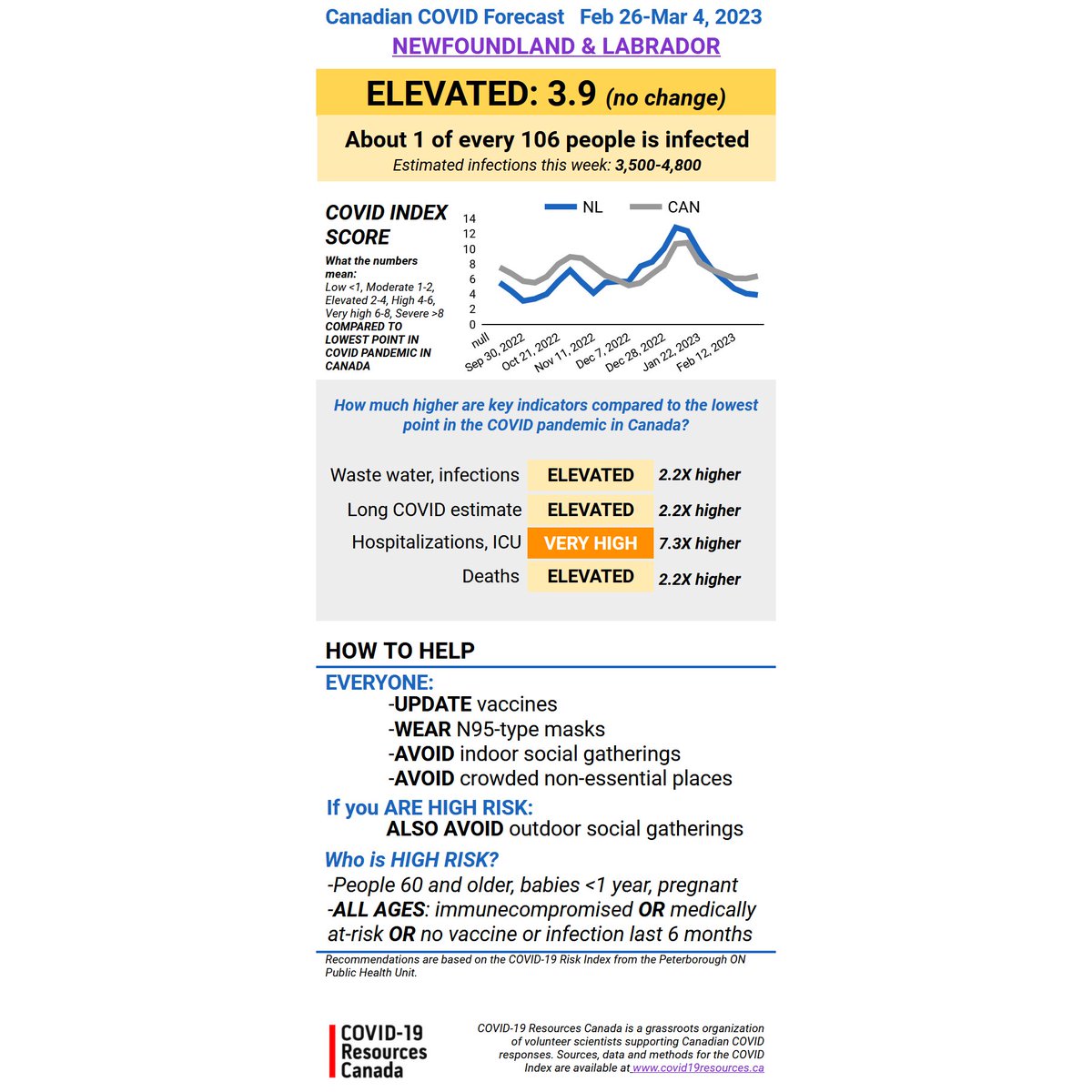
Canadian COVID Forecast Feb 26-Mar 4, 2023
NEWFOUNDLAND AND LABRADOR
ELEVATED
About 1 in every 106 people infected
Compared to lowest point of pandemic in Canada:
🟡Waste water, infections, long COVID cases ~2X higher
🟡Hospitalizations ~7X higher
🟡Deaths ~2X higher
NEWFOUNDLAND AND LABRADOR
ELEVATED
About 1 in every 106 people infected
Compared to lowest point of pandemic in Canada:
🟡Waste water, infections, long COVID cases ~2X higher
🟡Hospitalizations ~7X higher
🟡Deaths ~2X higher
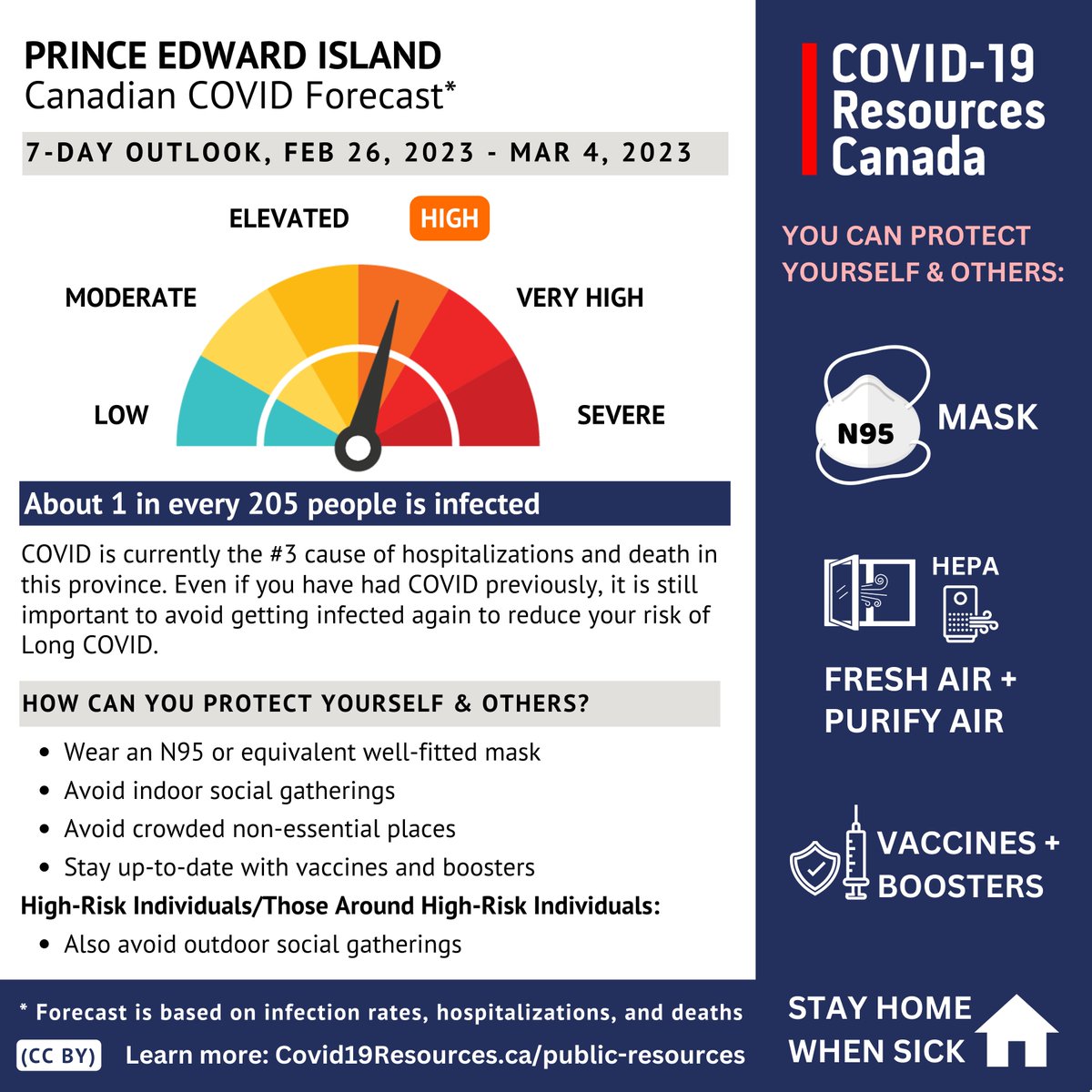
Canadian COVID Forecast Feb 26-Mar 4, 2023
PRINCE EDWARD ISLAND
HIGH
About 1 in every 205 people is infected.
HOW TO HELP:
Mask, get your booster, avoid non-essential indoor public places, social gatherings.
Higher risk: also avoid outdoor social gatherings.
PRINCE EDWARD ISLAND
HIGH
About 1 in every 205 people is infected.
HOW TO HELP:
Mask, get your booster, avoid non-essential indoor public places, social gatherings.
Higher risk: also avoid outdoor social gatherings.
Prévisions COVID 26 fév-4 mars/23
ÎLE DU PRINCE-ÉDOUARD
TRÈS ÉLEVÉ
~1 personne sur 205 infectée
Portez un masque, faites votre rappel, évitez lieux publics intérieurs non essentiels, rassemblements sociaux
Risque plus élevé : évitez également rassemblements sociaux en plein air
ÎLE DU PRINCE-ÉDOUARD
TRÈS ÉLEVÉ
~1 personne sur 205 infectée
Portez un masque, faites votre rappel, évitez lieux publics intérieurs non essentiels, rassemblements sociaux
Risque plus élevé : évitez également rassemblements sociaux en plein air

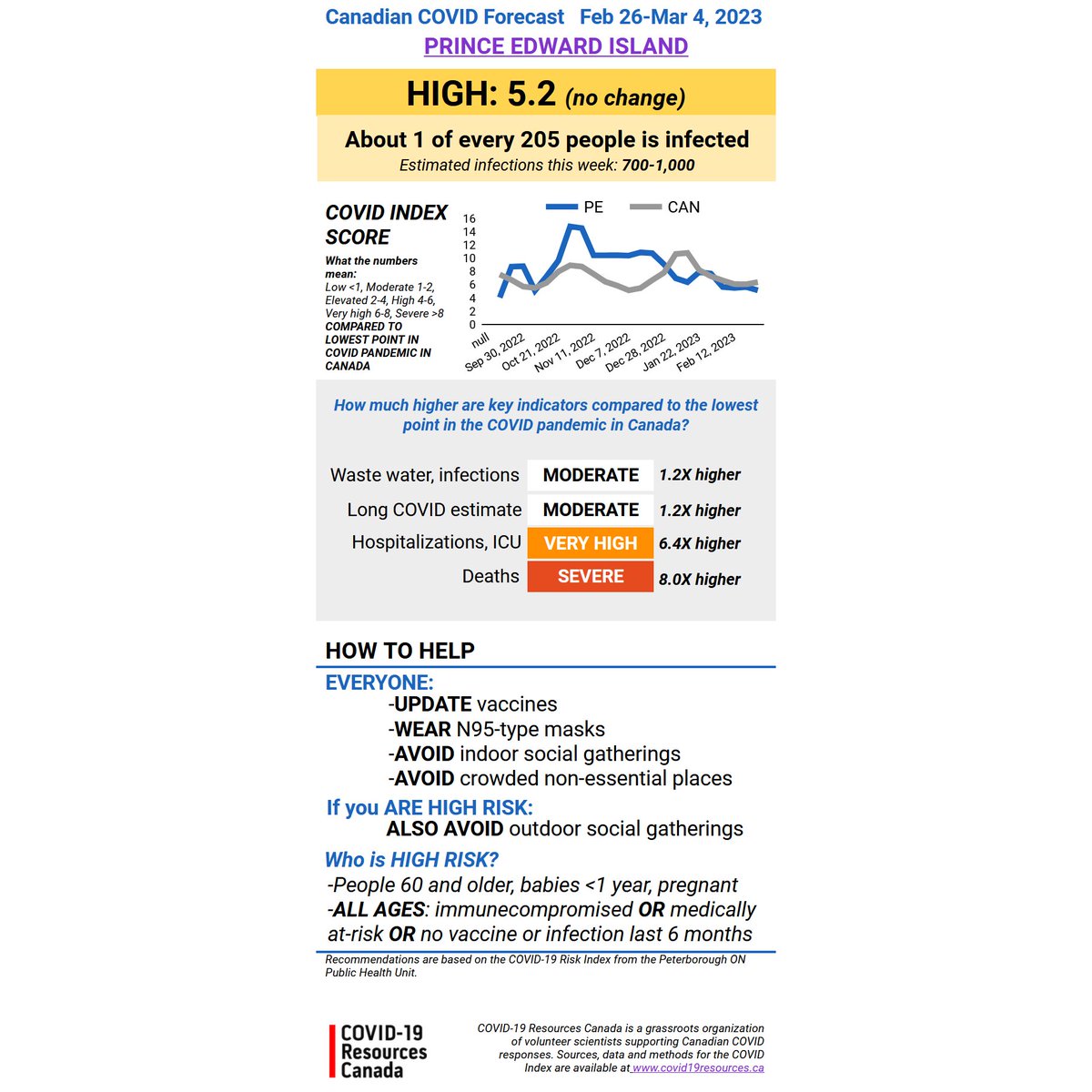
Canadian COVID Forecast Feb 26-Mar 4, 2023
PRINCE EDWARD ISLAND
HIGH
About 1 in every 205 people infected
Compared to lowest point of pandemic in Canada:
🟡Waste water, infections, long COVID cases: similar
🟡Hospitalizations ~6X higher
🟡Deaths ~8X higher
PRINCE EDWARD ISLAND
HIGH
About 1 in every 205 people infected
Compared to lowest point of pandemic in Canada:
🟡Waste water, infections, long COVID cases: similar
🟡Hospitalizations ~6X higher
🟡Deaths ~8X higher
Canadian COVID Forecast Feb 26-Mar 4, 2023
NOVA SCOTIA
SEVERE
About 1 in every 34 people is infected.
HOW TO HELP:
Mask, get your booster, avoid non-essential indoor public places, social gatherings.
Higher risk: also avoid outdoor social gatherings.
NOVA SCOTIA
SEVERE
About 1 in every 34 people is infected.
HOW TO HELP:
Mask, get your booster, avoid non-essential indoor public places, social gatherings.
Higher risk: also avoid outdoor social gatherings.

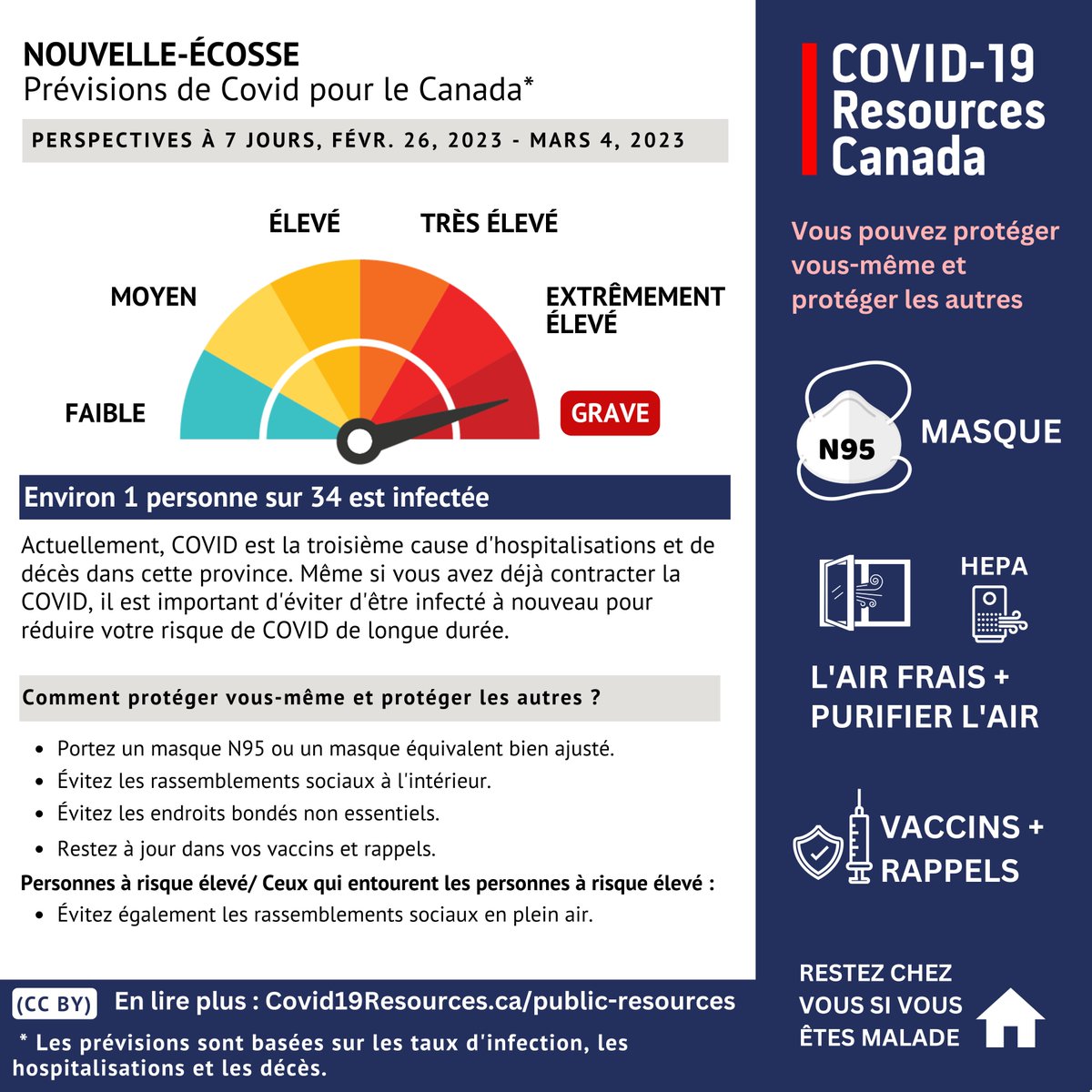
Prévisions COVID 26 fév-4 mars/23
NOUVELLE-ÉCOSSE
GRAVE
~1 personne sur 34 infectée
Portez un masque, faites votre rappel, évitez lieux publics intérieurs non essentiels, rassemblements sociaux
Risque plus élevé : évitez également rassemblements sociaux en plein air
NOUVELLE-ÉCOSSE
GRAVE
~1 personne sur 34 infectée
Portez un masque, faites votre rappel, évitez lieux publics intérieurs non essentiels, rassemblements sociaux
Risque plus élevé : évitez également rassemblements sociaux en plein air
Canadian COVID Forecast Feb 26-Mar 4, 2023
NOVA SCOTIA
SEVERE
About 1 in every 34 people infected
Compared to lowest point of pandemic in Canada:
🟡Waste water, infections, long COVID cases: ~12X higher
🟡Hospitalizations ~6X higher
🟡Deaths ~8X higher
NOVA SCOTIA
SEVERE
About 1 in every 34 people infected
Compared to lowest point of pandemic in Canada:
🟡Waste water, infections, long COVID cases: ~12X higher
🟡Hospitalizations ~6X higher
🟡Deaths ~8X higher

Canadian COVID Forecast Feb 26-Mar 4, 2023
NEW BRUNSWICK
SEVERE
About 1 in every 49 people is infected.
HOW TO HELP:
Mask, get your booster, avoid non-essential indoor public places, social gatherings.
Higher risk: also avoid outdoor social gatherings.
NEW BRUNSWICK
SEVERE
About 1 in every 49 people is infected.
HOW TO HELP:
Mask, get your booster, avoid non-essential indoor public places, social gatherings.
Higher risk: also avoid outdoor social gatherings.

Prévisions COVID 26 fév-4 mars/23
NOUVEAU BRUNSWICK
GRAVE
~1 personne sur 49 infectée
Portez un masque, faites votre rappel, évitez lieux publics intérieurs non essentiels, rassemblements sociaux
Risque plus élevé : évitez également rassemblements sociaux en plein air
NOUVEAU BRUNSWICK
GRAVE
~1 personne sur 49 infectée
Portez un masque, faites votre rappel, évitez lieux publics intérieurs non essentiels, rassemblements sociaux
Risque plus élevé : évitez également rassemblements sociaux en plein air

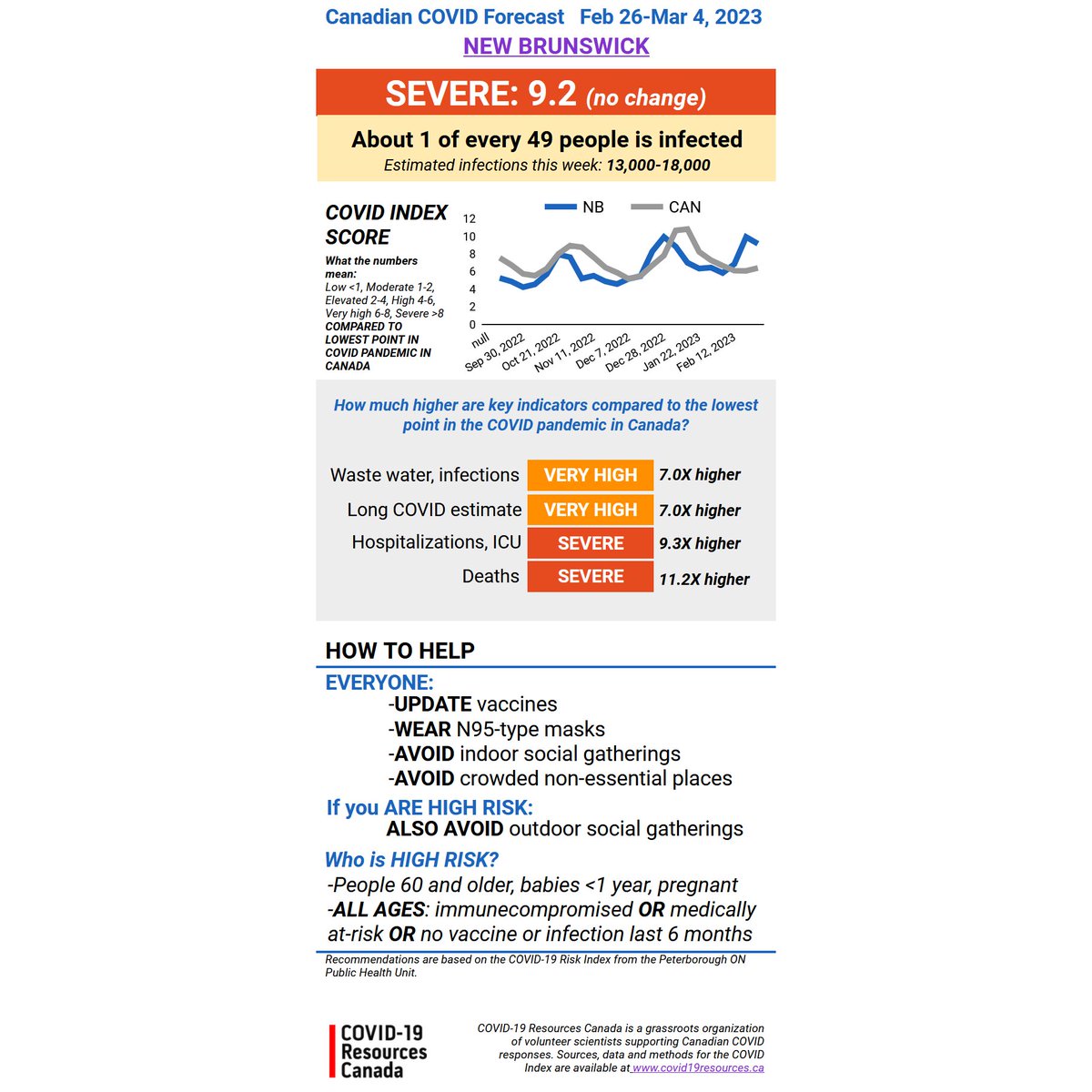
Canadian COVID Forecast Feb 26-Mar 4, 2023
NEW BRUNSWICK
SEVERE
About 1 in every 49 people infected
Compared to lowest point of pandemic in Canada:
🟡Waste water, infections, long COVID cases: ~7X higher
🟡Hospitalizations ~9X higher
🟡Deaths ~11X higher
NEW BRUNSWICK
SEVERE
About 1 in every 49 people infected
Compared to lowest point of pandemic in Canada:
🟡Waste water, infections, long COVID cases: ~7X higher
🟡Hospitalizations ~9X higher
🟡Deaths ~11X higher
Canadian COVID Forecast Feb 26-Mar 4, 2023
QUÉBEC
VERY HIGH
About 1 in every 38 people is infected.
HOW TO HELP:
Mask, get your booster, avoid non-essential indoor public places, social gatherings.
Higher risk: also avoid outdoor social gatherings.
QUÉBEC
VERY HIGH
About 1 in every 38 people is infected.
HOW TO HELP:
Mask, get your booster, avoid non-essential indoor public places, social gatherings.
Higher risk: also avoid outdoor social gatherings.

Prévisions COVID 26 fév-4 mars/23
QUÉBEC
EXTRÊMEMENT ÉLEVÉ
~1 personne sur 38 infectée
Portez un masque, faites votre rappel, évitez lieux publics intérieurs non essentiels, rassemblements sociaux
Risque plus élevé : évitez également rassemblements sociaux en plein air
QUÉBEC
EXTRÊMEMENT ÉLEVÉ
~1 personne sur 38 infectée
Portez un masque, faites votre rappel, évitez lieux publics intérieurs non essentiels, rassemblements sociaux
Risque plus élevé : évitez également rassemblements sociaux en plein air
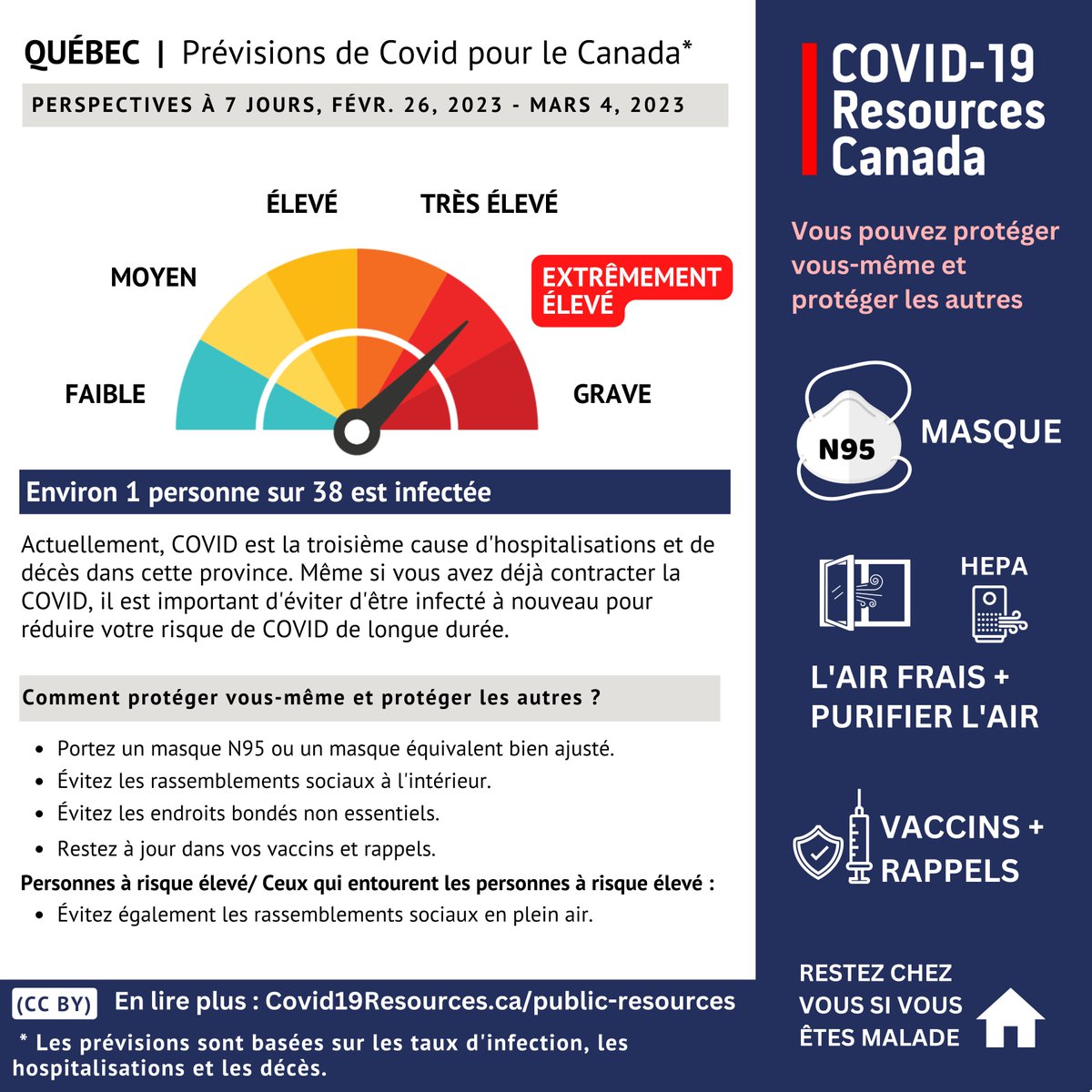
Canadian COVID Forecast Feb 26-Mar 4, 2023
QUÉBEC
VERY HIGH
About 1 in every 38 people infected
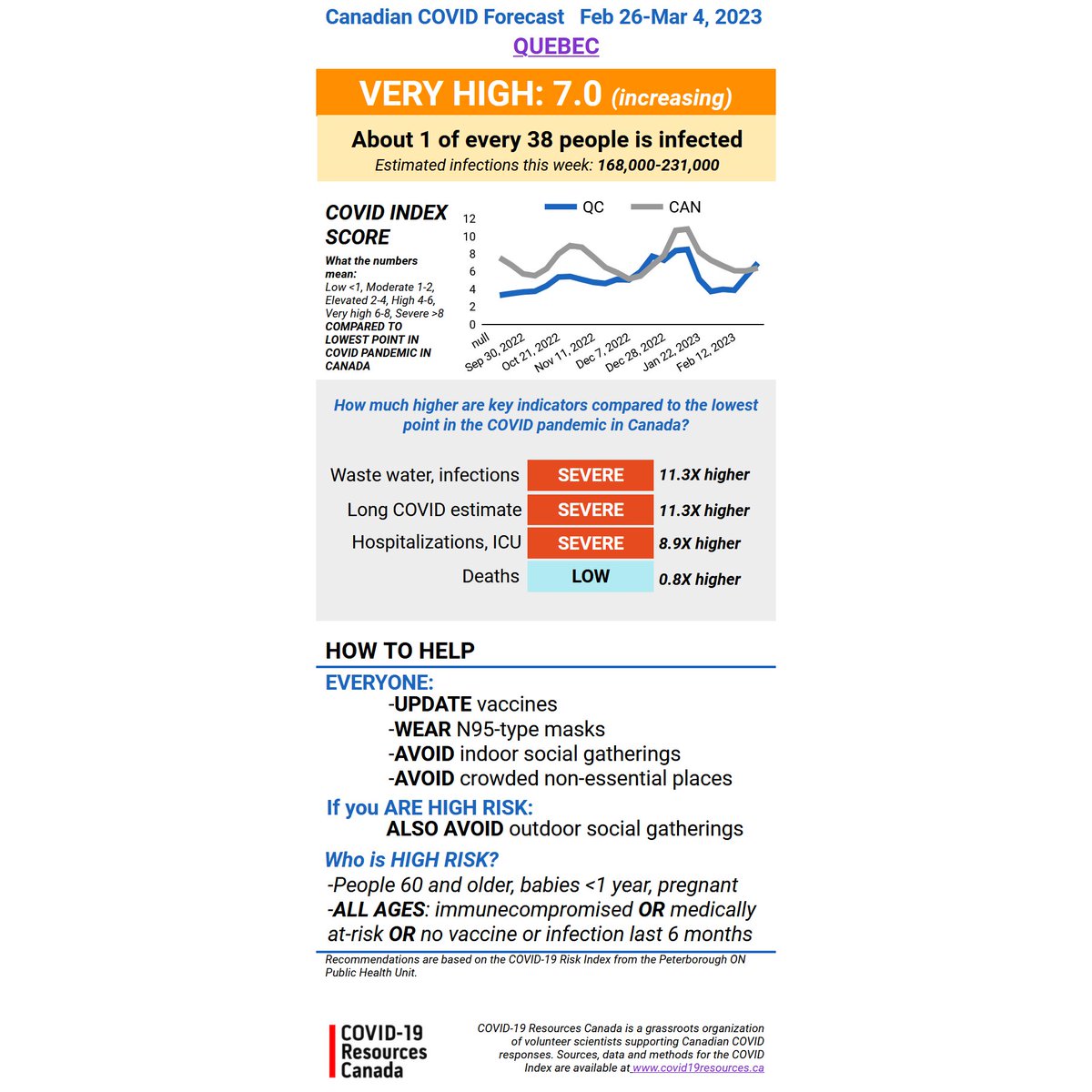
Compared to lowest point of pandemic in Canada:
🟡Waste water, infections, long COVID cases: ~11X higher
🟡Hospitalizations ~9X higher
🟡Deaths SIMILAR
QUÉBEC
VERY HIGH
About 1 in every 38 people infected
Compared to lowest point of pandemic in Canada:
🟡Waste water, infections, long COVID cases: ~11X higher
🟡Hospitalizations ~9X higher
🟡Deaths SIMILAR
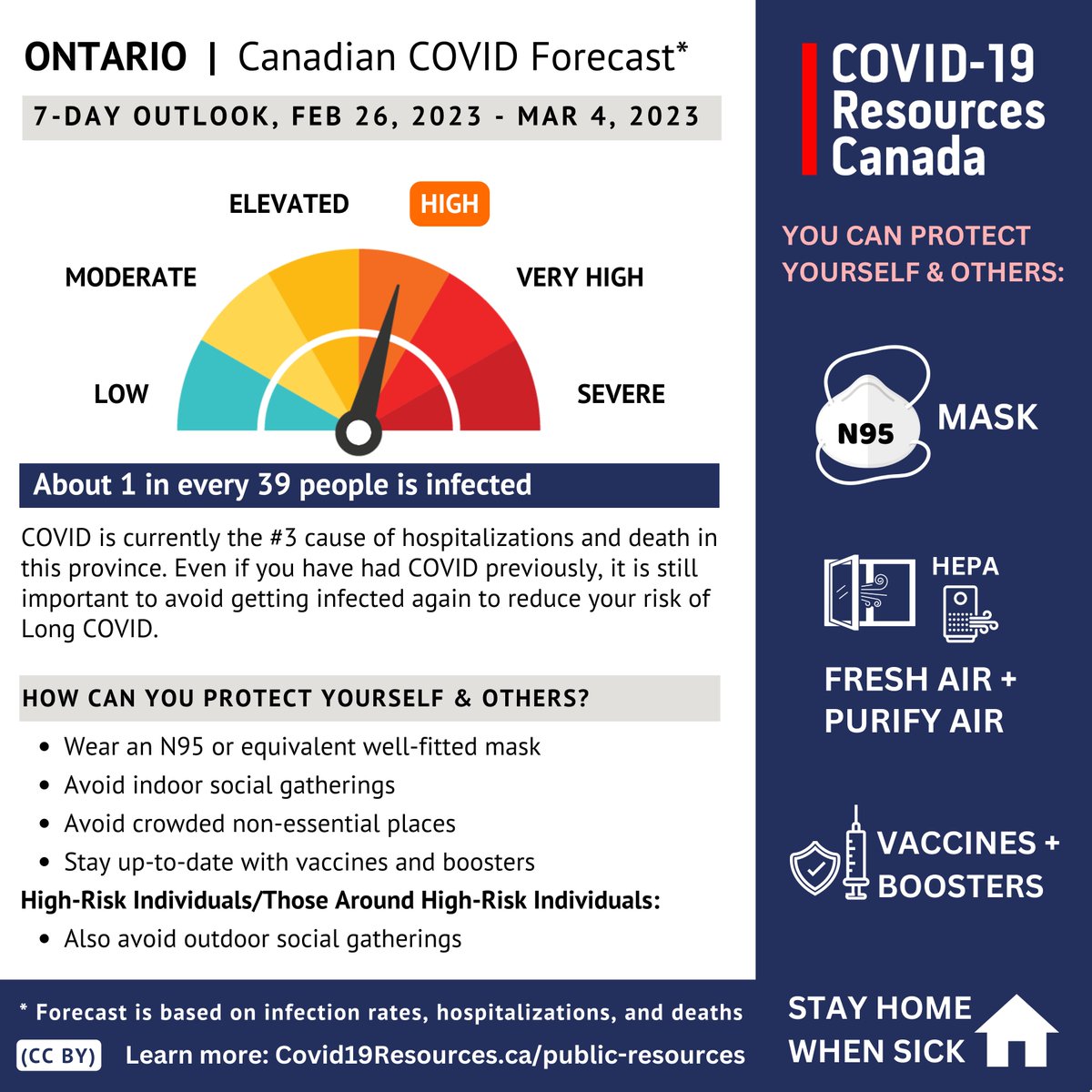
Canadian COVID Forecast Feb 26-Mar 4, 2023
ONTARIO
HIGH
About 1 in every 39 people is infected.
HOW TO HELP:
Mask, get your booster, avoid non-essential indoor public places, social gatherings.
Higher risk: also avoid outdoor social gatherings.
ONTARIO
HIGH
About 1 in every 39 people is infected.
HOW TO HELP:
Mask, get your booster, avoid non-essential indoor public places, social gatherings.
Higher risk: also avoid outdoor social gatherings.
Prévisions COVID 26 fév-4 mars/23
ONTARIO
TRÈS ÉLEVÉ
~1 personne sur 39 infectée
Portez un masque, faites votre rappel, évitez lieux publics intérieurs non essentiels, rassemblements sociaux
Risque plus élevé : évitez également rassemblements sociaux en plein air
ONTARIO
TRÈS ÉLEVÉ
~1 personne sur 39 infectée
Portez un masque, faites votre rappel, évitez lieux publics intérieurs non essentiels, rassemblements sociaux
Risque plus élevé : évitez également rassemblements sociaux en plein air

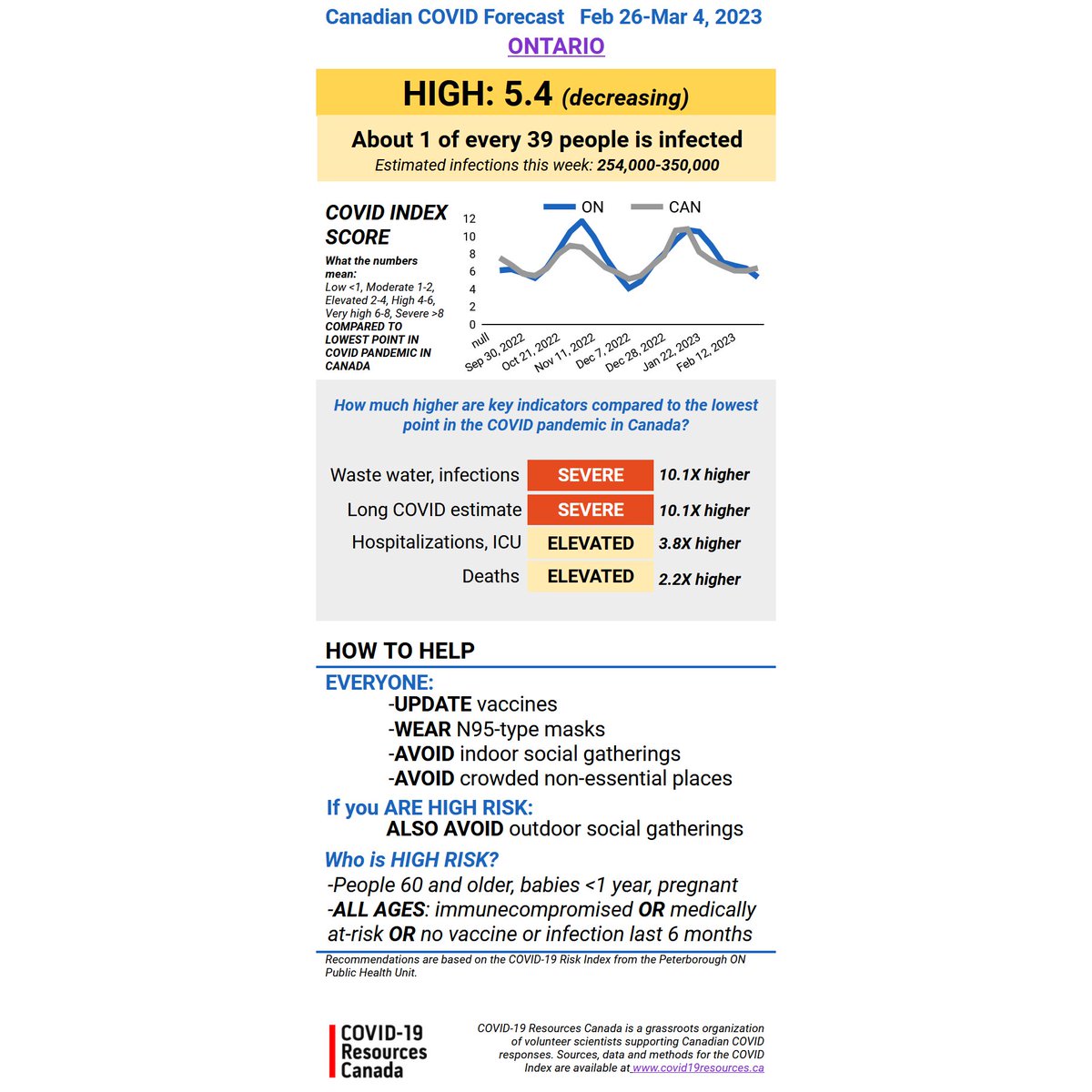
Canadian COVID Forecast Feb 26-Mar 4, 2023
ONTARIO
HIGH
About 1 in every 39 people infected
Compared to lowest point of pandemic in Canada:
🟡Waste water, infections, long COVID cases: ~10X higher
🟡Hospitalizations ~4X higher
🟡Deaths ~2X higher
ONTARIO
HIGH
About 1 in every 39 people infected
Compared to lowest point of pandemic in Canada:
🟡Waste water, infections, long COVID cases: ~10X higher
🟡Hospitalizations ~4X higher
🟡Deaths ~2X higher
Canadian COVID Forecast Feb 26-Mar 4, 2023
MANITOBA
VERY HIGH
About 1 in every 65 people is infected.
HOW TO HELP:
Mask, get your booster, avoid non-essential indoor public places, social gatherings.
Higher risk: also avoid outdoor social gatherings.
MANITOBA
VERY HIGH
About 1 in every 65 people is infected.
HOW TO HELP:
Mask, get your booster, avoid non-essential indoor public places, social gatherings.
Higher risk: also avoid outdoor social gatherings.

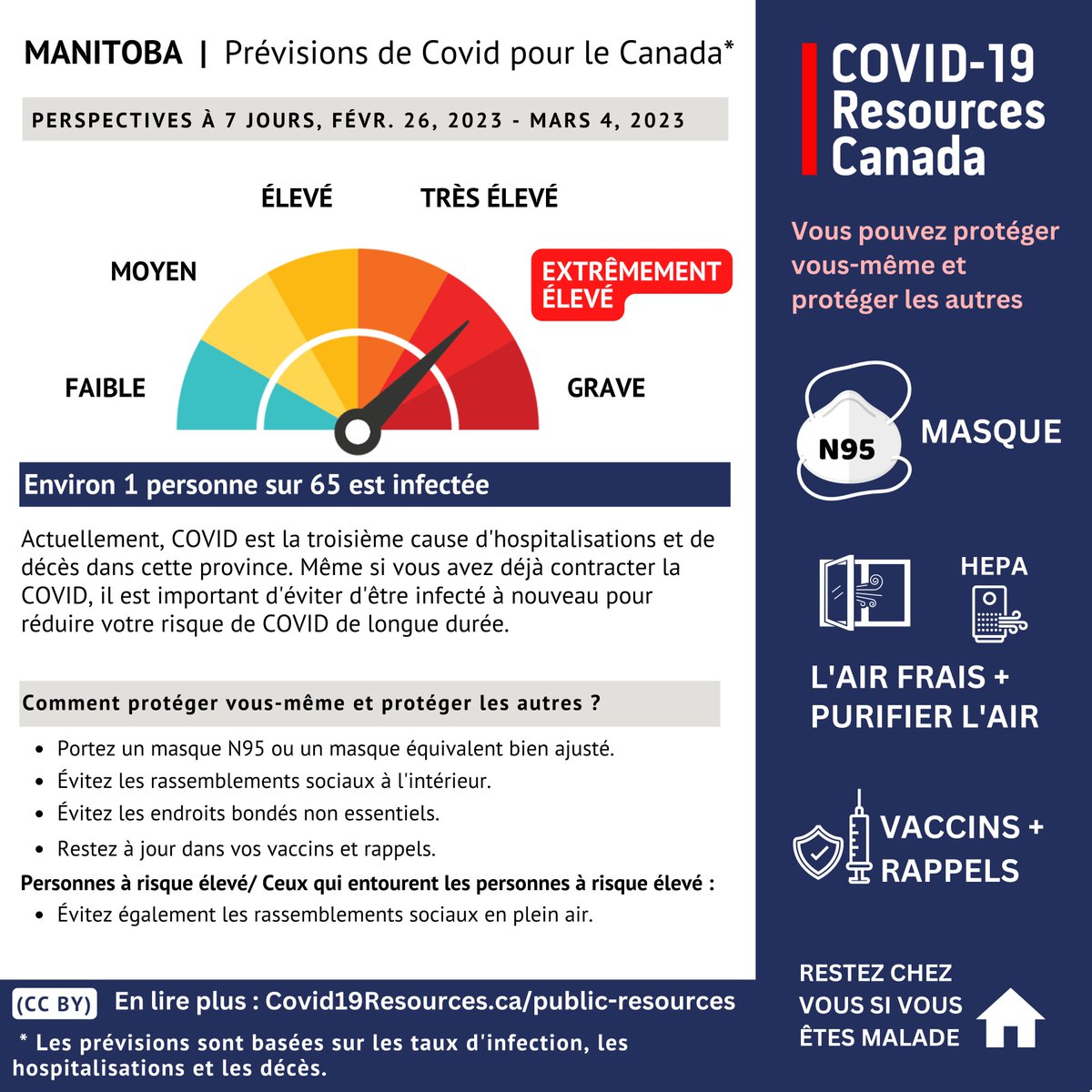
Prévisions COVID 26 fév-4 mars/23
MANITOBA
EXTRÊMEMENT ÉLEVÉ
~1 personne sur 65 infectée
Portez un masque, faites votre rappel, évitez lieux publics intérieurs non essentiels, rassemblements sociaux
Risque plus élevé : évitez également rassemblements sociaux en plein air
MANITOBA
EXTRÊMEMENT ÉLEVÉ
~1 personne sur 65 infectée
Portez un masque, faites votre rappel, évitez lieux publics intérieurs non essentiels, rassemblements sociaux
Risque plus élevé : évitez également rassemblements sociaux en plein air
Canadian COVID Forecast Feb 26-Mar 4, 2023
MANITOBA
HIGH
About 1 in every 65 people infected
Compared to lowest point of pandemic in Canada:
🟡Waste water, infections, long COVID cases: ~9X higher
🟡Hospitalizations ~7X higher
🟡Deaths ~6X higher
MANITOBA
HIGH
About 1 in every 65 people infected
Compared to lowest point of pandemic in Canada:
🟡Waste water, infections, long COVID cases: ~9X higher
🟡Hospitalizations ~7X higher
🟡Deaths ~6X higher

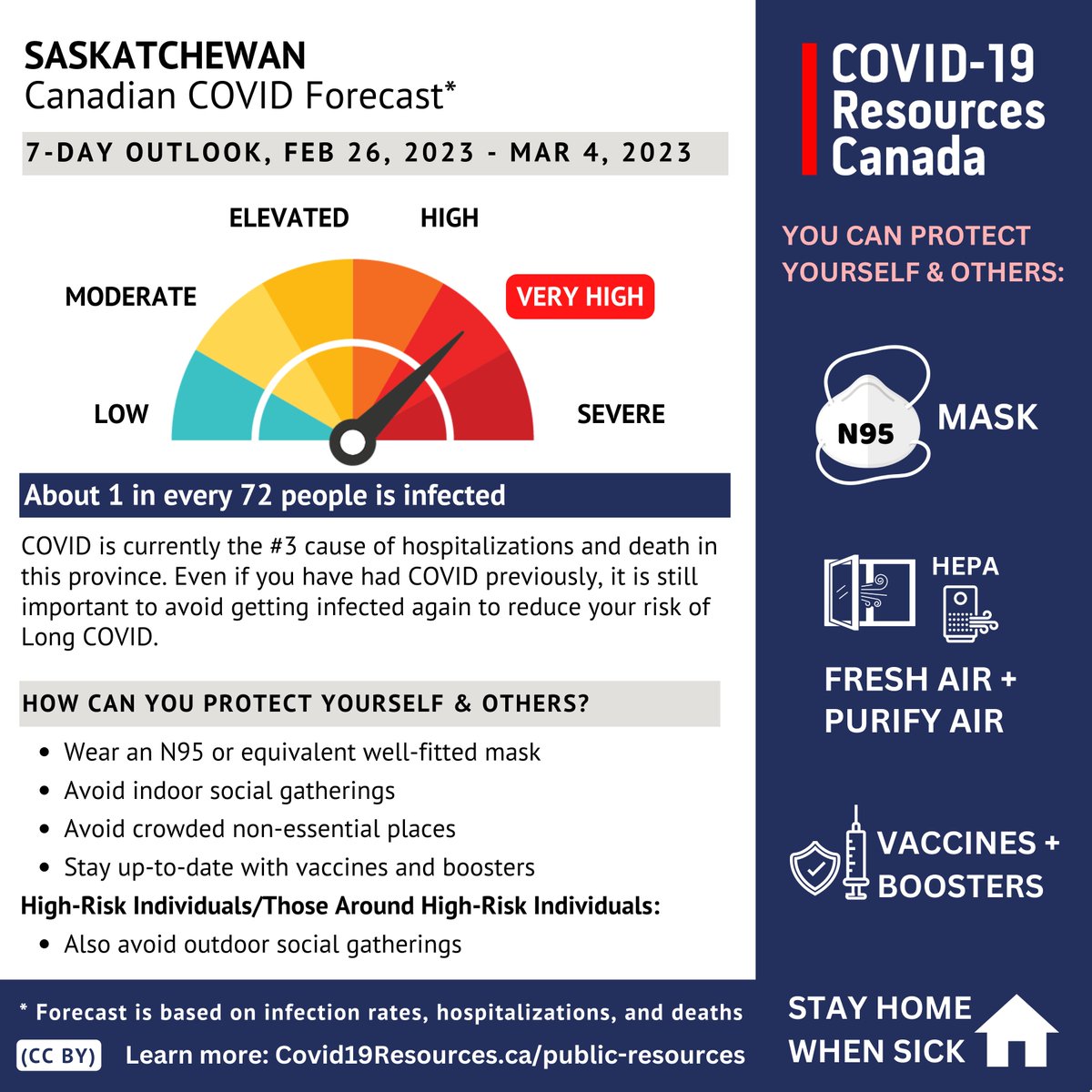
Canadian COVID Forecast Feb 26-Mar 4, 2023
SASKATCHEWAN
VERY HIGH
About 1 in every 72 people is infected.
HOW TO HELP:
Mask, get your booster, avoid non-essential indoor public places, social gatherings.
Higher risk: also avoid outdoor social gatherings.
SASKATCHEWAN
VERY HIGH
About 1 in every 72 people is infected.
HOW TO HELP:
Mask, get your booster, avoid non-essential indoor public places, social gatherings.
Higher risk: also avoid outdoor social gatherings.
Prévisions COVID 26 fév-4 mars/23
SASKATCHEWAN
EXTRÊMEMENT ÉLEVÉ
~1 personne sur 72 infectée
Portez un masque, faites votre rappel, évitez lieux publics intérieurs non essentiels, rassemblements sociaux
Risque plus élevé : évitez également rassemblements sociaux en plein air
SASKATCHEWAN
EXTRÊMEMENT ÉLEVÉ
~1 personne sur 72 infectée
Portez un masque, faites votre rappel, évitez lieux publics intérieurs non essentiels, rassemblements sociaux
Risque plus élevé : évitez également rassemblements sociaux en plein air

Canadian COVID Forecast Feb 26-Mar 4, 2023
SASKATCHEWAN
VERY HIGH
About 1 in every 72 people infected
Compared to lowest point of pandemic in Canada:
🟡Waste water, infections, long COVID cases: ~8X higher
🟡Hospitalizations ~8X higher
🟡Deaths ~3X higher
SASKATCHEWAN
VERY HIGH
About 1 in every 72 people infected
Compared to lowest point of pandemic in Canada:
🟡Waste water, infections, long COVID cases: ~8X higher
🟡Hospitalizations ~8X higher
🟡Deaths ~3X higher

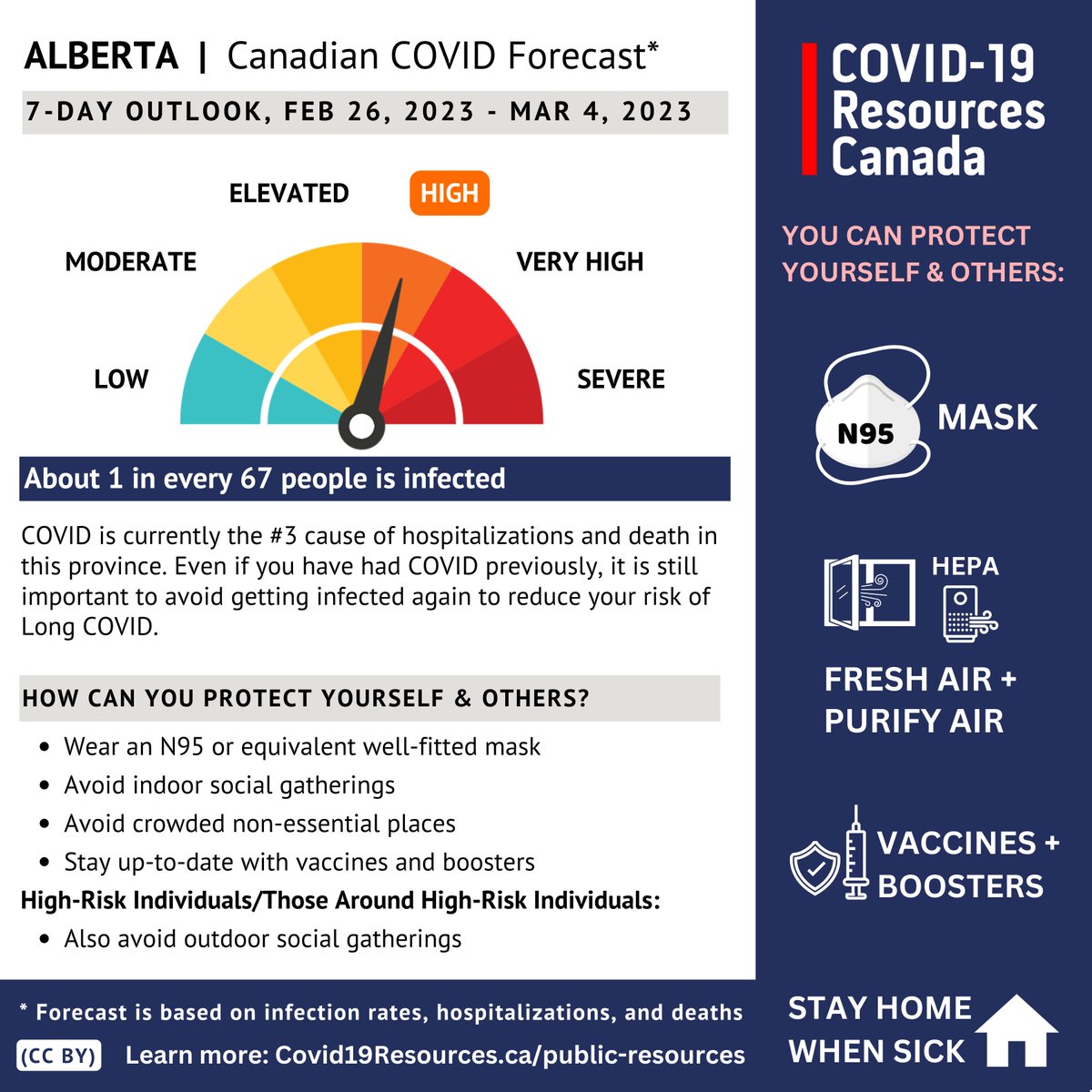
Canadian COVID Forecast Feb 26-Mar 4, 2023
ALBERTA
HIGH
About 1 in every 67 people is infected.
HOW TO HELP:
Mask, get your booster, avoid non-essential indoor public places, social gatherings.
Higher risk: also avoid outdoor social gatherings.
ALBERTA
HIGH
About 1 in every 67 people is infected.
HOW TO HELP:
Mask, get your booster, avoid non-essential indoor public places, social gatherings.
Higher risk: also avoid outdoor social gatherings.
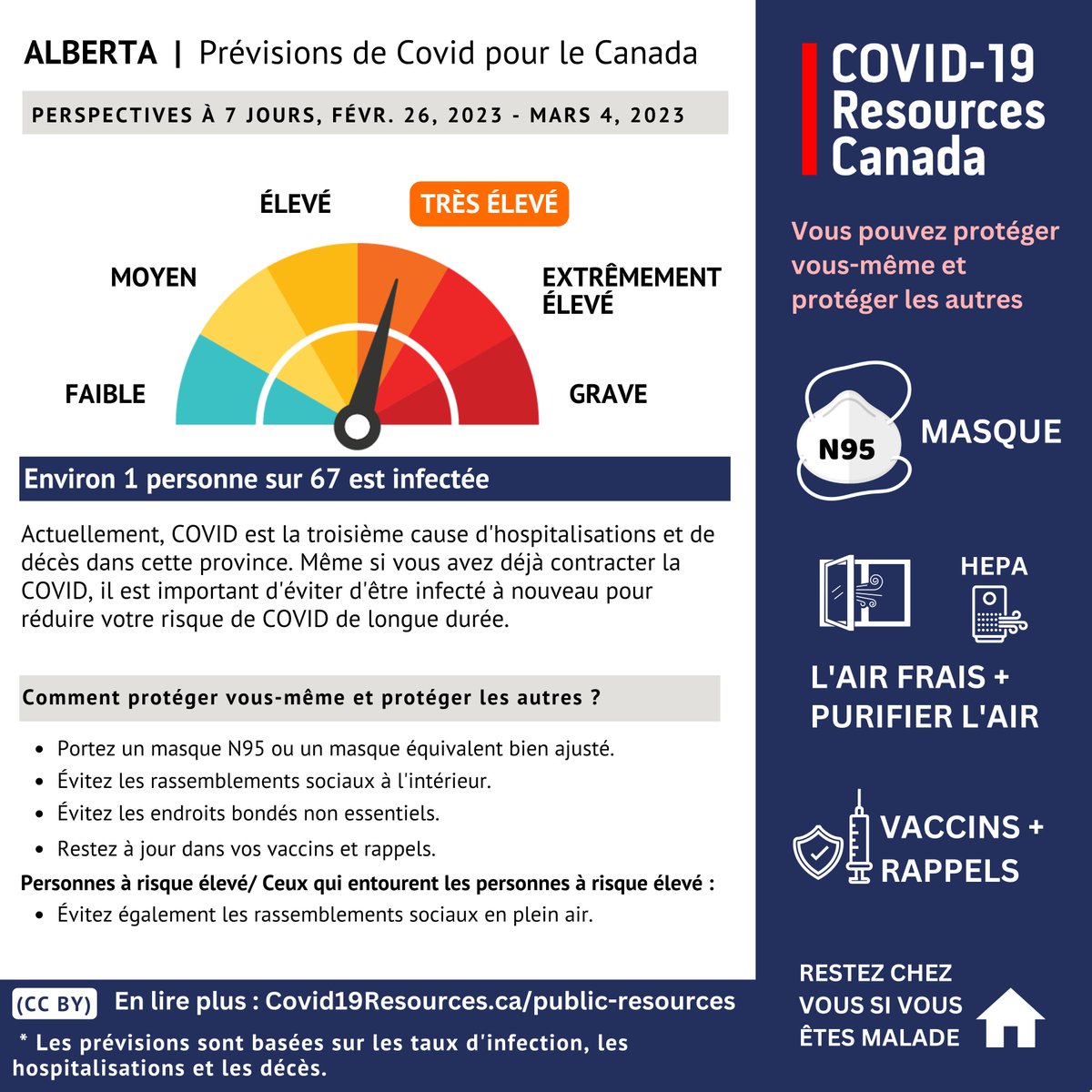
Prévisions COVID 26 fév-4 mars/23
ALBERTA
TRÈS ÉLEVÉ
~1 personne sur 67 infectée
Portez un masque, faites votre rappel, évitez lieux publics intérieurs non essentiels, rassemblements sociaux
Risque plus élevé : évitez également rassemblements sociaux en plein air
ALBERTA
TRÈS ÉLEVÉ
~1 personne sur 67 infectée
Portez un masque, faites votre rappel, évitez lieux publics intérieurs non essentiels, rassemblements sociaux
Risque plus élevé : évitez également rassemblements sociaux en plein air
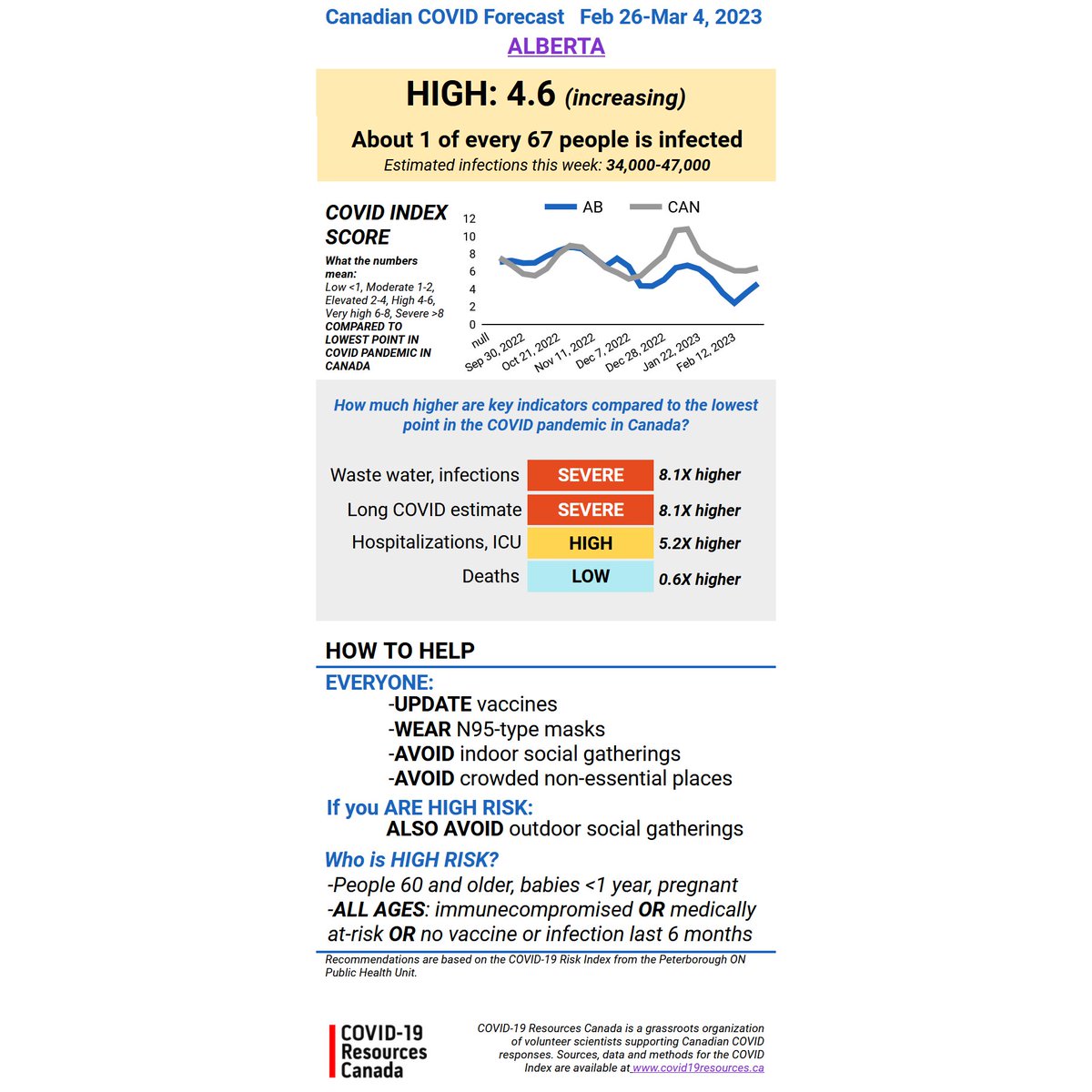
Canadian COVID Forecast Feb 26-Mar 4, 2023
ALBERTA
HIGH
About 1 in every 67 people infected
Compared to lowest point of pandemic in Canada:
🟡Waste water, infections, long COVID cases: ~8X higher
🟡Hospitalizations ~5X higher
🟡Deaths SIMILAR
ALBERTA
HIGH
About 1 in every 67 people infected
Compared to lowest point of pandemic in Canada:
🟡Waste water, infections, long COVID cases: ~8X higher
🟡Hospitalizations ~5X higher
🟡Deaths SIMILAR
Canadian COVID Forecast Feb 26-Mar 4, 2023
BRITISH COLUMBIA
VERY HIGH
About 1 in every 43 people is infected.
HOW TO HELP:
Mask, get your booster, avoid non-essential indoor public places, social gatherings.
Higher risk: also avoid outdoor social gatherings.
BRITISH COLUMBIA
VERY HIGH
About 1 in every 43 people is infected.
HOW TO HELP:
Mask, get your booster, avoid non-essential indoor public places, social gatherings.
Higher risk: also avoid outdoor social gatherings.

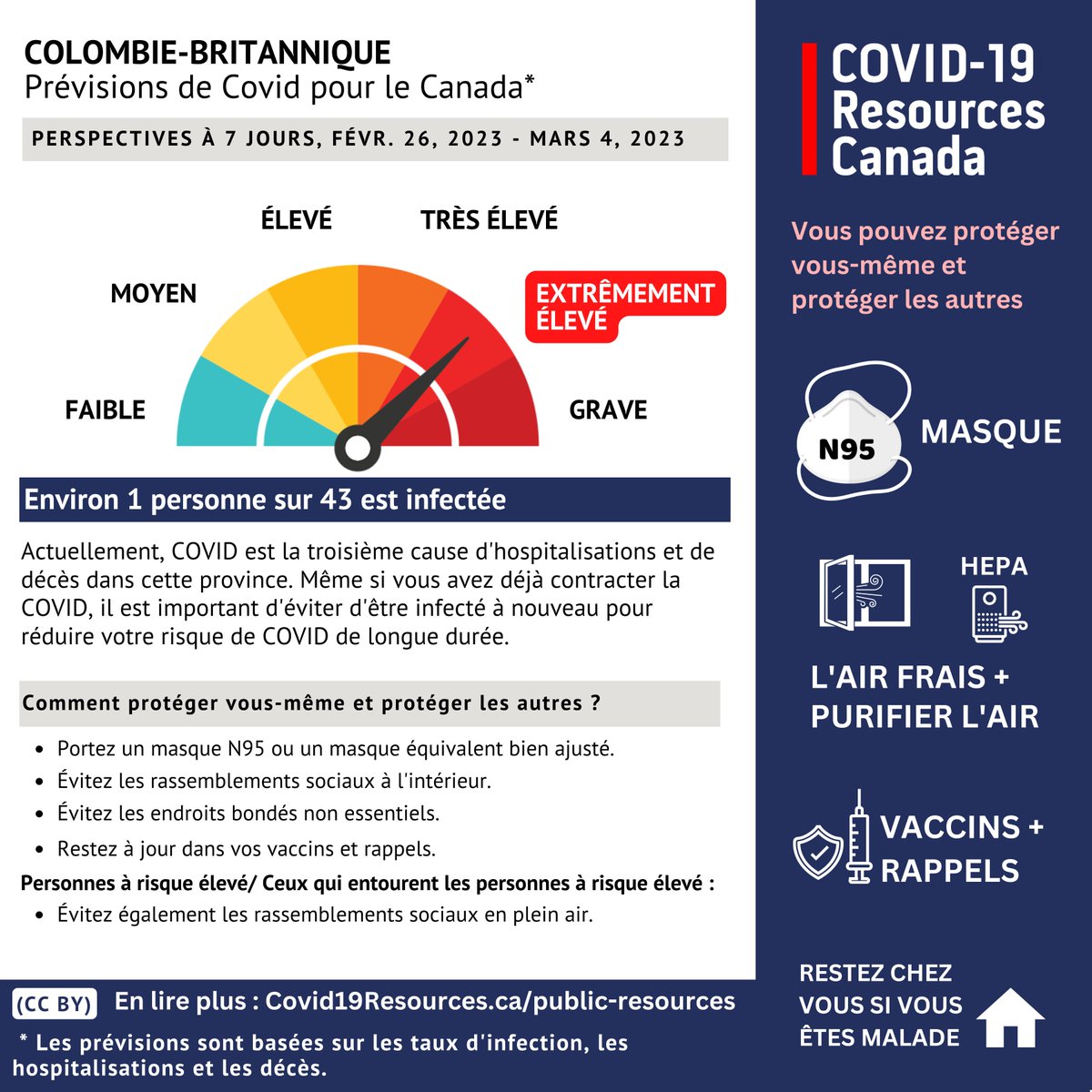
Prévisions COVID 26 fév-4 mars/23
C.-B.
EXTRÊMEMENT ÉLEVÉ
~1 personne sur 43 infectée
Portez un masque, faites votre rappel, évitez lieux publics intérieurs non essentiels, rassemblements sociaux
Risque plus élevé : évitez également rassemblements sociaux en plein air
C.-B.
EXTRÊMEMENT ÉLEVÉ
~1 personne sur 43 infectée
Portez un masque, faites votre rappel, évitez lieux publics intérieurs non essentiels, rassemblements sociaux
Risque plus élevé : évitez également rassemblements sociaux en plein air
Canadian COVID Forecast Feb 26-Mar 4, 2023
BRITISH COLUMBIA
VERY HIGH
About 1 in every 43 people infected
Compared to lowest point of pandemic in Canada:
🟡Waste water, infections, long COVID cases: ~10X higher
🟡Hospitalizations ~7X higher
🟡Deaths ~4X higher
BRITISH COLUMBIA
VERY HIGH
About 1 in every 43 people infected
Compared to lowest point of pandemic in Canada:
🟡Waste water, infections, long COVID cases: ~10X higher
🟡Hospitalizations ~7X higher
🟡Deaths ~4X higher

Canadian COVID Forecast Feb 26-Mar 4, 2023
NUNAVUT, NWT, YUKON
HIGH
About 1 in every 61 people is infected.
HOW TO HELP:
Mask, get your booster, avoid non-essential indoor public places, social gatherings.
Higher risk: also avoid outdoor social gatherings.
NUNAVUT, NWT, YUKON
HIGH
About 1 in every 61 people is infected.
HOW TO HELP:
Mask, get your booster, avoid non-essential indoor public places, social gatherings.
Higher risk: also avoid outdoor social gatherings.

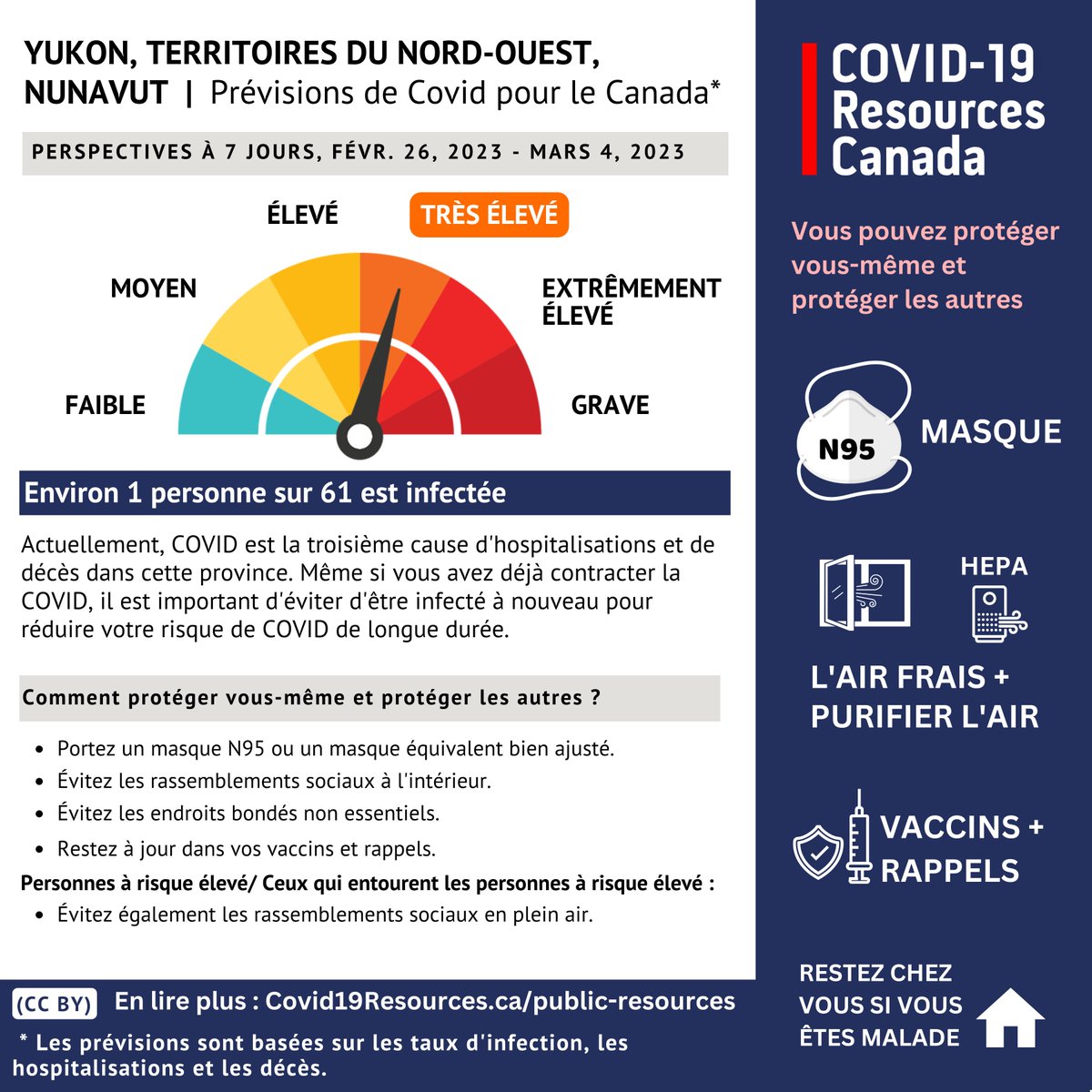
Prévisions COVID 26 fév-4 mars/23
NT, T.N.-O., YN
TRÈS ÉLEVÉ
~1 personne sur 61 infectée
Portez un masque, faites votre rappel, évitez lieux publics intérieurs non essentiels, rassemblements sociaux
Risque plus élevé : évitez également rassemblements sociaux en plein air
NT, T.N.-O., YN
TRÈS ÉLEVÉ
~1 personne sur 61 infectée
Portez un masque, faites votre rappel, évitez lieux publics intérieurs non essentiels, rassemblements sociaux
Risque plus élevé : évitez également rassemblements sociaux en plein air
Canadian COVID Forecast Feb 26-Mar 4, 2023
NUNAVUT, NWT, YUKON
HIGH
About 1 in every 61 people is infected.
HOW TO HELP:
Mask, get your booster, avoid non-essential indoor public places, social gatherings.
Higher risk: also avoid outdoor social gatherings.
NUNAVUT, NWT, YUKON
HIGH
About 1 in every 61 people is infected.
HOW TO HELP:
Mask, get your booster, avoid non-essential indoor public places, social gatherings.
Higher risk: also avoid outdoor social gatherings.

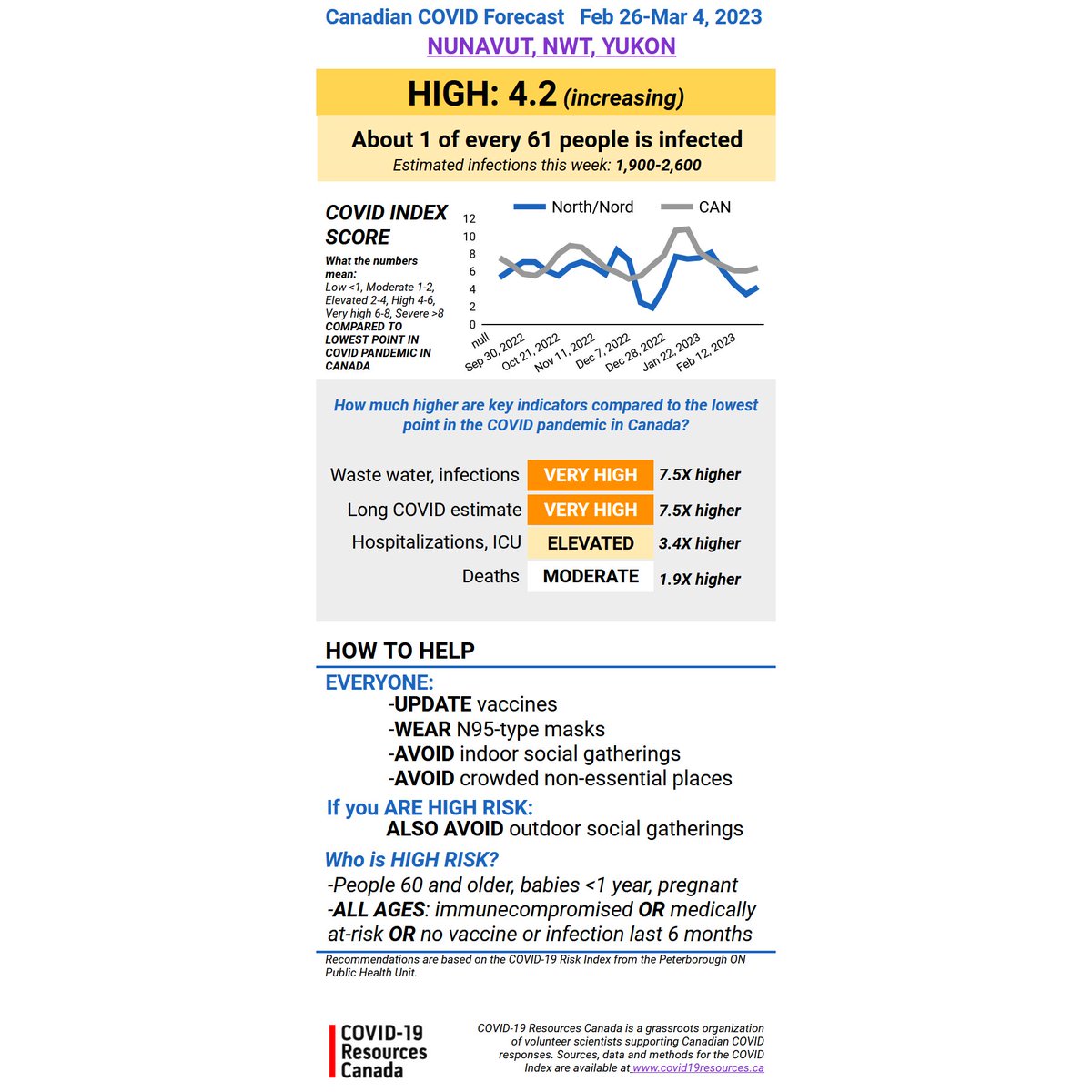
Canadian COVID Forecast Feb 26-Mar 4, 2023
NUNAVUT, NWT, YUKON
HIGH
About 1 in every 61 people infected
Compared to lowest point of pandemic in Canada:
🟡Waste water, infections, long COVID cases: ~8X higher
🟡Hospitalizations ~3X higher
🟡Deaths ~2X higher
NUNAVUT, NWT, YUKON
HIGH
About 1 in every 61 people infected
Compared to lowest point of pandemic in Canada:
🟡Waste water, infections, long COVID cases: ~8X higher
🟡Hospitalizations ~3X higher
🟡Deaths ~2X higher
Remember that as infections increase in multiple Canadian regions, hospitalizations then deaths will also increase.
The COVID Forecast score is based on all 3 of these input, not just infections.
Hang in there--be careful about your choices right now, if/when you have them.
The COVID Forecast score is based on all 3 of these input, not just infections.
Hang in there--be careful about your choices right now, if/when you have them.
If we don't see a new, more infectious variant arise after XBB.1.5 things might start to improve.
Nothing on the horizon yet, but XBB.1.5 took a while to gain a foothold in Canada.
Other countries like the UK are also seeing increasing infections again now linked to XBB.1.5.
Nothing on the horizon yet, but XBB.1.5 took a while to gain a foothold in Canada.
Other countries like the UK are also seeing increasing infections again now linked to XBB.1.5.
Canada is not alone in this problem.
Cross every digit you have hoping we don't see a new, more transmissible variant emerge.
And if it's been 6 months since your last vaccine dose or infection, get a new dose now, if your province permits it.
Cross every digit you have hoping we don't see a new, more transmissible variant emerge.
And if it's been 6 months since your last vaccine dose or infection, get a new dose now, if your province permits it.
It likely took a while for XBB.1.5 to get traction because enough of us had some protection against infection from fall boosters and/or infections.
Protection vs new infection from both will be wearing off now, leaving enough susceptible people that we can have a new surge/wave.
Protection vs new infection from both will be wearing off now, leaving enough susceptible people that we can have a new surge/wave.
And if you can get a new dose 3 months after infection or your last dose, do it, especially if you're higher risk.
We're likely in for another period of high levels of infection across the country (and already are in some provinces).
We're likely in for another period of high levels of infection across the country (and already are in some provinces).
Crossing every digit hoping that this is the last surge/wave for a while, and that it's not as big as the BA.5 wave this summer, which was associated with high levels of excess mortality.
We're not hearing the same level of news/chatter about ERs closing, cold medication flying off shelves.
But, some provinces are experiencing illness-related staff shortages in multiple sectors, which is usually a decent sign that COVID is making the rounds again.
But, some provinces are experiencing illness-related staff shortages in multiple sectors, which is usually a decent sign that COVID is making the rounds again.
In provinces that report staff and student absences due to illness, the absentee rate is again pretty high, at least in some provinces.
So, keep all this in mind and know that we'll likely have a bit of a rough go again for a while.
So, keep all this in mind and know that we'll likely have a bit of a rough go again for a while.
Help others, especially those most at risk. Offer to run errands.
And if you're in an essential public space like a pharmacy or grocery store or bank, consider putting a mask on to help make others feel better about wearing theirs.
And if you're in an essential public space like a pharmacy or grocery store or bank, consider putting a mask on to help make others feel better about wearing theirs.
People are social creatures. We take our cues from others, and most of us don't want to stand out or be judged as different.
Even if you don't feel you need to mask (although you should!), please help others who really need to mask feel better about doing it.
Even if you don't feel you need to mask (although you should!), please help others who really need to mask feel better about doing it.
Signing off till tonight.
Take care of each other. You matter. Everyone matters.
Take care of each other. You matter. Everyone matters.
@threadreaderapp unroll please
• • •
Missing some Tweet in this thread? You can try to
force a refresh