Scoop: A long-awaited report by the US intel community concludes ‘Havana Syndrome’ was not caused by an energy weapon or foreign adversary, shattering a widespread theory that a secret device debilitated scores of spies & diplomats. By @shaneharris & me washingtonpost.com/national-secur…
The report caps a years-long effort by the intelligence community to explain why US personnel experienced what they described as strange and painful acoustic sensations
Many of the afflicted personnel say they were the victims of a deliberate attack — possibly at the hands of Russia — a claim that the report contradicts in nearly every respect, officials said.
7 intel agencies participated in the review of roughly 1k cases. 5 agencies found it was “very unlikely” that a foreign adversary was responsible for the symptoms, either as the result of a directed energy weapon or as the byproduct of something else like electronic surveillance
1 agency abstained in its conclusion regarding a foreign actor. But when asked, no agency dissented from the conclusion that a foreign actor did not cause the symptoms, an official said.
Officials said they found no pattern or common set of conditions that could link individual cases. They also found no forensic information or geolocation data that would suggest an adversary had used a form of directed energy such as radio waves or ultrasonic beams.
There was no intelligence that foreign leaders had any knowledge of or had authorized an attack on U.S. personnel that could explain the symptoms, an official said.
In some cases, there was no “direct line of sight” to affected personnel working at U.S. facilities, further casting doubt on the possibility that a hypothetical energy weapon could have been the culprit, one of the officials said.
Despite the new conclusions, Secretary of State Blinken remains of the view that something happened to those employees who have reported significant ailments, and he is committed to making sure they are cared for, per source. Blinken has long doubted the mass hysteria theory
• • •
Missing some Tweet in this thread? You can try to
force a refresh

New: Pete Hegseth's triumphant portrayal of the conflict in Iran has alarmed U.S. officials who are concerned the statistics he often promotes are misinforming both the public and the president 🧵
The downing of the F-15E and A-10 fighter jets drew attention to Hegseth's earlier remarks boasting about “complete control of Iranian skies” and “uncontested airspace" but it's not just his claims about air dominance that are drawing scrutiny
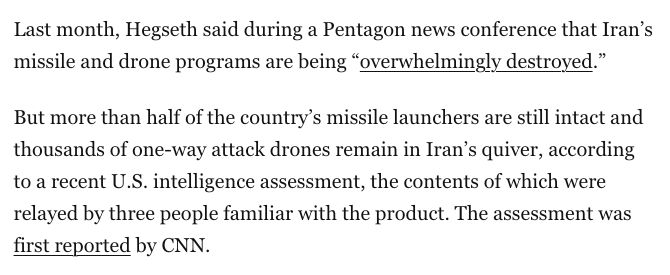
A major source of contention is Hegseth’s characterization of the U.S. effort to destroy Iran’s vaunted missile and drone program:
NEW: The high-risk plan to seize Iran’s uranium in a commando raid that would require building a runway in Iran and dropping in excavation equipment amid incoming fire, came at Trump’s request, signaling his interest in the complex operation
“This would be one of, if not the largest, most complicated special operations in history,” said Mick Mulroy, a former deputy assistant secretary of defense and retired CIA and Marine officer. “It’s a major risk to the force.”
Risky commando plan to seize Iran’s uranium came at Trump’s request. By @nakashimae, me, @AlexHortonTX @karendeyoung1 following WSJ scoop washingtonpost.com/national-secur…
SCOOP: Senior Israeli officials tell U.S. diplomats Iranian protesters “will get slaughtered” if they take to the streets, though Israel is still angling for a popular uprising, per a State Department cable from Embassy Jerusalem 🧵
The cable relayed an Israeli assessment that Iran’s regime is “not cracking” and is willing to “fight to the end” despite the supreme leader's assassination. “The people will get slaughtered” because the IRGC “has the upper hand."
Despite the grim forecast, Israeli officials said they hoped for a popular revolt and urged the US to prepare to support protesters if that happens
NEW: A classified report by the National Intelligence Council, representing the collective wisdom of America's 18 intelligence agencies, found that even a large-scale assault on Iran would be unlikely to oust its entrenched military and clerical establishment 🧵
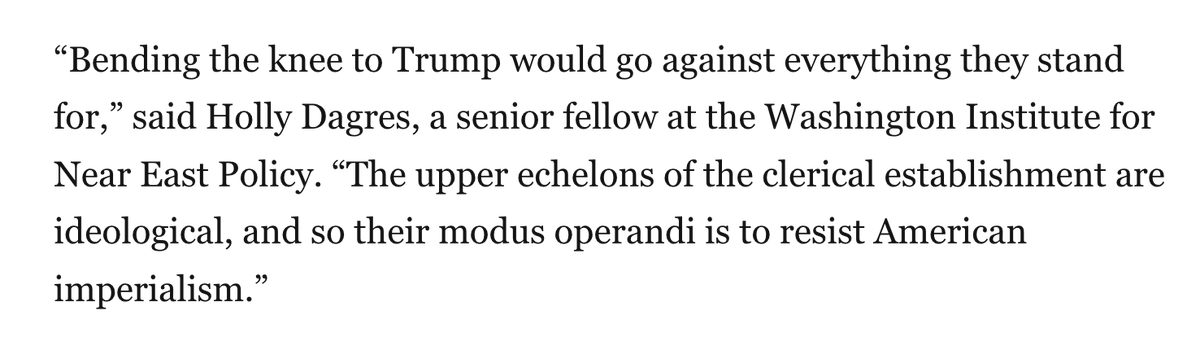
The report outlined succession scenarios resulting from either a short or extended U.S. military campaign. In both cases, it concluded the clerical and military establishment would respond to Khamenei's killing by following protocols designed to preserve continuity of power...
The report says the prospect of Iran’s fragmented opposition taking control of the country is “unlikely,” raising doubts about Trump’s declared plan to “clean out” Iran’s leadership structure and install a ruler of his choosing
SCOOP: A suspected Iranian drone attack hit the CIA’s station in Saudi Arabia in what would amount to a significant symbolic victory for the Islamic Republic as it lashes out at U.S. targets and personnel across the Middle East, sources tell @nakashimae and me
The U.S. and Saudi governments confirmed that two drones hit the U.S. Embassy complex in Riyadh on Monday but did not disclose that America’s spy hub was hit in the attack.
An internal State Department alert obtained by The Post said the attack “collapsed” part of the embassy’s roof and “contaminated” the inside with smoke. The notice said the embassy sustained “structural damage” and personnel “continue to shelter in place.”
NEW: Joint Chiefs Chair Dan Caine expressed concerns to Trump at the WH last Tues that any major operation against Iran will face challenges because the US munitions stockpile has been significantly depleted by US's ongoing defense of Israel & support for Ukraine.
Separately, in Pentagon meetings this month, Caine also has raised concerns about the scale of any Iran campaign, its inherent complexity and the possibility of U.S. casualties. The general has said that any operation would be made all the more difficult by a lack of allied support for a U.S. attack on Iran
Caine’s views are seen as highly credible by the administration due to the successful execution of two other major operations he’s overseen: the assault on Iran’s nuclear sites last summer, and the U.S. raid to capture Nicolás Maduro in January