1/ THREAD: Israel is currently undergoing a period of revolutionary change, and the pace of events can be difficult to keep up with, even for those residing and working here. Let me attempt to clarify some of the developments we are witnessing.
(video of Sat demo, @NTarnopolsky)
(video of Sat demo, @NTarnopolsky)
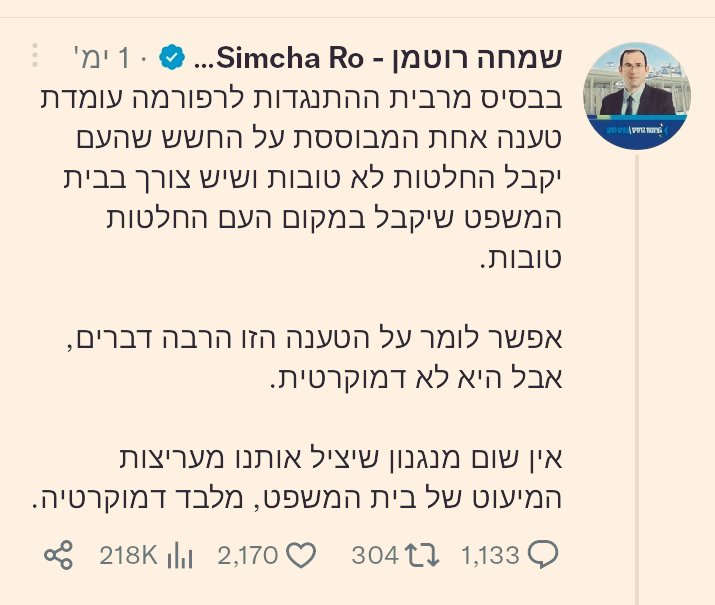
2/The government appears to be fully committed to implementing a comprehensive judicial overhaul similar to those already carried out in Poland and Hungary, which would grant the Prime Minister full control over the nomination of judges, substantially reduce the practical ability
3/ of the Supreme Court to carry out judicial review, alter the status of legal advisors to government ministries. These measures, if implemented, would confer unprecedented levels of power on the Netanyahu administration and, according to the consensus of most legal scholars,
4/ would effectively destroy the independence of the Judiciary. As the former Attorney General, who was personally nominated by Netanyahu, himself stated: "We are witnessing a regime revolution, not a judicial reform."
5/This trend towards populism and nationalism is not unprecedented, as we have seen it manifest in other countries. The liberal order has been unable to reform itself, resulting in its hollowing out, prompting a popular uprising (which I previously chronicled in my book, REVOLT).
6/ However, Israel enjoys the privilege of its history. As a young democracy, it has no history of authoritarian rule. The Zionist movement was built upon the principles of national self-determination and liberalism, accept by both Socialist and Right wing elements.
7/ The commitment to liberalism was not sloganism; at the Third Zionist Congress, led by the father of modern political Zionism, Theodore Herzl, the idea of suffrage was already accepted. it was at the end of the 19th century. The social-democrat elements of Israeli society
8/were already on full display in the national institutions built during the 1920s, 30s, and 40s, prior to the establishment of the State. The founding fathers of Israel declared democracy to be a necessary condition for the existence of the State.
9/Ben Gurion, the 1st Prime Minister, never attempted to establish an authoritarian regime. Despite discriminating against minorities, Israel's democratic ideal was sound, and its flaws were not unique to the time, as they were present in other republics, such as the US.
10/
This is relevant to the present moment, as between 200 and 400 thousand people have taken to the streets for the past nine weeks, every week, protesting against the government. The protest against the "reforms" is widespread and, to some extent, cuts across partisan lines.
This is relevant to the present moment, as between 200 and 400 thousand people have taken to the streets for the past nine weeks, every week, protesting against the government. The protest against the "reforms" is widespread and, to some extent, cuts across partisan lines.
11/The protesters have reclaimed the Israeli flag as their symbol, with almost every major group in the country joining the calls to freeze the legislative process. This includes leaders in the tech industry, prominent CEOs of retail chains and banks, former Israel Bank governors
12/nearly all scientific institutions, Israel's Nobel laureates, the country's senior economists, recipients of the prestigious secret defense prize, universities, reserve officers of Israel's special commando units (including the first combat team that raided the Antebe airport
13/to liberate Israeli hostages in 1976), former soldiers and officers of the IDF's most prestigious technological unit, all living former chiefs of staff, former Likud ministers, and many others. Recently, dozens of reserve fighter pilots, who are essential to Israel's airforce,
14/ announced that they would not participate in a one-day reserve activity in protest of the judicial overhaul. Today, the Chief of Staff called PM Netanyahu, warning him about the ramifications of these developments.The argument put forward by these pilots and others is simple-
15/they are willing to sacrifice their lives for a democratic and Jewish Israel, but they will not volunteer for a country that is no longer a democracy.
These protests are undoubtedly the most powerful the country has seen,
These protests are undoubtedly the most powerful the country has seen,
16/ yet it is essential to recognize that a significant portion of the Israeli public supports the government and its proposed overhaul.
Until now, the government has shown no genuine desire to compromise or freeze the legislative process.
Until now, the government has shown no genuine desire to compromise or freeze the legislative process.
17/ Many protesters presently renounce compromise, contending that democracy is non-negotiable.
Despite the government's numerical superiority in the Knesset and the consequent likelihood of the laws' passage, these times possess an allure of sorts -
Despite the government's numerical superiority in the Knesset and the consequent likelihood of the laws' passage, these times possess an allure of sorts -
18/ driven in no small part by the overwhelming exasperation with the government's march of folly. Observing individuals who previously had not considered participating in demonstrations now rallying in support of democracy fills the moment with a sense of hope.
19/ It is a small yet comforting thought that history will not record us as passive individuals who idly stood by as our liberties were confiscated, our republic plundered. Its not enought. The Likud must take a step back to save the country from some frightening scenarios. END
• • •
Missing some Tweet in this thread? You can try to
force a refresh