Ricardo Reis Profile picture
Mar 14 14 tweets 6 min read
** What does SVB's failure imply for the Fed hiking cycle?
Bank failures and bailout of large depositors has important implications for financial regulation, moral hazard, and general fairness. Good discussions here and in media.

What about for inflation and monetary policy?
🧵
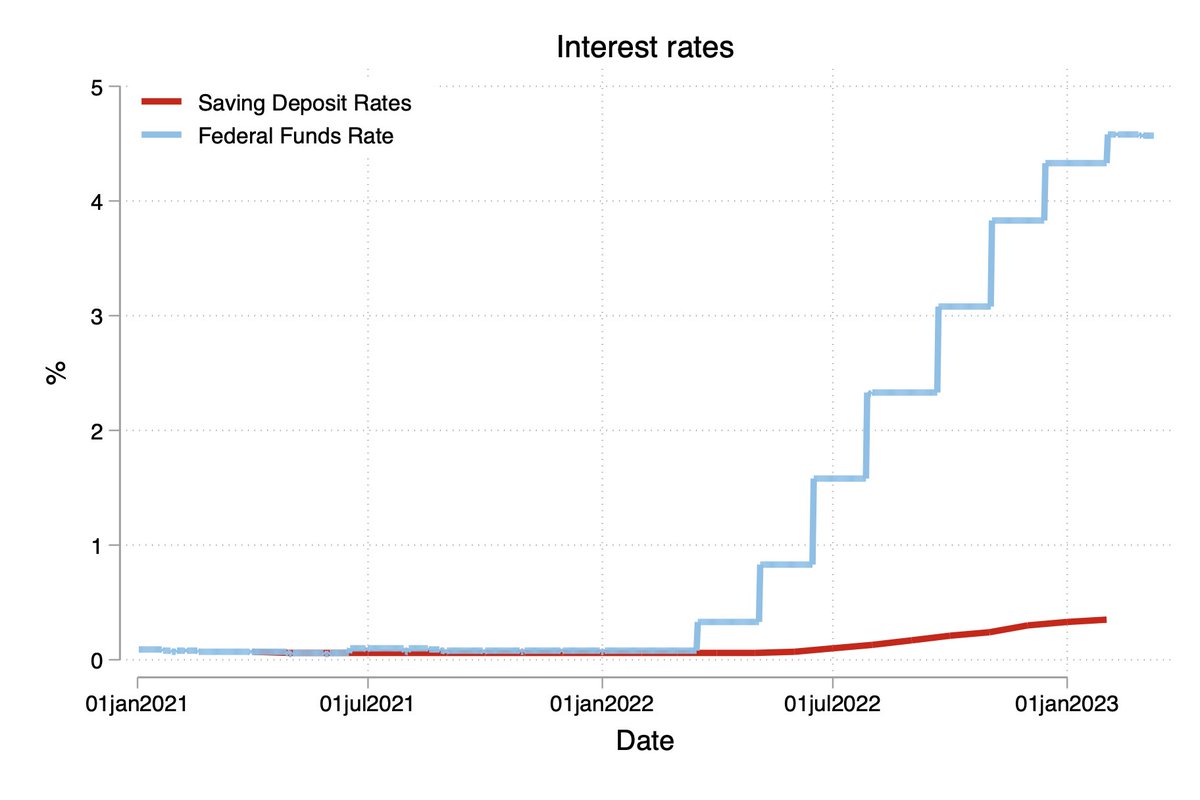
The rate that banks earn on their deposits at the Fed has risen. But the rate that banks pay to their deposits or savings accounts has not. Market power means banks' interest margin is higher, nice profits, the franchise value rises (see work by @AlexiSavov @schnabl_econ @idrechs
Standard monopoly theory: given higher price, banks' customers started buying less. Meaning, deposits moving out of the banks into other investments. Monetary aggregates fall endogenously. This has been going on for a year. Nothing unusual, standard monetarism side of tightening.
In the US, banks bought a lot of MBSs in 2020-21 when deposits were rising. Now, naturally, they have been selling. This puts upwards pressure on mortage rates.

Figure below from a talk by @schnabl_econ at the January AFA:
This extra tightening of mortgage rates is one of the channels through which inflation is brought down. You see its effects through the construction sector being the one shrinking fast in last year. It is from the monetary policy playbook.
But, if a few (small to medium) banks with depositors that:
(i) are quick to move deposits into higher-yielding savings, and
(ii) are in a "information bubble" so they are very quick to run in herds,
then you can have a run, bank failures, a crash.

amazon.com/Crash-Course-C…
What does the central bank do, from a strict monetary-policy inflation-control perspective, if it sees a run? It provides liquidity to stop further runs, and halt a too-violent contraction in money aggregates. Fed's weekend action is from the playbook.

amazon.com/21st-Century-M…
What's the next playbook step? If see a very quick sell-off of MBS, and worry about fire sale, then step in and do QE standing ready to buy MBS. This is what to look for in next few weeks. From the last decade's playbook (good idea? different discussion)
cepr.org/publications/b…
Fed has been trying to get rid of the "original sin of QE" for a while. There is no contradiction between raising rates while expanding the balance sheet. Rather, tightening risks financial stability, which requires having an elastic balance sheet.

If:
(i) liquidity facilities to banks to stop runs +
(ii) QE market-making for MBS to stop fire sales
work, then interest rates can stay focussed on fighting inflation.
In that case, still expect peak rate of 5.5-6%, nothing really changed this past week
federalreserve.gov/monetarypolicy…
Of course, if think that the Fed cannot stop a financial collapse, or that rescuing of a few banks will trigger a credit crunch, then this has a direct impact on inflation and the path for interest rates. Let's see in the next few weeks. Read up on crises
amazon.com/Crash-Course-C…
In the next FOMC meet, instead of the anticipated 25-50bp rise, for precaution instead 0-25bp is ok. Insofar as things calm down, can do 50bp next two meetings, stay on the same path, no material difference for inflation. But avoid financial dominance
economic-policy.org/76th-economic-…
IMHO, the large fall in the 2y rate in the last two days is either:
(i) markets over-reacting, as they have often done in this hiking cycle, and a correction will come soon, or
(ii) a flight to safety to government bonds raising debt revenue

aeaweb.org/articles?id=10…
It would be hard to have such a steep hiking cycle without some cracks appearing in the financial system. As long as the cracks do not become crashes, monetary policy can stay the course to bring down inflation and avoiding financial dominance. As it has done so far.

End of🧵

• • •

Missing some Tweet in this thread? You can try to force a refresh

 

Keep Current with Ricardo Reis

Ricardo Reis Profile picture

Stay in touch and get notified when new unrolls are available from this author!

Read all threads

This Thread may be Removed Anytime!

PDF

Twitter may remove this content at anytime! Save it as PDF for later use!

Try unrolling a thread yourself!

how to unroll video
  1. Follow @ThreadReaderApp to mention us!

  2. From a Twitter thread mention us with a keyword "unroll"
@threadreaderapp unroll

Practice here first or read more on our help page!

More from @R2Rsquared

Jan 2
*** Inflation and wages

A long time ago, Jordi Gali, Mark Gertler and Argia Sbordone noted: with sticky prices, inflation is expected to accelerate when marginal costs are temporarily low. Intuitively, costs will rise back, and as they do, firms will raise prices.
🧵1/12
This is sometimes called a New-Keynesian Phillips curve (not quite accurate as this is the optimal pricing condition from firms, no GE to link to real activity)

E_t ( 𝛽 𝜋_{t+1} - 𝜋_t) = - 𝜆 rmc_t
(all variables are deviation from steady states)

2/12
ideas.repec.org/a/eee/moneco/v…
But how to measure marginal costs? Gali-Gertler-Sbordone noted that if labor is the variable input, then the labor share of income in the non-farm business sector could be a good proxy. And they found a pretty good econometric fit of this condition.
3/12

ideas.repec.org/a/eee/moneco/v…
Read 12 tweets
Oct 1, 2022
*** The original sin of QE (and QT)

QE policies, adopted by the most central banks in the last 15 years, suffered from a sin at birth. This came back to bite this Thursday in the UK.

Confusingly, there are three distinct policies that go under the name of QE.
🧵 [1/15]
QE type 1 is increasing the deposits of banks at the CB. It happens when the CB borrows from banks, by issuing reserves, which are the most liquid asset in the economy. The goal is to increase liquidity in the private sector. It is about the size of the liabilities of the CB.
Most large CBs in the last decade have adopted a “saturated market“ regime (or “ample reserves” or “satiated liquidity” or “floor system”) by having large balance sheets. QE-type1 today would be a response to increases in demand for liquidity. Fed did QE1 in September of 2019.
Read 17 tweets
Sep 13, 2022
** Inflation: some optimism from expectations data

The data from surveys of inflation expectations in the second half of 2022 will be very informative to distinguish three theories. They have important implications fo what inflation *will be*.
🧵

The “ignore it” view is that inflation expectations do not matter and are useless to predict inflation. That view took a serious beating in 2021-22. Those who dismissed the expectations data badly missed the 2021-22 run-up in inflation.

A related version of the ignore-it view is that expectations matter, but measurement is too noisy to be all that useful. In normal times, this is debatable. But in large turning points for inflation, this is not true: the data shows the anchor drifting.

Read 14 tweets
Aug 26, 2022
** Evaluation of Powell’s speech today in light of the recent past

How does the 2022 Jackson Hole match up with my diagnosis three month ago of how and why 2021-22 monetary policy allowed inflation to rise?

Very well. 4-4.5 out of 5 grade.

I highlighted 4+1 factors.
🧵
My 1⃣: having all supply shocks feed 100% to higher inflation and zero to output
JP: "overarching focus right now is to bring inflation back down" "reducing inflation is likely to require a sustained period of below-trend growth" "the unfortunate costs of reducing inflation"
My 2⃣: relying on anchored inflation expectations, when there were signs of erosion in the “capital of inattention” about inflation earned stable inflation of last twenty years.

JP: "the concept of "rational inattention"" ...
Read 11 tweets
Aug 1, 2022
** Is it my fault that my head is wet? 🌧️

A strong recovery, fiscal stimulus, supply bottlenecks, Russia's invasion, energy crisis. Surely they are the causes for why inflation is high? Therefore, it is not the central banks’ fault!

Yes but no 🧵
If it suddenly starts raining, and my head gets soaking wet, it was the rain that caused it. Not my fault?

Well, it turns out I had an umbrella ☔️. I chose not to open it. Even if I did it for good reasons, and even if the umbrella wasn't perfect, it is my fault I got so wet.
Lots of shocks hit the economy all the time. Inflation targeting is all about using monetary policy to offset them. That is imperfect, so even the best/luckiest CBs will end up with 1-3%, or argue 5% one-off is best. But 7-9% for more than a year is (almost always) their fault.
Read 6 tweets
Jul 30, 2022
** The burst of high inflation in 2021-22: How and Why?

I just released a paper based on several talks I’ve given over many months (starting with Markus Academy @markuseconomist and ending with @BIS_org) on why monetary policy did not stop inflation rising in 2021-22 🧵
The focus is on advanced economies and the examples come from the @federalreserve and the @ecb. I highlight 🔢 factors, which I think were central. They are not exclusive, and I hope are broad enough to include other views in the public debate, with different weights on each one
1⃣ A misdiagnoses of shocks in 2021-22
i) Not tightening in 21H1 when recovery (stimulus) was strong
ii) Interpreting 21H2 supply shocks as markup shocks rather than falls in potential output
iii) “Seeing through” rise in energy prices of 22Q1 when expectations were not anchored
Read 8 tweets

Did Thread Reader help you today?

Support us! We are indie developers!


This site is made by just two indie developers on a laptop doing marketing, support and development! Read more about the story.

Become a Premium Member ($3/month or $30/year) and get exclusive features!

Become Premium

Don't want to be a Premium member but still want to support us?

Make a small donation by buying us coffee ($5) or help with server cost ($10)

Donate via Paypal

Or Donate anonymously using crypto!

Ethereum

0xfe58350B80634f60Fa6Dc149a72b4DFbc17D341E copy

Bitcoin

3ATGMxNzCUFzxpMCHL5sWSt4DVtS8UqXpi copy

Thank you for your support!

Follow Us on Twitter!

:(