NEW: Hundreds of Stanford students lined the halls yesterday to protest the law school’s dean, Jenny Martinez, for apologizing to Kyle Duncan, the judge shouted down last week.
The students effectively subjected Martinez to an intimidating walk of shame.🧵freebeacon.com/campus/student…
The students effectively subjected Martinez to an intimidating walk of shame.🧵freebeacon.com/campus/student…
Martinez arrived to the classroom where she teaches constitutional law to find a whiteboard covered in fliers attacking Duncan and defending those who disrupted him. The fliers parroted the argument, made by student activists, that the heckler’s veto is a form of free speech. 

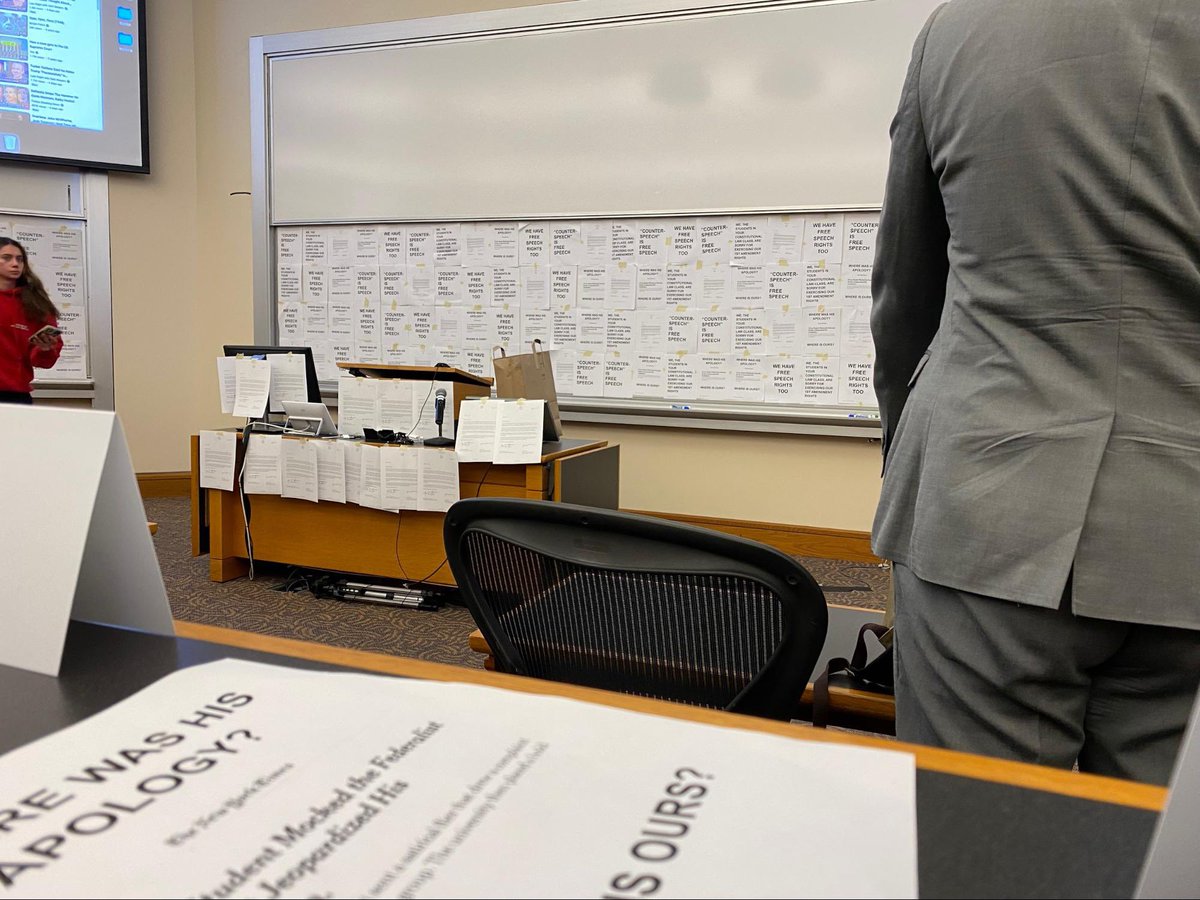
"We, the students in your constitutional law class, are sorry for exercising our 1st Amendment rights," some fliers read. As a private law school, Stanford is not bound by the First Amendment.
When Martinez’s class adjourned, the protesters, dressed in black and wearing face masks that read "counter-speech is free speech," stared silently at Martinez as she exited the room, according to five students who witnessed the episode.
The student protesters, who formed a human corridor from Martinez’s classroom to the building’s exit, comprised nearly a third of the law school. And the majority of Martinez’s class—approximately 50 students out of the 60 enrolled—participated in the protest themselves.
The few who didn’t join the protesters received the same stare down as their professor as they hurried through the makeshift walk of shame.
"They gave us weird looks if we didn’t wear black" and join the crowd, said Luke Schumacher, a first-year law student in Martinez’s class.
"They gave us weird looks if we didn’t wear black" and join the crowd, said Luke Schumacher, a first-year law student in Martinez’s class.
"It didn’t feel like the inclusive, belonging atmosphere that the DEI office claims to be creating."
Another student in the class, who likewise declined to protest, said the spectacle was a surreal experience.
Another student in the class, who likewise declined to protest, said the spectacle was a surreal experience.
"It was eerie," the student said. "The protesters were silent, staring from behind their masks at everyone who chose not to protest, including the dean."
Ironically, the student added, "this form of protest would have been completely fine" at Duncan’s talk on Thursday.
Ironically, the student added, "this form of protest would have been completely fine" at Duncan’s talk on Thursday.
This protest was even larger than the one that disrupted Duncan’s talk, and came on the heels of statements from at least three student groups rebuking Martinez’s apology.
The Stanford National Lawyers Guild said Saturday that Martinez had thrown "capable and compassionate administrators" under the bus. Stanford’s immigration law group issued a similar declaration Sunday, writing that Martinez’s apology to Duncan "only made this situation worse."
And Stanford Law School’s chapter of the American Constitution Society expressed outrage that Martinez and Tessier-Lavigne had framed Duncan "as a victim, when in fact he himself had made civil dialogue impossible."
The groups argued that the students who disrupted Duncan, in violation of Stanford’s free speech policies, were merely exercising their own free speech rights. That idea appears to be shared by Tirien Steinbach, the diversity dean who harangued Duncan.
In a conversation with students after the event, Steinbach claimed the hecklers hadn’t violated any law school policies, according to two people who witnessed the conversation.
She also alleged that Duncan hadn’t prepared a speech—a claim contradicted by video of the judge holding pages of pre-written remarks—and that he was a serial provocateur, belittling law students everywhere he's spoken in order to rile them up for the cameras.
Steinbach, who did not respond to a request for comment, laid the blame for the chaos entirely at Duncan’s feet, the people who witnessed the conversation said.
Martinez said at the start of her class that she had received a number of emails complaining about her apology to Duncan—which was co-signed by the president of Stanford—but told students they would not be litigating that dispute during Monday’s class.
After Martinez left the building, Schumacher said, the protesters began to cheer, cry, and hug. "We are creating a hostile environment at this law school," Schumacher said—"hostile for anyone who thinks an Article III judge should be able to speak without heckling."
• • •
Missing some Tweet in this thread? You can try to
force a refresh