A LOT of people look at the mental illness diagnosis data and assume that conservatives stigmatize seeking help so just get fewer DIAGNOSES.
This view is false, and we can prove it. Conservatives really are mentally healthier.
This view is false, and we can prove it. Conservatives really are mentally healthier.
https://twitter.com/ryanburge/status/1635439519926190081
The Pew survey has diagnosed mental illness, has a battery of questions about mental health (anxiety, deepression, happiness, worry, loneliness, etc), and has ideology.
We can ask, of respondents who have THE SAME REPORTED MENTAL HEALTH, do rates of DIAGNOSIS differ by ideology?
We can ask, of respondents who have THE SAME REPORTED MENTAL HEALTH, do rates of DIAGNOSIS differ by ideology?
I include controls for age, race, and sex.
Here's rates of diagnosis by ideology and intensity of mental health symptoms.
As you can see, among bad-mental-health-symptomatic people, conservatives have the SAME diagnosis rate as liberals.
Here's rates of diagnosis by ideology and intensity of mental health symptoms.
As you can see, among bad-mental-health-symptomatic people, conservatives have the SAME diagnosis rate as liberals.

In fact, "very conservative" people who are in the upper-third most sad, lonely, worried, anxious people have HIGHER rates of being diagnosed than liberals!
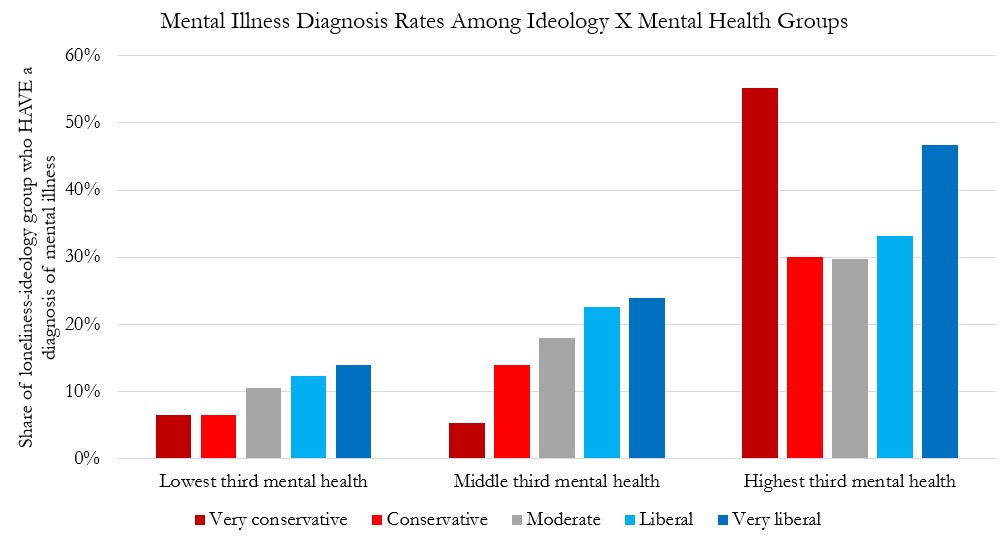
So when it comes to people with the "highest third" of bad mental health symptoms (i.e. plausibly mentally ill people), there is NO DIFFERENCE is dignosis by ideology.
There IS a difference among people with low-to-moderate symptoms of poor mental health.
There IS a difference among people with low-to-moderate symptoms of poor mental health.
But.... that proves the point of conservative resiliency!
Liberals have higher rates of mental illness because liberals who are NOT objectively experiencing bad mental health nonetheless PURSUE DIAGNOSES.
Liberals have higher rates of mental illness because liberals who are NOT objectively experiencing bad mental health nonetheless PURSUE DIAGNOSES.

In other words, the difference in diagnosed mental illness between conservatives and liberals has two factors:
1) Conservatives are actually happier, less worried, less anxious
2) Objectively fairly-mentally-well liberals nonetheless pursue diagnoses of mental illness
1) Conservatives are actually happier, less worried, less anxious
2) Objectively fairly-mentally-well liberals nonetheless pursue diagnoses of mental illness
If you want to say conservatives are just "undiagnosed mentally ill," then prove it. Shoe me evidence that conservatives have worse mental health in terms of symptoms, and show me evidence that poor-mental-health conservatives go undiagnosed. It's not there.
This is the argument you have to retreat to to defend the "conservatives just stigmatize bad health" argument, but it's philosophical nonsense.
https://twitter.com/WorkingRob/status/1635646298614276101
Yes, conservatives probably observe emergent negative affect and respond in the healthy way, that is, not identifying with that negative affect.
If we assume all people experience emergent episodes of negative affect at similar rates, we must ask why for some people it...
If we assume all people experience emergent episodes of negative affect at similar rates, we must ask why for some people it...
... seems to metastasize so much. Many factors, external, genetic, social, etc matter. Among those many factors, one contributor however is exactly what @JonHaidt flags: how you cognitively respond to emergent negative affect. CBT gives one particular healthy script.
CBT is not the only possible healthy script for responding to emergent negative affect. But the point is, we do know some very UNHEALTHY scripts, which CBT helps name, that basically boil down to dwelling on negativity all the time.
So the argument that conservatives actually are experiencing unhappiness, but just not reporting them, is dubious, because it presupposes that people experiencing emergent unhappiness SHOULD preserve that mental state long enough to report it.
But that argument.... is itself arguing IN FAVOR OF cognitive scripts that we know lead to poor mental health! It's an ouroboros!
Now, I am not arguing FOR repression. But I am saying that in principle if you start to feel sad for no super strong reason it is not unreasonable to try to focus on happier things and to not give the sadness power over your life by identifying with it.
Notice, acknowledge, move on, and when you take a survey the next day, ask yourself what defined the day, not what happened for 3 minutes before you moved on.
Good question. Including a control variable for metropolitan status has no effect on estimated results.
https://twitter.com/smod4real/status/1635647333382647813
• • •
Missing some Tweet in this thread? You can try to
force a refresh