

External ventricular drains (EVDs) are one of the most common procedures in neurosurgery… And having to troubleshoot said EVDs that stop working (usually in the middle of the night) is ALSO common, though not always intuitive 📟🫠
How to troubleshoot an EVD - a thread 🧵 /1
How to troubleshoot an EVD - a thread 🧵 /1
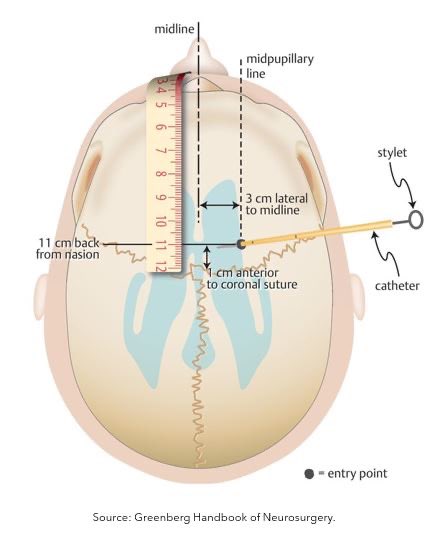
First, let's review how EVDs work. An EVD is a temporary catheter placed in the ventricle at the foramen of Monro that can (1) measure ICP & (2) control ICP by draining CSF.
/2
/2


The drainage system is leveled at the ear, and the collection chamber is raised to different heights to control CSF flow and, thus, drainage.
At a given height, CSF will drain whenever intraventricular pressure exceeds that set by the height of the collection system.
/3
At a given height, CSF will drain whenever intraventricular pressure exceeds that set by the height of the collection system.
/3

In addition to monitoring ICP & CSF output, EVDs record the ICP waveform, which can be informative when troubleshooting an EVD that has stopped draining.
When an EVD fails, the concern is that ICP will increase due to impaired CSF outflow, and neurologic decline may ensue.
/4
When an EVD fails, the concern is that ICP will increase due to impaired CSF outflow, and neurologic decline may ensue.
/4


What does it mean when an EVD stops draining, and what should you do?
You must critically assess each component of the EVD fluid column.
In general, EVD failure results from:
-obstruction (distal or proximal) - ie, from clot or debris
-collapsed ventricles (over-draining)
/5
You must critically assess each component of the EVD fluid column.
In general, EVD failure results from:
-obstruction (distal or proximal) - ie, from clot or debris
-collapsed ventricles (over-draining)
/5

First, assess for any mechanical obstruction:
🔵 Has the system become disconnected or clogged at any point?
🔵 Is the EVD correctly leveled at the ear?
🔵 Are there any obvious kinks in the catheter tubing?
🔵 Did the EVD migrate (check the scalp)?
/6
🔵 Has the system become disconnected or clogged at any point?
🔵 Is the EVD correctly leveled at the ear?
🔵 Are there any obvious kinks in the catheter tubing?
🔵 Did the EVD migrate (check the scalp)?
/6
Clues for mechanical obstruction include waveform dampening and/or lack of pulsation of the CSF meniscus in the drain tubing.
Mechanical obstructions are solved by direct repair or by replacing the collection system.
/7
Mechanical obstructions are solved by direct repair or by replacing the collection system.
/7

Next, assess for patency (performed by nsgy):
Drop test - if CSF drains when the system is lowered to the floor, the system is patent.
Raise test - if CSF tidaling is observed when the system is raised above the head, the system is patent (likely over-draining).
/8
Drop test - if CSF drains when the system is lowered to the floor, the system is patent.
Raise test - if CSF tidaling is observed when the system is raised above the head, the system is patent (likely over-draining).
/8
Summary:
🧠EVDs may (will?) stop draining
🧠EVD failure is likely due to mechanical obstruction or ventricular collapse, the interventions for which are very different
🧠Assessment of the patient, EVD collection system, & ICP waveform are crucial in determining patency
🧠EVDs may (will?) stop draining
🧠EVD failure is likely due to mechanical obstruction or ventricular collapse, the interventions for which are very different
🧠Assessment of the patient, EVD collection system, & ICP waveform are crucial in determining patency


• • •
Missing some Tweet in this thread? You can try to
force a refresh






