3-ish years ago, I put up this thread on the growth of the Chinese PLA Navy, calculating the total tonnage of warships launched during a 5-year period & comparing it to the numbers for the USN & allied/partner navies.
Looks to me like it's about time for an update.
Looks to me like it's about time for an update.
https://twitter.com/tshugart3/status/1306311601968955394
The previous thread covered the warships China launched from 2015-2019. This update will cover 2018-2022. The PLA Navy took a bit of a breather in its destroyer and frigate construction for a couple of years, so the numbers could be interesting. Did they still outbuild the USN?
In terms of hull count, the total launched dropped to 75 from 86 in the previous count.
Note: these numbers are from open source data for ship launches, which China doesn't always publicize like the USN, so don't @ me if you have a niggle with them. It's the best I could find. 🤷♂️
Note: these numbers are from open source data for ship launches, which China doesn't always publicize like the USN, so don't @ me if you have a niggle with them. It's the best I could find. 🤷♂️

By my count, the USN launched 35 warships during the same timeframe. 😐

"Ah", you say, "but Chinese warships are on average much smaller, so the USN probably outbuilt them on a tonnage basis this time!"
Not so much. The PLA Navy again outbuilt the USN by tonnage, about 580K tonnes compared to about 430K for the USN, or about 1/3 more.
Not so much. The PLA Navy again outbuilt the USN by tonnage, about 580K tonnes compared to about 430K for the USN, or about 1/3 more.

Let's consider, too, the USN has worldwide responsibilities, with roughly 60% of forces allocated to the Pacific—unlike (for now) the PLAN. By that measure, new US warships available for the Pacific would be closer to 260,000 tons, or less than 1/2 what the PLAN built.
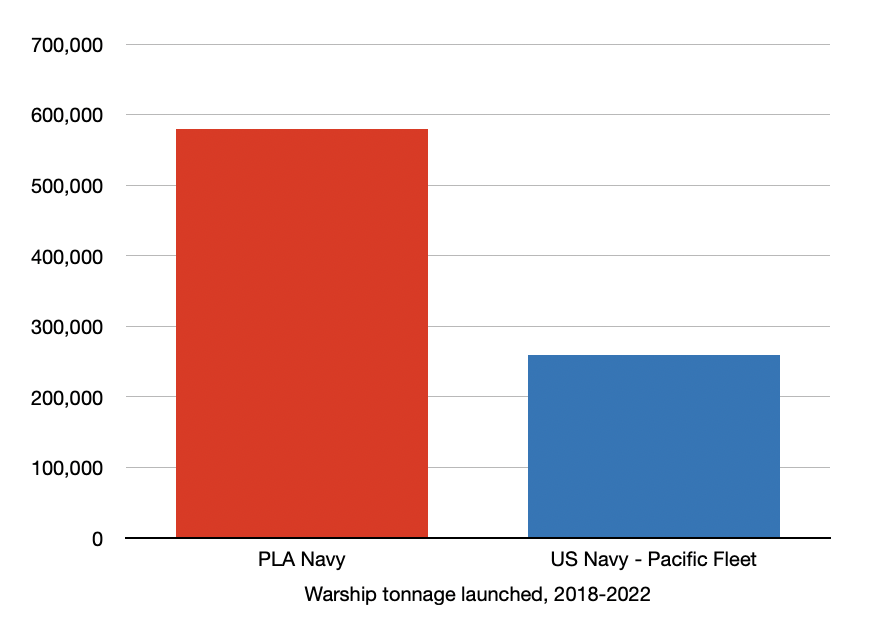
But what about US allies and partners (e.g., "the Quad") across the Indo-Pacific. Surely our combined maritime power will continue to dwarf the PLAN!
The Quad's shipbuilding tonnage (w/ the US Pacific Fleet's allocation)? A bit under 430K tons
The Quad's shipbuilding tonnage (w/ the US Pacific Fleet's allocation)? A bit under 430K tons

And once again, as seaborne-trade-dependent ally/partner nation policymakers consider the rise of the PLAN and what it could mean to them, they might want to consider this: the combined tonnage launched by the main non-US Indo-Pacific navies? About 230K tons.

As I said last time, given that the PLAN is a unitary force & that coalitions introduce inefficiencies, what seems clear to me is that were the US to be driven from the region, or to reduce its commitments due to lack of regional support, well...
None of this data captures the recent resurgence in PLA destroyer building, with at least 7 likely to launch in 2023...
https://twitter.com/tshugart3/status/1603119917091504128?s=61&t=wzU7Gmg1v-IVYROpt7BfEQ
Or the apparent commencement of construction of a new, larger class of Type 054B frigate. navalnews.com/naval-news/202…
So as I said 3 years ago to close things out, I'll say again that unless we change the trajectory of things...
• • •
Missing some Tweet in this thread? You can try to
force a refresh