
At the moment there's a lot of talk about Bakhmut being the right call, including from Ukrainian officials.
I'm still waiting to pass ultimate judgement due to multiple factors at play (and it might take years to know everything)
Let's talk about it.
1/21
I'm still waiting to pass ultimate judgement due to multiple factors at play (and it might take years to know everything)
Let's talk about it.
1/21
1) Ukraine is claiming that Russians have been pushed back from MSR's.
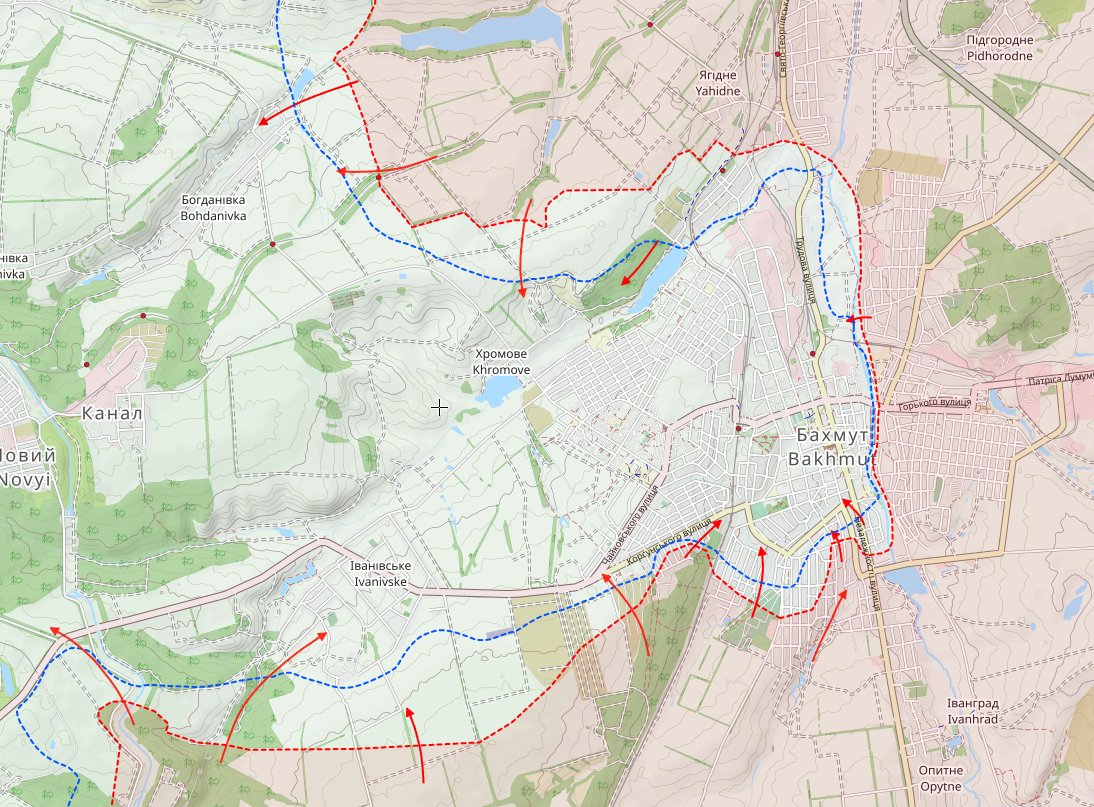
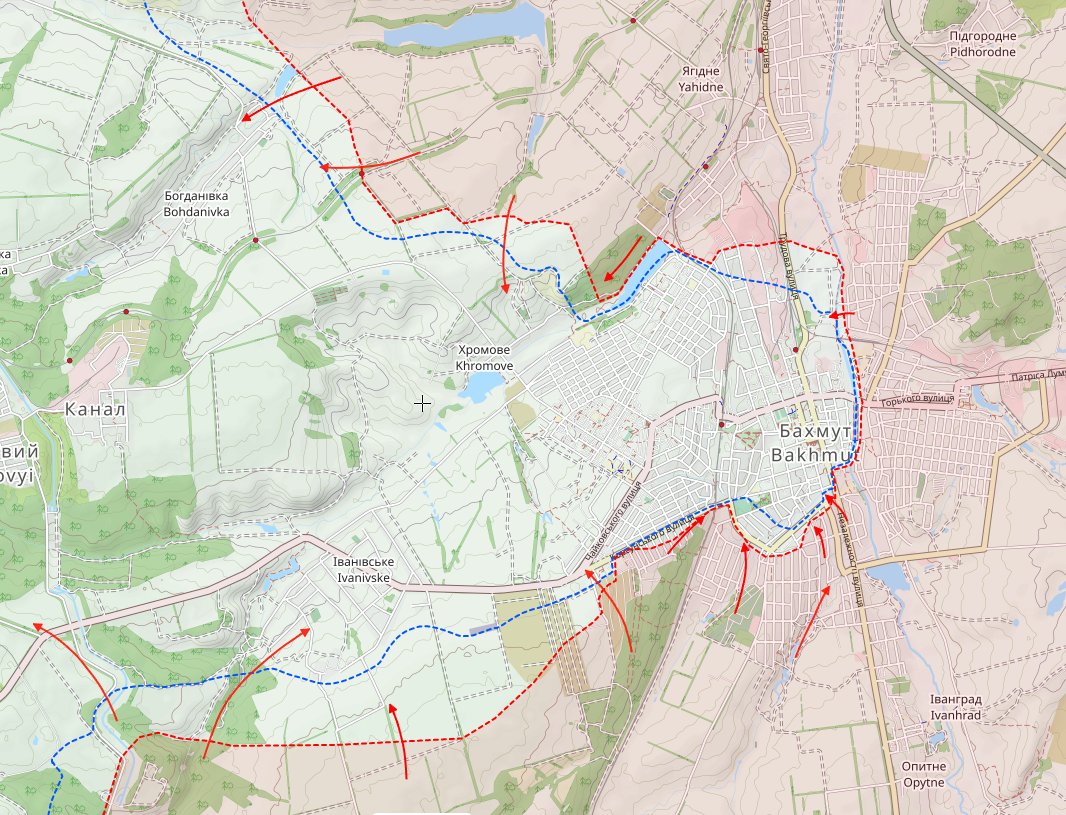
That might be true, but as of now we haven't seen much to confirm this. At best I think we're talking of pushing the Russians back a few hundred meters. Maps from two weeks ago and now from us and DS
2/21
That might be true, but as of now we haven't seen much to confirm this. At best I think we're talking of pushing the Russians back a few hundred meters. Maps from two weeks ago and now from us and DS
2/21


One can clearly see that the Russians have advanced from the positions held two weeks ago.
As I said, it's possible that the situation has significantly changed in the past few days with no visual evidence yet, but this is what we are seeing right now.
3/21
As I said, it's possible that the situation has significantly changed in the past few days with no visual evidence yet, but this is what we are seeing right now.
3/21
2) Ukrainian goals haven't necessarily been achieved.
Ukraine seems to have wanted to make Russia commit a significant part of its forces to Bakhmut. However, currently we're seeing mostly Wagner PMC and elements of the 106th VDV Division around the city.
4/21
Ukraine seems to have wanted to make Russia commit a significant part of its forces to Bakhmut. However, currently we're seeing mostly Wagner PMC and elements of the 106th VDV Division around the city.
4/21
If the objective was to make Russia commit their forces to a quagmire in Bakhmut, it doesn't seem like Russia has taken the bait quite as Ukraine hoped.
In fact, Ukraine has committed a number of units to holding the city, which brings us to the next point.
5/21
In fact, Ukraine has committed a number of units to holding the city, which brings us to the next point.
5/21
3) We don't know what holding Bakhmut (so far) has cost Ukraine.
The AFU has had to bring in a number of its operational reserves to hold the city's vulnerable flanks, including mechanized (67th, 92nd, 30th, 53rd) and airborne (80th) brigades.
6/21
The AFU has had to bring in a number of its operational reserves to hold the city's vulnerable flanks, including mechanized (67th, 92nd, 30th, 53rd) and airborne (80th) brigades.
6/21
Recent reports from the front and from people such as @konrad_muzyka and @KofmanMichael indicate that since Soledar fell Ukraine has not had the quite favourable 1:5 casualty ratio (or even 1:7 UKR claims) that's been boasted but something closer to 1:2.
7/21
7/21
The reported casualty ratios, and the number of valuable units brought to hold the city might mean that these operational reserves are themselves getting chewed up and having to be rotated at an increased rate yet are needed to prevent Russian advance.
8/21
8/21
If Bakhmut was indeed meant to attrit the Russians at an unsustainable rate, the use of Ukraine's best troops in a lowland city that only has GLOC's through a valley, might still raise questions. Was the narrow salient truly the best way to achieve Ukrainian objectives? 9/21
4/? Russian may be tying up Ukrainian units in Bakhmut
Even if the fighting has relaxed in the past week Ukraine still can't relax the presence on the city's vulnerable flanks due to the threat of encirclement.
This means these units can't be used anywhere else.
10/21
Even if the fighting has relaxed in the past week Ukraine still can't relax the presence on the city's vulnerable flanks due to the threat of encirclement.
This means these units can't be used anywhere else.
10/21
Russia has increased its pressure around Avdiivka and there are still some Russian units that we know exist but that we can't definitely place on the map and may not be committed at large yet
This means that Ukraine may be less able to answer to sudden Russian pressure or
11/21
This means that Ukraine may be less able to answer to sudden Russian pressure or
11/21
That the Russians still retain reserves they can effectively use to reinforce the areas that the Ukrainians decide to launch their counteroffensive on.
That many Ukrainian units being tied in Bakhmut means less operational flexibility for the Ukrainians too.
12/21
That many Ukrainian units being tied in Bakhmut means less operational flexibility for the Ukrainians too.
12/21
5) The battle isn't over yet
I'm going back to the maps I showed you earlier, but the battle is indeed still ongoing. Even if Ukraine has counterattacked on the flanks it's unclear how successful that has been, and the Russians are slowly advancing within the city itself.
13/21
I'm going back to the maps I showed you earlier, but the battle is indeed still ongoing. Even if Ukraine has counterattacked on the flanks it's unclear how successful that has been, and the Russians are slowly advancing within the city itself.
13/21
There's a lot of talk of the Russian offensive around Bakhmut having culminated, or being close to culmination, but should Russia decide to bring up forces, be that reserves or troops from other fronts, there is a chance that the situation around the city escalates again.
14/21
14/21
It's been a slower week or two, but as of now, we can't be sure that the battle has definitely ended.
Even the permanently optimistic ISW is considering the possibility of Russia bringing in more troops.
15/21
Even the permanently optimistic ISW is considering the possibility of Russia bringing in more troops.
15/21
The general mood swings between "all is lost" and "we've won" are very very fast and of course, the commentators are quick to latch on to any shift in the fighting that supports their own beliefs, even if there is still no definite evidence one way or another.
16/21
16/21
As with Severodonetsk, the initial Kherson offensive, the Kharkiv offensive, and many others, the definite facts from the ground will only emerge after some time has passed and a better view of the situation starts locking in place.
17/21
17/21
It's quite possible that despite the points I've raised here the overall attrition rate has been favourable enough for Ukraine that the Bakhmut salient with its, still vulnerable, flanks was worth keeping with all the blood it cost.
18/21
18/21
It's possible that there's a greater plan that Bakhmut has been in service of that we don't see as of now, and everything has gone according to that plan.
However, there's also the possibility that holding Bakhmut (as of now) was ultimately more trouble than it was worth.
19/21
However, there's also the possibility that holding Bakhmut (as of now) was ultimately more trouble than it was worth.
19/21
As for me? To me, Bakhmut still seems like a politically motivated meatgrinder that hasn't achieved that much except deny a victory to the Russians at a great cost to the AFU.
20/21
20/21
That, of course, might be politically valuable on its own, but so far it has also put its own political strain on Ukrainian institutions.
The question of "was it worth it, even if the Russians never take it" is hard to answer without a crystal ball though.
21/21
The question of "was it worth it, even if the Russians never take it" is hard to answer without a crystal ball though.
21/21
Addendum: some unknowns I forgot to present
- How has holding on to Bakhmut affected UA artillery shell supplies, especially considering they've needed to ration them for the future offensive?
- Even if the Russian attack stalls at Bakhmut will the UA morale rift be fixed?
- How has holding on to Bakhmut affected UA artillery shell supplies, especially considering they've needed to ration them for the future offensive?
- Even if the Russian attack stalls at Bakhmut will the UA morale rift be fixed?
Having to do with the latter:
- If the Russian attack stalls at Bakhmut will the problems now identified with Ukrainian command structures and military institutions by people such as @GlenGrant be ignored and swept under the rug?
Even if Bakhmut is a win they'll still exist.
- If the Russian attack stalls at Bakhmut will the problems now identified with Ukrainian command structures and military institutions by people such as @GlenGrant be ignored and swept under the rug?
Even if Bakhmut is a win they'll still exist.
Edit: forgot the 26th-day Ukrainian frontline on our 13th-day map. It should rather look like this.
The only change clearly positive for the Ukrainians is the Russian presence in the woods west of the canal being pushed back.
The only change clearly positive for the Ukrainians is the Russian presence in the woods west of the canal being pushed back.
• • •
Missing some Tweet in this thread? You can try to
force a refresh






