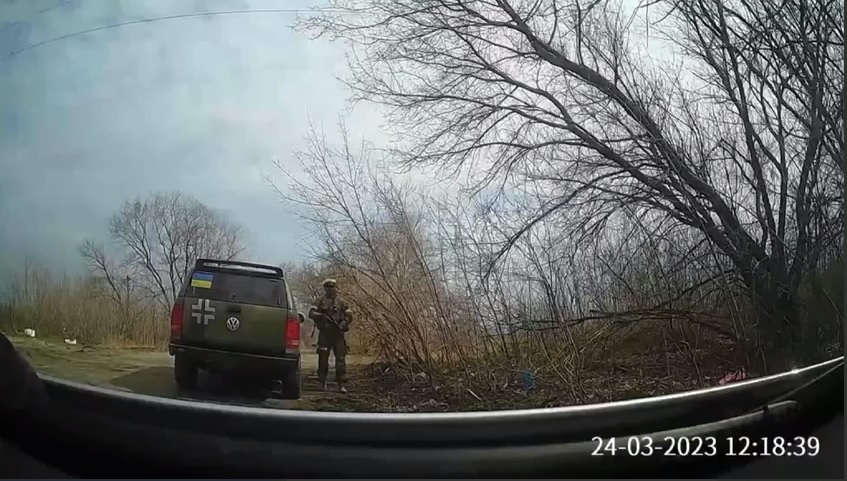
1/ Various russian Telegram channels share a video that allegedly shows Ukrainians stopping a car with a woman and a child (the child is not seen), engaging in a verbal alteration, and then shooting at the car. This looks like a staged video, for the following reasons:
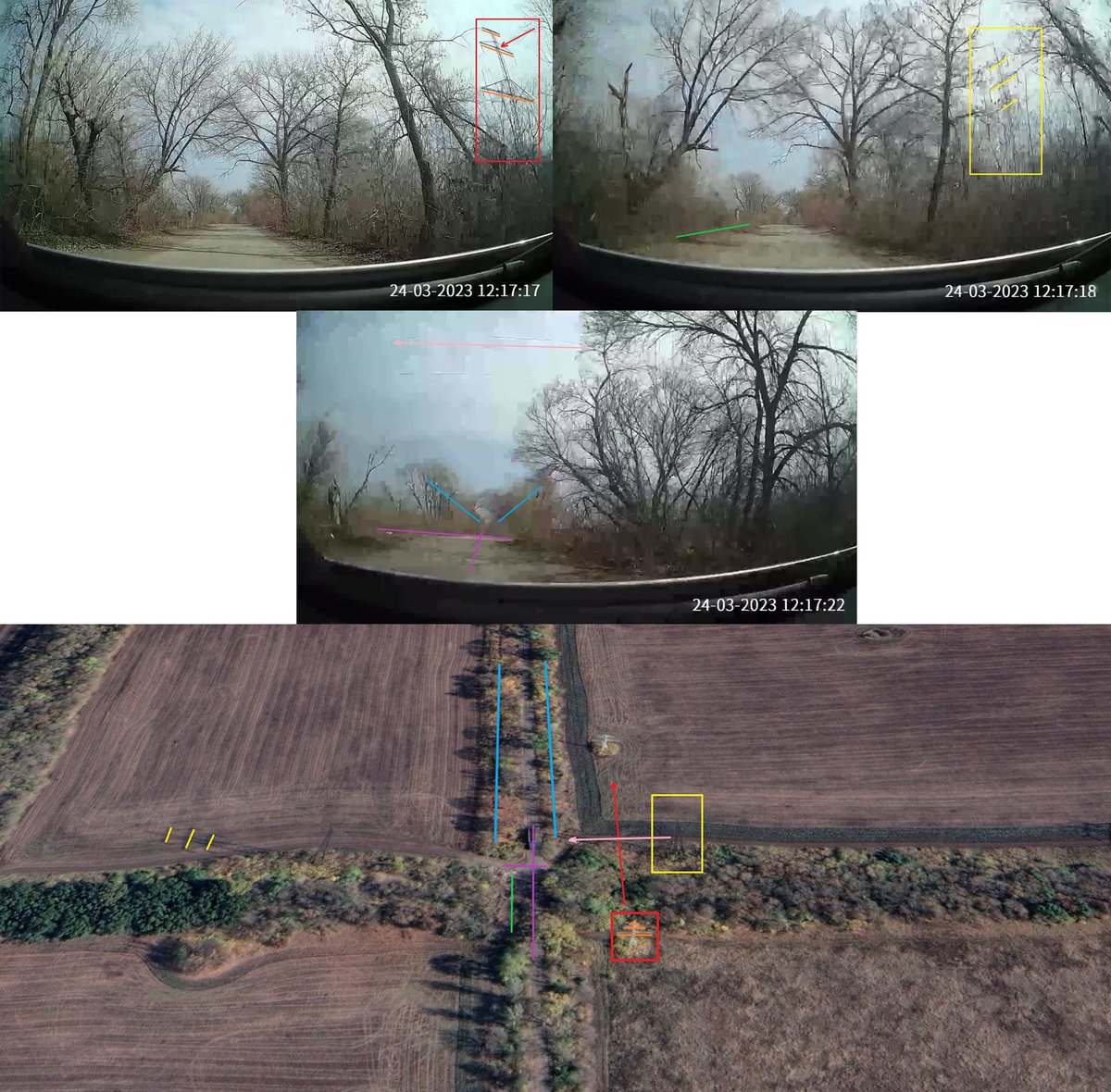
2/ The location where the video was filmed has reportedly been identified by the Telegram channel "Moscow Calling" as 47.9769473, 37.9534718. Source: t.me/m0sc0wcalling/…
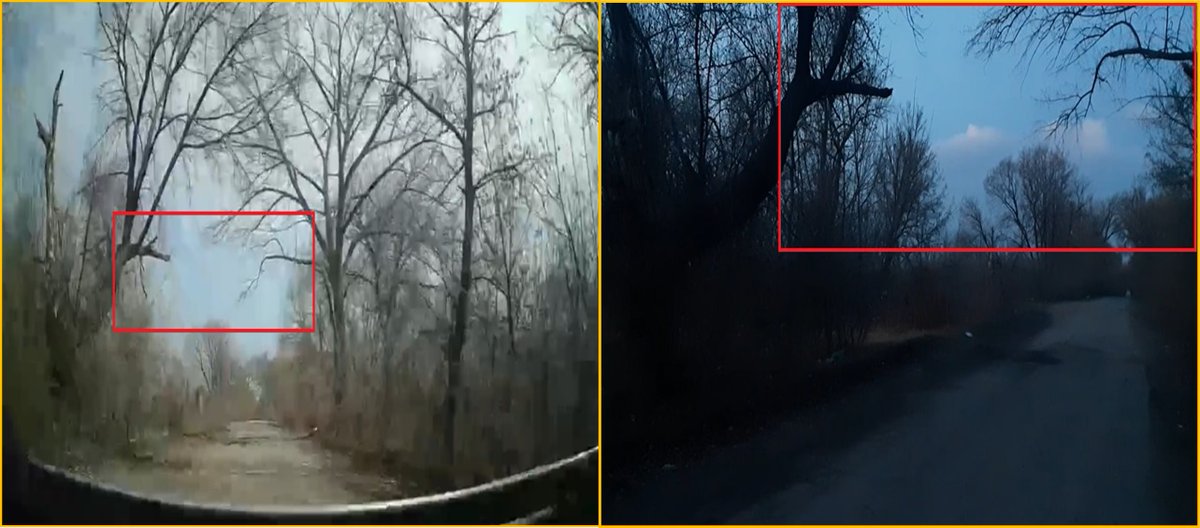
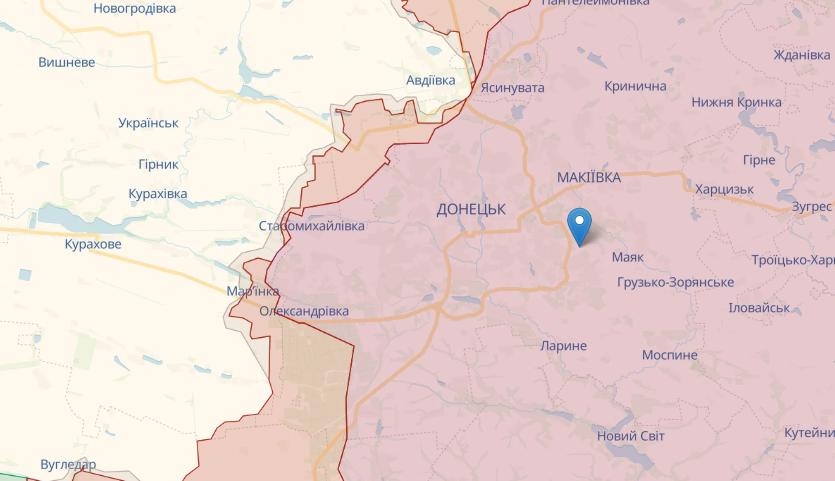
3/ The identified location, 47.9769473, 37.9534718, is situated deep within the occupied territory of Donetsk, as can be seen on the DeepState map.
4/ The soldiers in the video are wearing yellow armbands, which is an uncommon practice among Ukrainian soldiers who currently wear green armbands. This raises suspicions about the authenticity of the soldiers depicted in the video.
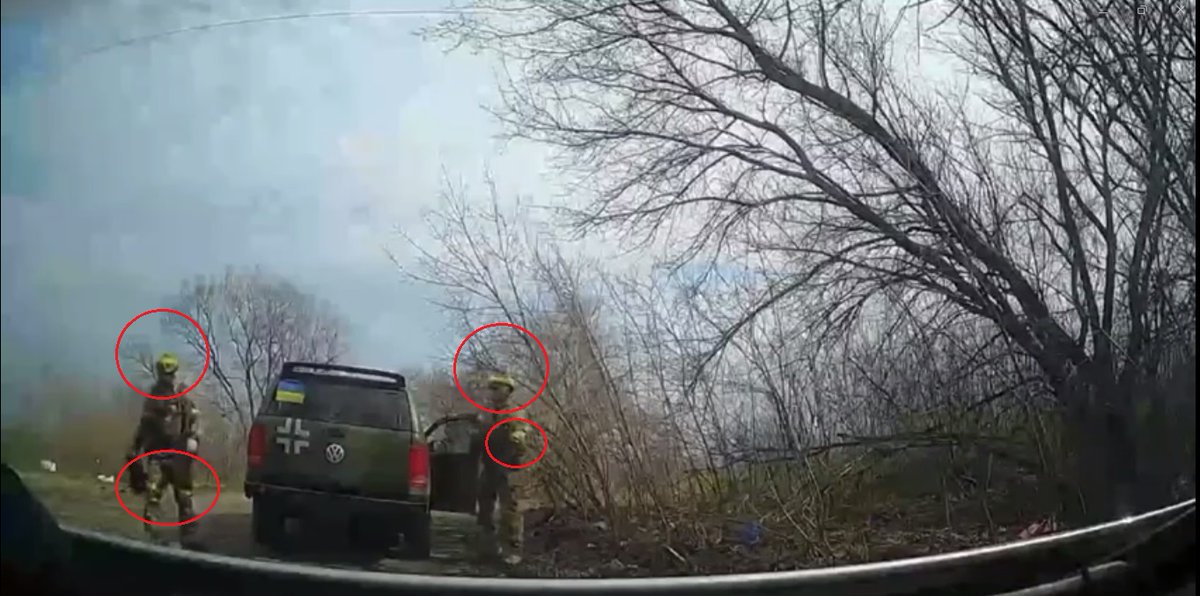
5/ The fact that the woman was driving with a dashcam is another cause for suspicion. It is illegal to film the movement of Ukrainian troops, and one would not be able to pass a checkpoint with a dashcam. Thus, the presence of a dashcam raises huge questions
6/ The car depicted in the video appears to be very clean, which is an unlikely condition for a vehicle traveling in a war zone. This gives the impression that the car was recently washed for the purpose of filming the video.
7/ The soldiers in the video appear to assault the woman because she speaks Russian, which is a trope that is often utilized in propaganda. The portrayal of the soldiers as two masked Ukrainian nationalists stopping a car with a woman and a child and then
8/ abusing them because they speak russian appears to be a manufactured narrative from russian propaganda playbook. Additionally, the woman's name appears to have a Muslim origin, which aligns with recent fake propaganda videos circulated by Russians,
9/ showing fake Ukrainian soldiers burning the Quran. It is worth noting that the location of the incident is deliberately obscure, making it difficult to determine where it took place. Additionally, all soldiers are conveniently wearing masks, obscuring their identity
10/ Furthermore, there is additional evidence suggesting that the video is staged. However, I will withhold further analysis until it is completed. The full video can be accessed via this link: t.me/readovkanews/5…
Additional: As the user @MrClarkyofAxel pointed out, the cross on back of the car is not a regular one, which is used by Ukrainian troops, but stylized Balkenkreuz, that resembled German troops during WW-2 period. Another clear indications of a staged propaganda piece.
Further analysis by @EjShahid provides independent confirmation of the location
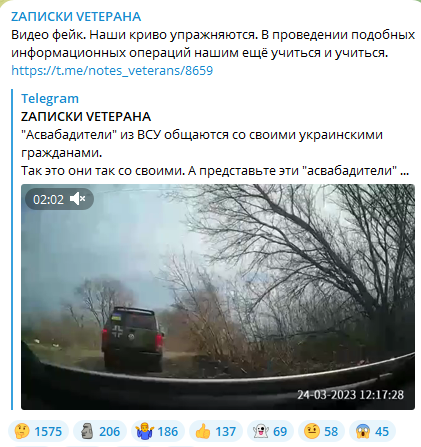
The story takes an unexpected turn. Russian famous telegram channel, with over 300,000 subscribers, has admitted that the video is fake:
"The video is fake, our crooked exercise. In conducting such information operations, there is still much for us to learn and improve upon."
• • •
Missing some Tweet in this thread? You can try to
force a refresh

There’s been a lot of discussion about the potential threat FPV drones could pose to US forces on the ground, with some going as far as claiming that American troops would suffer heavy casualties from FPV drones. That’s possible, but it’s also worth questioning the assumptions:
2/ First, it’s not clear to what extent Iran has actually trained and prepared its ground forces for large-scale use of small drones. Even relatively decentralized militaries still operate within ORBAT and logistics. So far, there isn’t strong evidence of systemic changes within the Iranian army to support widespread FPV deployment.
3/ Second, we’ve seen relatively little FPV usage from Iran-supported groups like Hamas or Hezbollah, despite continuous war with Israel. A few examples have emerged from Iraq, but we’re talking about a handful of videos at most. That’s not a level of a large-scale implementation
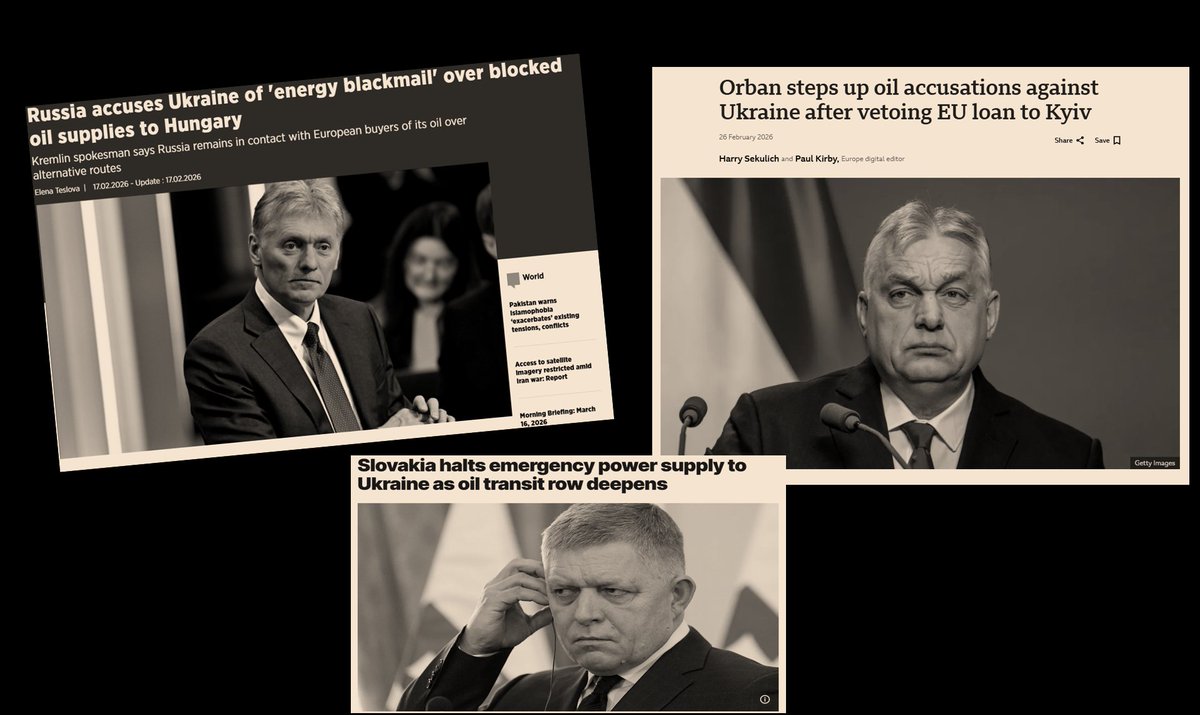
With an uncertain battlefield position, Russia has intensified hybrid operations to shape European public opinion. A key element is the spread of narratives portraying Ukraine as using “energy blackmail” against Europe, often echoed by politically sympathetic actors. 🧵Thread:
2/ Since the full-scale invasion began, Russian missile and drone strikes have targeted Ukraine’s energy system, damaging power plants, gas facilities, and transmission networks nationwide. Ukraine has lost about 11.5 GW of capacity, with damage reportedly exceeding $24.8 billion
3/ The war has also affected energy transport infrastructure. Ukrainian oil facilities have been attacked more than 400 times since the invasion began. On 27 January 2026, a strike damaged equipment working for the Druzhba pipeline near Brody in western Ukraine.
Leaked internal files from Moscow reveal that Russia’s ruling party, United Russia, keeps intelligence-style dossiers on its own politicians. They document corruption facts, criminal ties, and personal vulnerabilities, information used to manage Russia’s politics
Thread 🧵:
2/ United Russia is the political party that dominates Russia’s parliament and regional governments and serves as the main political vehicle of Putin.
Leaked documents from the party, published by @dallasparkua and @256CyberAssault, reveal details of an internal vetting process
3/ Meet Evgeniy Gnedov, who oversees the vetting of candidates for various lawmaking bodies - from local assemblies to the federal parliament.
A longtime security official, he spent decades inside the Federal Penitentiary Service of Russia, eventually rising to a senior role
Russia’s war in Ukraine has increasingly become a war of drones, but artillery still plays a key role on the battlefield. Newly obtained documents from 2014 to 2025 show that Russia continues to modernize its artillery production using industrial machinery from Europe. 🧵Thread:
2/ In a joint analysis, Frontelligence Insight and the @dallasparkua company reviewed hundreds of internal documents from Russian defense contractor Zenit-Investprom and found that Plant No. 9, a maker of artillery barrels and tank guns, went through major upgrades in 2025
3/ Six facilities within the Uralmash industrial zone were found to be undergoing modernization, including planned delivery of industrial machinery from several European countries. Several workshops were dedicated to work on the Armata project and the Koalitsiya SPG.
As we approach a point marking the beginning of the war’s 5th year, it is time to discuss how we assess the war’s overall dynamics, strictly from a military standpoint. One method many analysts use is the pace of territory capture. However, this methodology has a serious issue🧵:
2/ Generally, this is not a bad method of analyzing battlefield dynamics, as the history of wars shows far more cases of states advancing along frontlines or into enemy territory before a war ends in their favor than the opposite. The devil, however, lies in the details
3/ Putting aside other domains of war, such as economics and socio-politics, battlefield dynamics are often judged by metrics like casualty rates and square kilometers of controlled territory. This can produce a distorted picture, a problem I informally term the “Sahara Fallacy”