April 6th, 2023: @Twitter has been randomly shutting down API access for many apps and sadly we were affected today too. Hopefully we will be restored soon! We appreciate your patience until then.
In this post, we add on to the market notes (Chapter 12.7) on change of numeraire methods for continuous time treatments to stochastic calculus. In the next market notes, we introduce computational concepts in linear algebra on Euclidean spaces hangukquant.substack.com/p/change-of-nu…
(we will make this available for all readers) - this sets us up with the machinery and terminology required for talking about the mathematics of multiple random variables.
This will help us both in the discussion for portfolio management and the next chapter of stochastic calculus on term structure models.
The discussion of portfolio management will be resumed with looking at the shrinkage method for robust estimations in sample covariance matrix, known as the Ledoit-Wolf method, inspired from Oliver Ledoit of Credit Suisse and Michael Wolf of UZurich.
• • •
Missing some Tweet in this thread? You can try to
force a refresh

We have a momentum strategy of moving average pairs, and our Sharpe was 1.10. We are interested in questions like;
i) what is the probability of getting Sharpe 1.10 or better if we went long as often but at random timings as opposed to our rule based timing? (asset picking)
ii) what is the probability of getting Sharpe 1.10 or better if we went long some other asset B when our rule said to buy A? After all, markets are correlated. If we are good at timing (smart-beta), what is our alpha component of the total return?
iii) what is our overall skill at picking and timing in relation to market drift? (trader skill)
iv) Given 10 another moving average pairs, which of the moving average pairs have statistically significant edge?
As @therobotjames put it, often when people say they give away alpha, they rarely are. Here's an exception: I am discussing one of my event driven trades live ON TWITTER (probably a bad idea, but HangukQuant is now 2000 readers and I am celebratory). HERE GOES:
Singapore's monetary policy is the S$NEER, a managed float FX trade weighted againt a basket of trading partner currencies. 2 policy statements a year, and monthly updates on true values of S$NEER. When SGD exceeds policy bounds, central bank intervenes.
To prevent currency speculation (think Thai baht), central bank hides key variables 1) basket constituents 2) baset weights 3) policy band width 4) policy drift 5) policy midpoint.
Recalibration amounts to figuring these variables out.
end of quant tool series with HangukQuant. Take your Python programming skills to the next level with these resources:
Note that these resources are fairly detailed, not difficult but also so comprehensive that they will require resilience to sit through and study.
There is no avoiding hard work here, unfortunately.
Fluent Python is a great book for understanding Python basics, internals and mechanics top to bottom. This will give you knowledge of the language itself.
Next, you need to pick up object oriented programming. This can be done in any langauge, and there are great Java books. If you want to stick to Python, just go with Python object-oriented programming.
While equity hedge funds struggle in the past 2 years, apparently dumb #CTA money seeing great returns and chugging along - increased my trend/managed futures exposure way ahead into this ‘crisis’ - I don’t care about complexity when it comes to money! Easy money is better…TREND
FOLLOWING will continue to see some outsized performance in this divergent market - their returns are: price stickiness. Trend returns in commodity futures can be decomposed into roll yield and spot change. Term structure slope enforces trends!
(1) spot change has been somewhat sticky since they are due to long term structural supply constraints, geopolitical warfare etc. Hence oil, gas etc.
In korea, there is a game called the `ladder' game. Friends asked me how come the results always lead to a one-one mapping in terms of ranking. heard of the game @saanglee ?
If only they read simple mathematical proofs for invertibility...haha
basically you draw a ladder like this, and each number will be mapped to a unique letter, no matter how you draw it.
We can easily proof this: we want to show that two numbers cannot map to the same letter. Suppose not. Then there exists two numbers pointing to same letter.
Now consider that the ladder game is also a legitimate game if you look at it from the bottom up. Then, there exists a letter that maps to two numbers. This is a contradiction.
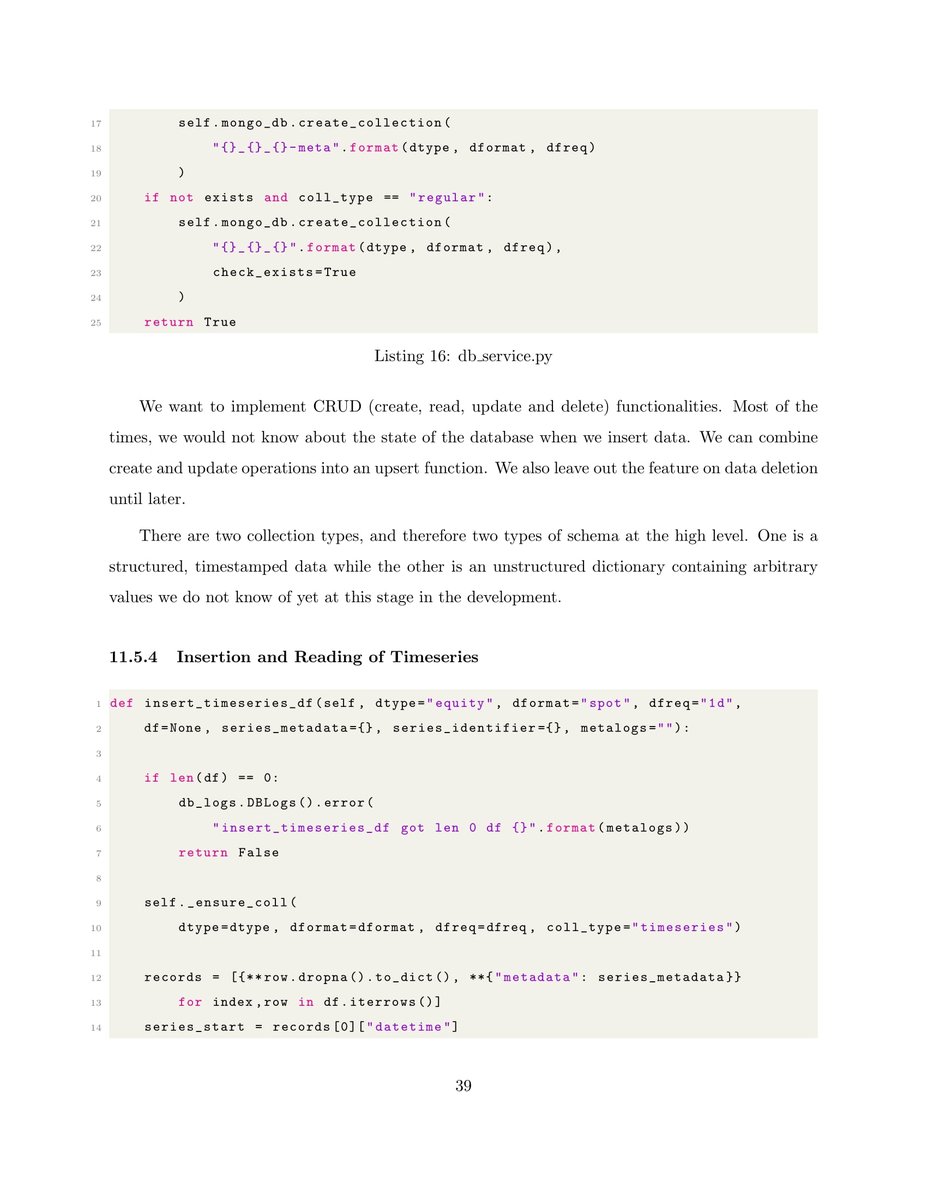
We implemented a fully functional database service with PyMongo as our driver, and integrate it with the data retrieval service this week. This version of the paper adds 30 pages of discussion and code implementation, totaling a 55-page report.
(post linked, GIVEAWAY below)
In the next report, we cover topics in asynchronous programming, multi-threading, batch processing, reducing network trips and HTTP handshakes to increase read-write throughput.
From the first 100 RTs, we will pick 5 for full access to v2 paper, and another 5 for full access to
next iteration. To participate, RT and comment `please dad' then SS and send me a DM.