Read on Twitter
Some people have high climate emissions from transport but who are they?
In my new paper with @mmbuchs & J. Scheiner we looked into this, focusing in particular on those with high emissions from air travel but not car travel (or vice-versa) doi.org/10.1016/j.erss…
THREAD
In my new paper with @mmbuchs & J. Scheiner we looked into this, focusing in particular on those with high emissions from air travel but not car travel (or vice-versa) doi.org/10.1016/j.erss…
THREAD

@mmbuchs My initial motivation for this study was the impression (anecdotal + from some studies) that *some* people have very low emissions from their daily travel (as they don't drive), but then *fly a lot*. And I was curious to understand better who they are
@mmbuchs There has been a lot of attention recently (both in research & media) on "high emitters" and that's great. And we know broadly the factors that are associated with high (transport) emissions: high income, being male, employment, middle adulthood, high education BUT...
...we also know from those studies that there is a *lot of variation* within the group of high emitters (= low predictive power of the regression models). There might be different profiles of high emitters behind that rather stereotypical profile
So in this study we looked at 3 groups:
- people with high emissions from air travel, but low emissions from car travel
- people with emissions from car travel but low from air travel
- people with high emissions from both
and compared them to the rest of the population
- people with high emissions from air travel, but low emissions from car travel
- people with emissions from car travel but low from air travel
- people with high emissions from both
and compared them to the rest of the population
Taken together these high emitter groups account for 6-30% of the population in England, but for 19-60% of emissions from passenger transport (air+car), depending on the definition adopted.
The 'dissonant' groups (with high emission from air travel but low from car or vice-versa) account for 5-21% of the population, but 12-31% of total passenger transport emissions (depending on the definition)
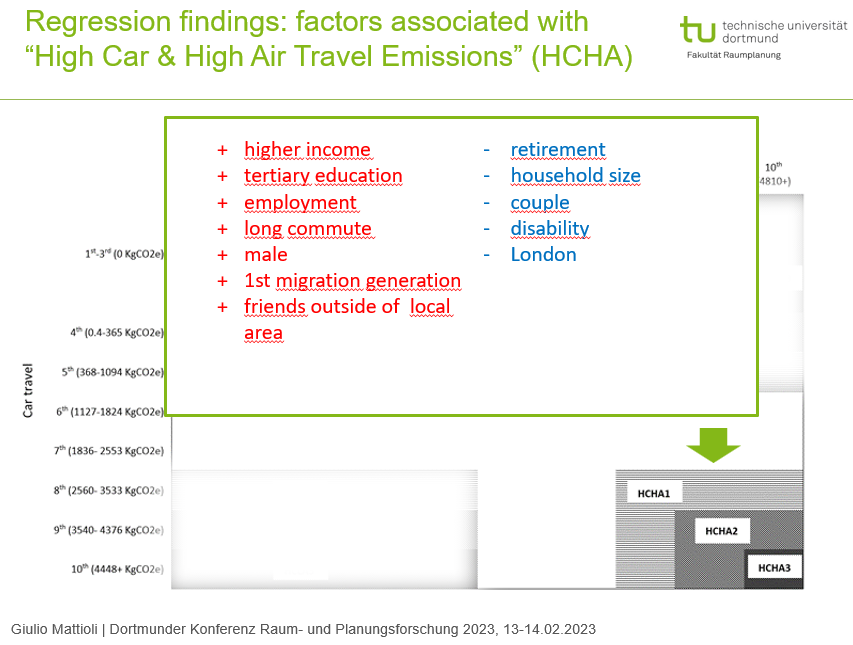
When we look at people with high emissions from *both* car and air travel we find sort of the same profile highlighted by previous studies.
But being a migrant, having dispersed social networks and a long commute are also important here
But being a migrant, having dispersed social networks and a long commute are also important here
People who fly a lot but drive little are *very* different from the stereotypical profile of the high emitter.
Yes they're high income but they tend to be young, urban & female and again there's an important association with migration / ethnic background & having family abroad
Yes they're high income but they tend to be young, urban & female and again there's an important association with migration / ethnic background & having family abroad

People who have high emissions from car travel but don't fly are again very different.
Yes they tend to be male adults & employed & live in car-dependent areas with long commutes but they have average or lower income and there's a higher incidence of disability.
Yes they tend to be male adults & employed & live in car-dependent areas with long commutes but they have average or lower income and there's a higher incidence of disability.
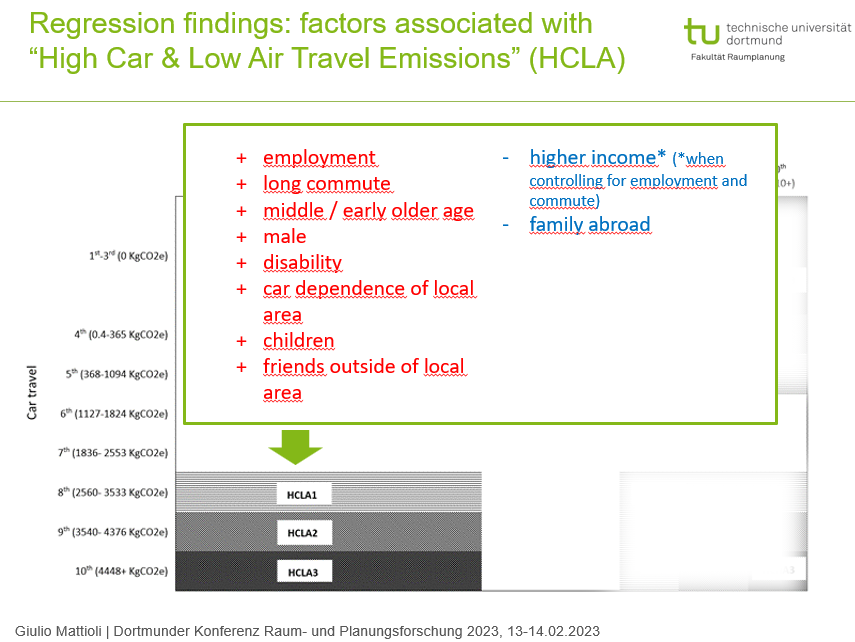
[For this last group we find an overlap with the characteristics of the participants to the 2018/2019 Yellow Vests protests. And remember the Yellow Vests wanted lower car fuel taxes but proposed *higher* taxes on aviation fuel as an alternative]
Overall, there's a lot of heterogeneity within the group of high emitters, only few factors (education, retirement, old age, and spatial dispersion of social networks) are associated with all three groups in the same direction.
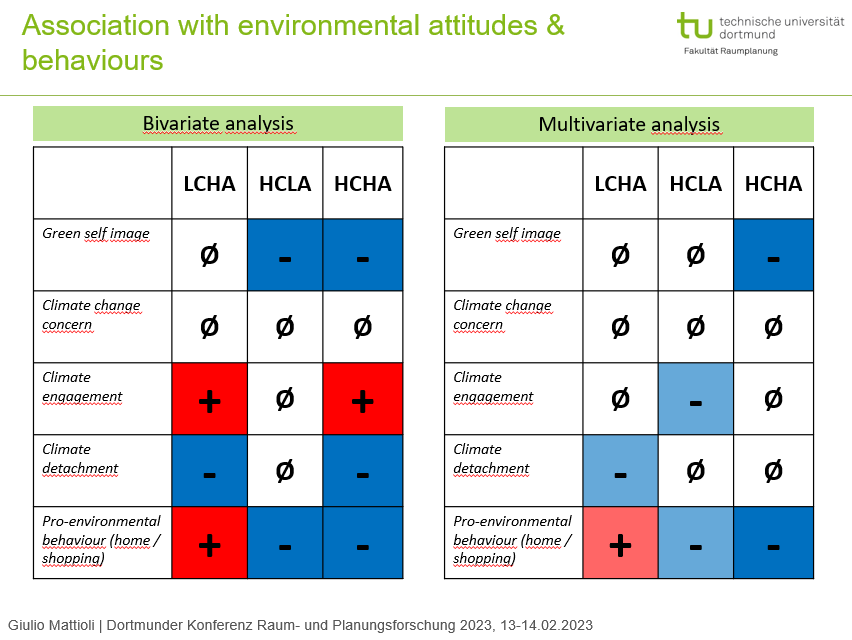
We looked into whether high emitters are different from the rest of the population in terms of attitudes towards the environment & climate.
It turns out that they don't really differ much (once you control for other factors)
It turns out that they don't really differ much (once you control for other factors)
Conversely, we find that living further away from your workplace and from friends / family are important drivers of high transport emissions.
This seems almost obvious to say (!) but these factors are often not considered in studies on emissions.
This seems almost obvious to say (!) but these factors are often not considered in studies on emissions.
The study is the final paper from the first phase of our @long_society project (ldsproject.home.blog) which is funded by @dfg_public, in collaboration with the Transport & Mobility theme from @CREDS_UK (creds.ac.uk/transport-mobi…).
We used the great @usociety dataset which allowed us to include many variables that are typically not included in such studies.
The paper is behind paywall but should be open access at this link authors.elsevier.com/a/1gsx07tZ6Z-F… until 25th May (END)
@threadreaderapp please unroll
• • •
Missing some Tweet in this thread? You can try to
force a refresh