Aakash Gupta Profile picture
Apr 16, 2023 13 tweets 5 min read Read on X
Replying to replies won’t boost your post 75x.

99% of people who copied my thread botched it. I've actually worked on algorithms for 15 years at places like Google.

And I've studied the changes to the algorithm just yesterday. Here's how to ATTACK the latest algorithm: Image
1. The algorithm constructs the feed INDIVIDUALLY for each user

Your tweet does NOT have individual stats.

It has stats on a "per-reader level."

The 75x boost only applies IF the system predicts a 100% probability the SPECIFIC reader will reply AND the author replies to that. Image
2. So here's your point of LEVERAGE:

Increase the probability replies are replied to.

Case 1: The probability a person replies to a specific tweet is 10%, but 0% probability you reply.
→ 10% * 0% * 75x = 0x

Case 2: 100% you reply.
→ 10% * 100% * 75x = 7.5x. Image
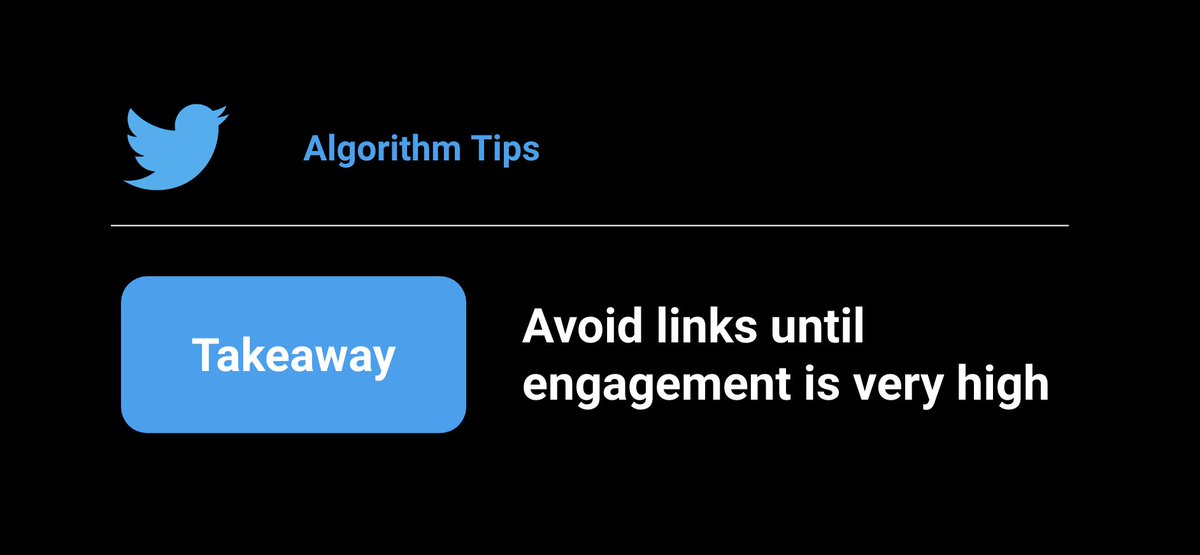
3. There is NO direct link penalty

The old de-boost that penalized their existence is GONE.

But, there are still ways links are penalized:

1. Users interact with them less, so their predicted scores are low
2. They reduce your likelihood of getting the 2-min bonus Image
4. The algorithm cares DEEPLY about time spent

As the probability increases that a user spends 2 minutes, you get up to a 10x boost.

It takes 400 words to drive 2 minutes of reading.

So, either:

· Write threads
· Write long tweets
· Or having interesting replies Image
5. Nothing beats QUALITY

The way you are really going to bend the trajectory of your tweet is by getting people who don't normally like or reply to do so.

That will increase the probability of those boosts to other people who are stingy with their love. Image
6. Retweets are still HUGE

The retweet 1x boost shouldn't fool you. It doesn't mean retweets aren't valuable.

They are very valuable.

Yes, you only get a 1x boost if the system predicts a user will retweet. But, the retweet broadcasts your tweet to many more users. Image
7. The algorithm does like videos people WATCH

The .005x boost seems insignificant.

But it can add up over time and on the margin.

It's one of the few "characteristics" that you can easily control to push up your numbers. Image
8. You CAN'T report someone out of the algorithm

The -74x and -369x penalties look ominous.

But if you piss off someone who does lots of reporting, that's not gonna affect the probabilities for others.

It's only if you piss off someone not easily pissed off. Image
The algorithm is CONSTANTLY changing. Just take a look at these commits.

No one else on Twitter is following the GitHub repo as closely as me. Or producing guides as easy to read.

Follow me for weekly updates: @aakashg0 Image
Here was my original thread that went viral (and 99% of copycats botched the read-out of):
And here's last week's update that 90% of those people never even saw, so they were operating on old information.

You can expect a similar update next week:
How to ATTACK the latest Twitter algorithm: Image

• • •

Missing some Tweet in this thread? You can try to force a refresh

 

Keep Current with Aakash Gupta

Aakash Gupta Profile picture

Stay in touch and get notified when new unrolls are available from this author!

Read all threads

This Thread may be Removed Anytime!

PDF

Twitter may remove this content at anytime! Save it as PDF for later use!

Try unrolling a thread yourself!

how to unroll video
  1. Follow @ThreadReaderApp to mention us!

  2. From a Twitter thread mention us with a keyword "unroll"
@threadreaderapp unroll

Practice here first or read more on our help page!

More from @aakashgupta

Mar 20
Evals are the new PRD.

The companies building AI products that actually work are running 12.8 eval experiments per day. Here is the playbook with @ankrgyl, Founder and CEO of @braintrust ($800M valuation, behind Vercel, Replit, Ramp, Zapier, Notion, Airtable):

⏱ 1:43 Why vibe checks stop scaling
⏱ 6:35 Evals are the new PRD
⏱ 8:45 The Claude Code evals controversy
⏱ 18:48 Building an eval live from zero
⏱ 29:51 Connecting Linear MCP and iterating
⏱ 39:12 Why you need evals that fail
⏱ 43:36 Offline vs online evals
⏱ 47:40 Three mistakes killing eval culture

The core framework: every eval is exactly three things. A set of inputs your product needs to handle. A task that takes those inputs and generates outputs. A scoring function that produces a number between 0 and 1.

We built one from scratch on camera. Score went from 0 to 0.75 in under 20 minutes.
@ankrgyl @braintrust YouTube:

@ankrgyl @braintrust Spotify:

open.spotify.com/episode/6AK7zQ…
Read 4 tweets
Mar 20
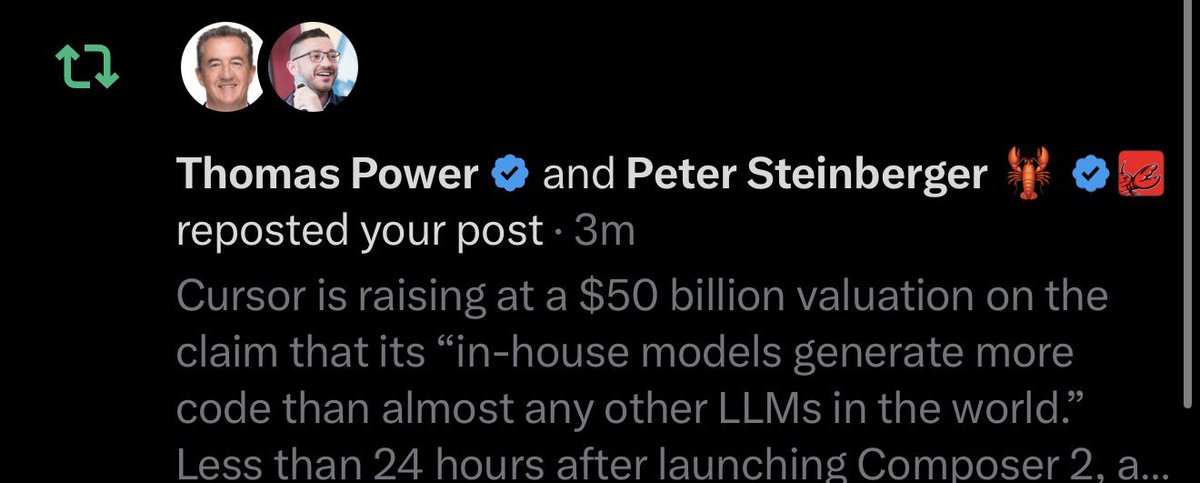
Cursor is raising at a $50 billion valuation on the claim that its “in-house models generate more code than almost any other LLMs in the world.” Less than 24 hours after launching Composer 2, a developer found the model ID in the API response: kimi-k2p5-rl-0317-s515-fast.

That’s Moonshot AI’s Kimi K2.5 with reinforcement learning appended. A developer named Fynn was testing Cursor’s OpenAI-compatible base URL when the identifier leaked through the response headers. Moonshot’s head of pretraining, Yulun Du, confirmed on X that the tokenizer is identical to Kimi’s and questioned Cursor’s license compliance. Two other Moonshot employees posted confirmations. All three posts have since been deleted.

This is the second time. When Cursor launched Composer 1 in October 2025, users across multiple countries reported the model spontaneously switching its inner monologue to Chinese mid-session. Kenneth Auchenberg, a partner at Alley Corp, posted a screenshot calling it a smoking gun. KR-Asia and 36Kr confirmed both Cursor and Windsurf were running fine-tuned Chinese open-weight models underneath. Cursor never disclosed what Composer 1 was built on. They shipped Composer 1.5 in February and moved on.

The pattern: take a Chinese open-weight model, run RL on coding tasks, ship it as a proprietary breakthrough, publish a cost-performance chart comparing yourself against Opus 4.6 and GPT-5.4 without disclosing that your base model was free, then raise another round.

That chart from the Composer 2 announcement deserves its own paragraph. Cursor plotted Composer 2 against frontier models on a price-vs-quality axis to argue they’d hit a superior tradeoff. What the chart doesn’t show is that Anthropic and OpenAI trained their models from scratch. Cursor took an open-weight model that Moonshot spent hundreds of millions developing, ran RL on top, and presented the output as evidence of in-house research. That’s margin arbitrage on someone else’s R&D dressed up as a benchmark slide.

The license makes this more than an attribution oversight. Kimi K2.5 ships under a Modified MIT License with one clause designed for exactly this scenario: if your product exceeds $20 million in monthly revenue, you must prominently display “Kimi K2.5” on the user interface. Cursor’s ARR crossed $2 billion in February. That’s roughly $167 million per month, 8x the threshold. The clause covers derivative works explicitly.

Cursor is valued at $29.3 billion and raising at $50 billion. Moonshot’s last reported valuation was $4.3 billion. The company worth 12x more took the smaller company’s model and shipped it as proprietary technology to justify a valuation built on the frontier lab narrative.

Three Composer releases in five months. Composer 1 caught speaking Chinese. Composer 2 caught with a Kimi model ID in the API. A P0 incident this year. And a benchmark chart that compares an RL fine-tune against models requiring billions in training compute without disclosing the base was free.

The question for investors in the $50 billion round: what exactly are you buying? A VS Code fork with strong distribution, or a frontier research lab? The model ID in the API answers that.

If Moonshot doesn’t enforce this license against a company generating $2 billion annually from a derivative of their model, the attribution clause becomes decoration for every future open-weight release. Every AI lab watching this is running the same math: why open-source your model if companies with better distribution can strip attribution, call it proprietary, and raise at 12x your valuation?

kimi-k2p5-rl-0317-s515-fast is the most expensive model ID leak in the history of AI licensing.
Mandatory “find me on substack”

aibyaakash.com
“Babe, the man behind the first one man one billion dollar company reposted your tweet” 😲 Image
Read 5 tweets
Jan 28
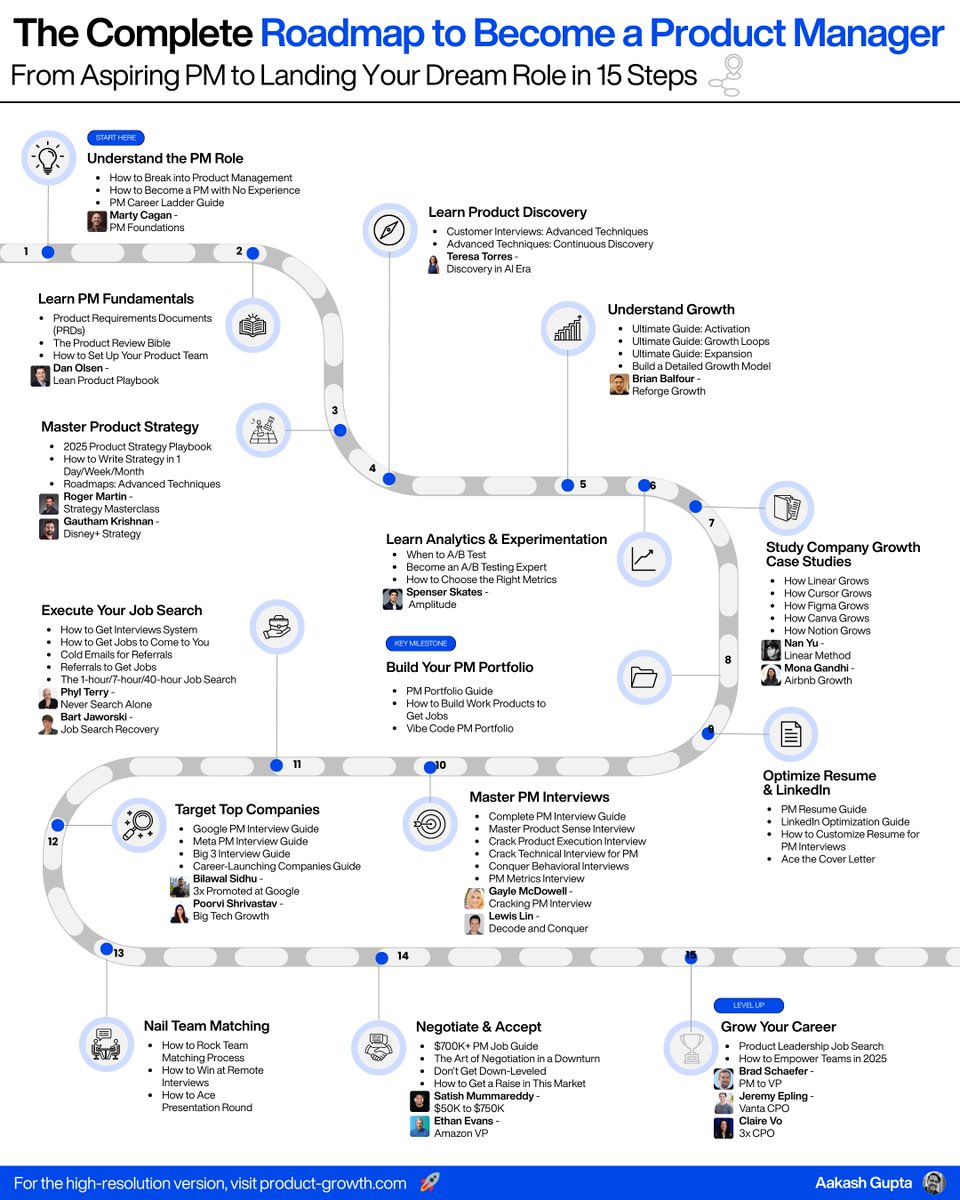
If I were to learn PM again, I would start here.

15 steps to a PM job paying $200K+: Image
1. Understand the PM role

Start with how to break in: news.aakashg.com/p/how-to-break…

Watch Marty Cagan: open.spotify.com/episode/6KcmM7…
2. Learn PM fundamentals

Master PRDs: news.aakashg.com/p/product-requ…

Watch Dan Olsen: youtube.com/watch?v=sl7r3w…
Read 17 tweets
Nov 8, 2025
Senior AI PMs make $306K (US). Big tech pays $550K+

I analyzed 250 AI PM job postings.

Here's what hiring managers want: Image
1. AI Product Strategy & Lifecycle (94%)

Define product vision, strategy & roadmap for AI/ML features from 0→1 through scale:

• Quality Envelopes → Define accuracy thresholds
• Cascade Architecture → Right-size models
• SUQS Framework → Track success pillars
• Evals-First → Define success first
🔗 AI Product Strategy → news.aakashg.com/p/ai-product-s…
🔗 AI Prototype to Production → news.aakashg.com/p/ai-prototype…
🔗 AI Roadmaps → news.aakashg.com/p/ai-roadmap
🔗 AI Product Sense → news.aakashg.com/p/ai-product-s…
🔗 How to Build AI → news.aakashg.com/p/how-to-build…
Read 9 tweets
Oct 29, 2025
DUOLINGO COULDN'T TEACH ME HEBREW IN 2 YEARS

ChatGPT did it in just 3 months.

Here's the exact 8 Prompts I used:
1. Adaptive Daily Lesson Builder

"You're my personal Hebrew tutor. Build me a 20-minute lesson for today based on my current level [beginner/intermediate/advanced]. Include: 10 new vocabulary words with context, 1 key grammar concept with 3 examples, and 5 practice sentences I should translate. End with tomorrow's preview."
2. Real Conversation Partner

"Let's have a 10-minute conversation in Hebrew about [topic: weekend plans/work/hobbies]. Start each response in Hebrew, then add English corrections below using this format: '❌ You said X → ✅ Say Y (because Z)'. Adjust your Hebrew complexity to match my responses."
Read 9 tweets
Oct 26, 2025
In product management, not everything is straight forward maths, or solvable by AI.

Yet, some PMs still make better decisions most of the time.

How?

That's product sense: Image
"The ability to find the right solution for the user and business, despite limited and ambiguous information."

I love this definition from @Sid Arora.
You start with the PM process:

1. Take a vague & ambiguous problem statement
2. Create, or clarify the overall goal
3. Identify all users in ecosystem
4. Pick 1-2 users
5. Identify major problems of the user
6. Select the problems to solve
7. Brainstorm for solutions
8. Select the highest ROI solution
9. Build and deploy the solution
10. Measure success / collect feedback
Read 12 tweets

Did Thread Reader help you today?

Support us! We are indie developers!


This site is made by just two indie developers on a laptop doing marketing, support and development! Read more about the story.

Become a Premium Member ($3/month or $30/year) and get exclusive features!

Become Premium

Don't want to be a Premium member but still want to support us?

Make a small donation by buying us coffee ($5) or help with server cost ($10)

Donate via Paypal

Or Donate anonymously using crypto!

Ethereum

0xfe58350B80634f60Fa6Dc149a72b4DFbc17D341E copy

Bitcoin

3ATGMxNzCUFzxpMCHL5sWSt4DVtS8UqXpi copy

Thank you for your support!

Follow Us!

:(