Read on Twitter
Does it make sense to replace a new gas boiler with a heat pump in the UK?
Yes it does. Over 15 years a heat pump will emit 77-86% fewer carbon emissions.
After 13 months carbon emissions from heat pump manufacturing are offset.
Calculations underlying the graph in this 🧵
Yes it does. Over 15 years a heat pump will emit 77-86% fewer carbon emissions.
After 13 months carbon emissions from heat pump manufacturing are offset.
Calculations underlying the graph in this 🧵

1/ In 2019 we replaced a fairly new gas boiler with a heat pump.
After having been told on Twitter that this does not make sense from a carbon perspective I wrote this in response for @FORESIGHTdk.
foresightdk.com/why-i-replaced…
After having been told on Twitter that this does not make sense from a carbon perspective I wrote this in response for @FORESIGHTdk.
foresightdk.com/why-i-replaced…
2/ To estimate the embodied emissions associated with manufacture and refrigerant leakage I used a peer-reviewed paper which puts embodied emissions for a domestic heat pump at 1563 kg CO2e. sciencedirect.com/science/articl…
3/ I then used 308g CO2 as a marginal carbon emission factor per kWh of electricity to work out the operational emissions of our heat pump per year. I calculated that my heat pump avoids 1,313 kg CO2e a year resulting in a carbon payback of <1.5 years.
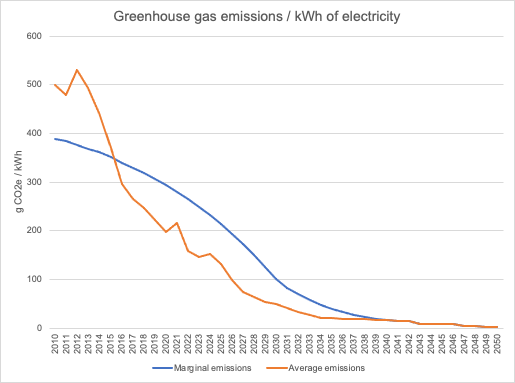
4/ Since 2019 the grid has become cleaner. Marginal emissions are 248g CO2 / kWh and average emissions are 146g CO2 / kWh. Here's the latest Green Book guidance with the emission factors. gov.uk/government/pub…
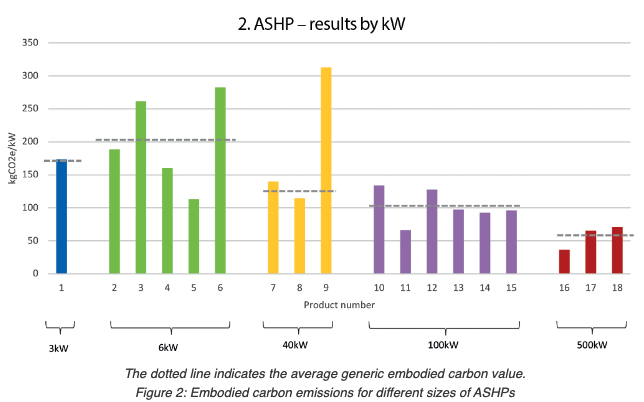
5/ New guidance on embodied carbon has been provided by @CIBSE. Using those figures, for a heat pump with a capacity of 7kW we can assume embodied carbon of around 1,500 kg CO2e based on the CIBSE figures below (slightly >200 kg CO2e/kW capacity). cibsejournal.com/technical/embo…
6/ Now let's compare this to a typical gas boiler.
Embodied emissions of the boiler are ignored in my calculation of gas boiler emissions as we assume the gas boiler is already in place. What I'm interested in is how quickly a heat pump install will offset its embodied carbon.
Embodied emissions of the boiler are ignored in my calculation of gas boiler emissions as we assume the gas boiler is already in place. What I'm interested in is how quickly a heat pump install will offset its embodied carbon.
7/ Median annual gas consumption per household is 12,100 kWh, excluding the 2.4% of gas used for cooking. assets.publishing.service.gov.uk/government/upl…
8/ Per kWh of gas used the boiler emits 183g CO2 based on Green Book guidance. That is 2,209 kg CO2e / year. Let's assume the gas boiler runs for another 15 years resulting in total operational emissions of 33,134 kg CO2e.
9/ Compare that to a heat pump: Using marginal emission factors from Green Book guidance and SCoP of 3 total operational emissions over 2023-2037 are expected to be 6,153 kg CO2e. For average emission factors it is 3,242 kg CO2e.
10/ Let's add embodied carbon emissions. Using CIBSE figures it would bring heat pump emissions over 15 years up to 7,653 kg CO2e for marginal and 4,742 kg CO2e for average emission factors.
That's 77-86% of gas boiler emissions. After 13 months the embodied carbon is offset.
That's 77-86% of gas boiler emissions. After 13 months the embodied carbon is offset.
11/ Sceptics will say that perhaps the embodied emissions do not capture all emissions. So let's double the CIBSE figure I used for argument's sake. That still results in total emission savings of 72-81% of a heat pump compared to an existing gas boiler.
12/ Even when we assume 10x more embodied carbon in the heat pump it would still make sense to replace a new gas boiler resulting in savings of 36-45% over the next 15 years.
13/ Others will say that the emissions factor for gas is too low because it does not include upstream emissions. Applying 210 kg CO2e / kWh instead results in higher carbon savings of 80-87% of a heat pump compared to an existing gas boiler.
https://twitter.com/heatpolicyrich/status/1642894692411924481?s=20
14/ We can change the assumptions in different ways but the basic message stands even with very conservative and unrealistic assumptions:
A heat pump saves a lot of carbon even if it replaces a brand new gas boiler.
A heat pump saves a lot of carbon even if it replaces a brand new gas boiler.
15/ And once again in anticipation of comments on other subjects related to heat pumps I share this myth buster here.
https://twitter.com/janrosenow/status/1640983125122764800
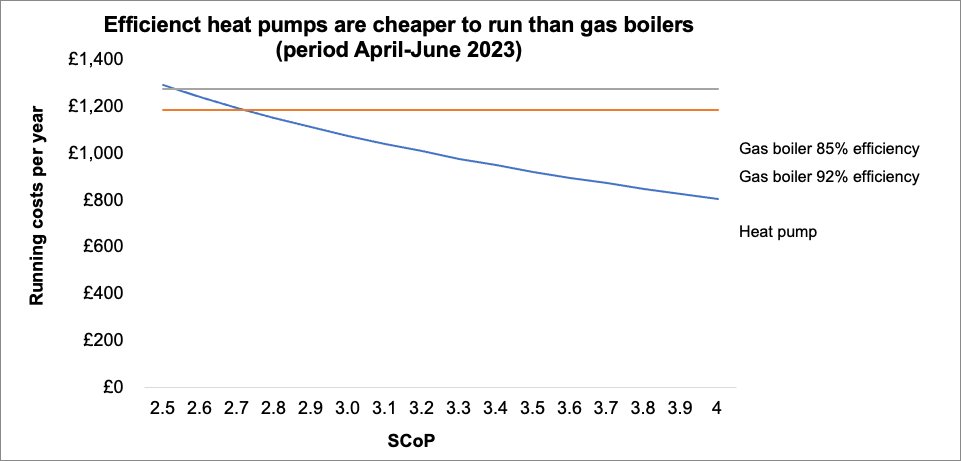
16/ Add on: Many people want to know about the running costs of heat pumps vs gas boilers. Energy prices change very frequently right now but here's a snapshot for the current energy price guarantee period.
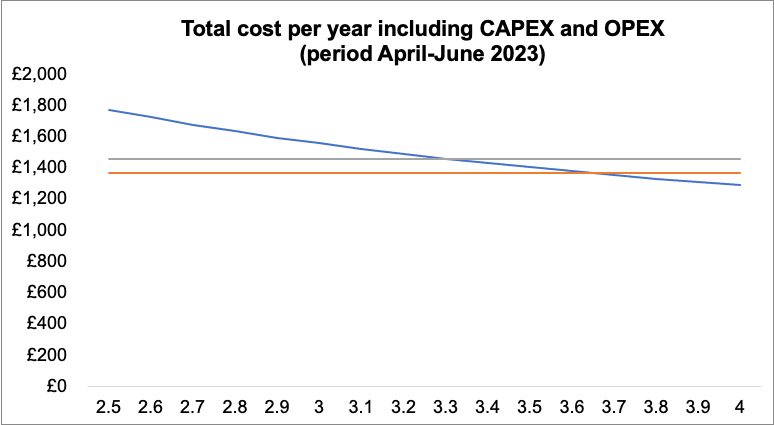
17/ If we add in the capital cost and assume a 15 year lifetime you would need an SCoP of 3.4-3.7 to break even with a gas boiler depending of the efficiency.
• • •
Missing some Tweet in this thread? You can try to
force a refresh