Recently, many fast-growing XBB lineages have gained RBD mutations on K478, such as VOI XBB.1.16 (K478R), XBB.2.3.5 (K478N), XBB.2.3.4 (K478Q). Also, many XBB* have independently obtained F456L, like FD.1.1, FE.1, XBB.1.5.10. In this thread I'll briefly discuss these mutations.
Like the results by Kei @SystemsVirology, we found XBB.1.16 and XBB.1.5 have comparable immune evasion capabilities in the serum tested. The ACE2 binding affinity of XBB.1.16 and XBB.1.5 is also similar. In contrast, F456L brings additional immune evasion but lowers ACE2 binding.
F456L escapes XBB.1.5-effective class I mAbs. These mAbs are quite abundant in various immune backgrounds, such as people who experienced BA.5 breakthrough infections or repeated Omicron infections. Those that are developing RBD-targeting mAb drugs should pay attention to F456L
K478 mutations can also escape mAbs whose epitope centered around 478, as revealed by DMS. However, these mAbs are pretty rare in the cohorts we examined, thus we don't see additional serum immune evasion by XBB.1.16. Note that these mAbs are Omicron-specific (cannot bind WT RBD)
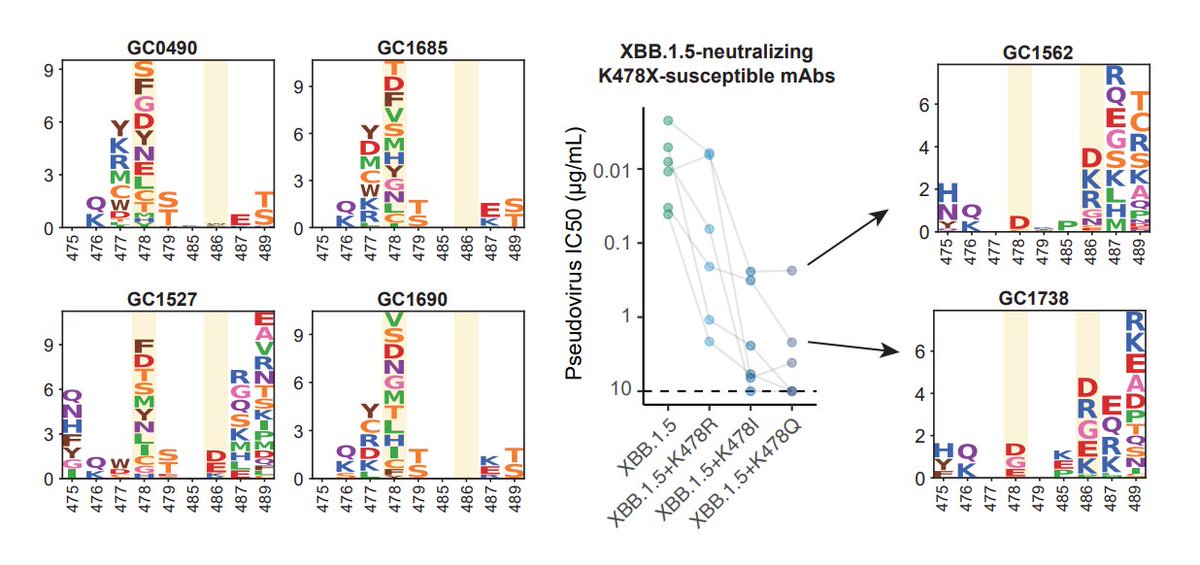
The lack of strengthened immune evasion or ACE2 binding cannot explain why K478 mutations are constantly popping out in fast-growing lineages. This contradiction might be due to the fact that we haven't captured the real immune background that introduced those 478 mutations.
One potential background that can give rise to K478X is repeated BA.5/BQ.1.1/XBB exposures. This is because F486 would mask the immunogenicity of K478 (so F486 must mutate), and two Omicron stimulation is needed to alleviate immune imprinting for Omicron-specific mAbs to appear.
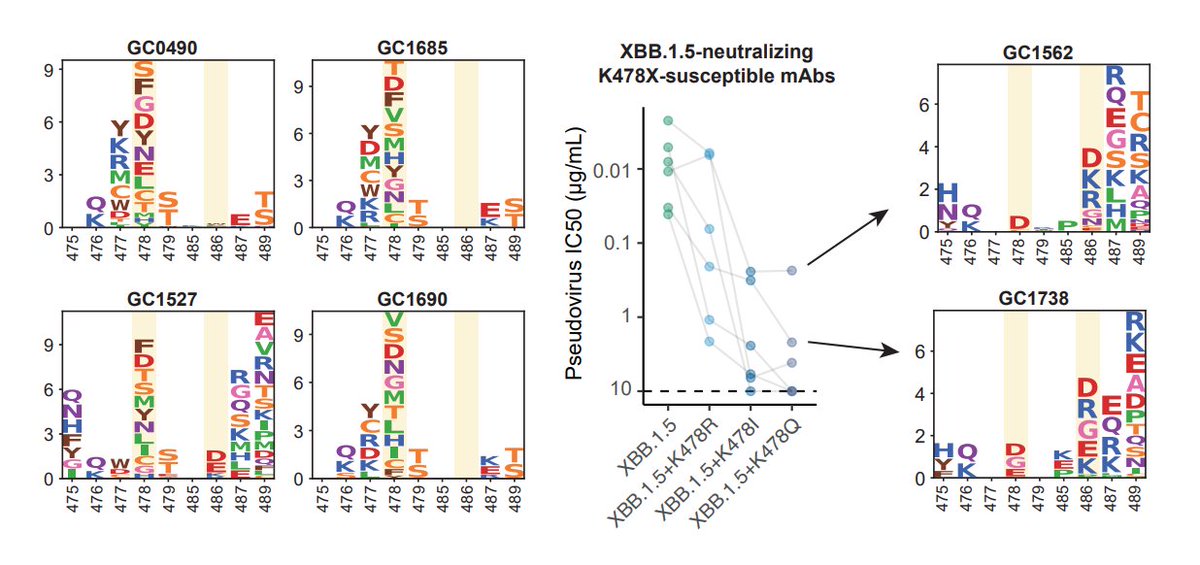
Another potential background that could introduce K478X is Delta-imprinted convalescents who experienced BA.5/BQ.1.1/XBB infections, which may allow the generation of abundant K478X-sensitive mAbs since Delta carries T478K. This might explain why K478X mostly appeared from India.
More detailed descriptions of the data will be shared next week on BioRxiv, together with new studies on immune imprinting dynamics and RBD evolution prediction of XBB*. A huge new update of DMS data for immune evasion and ACE2 binding prediction will also be shared. Stay tuned!
• • •
Missing some Tweet in this thread? You can try to
force a refresh

KP.3 is starting to outcompete KP.2. Its unique Q493E mutation brings some critical features: 1) KP.3 has higher ACE2 binding affinity than KP.2. 2) KP.3 is more immune evasive. KP.3 +31del (KP.3.1.1) is the most. 3) KP.3 is especially good at evading Class 1 antibodies.
Q493E of KP.3 may have an epistasis effect with the F456L mutation, resulting in the increase of ACE2 binding affinity. This is important since strong ACE2 binding would allow KP.3 to easily accumulate highly immune evasive RBD mutations, such as A475V.
Q493E enables KP.3 to escape a lot of Class 1 V3-53/66 encoded mAbs, even if elicited by JN.1 infection. Since these V3-53/66 NAbs are highly enriched in mRNA vaccine recipients, we would expect KP.3 and KP.2 to show substantial immune evasion even with JN.1 mRNA boosters.
New study. We compared the immune response of XBB and JN.1 in human infections to evaluate the necessity for #SARSCOV2 vaccine updates
Results:
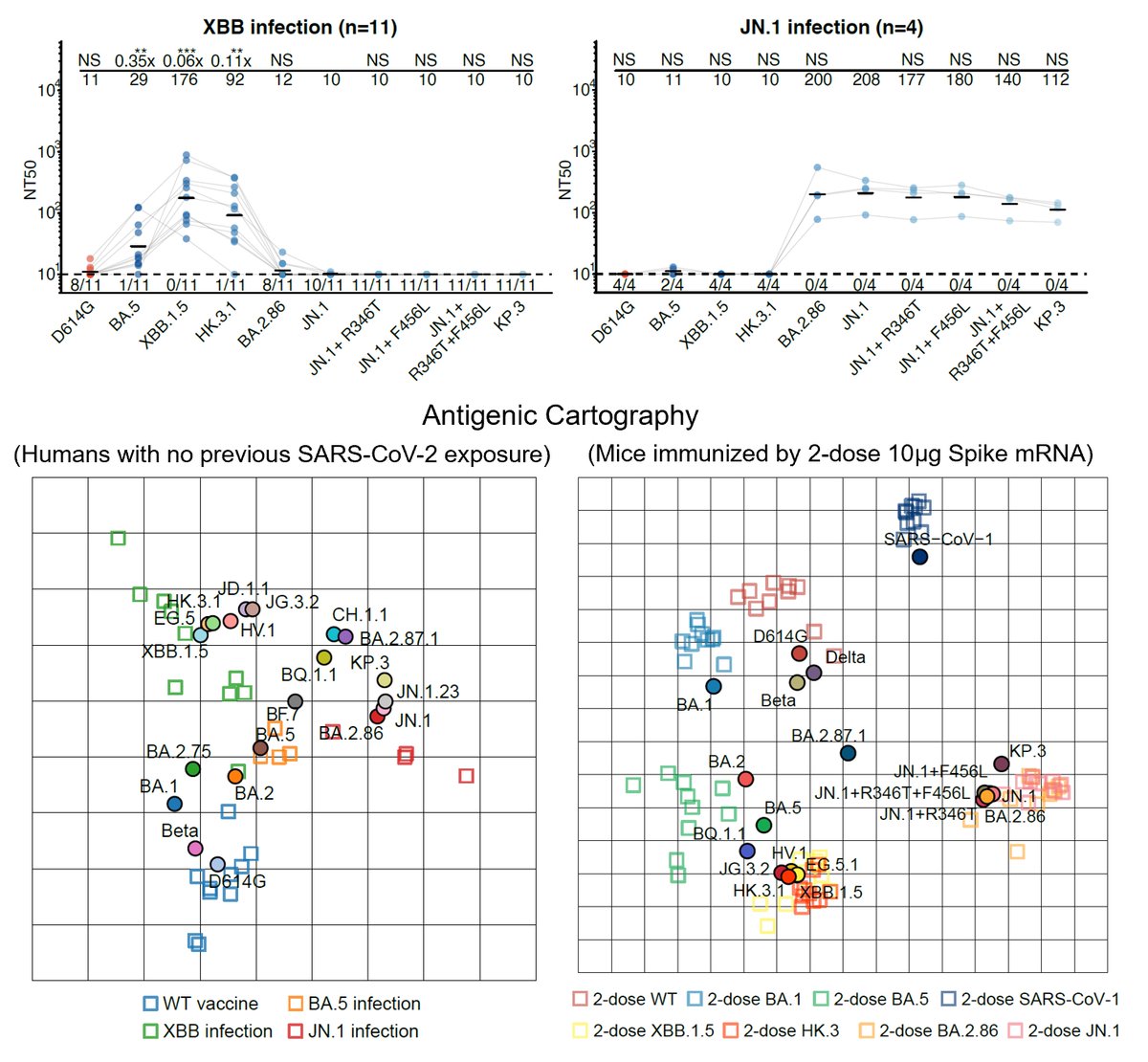
JN.1 exposure induces higher neutralization against emerging mutants, including FLiRT (JN.1+346T+456L) and KP.3 biorxiv.org/content/10.110…
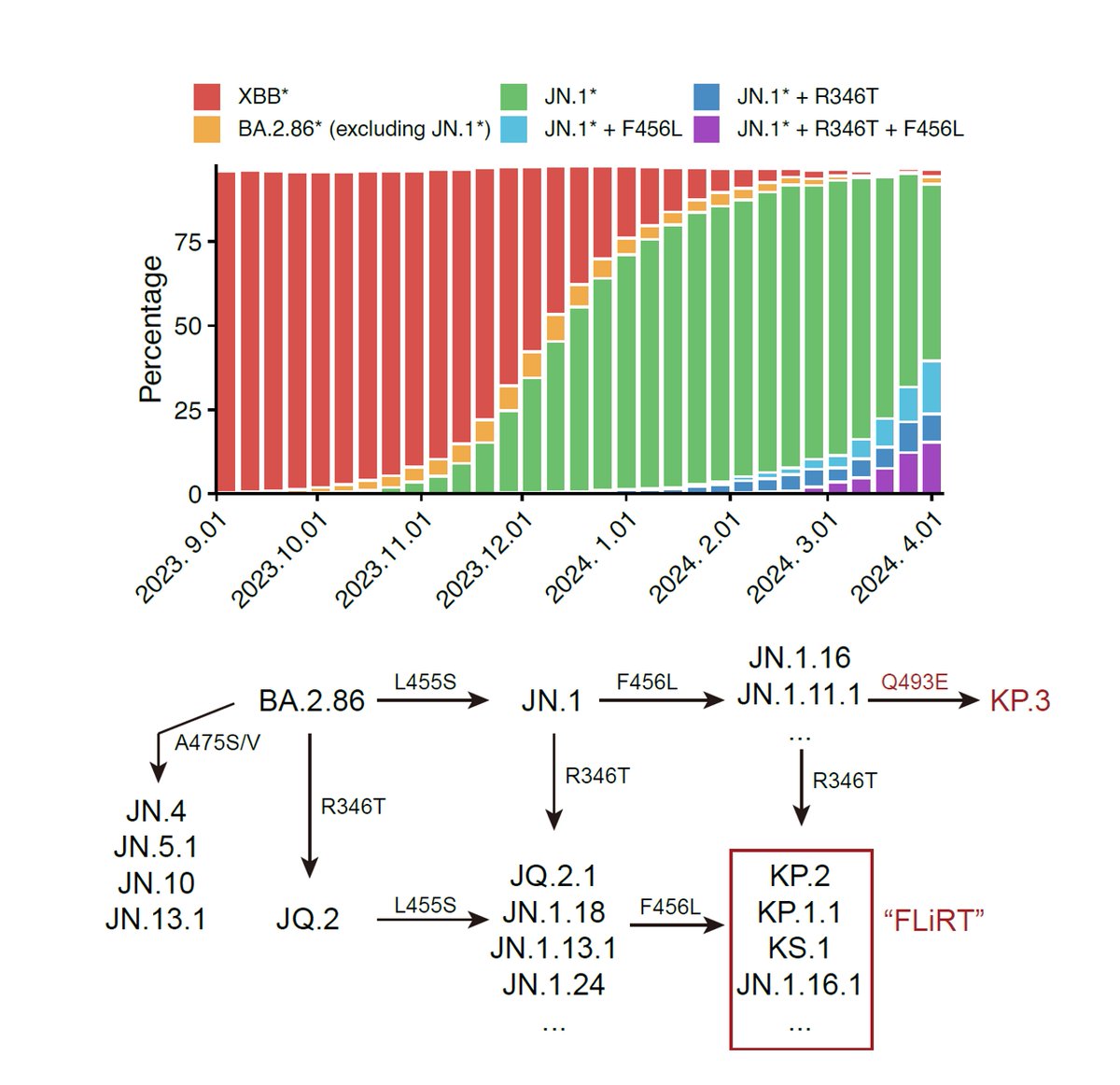
Since JN.1 lineages have replaced XBB lineages and JN.1 subvariants are continuously gaining immune-evasive mutations, such as R346T, F456L, R346T+F456L (FLiRT), and F456L+Q493E (KP.3), it's time to evaluate whether we need to switch SARS-CoV-2 vaccine antigen to JN.1.
(2/7)
We first compared the antibody response of XBB and JN.1 infection in SARS-CoV-2 naive individuals (people who weren't vaccinated and haven't been infected). Similar to naive mice, we found that XBB and JN.1 lineages are also antigenic distinct in naive humans.
(3/7)
Imagine we can identify JN.1-neutralizing mAbs at the start of the pandemic, how revolutionary it would be for COVID mAb drug development. Here we provide a strategy to select potent SARS-CoV-2 broad-spectrum mAbs when we only know the ancestral strain. biorxiv.org/content/10.110…
Many studies have claimed the discovery of “SARS-CoV-2 bnAbs” based on the efficacy against known variants at that time. However, most of these "bnAbs" were rapidly escaped by subsequent viral evolution.
This is because “neutralization against known variants” is a poor indicator for true bnAbs against fast-evolving pathogens.
Inferred from a retrospective analysis of our SARS-CoV-2 mAb collection, we found that among the potent mAbs available at the early stage of the pandemic, only 1~3% could remain effective for more than two years.
If we could rationally identify bnAbs that remain potent against future variants, it would revolutionize mAb drug development against evolving viruses.
(2/9)
Previously, we showed the possibility of accurately predicting SARS-CoV-2 RBD evolution by aggregating high-throughput antibody DMS results.
Therefore, we hypothesize that if we use constructed pseudoviruses carrying predicted mutations as filters, we could screen for those "true" bnAbs as drug candidates, even when no knowledge of real-world viral evolution was available.
To demonstrate whether this strategy would work, we used the DMS profiles of mAbs elicited by SARS-CoV-2 WT infection/vaccination, which were the only data available early in the pandemic, and constructed pseudoviruses (B.1-S1~S5) harboring mutations on the identified hotspots.
(3/9)nature.com/articles/s4158…
Our paper on JN.1 is now online @TheLancetInfDis!
The manuscript explains how a single RBD mutation L455S could turn BA.2.86 into a heavy immune evasive variant JN.1.
Notably, JN.1 is now approaching worldwide dominance (42% two weeks ago). thelancet.com/journals/lanin…
Two months ago, we warned about JN.1 due to its extreme immune evasion. The reason why we paid attention to JN.1 so early is that we know BA.2.86 is very weak to Class 1 antibodies and L455S is one of the strongest Class 1 antibody escaping mutations. 2/6
Many labs have shown that BA.2.86 is well-neutralized. However, the absolute neutralizing titers cannot tell the full story. Since the majority of BA.2.86-neutralizing Abs are from a single epitope, huge changes in titers could happen when BA.2.86 acquires critical mutations. 3/6
Our research on how repeated Omicron exposure mitigates ancestral strain immune imprinting is finally out in @Nature!
In this paper, we found that multiple Omicron exposures can induce high proportions of Omicron-specific Abs that target new RBD epitopes.
There is an additional burning question following this study. In this paper, we showed that 3 doses of inactivated vaccination + 2 Omicron infection could override immune imprinting. However, multiple studies using mRNA vaccine cohorts did not see this phenomenon.
Updates on BA.2.86. 1) BA.2.86's ACE2 binding affinity is very high. 2) BA.2.86 has lower fusogenicity than XBB.1.5. 3) BA.2.86's infectivity in Vero cells is similar to BA.1, lower than XBB.1.5. 4) Structure analysis shows that BA.2.86's Spike prefers RBD "down" conformation.
BA.2.86's RBD showed a pretty high hACE2 binding affinity measured by SPR, higher than that of XBB.1.5 and EG.5 and is even comparable to "FLip" variants like HK.3. BA.2.86's V483del indeed decreases ACE2 binding, but R403K is just too powerful and makes up for the loss. 2/n
We also measured the cell-cell fusion capability using Spike-transfected 293T cells and 293T-hACE2 cells. BA.2.86 showed a lower fusogenicity than XBB.1.5, despite the fact that BA.2.86's ACE2 binding affinity is much higher. Note this assay is free of pseudoviruses. 3/n