Recently, many fast-growing XBB lineages have gained RBD mutations on K478, such as VOI XBB.1.16 (K478R), XBB.2.3.5 (K478N), XBB.2.3.4 (K478Q). Also, many XBB* have independently obtained F456L, like FD.1.1, FE.1, XBB.1.5.10. In this thread I'll briefly discuss these mutations.
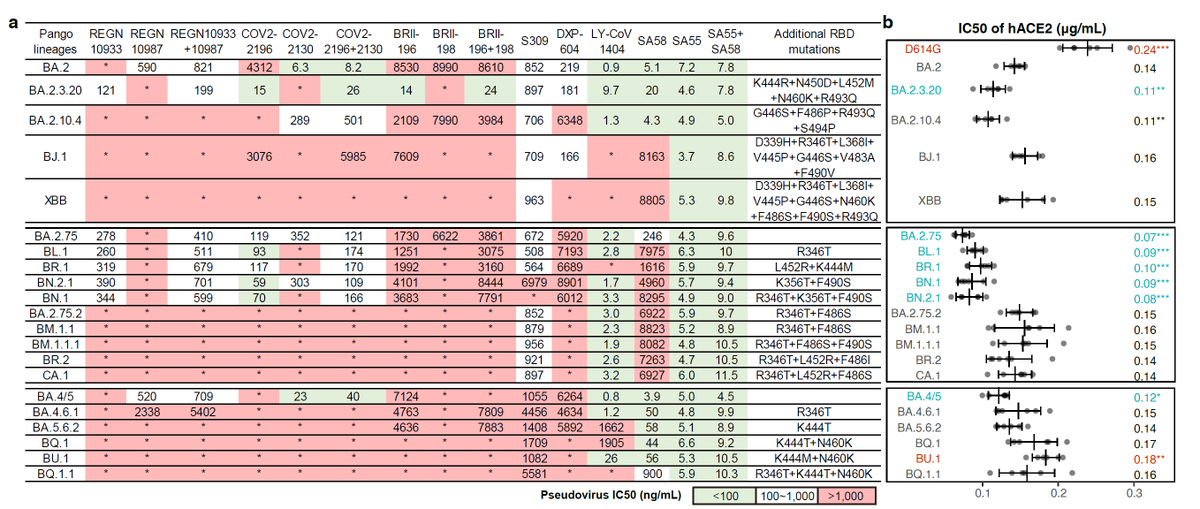
Like the results by Kei @SystemsVirology, we found XBB.1.16 and XBB.1.5 have comparable immune evasion capabilities in the serum tested. The ACE2 binding affinity of XBB.1.16 and XBB.1.5 is also similar. In contrast, F456L brings additional immune evasion but lowers ACE2 binding.
F456L escapes XBB.1.5-effective class I mAbs. These mAbs are quite abundant in various immune backgrounds, such as people who experienced BA.5 breakthrough infections or repeated Omicron infections. Those that are developing RBD-targeting mAb drugs should pay attention to F456L
K478 mutations can also escape mAbs whose epitope centered around 478, as revealed by DMS. However, these mAbs are pretty rare in the cohorts we examined, thus we don't see additional serum immune evasion by XBB.1.16. Note that these mAbs are Omicron-specific (cannot bind WT RBD)
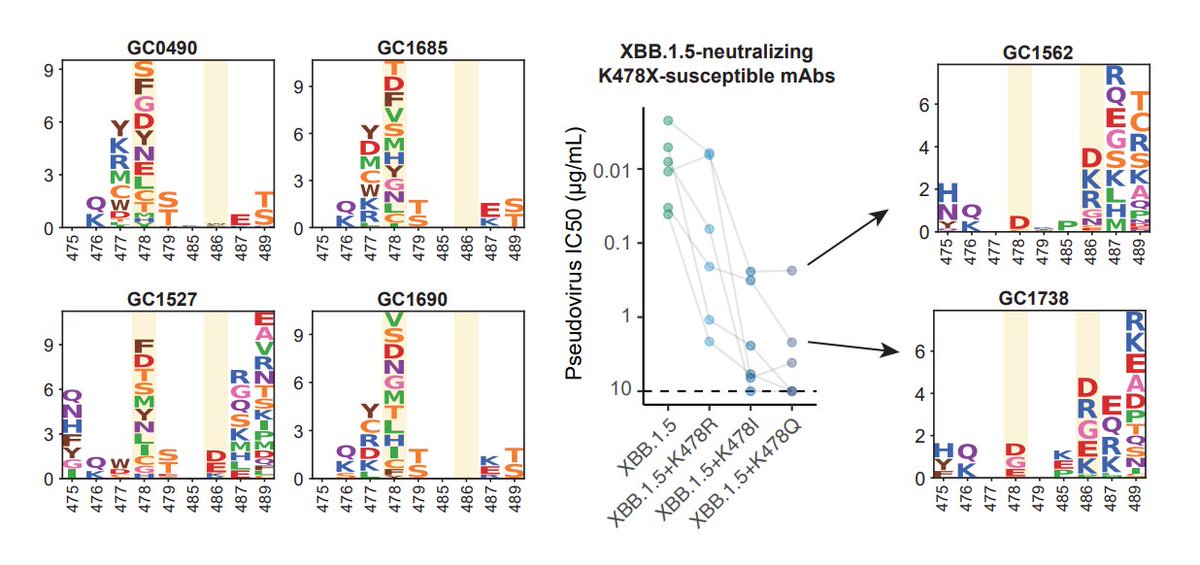
The lack of strengthened immune evasion or ACE2 binding cannot explain why K478 mutations are constantly popping out in fast-growing lineages. This contradiction might be due to the fact that we haven't captured the real immune background that introduced those 478 mutations.
One potential background that can give rise to K478X is repeated BA.5/BQ.1.1/XBB exposures. This is because F486 would mask the immunogenicity of K478 (so F486 must mutate), and two Omicron stimulation is needed to alleviate immune imprinting for Omicron-specific mAbs to appear.
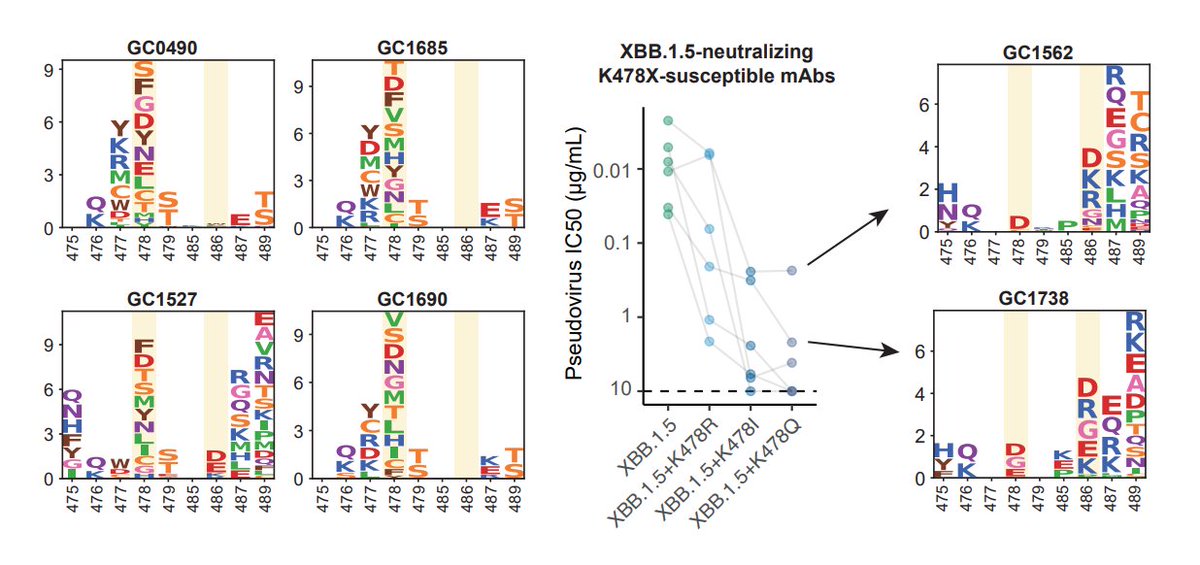
Another potential background that could introduce K478X is Delta-imprinted convalescents who experienced BA.5/BQ.1.1/XBB infections, which may allow the generation of abundant K478X-sensitive mAbs since Delta carries T478K. This might explain why K478X mostly appeared from India.
More detailed descriptions of the data will be shared next week on BioRxiv, together with new studies on immune imprinting dynamics and RBD evolution prediction of XBB*. A huge new update of DMS data for immune evasion and ACE2 binding prediction will also be shared. Stay tuned!
• • •
Missing some Tweet in this thread? You can try to
force a refresh

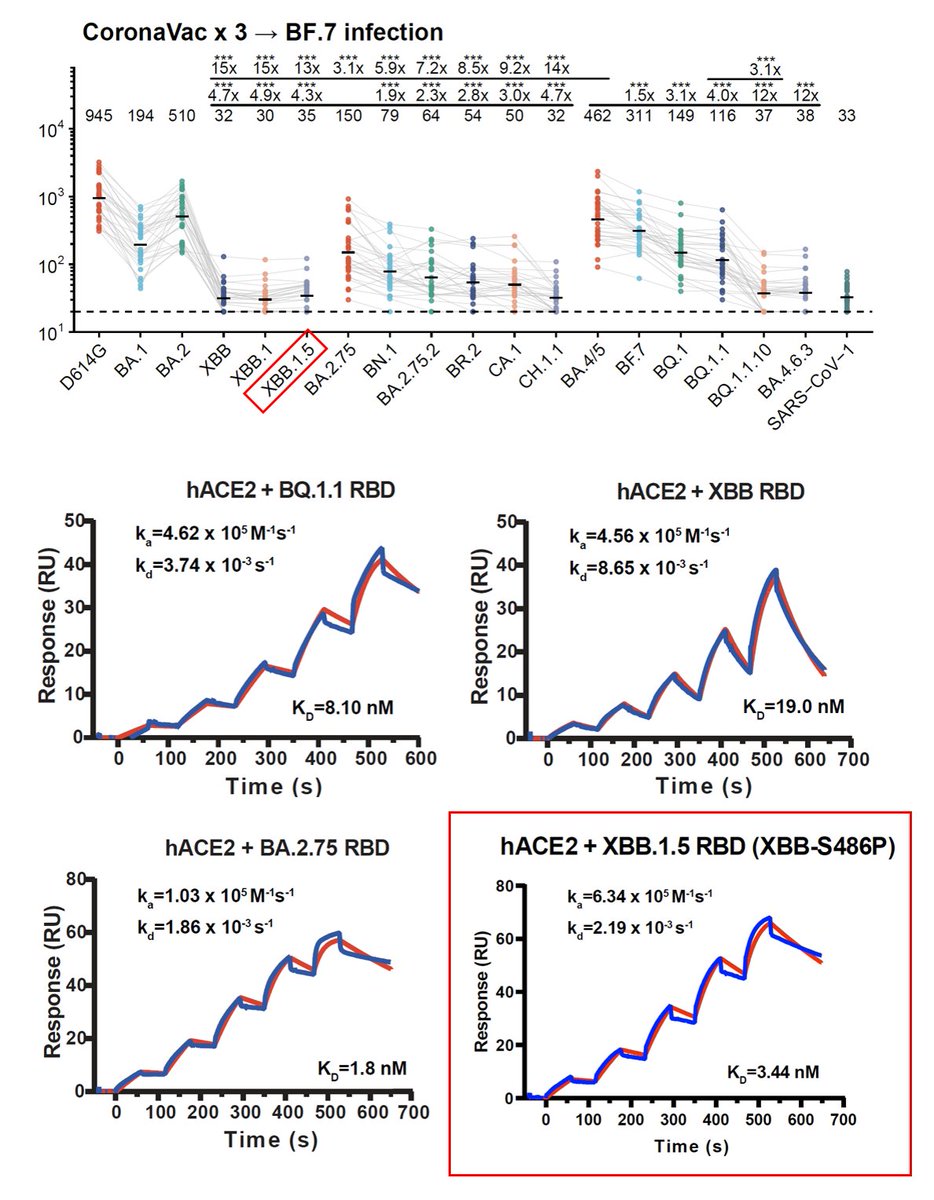
The superior growth advantage of XBB.1.5 has been well-documented by many colleagues @JPWeiland@LongDesertTrain@EricTopol. Here I'll add some experimental data: 1) XBB.1.5 is equally immune evasive as XBB.1, but 2) XBB.1.5 has a much higher hACE2 binding affinity. 1/
Notably, even BF.7 breakthrough infection doesn't induce high neutralization against XBB.1 and XBB.1.5. The S486P mutation only caused a slight reduction in immune evasion capability. mRNA breakthrough infection samples (n=9) here all received at least 2-dose mRNA vac. 2/
However, the S486P mutation greatly enhanced hACE2 binding, since 486S completely destroyed the local hydrophobic interaction while 486P retained it. 3/
Our paper regarding Omicron convergent evolution is out on @Nature.
In this story, we analyzed the immune evasion capability of ~50 convergent variants and explained how RBD mutations suddenly emerged convergently due to a more focused immune pressure. nature.com/articles/s4158…
Moreover, in this paper, we proved that by accurately mapping the immune pressure elicited by our humoral immunity, we can predict future immune-evasive RBD mutations of the virus! This is a big step to help us better prepare new variant-specific vaccines and antibody drugs.
The details of this paper have been extensively covered in my old tweets, which are attached here for those that are interested.
Latest update on some new convergent variants.
Summary: 1. XBB, XBB.1, CH.1.1, BA.4.6.3, and BQ.1.1.10 (BQ.1.1+Y144del) are currently the most immune-evasive strains to monitor. 2. BQ.1*+NTD mutations, such as Y144del, makes them much more immune evasive. biorxiv.org/content/10.110…
Like @LongDesertTrain@JosetteSchoenma@CorneliusRoemer have mentioned, recently there has been a rapid increase of Y144del proportion in the BQ.1* lineages. This NTD deletion is observed in many worrisome BA.5 sublineages such as BQ.1.1.10, BQ.1.18, as well as BA.4.6.3.
The appearance of Y144del in those BA.5 sublineages is a really bad sign since we know this mutation is extremely good at escaping NTD-neutralizing antibodies. See below, Y144 is located at the epitope center of a specific group of NTD NAbs that are potent against BA.5.
Updating results regarding convergent variants BU.1, BR.2, BM.1.1.1, CA.1, and XBB.
XBB is currently the most antibody-evasive strain tested, and BR.2, BM.1.1.1, CA.1 are more immune evasive than BA.2.75.2 and BQ.1.1. biorxiv.org/content/10.110…
Similar to BQ.1.1, XBB also escapes Evusheld and Bebtelovimab. BU.1, BR.2, BM.1.1.1, CA.1, and XBB all displayed sufficient hACE2 binding capability.
XBB is significantly more immune evasive than BA.2.75.2 and BQ.1.1 against plasma from all breakthrough infections, comparable to or even exceeding SARS-CoV-1 level escaping capability. BR.2, BM.1.1.1 and CA.1 also exhibit very strong immune evasion, but less compared to XBB.
Updating information regarding convergent variants BA.2.3.20, BN.1, BA.2.10.4, BN.2.1, BA.4.6.1, BQ.1, BQ.1.1.
In short, BA.2.75.2 and BQ.1.1 are the most antibody-evasive convergent variants tested, far exceeding BA.5 and approaching SARS-CoV-1 level. (1/4)
BA.2.75.2 is slightly more evasive than BQ.1.1 against plasma from BA.2/BA.5 breakthrough infections. Its due to the enriched NTD-NAbs elicited by BA.2/BA.5 infections, which BQ.1.1 can't escape. Note that these varaints are approaching SARS-CoV-1 level escaping capability. (2/4)
As expected, BQ.1.1 escapes Evusheld and bebtelovimab, making all clinically available antibody drugs ineffective. BQ.1.1 and BA.2.75.2 both displayed sufficient hACE2 binding capability. (3/4)
Sharing our investigation on the unprecedented convergent RBD evolution of BA.2.75 and BA.5 on sites including 346, 356, 444-446, 450, 460, 486, which have generated highly concerning variants such as BA.2.75.2, BR.1, BJ.1, and BQ.1.1. (1/n) biorxiv.org/content/10.110…
In this paper, we tried to solve the following three questions: 1) How immune evasive could these variants be? 2) Why do they evolve mutations on these converging sites? 3) What could this convergence evolution finally lead to? (2/n) biorxiv.org/content/10.110…
As many have noticed, recent evolution of Omicron has led to numerous subvariants that exhibit high growth advantages over BA.5. Interestingly, mutations on their receptor-binding domain (RBD) converge on several hotspots, including R346, R356, K444, L452, N460 and F486. (3/n)