Read on Twitter
@KCTaz @EthonRaptor @bomac_macbo @ProfMickWilson @Data79504085 @Hji45519156 @BlasphemousBan1 @FD2you @DawnTJ90 @BradPKeyes @Callan23474387 @Mark_A_Lunn @AristotleMrs @0Sundance @TheDisproof @BointonGiles @DoesThisW0rk @3GHtweets @Climatehope2 @Jaisans @S_D_Mannix @glinch72 @TWTThisIsNow @JustThi30117912 @paulp1232 @MartinJBern @Willard1951 @ShroedingerBird @ammocrypta @ChrisBBacon3 @B_Bolshevik100 @rosmadiwahab @Robert76907841 @Anvndarnamn5 @EricWil06256732 @FillmoreWhite @TommyLambertOKC @RobMeekel @JohnDublin10 @Veritatem2021 @NoTricksZone @RoelofBoer @DawnJT90 @DawnTj9 @PeterDClack @FriendsOScience @Kenneth72712993 @wattsupwiththat @AlexEpstein 1/15」KCTaz wrote to Eli, "So, you agree Earth is not warming."
Actually, Eli didn't mention or allude to temperatures (this time).
Actually, Eli didn't mention or allude to temperatures (this time).
@KCTaz @EthonRaptor @bomac_macbo @ProfMickWilson @Data79504085 @Hji45519156 @BlasphemousBan1 @FD2you @DawnTJ90 @BradPKeyes @Callan23474387 @Mark_A_Lunn @AristotleMrs @0Sundance @TheDisproof @BointonGiles @DoesThisW0rk @3GHtweets @Climatehope2 @Jaisans @S_D_Mannix @glinch72 @TWTThisIsNow @JustThi30117912 @paulp1232 @MartinJBern @Willard1951 @ShroedingerBird @ammocrypta @ChrisBBacon3 @B_Bolshevik100 @rosmadiwahab @Robert76907841 @Anvndarnamn5 @EricWil06256732 @FillmoreWhite @TommyLambertOKC @RobMeekel @JohnDublin10 @Veritatem2021 @NoTricksZone @RoelofBoer @DawnJT90 @DawnTj9 @PeterDClack @FriendsOScience @Kenneth72712993 @wattsupwiththat @AlexEpstein 2/15」Eli wrote, "That's L'Chatelier's fallacy."
Wrong. Le Chatelier's Principle should inform your intuition to EXPECT negative feedbacks. But OBSERVATION confirms it: all of the most important carbon feedbacks are very strongly negative / attenuating.
chem.libretexts.org/Bookshelves/Ph…
Wrong. Le Chatelier's Principle should inform your intuition to EXPECT negative feedbacks. But OBSERVATION confirms it: all of the most important carbon feedbacks are very strongly negative / attenuating.
chem.libretexts.org/Bookshelves/Ph…
@KCTaz @EthonRaptor @bomac_macbo @ProfMickWilson @Data79504085 @Hji45519156 @BlasphemousBan1 @FD2you @DawnTJ90 @BradPKeyes @Callan23474387 @Mark_A_Lunn @AristotleMrs @0Sundance @TheDisproof @BointonGiles @DoesThisW0rk @3GHtweets @Climatehope2 @Jaisans @S_D_Mannix @glinch72 @TWTThisIsNow @JustThi30117912 @paulp1232 @MartinJBern @Willard1951 @ShroedingerBird @ammocrypta @ChrisBBacon3 @B_Bolshevik100 @rosmadiwahab @Robert76907841 @Anvndarnamn5 @EricWil06256732 @FillmoreWhite @TommyLambertOKC @RobMeekel @JohnDublin10 @Veritatem2021 @NoTricksZone @RoelofBoer @DawnJT90 @DawnTj9 @PeterDClack @FriendsOScience @Kenneth72712993 @wattsupwiththat @AlexEpstein 3/15」Eli wrote, "The position of the equilibrium only shifts PART WAY to oppose the change"
"Part way" to WHAT?
There's nothing "part way" about the fact that carbon feedbacks are strongly negative.
At current emission rates, CO2 would plateau between 500 & 550 ppmv.
"Part way" to WHAT?
There's nothing "part way" about the fact that carbon feedbacks are strongly negative.
At current emission rates, CO2 would plateau between 500 & 550 ppmv.
@KCTaz @EthonRaptor @bomac_macbo @ProfMickWilson @Data79504085 @Hji45519156 @BlasphemousBan1 @FD2you @DawnTJ90 @BradPKeyes @Callan23474387 @Mark_A_Lunn @AristotleMrs @0Sundance @TheDisproof @BointonGiles @DoesThisW0rk @3GHtweets @Climatehope2 @Jaisans @S_D_Mannix @glinch72 @TWTThisIsNow @JustThi30117912 @paulp1232 @MartinJBern @Willard1951 @ShroedingerBird @ammocrypta @ChrisBBacon3 @B_Bolshevik100 @rosmadiwahab @Robert76907841 @Anvndarnamn5 @EricWil06256732 @FillmoreWhite @TommyLambertOKC @RobMeekel @JohnDublin10 @Veritatem2021 @NoTricksZone @RoelofBoer @DawnJT90 @DawnTj9 @PeterDClack @FriendsOScience @Kenneth72712993 @wattsupwiththat @AlexEpstein 4/15」All the major carbon feedbacks are very strongly negative.
The two biggest obviously are:
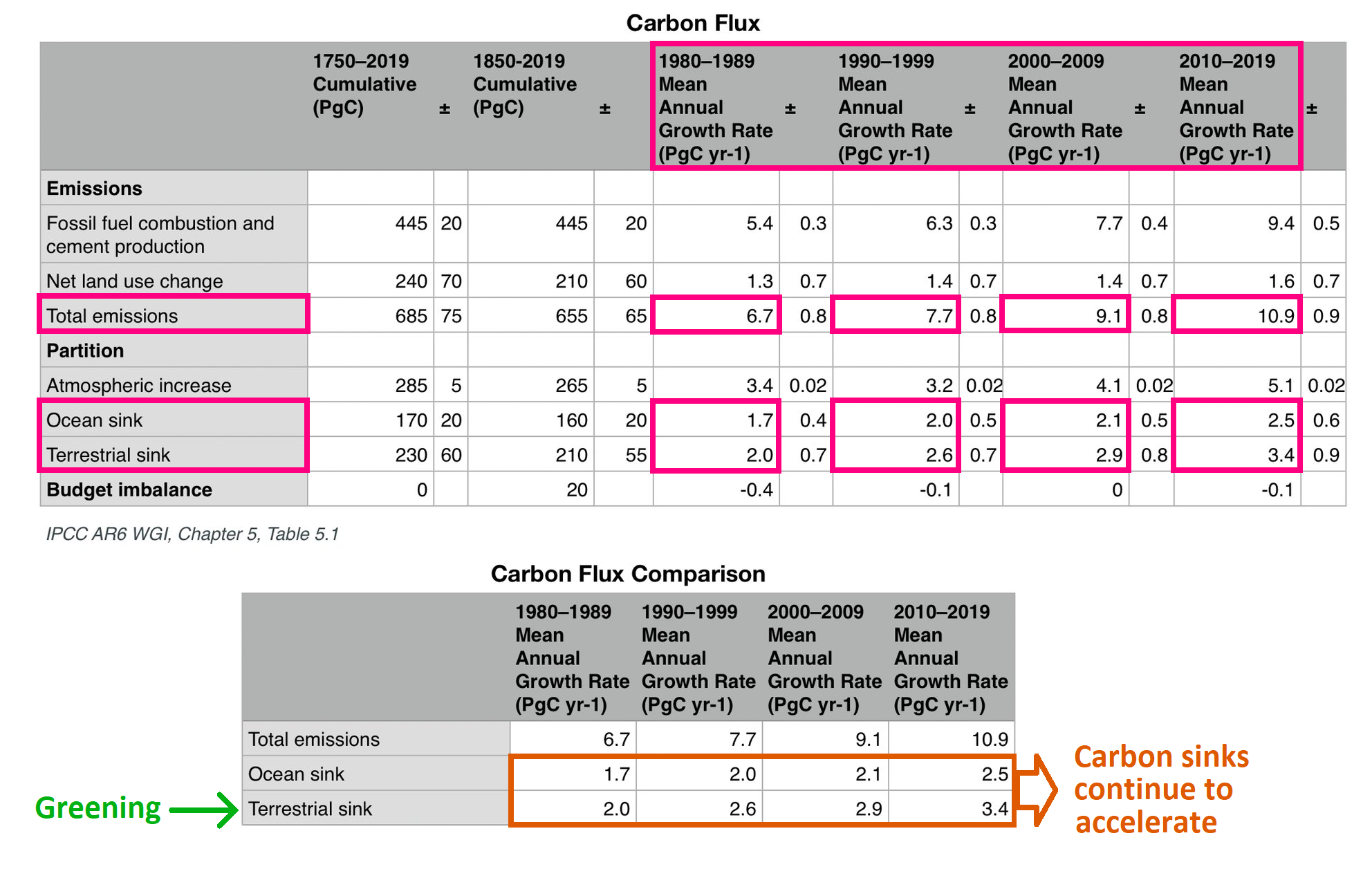
CO2 Fertilization Feedback (“greening”) is negative:
higher atmospheric CO2 level
→ accelerated tree growth
→ faster removal of CO2 from the air
→ lower CO2 level
The two biggest obviously are:
CO2 Fertilization Feedback (“greening”) is negative:
higher atmospheric CO2 level
→ accelerated tree growth
→ faster removal of CO2 from the air
→ lower CO2 level
@KCTaz @EthonRaptor @bomac_macbo @ProfMickWilson @Data79504085 @Hji45519156 @BlasphemousBan1 @FD2you @DawnTJ90 @BradPKeyes @Callan23474387 @Mark_A_Lunn @AristotleMrs @0Sundance @TheDisproof @BointonGiles @DoesThisW0rk @3GHtweets @Climatehope2 @Jaisans @S_D_Mannix @glinch72 @TWTThisIsNow @JustThi30117912 @paulp1232 @MartinJBern @Willard1951 @ShroedingerBird @ammocrypta @ChrisBBacon3 @B_Bolshevik100 @rosmadiwahab @Robert76907841 @Anvndarnamn5 @EricWil06256732 @FillmoreWhite @TommyLambertOKC @RobMeekel @JohnDublin10 @Veritatem2021 @NoTricksZone @RoelofBoer @DawnJT90 @DawnTj9 @PeterDClack @FriendsOScience @Kenneth72712993 @wattsupwiththat @AlexEpstein 5/15」CO2 Absorption By Water Feedback is negative:
(This is the other of the two biggest carbon feedbacks.)
higher atmosphericCO2 level
→ faster absorption of CO2 from atmosphere by oceans
→ lower atmosphericCO2 level
sealevel.info/AR6_WG1_Table_…
sealevel.info/AR6_WG1_Table_…
(This is the other of the two biggest carbon feedbacks.)
higher atmosphericCO2 level
→ faster absorption of CO2 from atmosphere by oceans
→ lower atmosphericCO2 level
sealevel.info/AR6_WG1_Table_…
sealevel.info/AR6_WG1_Table_…

@KCTaz @EthonRaptor @bomac_macbo @ProfMickWilson @Data79504085 @Hji45519156 @BlasphemousBan1 @FD2you @DawnTJ90 @BradPKeyes @Callan23474387 @Mark_A_Lunn @AristotleMrs @0Sundance @TheDisproof @BointonGiles @DoesThisW0rk @3GHtweets @Climatehope2 @Jaisans @S_D_Mannix @glinch72 @TWTThisIsNow @JustThi30117912 @paulp1232 @MartinJBern @Willard1951 @ShroedingerBird @ammocrypta @ChrisBBacon3 @B_Bolshevik100 @rosmadiwahab @Robert76907841 @Anvndarnamn5 @EricWil06256732 @FillmoreWhite @TommyLambertOKC @RobMeekel @JohnDublin10 @Veritatem2021 @NoTricksZone @RoelofBoer @DawnJT90 @DawnTj9 @PeterDClack @FriendsOScience @Kenneth72712993 @wattsupwiththat @AlexEpstein 6/15」Rock Weathering Feedback is negative:
higher atmospheric CO2 level
→ faster absorption of CO2 from atmosphere by silicate rock weathering
→ lower atmospheric CO2 level
higher atmospheric CO2 level
→ faster absorption of CO2 from atmosphere by silicate rock weathering
→ lower atmospheric CO2 level
@KCTaz @EthonRaptor @bomac_macbo @ProfMickWilson @Data79504085 @Hji45519156 @BlasphemousBan1 @FD2you @DawnTJ90 @BradPKeyes @Callan23474387 @Mark_A_Lunn @AristotleMrs @0Sundance @TheDisproof @BointonGiles @DoesThisW0rk @3GHtweets @Climatehope2 @Jaisans @S_D_Mannix @glinch72 @TWTThisIsNow @JustThi30117912 @paulp1232 @MartinJBern @Willard1951 @ShroedingerBird @ammocrypta @ChrisBBacon3 @B_Bolshevik100 @rosmadiwahab @Robert76907841 @Anvndarnamn5 @EricWil06256732 @FillmoreWhite @TommyLambertOKC @RobMeekel @JohnDublin10 @Veritatem2021 @NoTricksZone @RoelofBoer @DawnJT90 @DawnTj9 @PeterDClack @FriendsOScience @Kenneth72712993 @wattsupwiththat @AlexEpstein 7/15」CO2 / Coccolithophore Feedback is negative.
higher CO2 level
→ accelerated growth of calcifying coccolithophores (accelerated “biological carbon pump”)
→ faster removal of carbon from the upper ocean
→ lower atmospheric CO2 level
(CaCO3 density=2.7, so it sinks.)
higher CO2 level
→ accelerated growth of calcifying coccolithophores (accelerated “biological carbon pump”)
→ faster removal of carbon from the upper ocean
→ lower atmospheric CO2 level
(CaCO3 density=2.7, so it sinks.)
@KCTaz @EthonRaptor @bomac_macbo @ProfMickWilson @Data79504085 @Hji45519156 @BlasphemousBan1 @FD2you @DawnTJ90 @BradPKeyes @Callan23474387 @Mark_A_Lunn @AristotleMrs @0Sundance @TheDisproof @BointonGiles @DoesThisW0rk @3GHtweets @Climatehope2 @Jaisans @S_D_Mannix @glinch72 @TWTThisIsNow @JustThi30117912 @paulp1232 @MartinJBern @Willard1951 @ShroedingerBird @ammocrypta @ChrisBBacon3 @B_Bolshevik100 @rosmadiwahab @Robert76907841 @Anvndarnamn5 @EricWil06256732 @FillmoreWhite @TommyLambertOKC @RobMeekel @JohnDublin10 @Veritatem2021 @NoTricksZone @RoelofBoer @DawnJT90 @DawnTj9 @PeterDClack @FriendsOScience @Kenneth72712993 @wattsupwiththat @AlexEpstein 8/15」The only positive carbon feedbacks are very minor. E.g.,
CO2 / Water Temperature Feedback.
Gas solubility decreases as the water warms. This is a slight positive feedback mechanism:
warmer water
→ slower CO2 uptake
→ higher atmospheric CO2 level
→ warmer water
CO2 / Water Temperature Feedback.
Gas solubility decreases as the water warms. This is a slight positive feedback mechanism:
warmer water
→ slower CO2 uptake
→ higher atmospheric CO2 level
→ warmer water
@KCTaz @EthonRaptor @bomac_macbo @ProfMickWilson @Data79504085 @Hji45519156 @BlasphemousBan1 @FD2you @DawnTJ90 @BradPKeyes @Callan23474387 @Mark_A_Lunn @AristotleMrs @0Sundance @TheDisproof @BointonGiles @DoesThisW0rk @3GHtweets @Climatehope2 @Jaisans @S_D_Mannix @glinch72 @TWTThisIsNow @JustThi30117912 @paulp1232 @MartinJBern @Willard1951 @ShroedingerBird @ammocrypta @ChrisBBacon3 @B_Bolshevik100 @rosmadiwahab @Robert76907841 @Anvndarnamn5 @EricWil06256732 @FillmoreWhite @TommyLambertOKC @RobMeekel @JohnDublin10 @Veritatem2021 @NoTricksZone @RoelofBoer @DawnJT90 @DawnTj9 @PeterDClack @FriendsOScience @Kenneth72712993 @wattsupwiththat @AlexEpstein 9/15」That's partly offset by increased air→ocean gas transfer due to reduced sea ice coverage (a minor negative feedback):
higher atmospheric CO2 level
→ warmer water
→ reduced sea ice at high latitudes
→ accelerated air-to-ocean gas transfer
→ lower atmospheric CO2 level
higher atmospheric CO2 level
→ warmer water
→ reduced sea ice at high latitudes
→ accelerated air-to-ocean gas transfer
→ lower atmospheric CO2 level
@KCTaz @EthonRaptor @bomac_macbo @ProfMickWilson @Data79504085 @Hji45519156 @BlasphemousBan1 @FD2you @DawnTJ90 @BradPKeyes @Callan23474387 @Mark_A_Lunn @AristotleMrs @0Sundance @TheDisproof @BointonGiles @DoesThisW0rk @3GHtweets @Climatehope2 @Jaisans @S_D_Mannix @glinch72 @TWTThisIsNow @JustThi30117912 @paulp1232 @MartinJBern @Willard1951 @ShroedingerBird @ammocrypta @ChrisBBacon3 @B_Bolshevik100 @rosmadiwahab @Robert76907841 @Anvndarnamn5 @EricWil06256732 @FillmoreWhite @TommyLambertOKC @RobMeekel @JohnDublin10 @Veritatem2021 @NoTricksZone @RoelofBoer @DawnJT90 @DawnTj9 @PeterDClack @FriendsOScience @Kenneth72712993 @wattsupwiththat @AlexEpstein 10/15」Permafrost & Clathrate / Methane Feedback.
In a warming climate, Arctic permafrost, and/or underwater methane clathrates can melt, releasing methane ("the other carbon") into the atmosphere, with a slight warming effect. (This is an extremely minor feedback.)
In a warming climate, Arctic permafrost, and/or underwater methane clathrates can melt, releasing methane ("the other carbon") into the atmosphere, with a slight warming effect. (This is an extremely minor feedback.)
@KCTaz @EthonRaptor @bomac_macbo @ProfMickWilson @Data79504085 @Hji45519156 @BlasphemousBan1 @FD2you @DawnTJ90 @BradPKeyes @Callan23474387 @Mark_A_Lunn @AristotleMrs @0Sundance @TheDisproof @BointonGiles @DoesThisW0rk @3GHtweets @Climatehope2 @Jaisans @S_D_Mannix @glinch72 @TWTThisIsNow @JustThi30117912 @paulp1232 @MartinJBern @Willard1951 @ShroedingerBird @ammocrypta @ChrisBBacon3 @B_Bolshevik100 @rosmadiwahab @Robert76907841 @Anvndarnamn5 @EricWil06256732 @FillmoreWhite @TommyLambertOKC @RobMeekel @JohnDublin10 @Veritatem2021 @NoTricksZone @RoelofBoer @DawnJT90 @DawnTj9 @PeterDClack @FriendsOScience @Kenneth72712993 @wattsupwiththat @AlexEpstein 11/15」Those last three (two positive and one negative) are all minor.
The major carbon feedbacks are all negative, so obviously net carbon feedbacks are very strongly negative / stabilizing / attenuating.
The major carbon feedbacks are all negative, so obviously net carbon feedbacks are very strongly negative / stabilizing / attenuating.
@KCTaz @EthonRaptor @bomac_macbo @ProfMickWilson @Data79504085 @Hji45519156 @BlasphemousBan1 @FD2you @DawnTJ90 @BradPKeyes @Callan23474387 @Mark_A_Lunn @AristotleMrs @0Sundance @TheDisproof @BointonGiles @DoesThisW0rk @3GHtweets @Climatehope2 @Jaisans @S_D_Mannix @glinch72 @TWTThisIsNow @JustThi30117912 @paulp1232 @MartinJBern @Willard1951 @ShroedingerBird @ammocrypta @ChrisBBacon3 @B_Bolshevik100 @rosmadiwahab @Robert76907841 @Anvndarnamn5 @EricWil06256732 @FillmoreWhite @TommyLambertOKC @RobMeekel @JohnDublin10 @Veritatem2021 @NoTricksZone @RoelofBoer @DawnJT90 @DawnTj9 @PeterDClack @FriendsOScience @Kenneth72712993 @wattsupwiththat @AlexEpstein 12/15」Eli wrote, "CO2 atm concentration change is only about half of what emissions would make it unopposed."
That's only because CO2 emissions have accelerated. (I trust you're not one of those alarmist nuts who think a fixed 50% "airborne fraction" remains in the atmosphere.)
That's only because CO2 emissions have accelerated. (I trust you're not one of those alarmist nuts who think a fixed 50% "airborne fraction" remains in the atmosphere.)
@KCTaz @EthonRaptor @bomac_macbo @ProfMickWilson @Data79504085 @Hji45519156 @BlasphemousBan1 @FD2you @DawnTJ90 @BradPKeyes @Callan23474387 @Mark_A_Lunn @AristotleMrs @0Sundance @TheDisproof @BointonGiles @DoesThisW0rk @3GHtweets @Climatehope2 @Jaisans @S_D_Mannix @glinch72 @TWTThisIsNow @JustThi30117912 @paulp1232 @MartinJBern @Willard1951 @ShroedingerBird @ammocrypta @ChrisBBacon3 @B_Bolshevik100 @rosmadiwahab @Robert76907841 @Anvndarnamn5 @EricWil06256732 @FillmoreWhite @TommyLambertOKC @RobMeekel @JohnDublin10 @Veritatem2021 @NoTricksZone @RoelofBoer @DawnJT90 @DawnTj9 @PeterDClack @FriendsOScience @Kenneth72712993 @wattsupwiththat @AlexEpstein 13/15」If CO2 emissions were suddenly halved, the "airborne fraction" would be zero. If CO2 emissions were suddenly doubled, the "airborne fraction" would (initially) be 75% (though it would then decrease due to rising levels).
I'm sure you understand that, right, Eli?
I'm sure you understand that, right, Eli?
@KCTaz @EthonRaptor @bomac_macbo @ProfMickWilson @Data79504085 @Hji45519156 @BlasphemousBan1 @FD2you @DawnTJ90 @BradPKeyes @Callan23474387 @Mark_A_Lunn @AristotleMrs @0Sundance @TheDisproof @BointonGiles @DoesThisW0rk @3GHtweets @Climatehope2 @Jaisans @S_D_Mannix @glinch72 @TWTThisIsNow @JustThi30117912 @paulp1232 @MartinJBern @Willard1951 @ShroedingerBird @ammocrypta @ChrisBBacon3 @B_Bolshevik100 @rosmadiwahab @Robert76907841 @Anvndarnamn5 @EricWil06256732 @FillmoreWhite @TommyLambertOKC @RobMeekel @JohnDublin10 @Veritatem2021 @NoTricksZone @RoelofBoer @DawnJT90 @DawnTj9 @PeterDClack @FriendsOScience @Kenneth72712993 @wattsupwiththat @AlexEpstein 14/15」Eli wrote, "Bad news is part of that change, ocean absorption, will come back to haunt us later"
Bless, not haunt!!!
"Later" ≈ 1000 years. By then, the anthropogenic CO2 surge will be long over. There's not enough coal on Earth to keep CO2 >400 ppmv that long.
Bless, not haunt!!!
"Later" ≈ 1000 years. By then, the anthropogenic CO2 surge will be long over. There's not enough coal on Earth to keep CO2 >400 ppmv that long.
@KCTaz @EthonRaptor @bomac_macbo @ProfMickWilson @Data79504085 @Hji45519156 @BlasphemousBan1 @FD2you @DawnTJ90 @BradPKeyes @Callan23474387 @Mark_A_Lunn @AristotleMrs @0Sundance @TheDisproof @BointonGiles @DoesThisW0rk @3GHtweets @Climatehope2 @Jaisans @S_D_Mannix @glinch72 @TWTThisIsNow @JustThi30117912 @paulp1232 @MartinJBern @Willard1951 @ShroedingerBird @ammocrypta @ChrisBBacon3 @B_Bolshevik100 @rosmadiwahab @Robert76907841 @Anvndarnamn5 @EricWil06256732 @FillmoreWhite @TommyLambertOKC @RobMeekel @JohnDublin10 @Veritatem2021 @NoTricksZone @RoelofBoer @DawnJT90 @DawnTj9 @PeterDClack @FriendsOScience @Kenneth72712993 15/15」1000 yrs from now, when civilization, if it survives, will surely be nuclear-powered, the slight increase of millennium-old carbon from oceans will give a slight but welcome relief to the severe shortage of atmospheric CO2.
@threadreaderapp @rattibha @threaddotblue unroll
@threadreaderapp @rattibha @threaddotblue unroll
• • •
Missing some Tweet in this thread? You can try to
force a refresh