
1/ The excellent @IanMatveev has done another deep dive into military strategy in Ukraine – this time a look at the geographical considerations of a possible Ukrainian counter-offensive in the south. See below for a translation (long thread ahead!). 
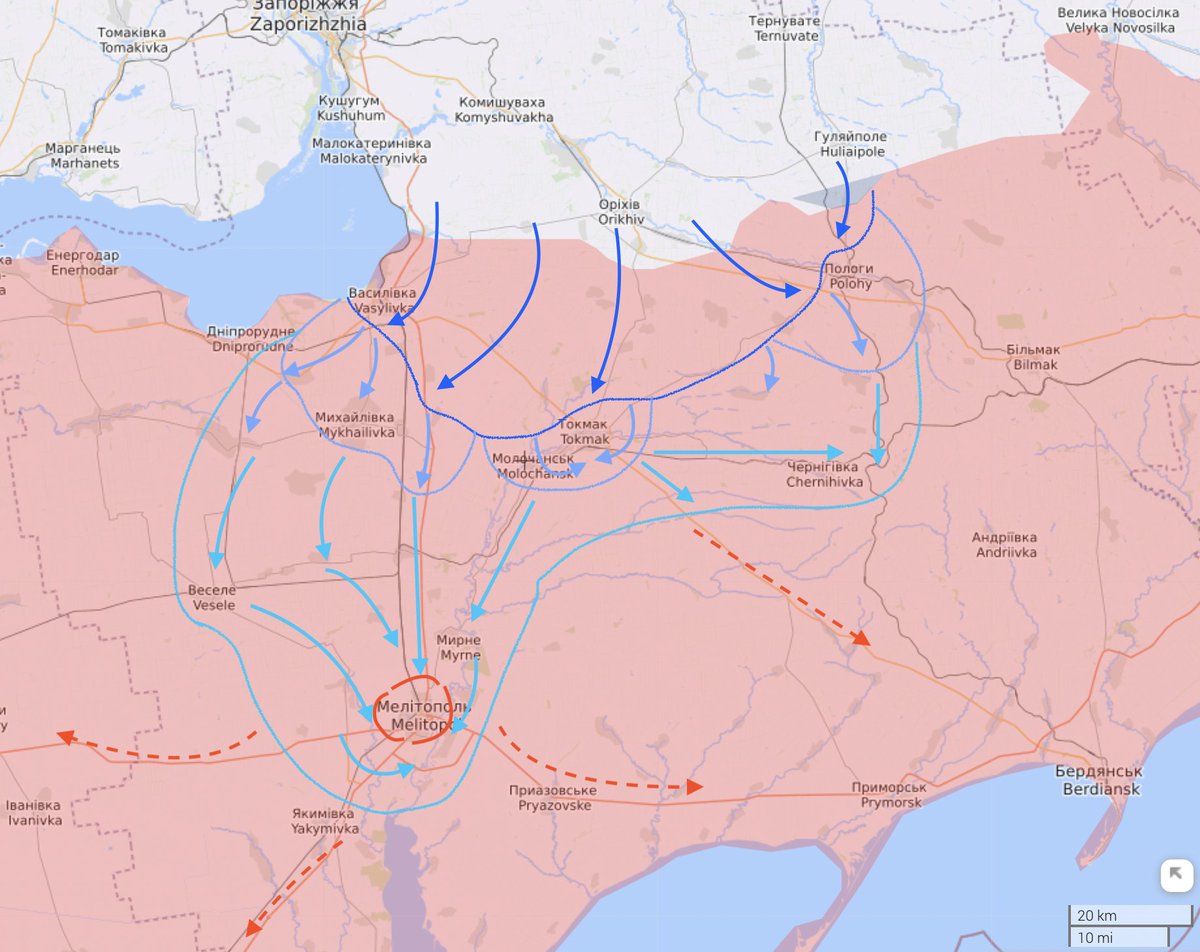
2/ From @IanMatveev: The Ukrainian counter-offensive will certainly begin in the near future. What will it be like? It is quite possible that the Armed Forces of Ukraine will attack in the direction of Melitopol and Crimea. Let's analyse such an offensive's main elements.
3/ On the Zaporizhzhia front, Ukrainian forces can advance in two main directions - to Melitopol and Mariupol. I wrote about the pros and cons of both options here: t.me/arrowsmap/18 . Today we'll study one of them in detail – the one that I think is preferable.
4/ We will talk about the main aspects of the offensive:
1. The battlefield
2. Opposing forces
3. Attack preparation
4. The beginning of the breakthrough
5. Key points
6. Difficult moments
7. The main stages ⬇️
1. The battlefield
2. Opposing forces
3. Attack preparation
4. The beginning of the breakthrough
5. Key points
6. Difficult moments
7. The main stages ⬇️
5/ Part 1 - the battlefield
I assume that the battle will take place on a 70 km wide strip from Kamianske to Huliaipole and further south, possibly gradually shifting to the west. This entire area is completely open and observable.
I assume that the battle will take place on a 70 km wide strip from Kamianske to Huliaipole and further south, possibly gradually shifting to the west. This entire area is completely open and observable.

6/ On the one hand, tracked vehicles can easily drive straight across the fields, on the other hand, it will be easier to detect and destroy them with artillery fire. This is similar to what’s happened with Russian tanks near Vuhledar and Avdiivka.
7/ The main water obstacle is the Molochna River, but it stretches from north to south, along the direction of the main strike. Reliable crossings over it, although extremely desirable, are not vital.

8/ There is also the Tokmachka River and two small rivers with inlets in Kamianske and Vasylivka. The other small rivers are easily crossed with a minimal number of engineering devices, which the AFU will certainly have.
9/ Let's look at the elevation map as well. Only the left flank has a clear elevation. In general there is no great need to capture it. Although of course this is a convenient position for artillery and it would be nice to get control over it.

10/ But then you would need additional forces and it would probably be easier to suppress the batteries with air strikes and HIMARS.
11/ The network of relatively good roads is dense, with at least three adequate supply routes, among them a large main highway that armoured vehicles will not wreck. This is important, among other things, because the roads are convenient for moving troops in armoured vehicles.


12/ Overall, I would say the battlefield is convenient for a breakthrough and a quick offensive. There are no significant obstacles and the defenders can only cling to populated areas.
13/ On the other hand the attackers have a disadvantage as well – it is difficult to find a line for an operational pause from where to repel Russian counterattacks.
14/ Therefore, the offensive must progress quickly, otherwise the AFU may find itself in uncomfortable positions at a difficult moment.
15/ Part 2 – opposing forces.
Given the three directions of attack (Vasylivka, Tokmak and Polohy), the AFU would need at least three mixed mechanised brigades with tanks, self-propelled artillery and BMPs.
Given the three directions of attack (Vasylivka, Tokmak and Polohy), the AFU would need at least three mixed mechanised brigades with tanks, self-propelled artillery and BMPs.

16/ It would also need fast wheeled armoured vehicles (or the equivalent number of small units).
At the same time it is necessary to have 1-2 brigades in reserve in order to send them immediately to the breakthrough where it is possible to overcome the first line.
At the same time it is necessary to have 1-2 brigades in reserve in order to send them immediately to the breakthrough where it is possible to overcome the first line.
17/ In addition, 3-4 motorised infantry brigades are needed to support the offensive and block the enemy in key areas.
If the offensive follows the largest possible route, the defence lines would be 200 kilometres long in the west and east.
If the offensive follows the largest possible route, the defence lines would be 200 kilometres long in the west and east.

18/ Ukrainian brigades usually hold a length of 8-15 kilometres of front line. The Ukrainians can extend this to 20, using flexible defences based on population centres, as well as territorial defence brigades, so at least 10 brigades are needed.
19/ In total, the AFU needs six brigades in the first echelon, three more in the second, and approximately 10 in the third. Add artillery, air defence, and support services and you get a grouping of 130,000 or more with a basic brigade strength of 6,000.

20/ This would require at least 120-150 tanks (one battalion per mechanised brigade) and 300+ BMPs and APCs.
21/ At the front there is the 128th separate mountain brigade, the 65th mechanised brigade, two territorial defence brigades and three national guard brigades. With 7 units the line of defence, by the way, is 70 kilometres long.
22/ There are no available forces for the offensive – they are now in reserve.
https://twitter.com/JominiW/status/1644436109894512668
23/ As for the Russian troops, here we have to rely on old data. The front in this place is static and Russian sources themselves rarely report on particular units. For example, here's a post about the 291st Regiment, which is part of the 42nd Motorised Rifle Division.

24/ But it is very stretched out and is said to be here only in Polohy (by this regiment) or in Robotyne by another source – uacontrolmap.com. The main force is the 19th Motorised Rifle Division – about 11,000 men, 120 tanks and 300+ armoured vehicles.
25/ Other powerful Russian units include the 64th Motorised Rifle Brigade, the 11th Airborne Assault Brigade and the 45th Special Forces Brigade. As well as a fairly large contingent from the Luhansk and Donetsk 'Democratic Republics' and even probably Wagner.
26/ According to another source: the 1430 Motorised Rifle Regiment, 177 Motorised Rifle Regiment, 22nd Special Forces Brigade and 37th Motorised Rifle Brigade.
27/ On paper it amounts to the equivalent of 4 brigades, with another 2-3 brigades similar in strength to the territorial defence and additional units.
deepstatemap.live/#10/47.4694/35…
deepstatemap.live/#10/47.4694/35…
28/ The combat effectiveness and equipment of these troops raises big questions. All the reserves go to other directions, probably here there is a shortage of modern tanks (T-62s were brought to this section of the front) and ammunition.
29/ But the Armed Forces of Ukraine will address these issues at the stage of preparation for the attack.
Speaking of the forces of Putin's army, one must not forget the fortifications. Those lines of trenches and concrete pyramids (here is a good map: google.com/maps/d/viewer?…).
Speaking of the forces of Putin's army, one must not forget the fortifications. Those lines of trenches and concrete pyramids (here is a good map: google.com/maps/d/viewer?…).
30/ On their own they do not pose a great threat and are even detrimental to the defence – you can literally see them from the satellite view.
The Ukrainians will know in advance where these lines are, and will be able to allocate tasks to destroy them in advance.
The Ukrainians will know in advance where these lines are, and will be able to allocate tasks to destroy them in advance.


31/ In some places they will just bypass them. Some positions are in blatantly dumb places. But they can still give some benefit to the defence, including through the use of mines.
32/ On the overall map, we can draw several conclusions:
1. There are two main lines of defence, located close to each other (from 16 to 4.5 km).
2. The Mykhailivka-Mala Bilozerka area is the most heavily covered.
1. There are two main lines of defence, located close to each other (from 16 to 4.5 km).
2. The Mykhailivka-Mala Bilozerka area is the most heavily covered.

33/ 3. The line along the route E105 protects against an attack from the east after the forcing of the river.
4. Melitopol is almost not covered by these fortifications, but Tokmak is encircled by them.
5. The lines often rely on populated areas.
4. Melitopol is almost not covered by these fortifications, but Tokmak is encircled by them.
5. The lines often rely on populated areas.

34/ The overall picture is that the Russian Army would prefer to hold the left flank and is ready to let the AFU attack on the right, in order to then defend Tokmak and the Molochna River line.
35/ The lack of dense coverage of the E105 route is a big mistake. But of course focusing only on these crude trenches is not worth it.
36/ Part 3 – attack preparation
Talking about basic preparations like reconnaissance and camouflaging of the advancing forces, creating forward depots and working out plans and everything else makes little sense.
Talking about basic preparations like reconnaissance and camouflaging of the advancing forces, creating forward depots and working out plans and everything else makes little sense.
37/ Separately, I want to discuss the strikes on the Russian troops that we should expect from the AFU.
38/ A couple of weeks or even a month in advance, exhausting strikes can begin, the purpose of which is to deprive the Russian army of operational resources for repair and replenishment.
39/ For example, if a bridge is destroyed, a rapidly erected replacement will be installed. This means that when another or the same bridge is bombed on the day of the offensive, there will no longer be such structures left in the warehouse for quick repairs.
40/ It is the same with ammunition depots. If bombed in advance, of course new structures will eventually be brought in. But there will be no more left where they are brought from. Besides, when the front is calm, things can be prioritised.
41/ Well, why do you need this spare highway – we'll fix it later somehow. Three warehouses burned down, but you don't need that many – let's rebuild one somewhere else for now.
As a result, logistics can become much more vulnerable to attack just before the offensive.
As a result, logistics can become much more vulnerable to attack just before the offensive.
42/ So, where and what to attack? In my opinion, the key targets are:
Melitopol airfield.
One of the Russian military bases is located there and there are other facilities under military control in and around the city, they can also come under attack, as before.
Melitopol airfield.
One of the Russian military bases is located there and there are other facilities under military control in and around the city, they can also come under attack, as before.

43/ Dzhankoi railway junction
Here everything is obvious. Not only does the railway run through this junction to the west - to Sevastopol, but also to the north through Chonhar to Melitopol. In fact, Dzhankoi is the second Crimean bridge.
Here everything is obvious. Not only does the railway run through this junction to the west - to Sevastopol, but also to the north through Chonhar to Melitopol. In fact, Dzhankoi is the second Crimean bridge.

44/ The Fedorivka railway junction in Novobohdanivka
An important junction at the intersection of roads running from east to west and north to south. Not globally important, but important for the movement of forces directly during combat.
An important junction at the intersection of roads running from east to west and north to south. Not globally important, but important for the movement of forces directly during combat.
45/ Volnovakha railway junction
This is the starting point for the railway leading west approximately in the middle of occupied territory. Also important for supply and troop movement.
This is the starting point for the railway leading west approximately in the middle of occupied territory. Also important for supply and troop movement.
46/ Bridges on the Molochna river
The river crosses the combat zone and it is vital for the Russian army to keep crossing it. Only one bridge can be restored if two or three are destroyed. And when it gets hot, it will be too late to repair the other two.
The river crosses the combat zone and it is vital for the Russian army to keep crossing it. Only one bridge can be restored if two or three are destroyed. And when it gets hot, it will be too late to repair the other two.

47/ Bridges near Chonhar and Syvash
Difficult targets, also because of the distance and the strength of the bridges themselves. But if they are damaged, even for a short time, it could upset the overall balance of military supplies, which probably go in part just through Crimea.
Difficult targets, also because of the distance and the strength of the bridges themselves. But if they are damaged, even for a short time, it could upset the overall balance of military supplies, which probably go in part just through Crimea.

48/ Bridges over the Crimean Canal
Destroying these bridges could deprive the grouping at the mouth of the Dnipro of normal communications with the front. It will come in handy, including during the third phase of the offensive (more on this later).
Destroying these bridges could deprive the grouping at the mouth of the Dnipro of normal communications with the front. It will come in handy, including during the third phase of the offensive (more on this later).
49/ Obytichna River bridges
The Obytichna is like the Molochna, only further east. Several important bridges are there, including one that carries the "land corridor." Several other rivers in the area flow into the Sea of Azov. All the bridges over them could become targets.
The Obytichna is like the Molochna, only further east. Several important bridges are there, including one that carries the "land corridor." Several other rivers in the area flow into the Sea of Azov. All the bridges over them could become targets.
50/ Berdiansk oil depots and port
Berdiansk is the nearest major port through which to supply the Russian grouping on the Zaporizhzhia front. If it is damaged, the occupation forces will lose another supply route (or it will become less effective).
Berdiansk is the nearest major port through which to supply the Russian grouping on the Zaporizhzhia front. If it is damaged, the occupation forces will lose another supply route (or it will become less effective).
51/ S-300/400 air defence positions and radars
Their location should be clarified by Ukrainian intelligence, but it is unlikely that they are only in Crimea.
Their location should be clarified by Ukrainian intelligence, but it is unlikely that they are only in Crimea.

52/ These are the most dangerous and relatively non-mobile anti-aircraft complexes. The Russian command usually groups them in divisions, creating entire bases.
Military bases all along the Zaporizhzhia front will also come under attack, targeted from satellite images.
Military bases all along the Zaporizhzhia front will also come under attack, targeted from satellite images.
53/ While the Russian army recovers what it can, reconnaissance will trace the most important logistics lines, determine the enemy's priorities, its reserve depots and lines.
54/ A general strike map might look something like this:

55/ Immediately before the attack, HIMARS and artillery will hit the nearest warehouses, troop locations, the railway junction in Tokmak and identified particularly important objects like radars (using AGM-88 HARM missiles) or locations of soldiers and Rosgvardia members.
56/ Another type of preparation is exhausting attacks/fire along the front lines. Here it is important not to overdo it and not to suffer heavy losses, and better to do without them at all. Now this is more than realistic with the help of drones.
57/ You can triple the massive pressure from the air for 3-4 days or even a week in a row by dropping grenades and with pinpoint artillery. The important thing is that this should be done not only in the intended direction of the breakthrough, but everywhere.
58/ This is so that Russian force commanders have to react everywhere and disperse reinforcements to reinforce the entire front line. For example, here is what Russian war criminal Igor Girkin writes:

Next part is here:
https://twitter.com/ChrisO_wiki/status/1653150189857718278
• • •
Missing some Tweet in this thread? You can try to
force a refresh






