Armchair Warlord Profile picture
May 6, 2023 23 tweets 9 min read Read on X
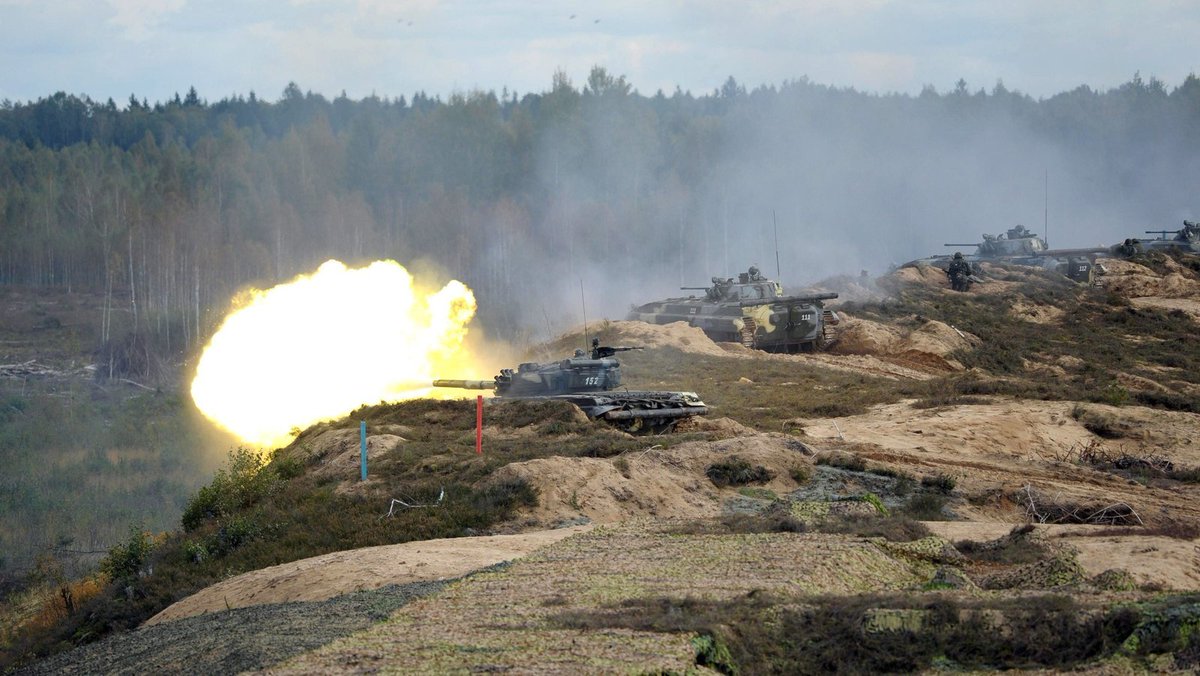
Let's talk about defense in depth. Seems appropriate at the moment.

A thread: Image
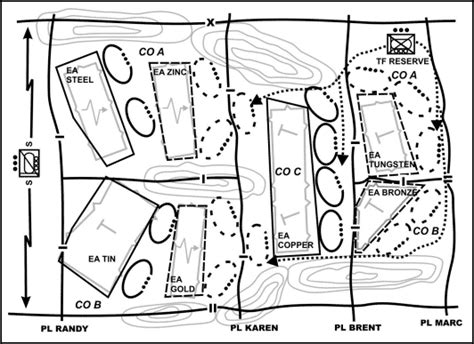
Most field manuals will give you a map like this and talk in circles around how this tactic is actually supposed to work, probably because most soldiers (with good reason) don't particularly like admitting to trading lives for space and time. ImageImage
Regardless, it is simple, easy to execute, and works extremely well.

Everyone is all gung-ho to do a slick mobile defense until they find out that if they miss the counterattack timing by an hour the entire plan falls apart. Image
The standard way to deploy for this (and for many other missions) is with a "two up, one back" arrangement, where a unit deploys two of its three subcomponents forward with one in reserve.

This provides adequate coverage of the front line with an adequate reserve.
Here we see a "heavy" division deployed in exactly such an arrangement, with two brigades forward and one in reserve, and each of the forward brigades deploying two of their battalions forward with one in local reserve.

A screen is deployed forward of the defense proper. Image
As is noted on the template, each battalion on the front line has ten kilometers of frontage - quite easy to cover for a heavy unit. This works out to a line of front-line platoon battle positions a kilometer or two apart, simple enough to cover with patrols and heavy weapons. Image
This unit has also had plenty of time to dig in and has established three separate obstacle belts.

Each of them is a complex obstacle that will require hours of work by sappers to breach. ImageImageImageImage
But we're not fighting this as a division, we're fighting at the corps level. This is a heavy corps deployed in a defense in depth across a 160km front, with four divisions forward and one in reserve.

This force has a total of 45 maneuver battalions available, 9 per division. Image
It's an old military rule of thumb that if you want to attack successfully you need a 3:1 advantage over the enemy. Every defending soldier can be expected to incapacitate two attackers before falling himself, and the third attacker will finally take the position. Image
With that being said, it's astonishingly rare that one army is able to just gain a theater-wide 3:1 advantage. Generally what happens is one army amasses a more local superiority to allow a breakthrough and collapse the front.
Here, the enemy has gained a 2:1 overall numerical advantage, but by massing most of their force against a single sector they'll achieve a 7:1 advantage against the targeted division. The remaining forces will conduct local attacks to tie down the other front-line units. Image
The screen falls back as the enemy attacks. The first wave in the breakthrough sector is 18 battalions - two whole divisions set against the four front-line battalions at 4.5:1 odds, dropping to 3:1 as the brigade reserves move up. Image
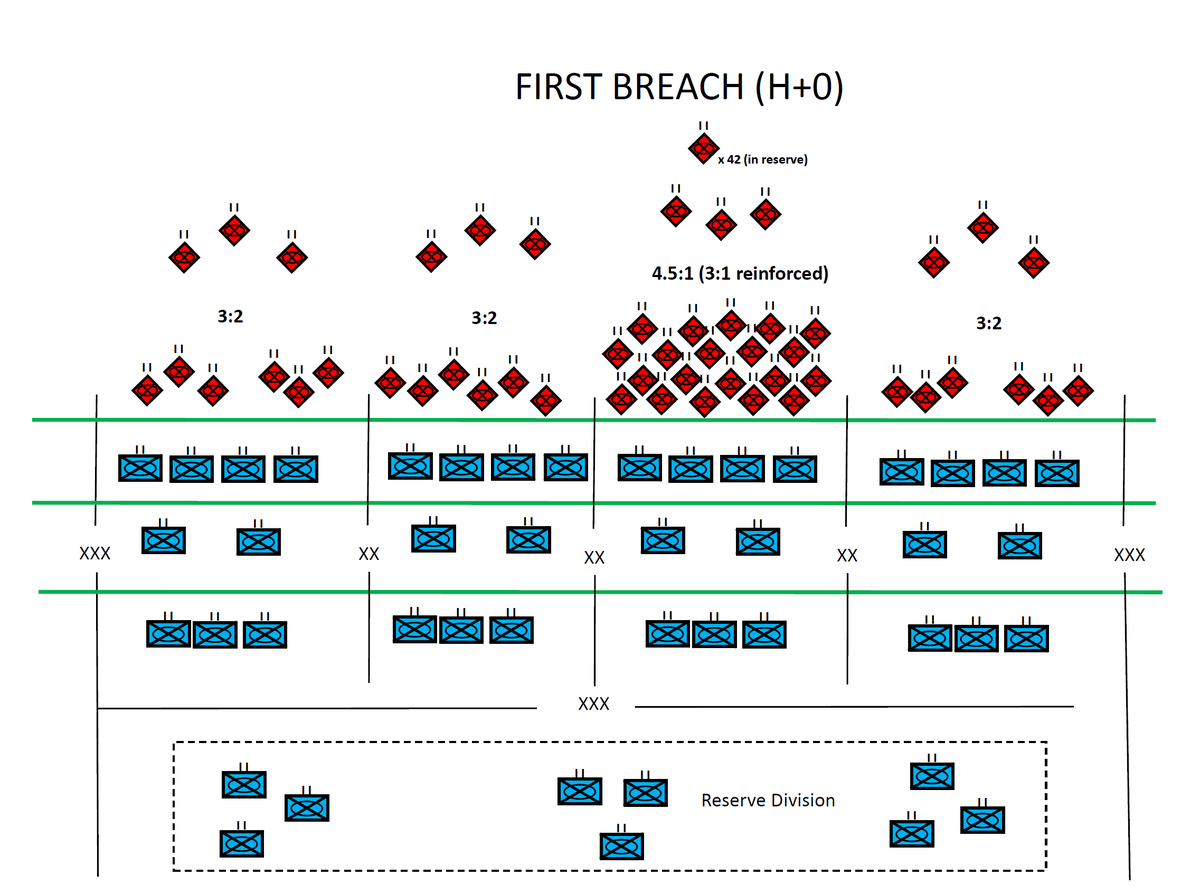
After an intense battle the first line is breached and the two front-line brigades are wiped out, taking 12 enemy battalions with them. There are modest losses on the flanks.

As the enemy main effort becomes apparent, reserves converge from the flanking divisions and corps. Image
Now facing 14 battalions in the breakthrough zone, the enemy commits a full 30 battalions to smash through the second defensive line.

More distant reserves are still converging on the growing salient, and the fixing attacks on the flanks continue. Image
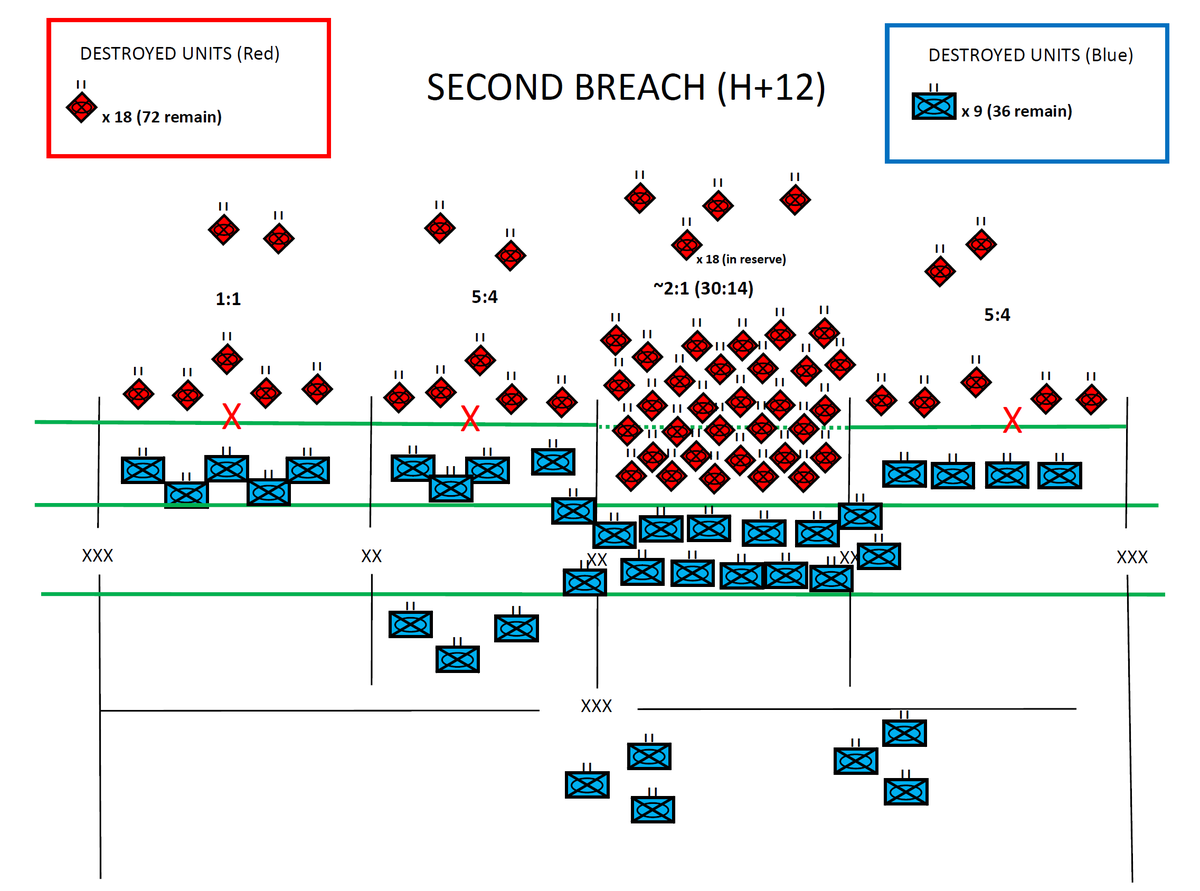
Even this massive force struggles to make headway, but eventually smashes through the second defensive line at the cost of almost every unit on both sides of the main assault rendered combat-ineffective.

All reserves are committed to hold the final line. Image
Now running out of reserves, the enemy commits their last 18 battalions in an attempt to crack the third line. This time, growing operational friction (they're now attempting a third breach 20km deep into the position) and declining numerical advantage defeat the attack. Image
The enemy consolidates and transitions back to the defense, with three-quarters of their total force (some 68 battalions) out of action after punching a 40x20km dent into the line.

Losses on the blue side, while lighter overall, are proportionally severe at 32 battalions. Image
As an aside, Red owns most of the battlefield and will be able to salvage damaged and abandoned equipment left on the field. Image
Now, it should be noted this is an "all else equal" analysis. Fire and air superiority will both affect the battlefield in critical ways - fire superiority by easing (or steepening!) the brutal 2:1 loss ratio and air superiority by interfering with reserve movement.
How is this relevant to Ukraine? Well, that corps defensive layout is a "doctrinal template" that can be applied to existing terrain as a first step to analyze force dispositions.
The front line in Zaporozhe happens to be about 160km long. Let's see what the Russian defensive scheme looks like with it applied.

It even fits closely into the known Russian obstacle belts. I assume (reasonably) there's a less visible mine belt along the contact line. Image
Not only can the Russians be expected to rapidly gain and keep fire and air superiority across the battlefield (and move in reinforcements from out of sector), but I don't know where the Ukrainians expect to get the 100+ battalions they'd need to actually defeat this scheme from. ImageImage
And if you think I'm being optimistic on the Russians here, take your concerns up with EUCOM. Gen. Cavoli's recent lukewarm public comments on Ukrainian prospects going forward speak for themselves. Image

• • •

Missing some Tweet in this thread? You can try to force a refresh

 

Keep Current with Armchair Warlord

Armchair Warlord Profile picture

Stay in touch and get notified when new unrolls are available from this author!

Read all threads

This Thread may be Removed Anytime!

PDF

Twitter may remove this content at anytime! Save it as PDF for later use!

Try unrolling a thread yourself!

how to unroll video
  1. Follow @ThreadReaderApp to mention us!

  2. From a Twitter thread mention us with a keyword "unroll"
@threadreaderapp unroll

Practice here first or read more on our help page!

More from @ArmchairW

May 6
Trump seems to have concluded a ceasefire with the Houthis, negotiated in Oman, that will see the Bab al-Mandeb reopened to American ships and leave Israel and Yemen to continue their long-range war.

If this was his intention all along, the bombing campaign suddenly makes sense. Image
Rather than waging an open-ended air campaign in effective support of Netanyahu's poorly-defined schemes in the region, Trump may have simply wanted to get the strait reopened to American traffic so business as usual could resume... or at least that was an acceptable step down.
Lest we forget, the Houthis had announced an intention to attack any American traffic passing through the straits some time ago.

I wonder if this whole thing was actually a head-fake with the Israel lobby. Negotiations seem to have been conducted very quietly, via Witkoff.
Read 7 tweets
Apr 27
Breaking the "Drone Wall"

The latest talking point out of the Ukrainian side is that they don't really need NATO's support any more because they have tons of kill drones and they're so incredibly lethal that's enough to hold off the Russians indefinitely.

Let's examine this.⬇️

First of all, let's examine the kill drone as a weapon system. Generally known as FPV drones, or as I prefer to call them, antitank drones, these are small, simple quadcopter drones equipped with a camera, a radio or wire communications system, and an explosive warhead.

This makes for a new type of weapon system that, rather than being extremely powerful at face value, gains its effectiveness through a combination of smart guidance and ubiquity. They do three things that prewar "legacy" antitank systems do not:

1. They have extremely precise guidance and can be maneuvered to attack weak points on an armored target or pursue dismounted troops into cover;

2. They have onboard sensors and sustained flight capability, and are capable of not just attacking targets outside of the operator's line of sight but actively conducting reconnaissance; and

3. They are relatively light and cheap, with two or three kill drones fitting into the size and weight factor of a single old-style antitank missile, and thousands of drones stamped out in Chinese factories daily on no-questions-asked contracts to be jury-rigged to ubiquitous Soviet-era antitank warheads.

These weapons do, however, have drawbacks compared to conventional antitank systems.

1. Radio-controlled models are vulnerable to electronic countermeasures;

2. They have limited lift capability and as such their warheads are generally relatively weak, often simply repurposed single-stage RPG-7 shells or purpose-built charges that are little better;

3. They fly relatively slowly and can be, and frequently are, defeated successfully by defensive fire from determined dismounted troops; and

4. They "fire" extremely slowly, as each drone must be manually prepped, linked to a command system, checked out, flown out to a target that could be several kilometers away, and then carefully maneuvered into the target for maximum effect. The rate of fire for a single drone team is thus measured in minutes per round rather than rounds per minute. Engagements where you see multiple drones hit in quick succession are the result of multiple teams attacking a single target or group of targets.

The Russians and to a lesser extent the Ukrainians have implemented countermeasures to lessen their forces' vulnerability to these weapons, generally consisting of ECM systems, defensive fire (skeet shooting has become a matter of great tactical relevance lately), and elaborate "cope caging" that would have drawn extreme mockery a few years ago and which still does in the circles of people who aren't going to survive the first battle of the next war. As such, the probability of kill (PK) of a given antitank drone launch at the moment is, optimistically, about 10% against an appropriately prepared armored vehicle.

And now, my readers, we see the inherent weakness of a military doctrine centered around these weapons. Recall what I previously said about the slow rate of fire of drone teams and compare it to the low PK to be expected of any system which an adaptive enemy has had a chance to respond to. Assuming a PK of about 8% and a five-minute engagement cycle, any given Russian armored vehicle can expect to have about one "drone-hour" of combat lifetime under attack by these systems. Thus a single vehicle being engaged by six teams, for instance, can expect to last ten minutes before being knocked out.

This combat model is borne out by numerous engagements in which Russian units have pushed through drone attack with few to modest losses despite clearly being under attack by multiple teams for extended periods of time. The "drone wall" tactic does, however, create a sufficiently dense swarm of drones at the point of contact to render advances at the platoon level largely a matter of luck and deliberate company-scale attacks a bloody proposition for the chance of little ground gained.

What about larger-scale attacks, though?

Let's run a little wargame. In this scenario, a Ukrainian division (let's say one of their new "tactical corps" that's effectively a divisional unit) is defending against a Russian divisional attack. The Ukrainian unit has deployed into a formation designed to maximize the intensity of antitank drone fire to be directed against an attack at any point on the front - very similar to AFU deployments on the ground right now - with two defensive lines of dismounted infantry in closely-spaced strongpoints and a final "line" of mechanized reserves to bottle up any breakthroughs. A mechanized Russian division has been tasked to smash its way through.

The exact geometry is also noted on the graphic below, but I'll state it here for completeness' sake - the AFU division is occupying a 27km front with three brigades each occupying nine kilometers. The two infantry defensive lines are each composed of platoon strongpoints located one kilometer apart, with the second line positioned three kilometers to the rear of the first line and able to support it with drone fire under intense combat conditions.

A few notes on the rules here.

1. Every Ukrainian strongpoint is assumed to contain one drone team with an engagement range under "assault" conditions of five kilometers. Each team will fire once every five minutes. Firing strongpoints will be marked with a red box in the graphics.

2. As I pointed out above, Russian vehicles have a combat lifespan of one "drone-hour." As such it will take twelve "shots" from a single drone team to kill a vehicle, or one shot from twelve drone teams.

3. I am assuming that a Russian unit will take 30 minutes to move 3-5 kilometers tactically, accounting for en-route mine clearance, etc. Moving through cleared areas will of course be quite fast.

4. Ukrainian strongpoints attacked from the front must be deliberately assaulted, which will take 30 minutes at 3:1 odds. Strongpoints that have been flanked can be hastily assaulted in the same turn as movement.

5. Ukrainian strongpoints in close combat with superior Russian units are suppressed and cannot fly off drones. This will be marked with a black box in the graphics.

6. Ukrainian artillery has largely been silenced and the Russians have stiff fire superiority and their own drones searching the battlefield. Once a Ukrainian drone team opens fire it will be spotted and destroyed by Russian indirect fire within two hours. Strongpoints with dead drone teams will be crossed out and will not fire, but must still be assaulted and cleared of their infantry for the Russians to progress.

7. The Ukrainian reserves cannot simply blitz to the breakthrough sector - they must be alerted and then move out, under attack by Russian interdiction fires and clearing scatter-mine obstacles on the way. Thus they are going to move relatively slowly.

8. The Russians have achieved operational surprise and there is no large AFU reserve force waiting for the assault. This isn't particularly unusual, a similar situation occurred at the start of the Battle of Avdeevka and the Kharkov incursion last year. The Russians seem to be able to pretty reliably mass large forces for operations if need be, without Ukraine or NATO intelligence noticing.

Simple enough? Maybe I should put in an application at Milton-Bradley!

Let's begin - I'll now transition to thread format.⬇️Image
Here we see the initial battlefield set. Of note, I'm depicting the Russians tactically by company but will be keeping a more precise tally of assault vehicles destroyed. Russian company icons will be removed as appropriate.

The little ovals are Ukrainian battle positions. Image
Dust rises on the war-torn steppe as a huge assault force rolls into view - an entire Russian battalion coming on out of the Russian line some way to the south.

The five closest strongpoints launch drones as artillery begins hammering down across the defensive line. Image
Read 14 tweets
Jan 8
The closest historical analogy to the Ukrainian War I can think of is the American Civil War - ironically a conflict that Europeans have always shied away from carefully studying.

A thread.⬇️ Image
The underlying causes of the American Civil War festered for decades, finally erupting into open conflict after a series of political calculations and miscalculations brought down a national compromise that increasingly resembled a house of cards. Image
Image
Image
Image
Ditto Ukraine. I've said elsewhere the number of political offramps available to Western leaders to avoid this war were so numerous that the fact war broke out can only be explained as the result of anti-Russian policy - clearly miscalculated policy given the results thus far. Image
Read 22 tweets
Oct 15, 2024
Let's bust some propaganda.

Top 10 pro-Ukrainian talking points - and why they're nonsense.⬇️ Image
10. Ukraine is a democracy!

False. The last free and fair election in Ukraine - not held under an ultranationalist jackboot after the 2014 coup - was in 2010.

All elections in Ukraine have been suspended since 2022, and Zelensky's five-year term from 2019 expired months ago. Image
Image
9. Russia is an autocracy!

False. Vladimir Putin and United Russia enjoy approval ratings among the Russian public that are extremely high, even in polling conducted by Western-backed, anti-Putin organizations.

Putin is popular enough to win any election held in Russia handily. Image
Read 13 tweets
Sep 15, 2024
How many plans has NATO gone through to try to beat Russia in Ukraine?

Let's count 'em! Image
Plan A: The FGM-148 Javelin

It seems absurd now, but in late 2021 NATO's leadership thought Javelin was a tank-deleting magic wand that would deter Putin from challenging Zelensky's scheme to conquer the LDPR.

Javelin failed in service and is a rare sight on the battlefield. Image
Plan B: The Kazakh Gambit

The West quite obviously fomented an uprising in Kazakhstan in January 2022 in hopes of distracting Russia from the then-boiling Ukrainian crisis.

Didn't work. CSTO troops arrived and helped the Kazakh government crush the would-be color revolution. Image
Read 16 tweets
Aug 18, 2024
Anatomy of a Fiasco: The Bridge at Glushkovo

Late last week the Ukrainian command, seeing their offensive in Sudzha-Koronevo bog down, tried to expand the flanks of their salient into Russian territory in Kursk. Part of this was an attack on the Glushkovo district to the west. Image
The Glushkovo District is somewhat isolated from the Russian interior by the Seim River.

Having learned the wrong lessons from their 2022 counteroffensive in Kherson, the AFU command decided to try to induce a wholesale Russian withdrawal by attacking the bridges over the Seim. Image
The large road bridge at Glushkovo, the district center, would be their first target. As in Kherson two years ago, HIMARS fired on the bridge with GMLRS. As in Kherson two years ago, it was ineffective.

Unlike in Kherson two years ago, the Russians killed the HIMARS launcher.
Image
Read 8 tweets

Did Thread Reader help you today?

Support us! We are indie developers!


This site is made by just two indie developers on a laptop doing marketing, support and development! Read more about the story.

Become a Premium Member ($3/month or $30/year) and get exclusive features!

Become Premium

Don't want to be a Premium member but still want to support us?

Make a small donation by buying us coffee ($5) or help with server cost ($10)

Donate via Paypal

Or Donate anonymously using crypto!

Ethereum

0xfe58350B80634f60Fa6Dc149a72b4DFbc17D341E copy

Bitcoin

3ATGMxNzCUFzxpMCHL5sWSt4DVtS8UqXpi copy

Thank you for your support!

Follow Us!

:(