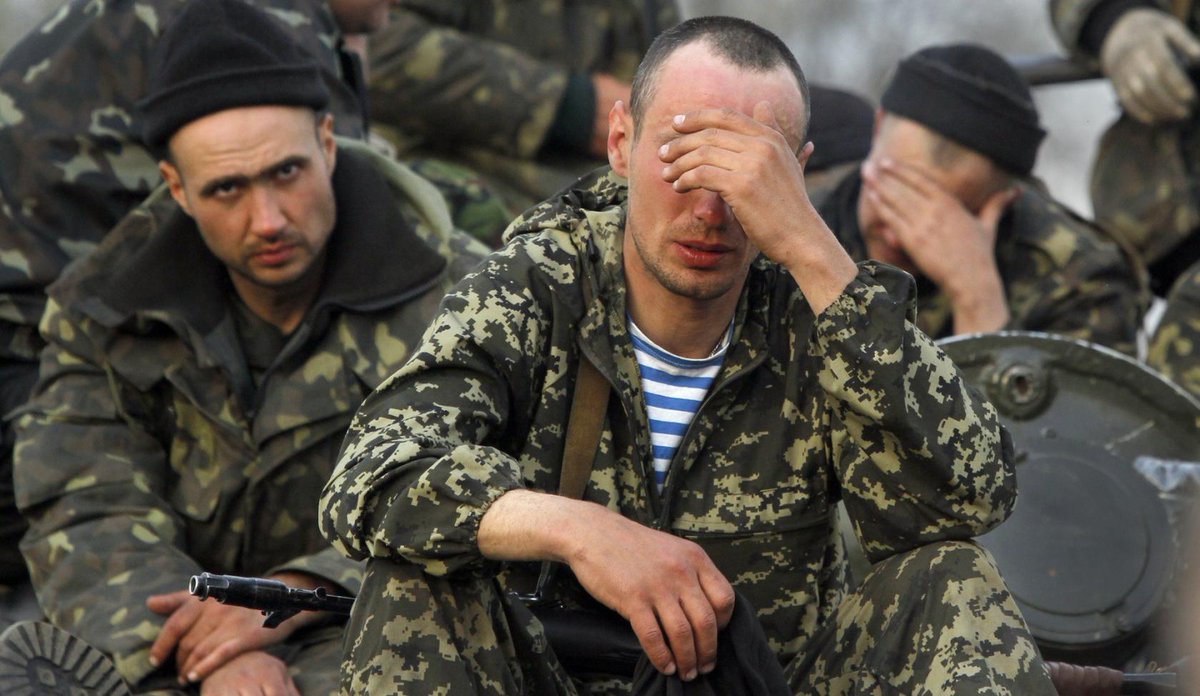
1/ Mobilised Russian soldiers from the Moscow region have described the extreme conditions they face around Avdiivka in eastern Ukraine, with men scavenging for food, drinking corpse-contaminated water, and living and fighting amongst piles of rotting unburied bodies. ⬇️ 

2/ The men's experiences have previously been highlighted in videos recorded by the men themselves, in which they appeal to Putin to reassign them:
https://twitter.com/wartranslated/status/1634860992973660160
3/ And by their relatives, appealing in vain for Putin to return their men from the slaughter:
https://twitter.com/ChrisO_wiki/status/1631940640110985216
4/ Many of the men died in repeated failed assaults against heavily fortified Ukrainian positions near Avdiivka. However, some of the survivors got back to Russia and told their stories to their relatives, describing the World War I-style conditions that they experienced.
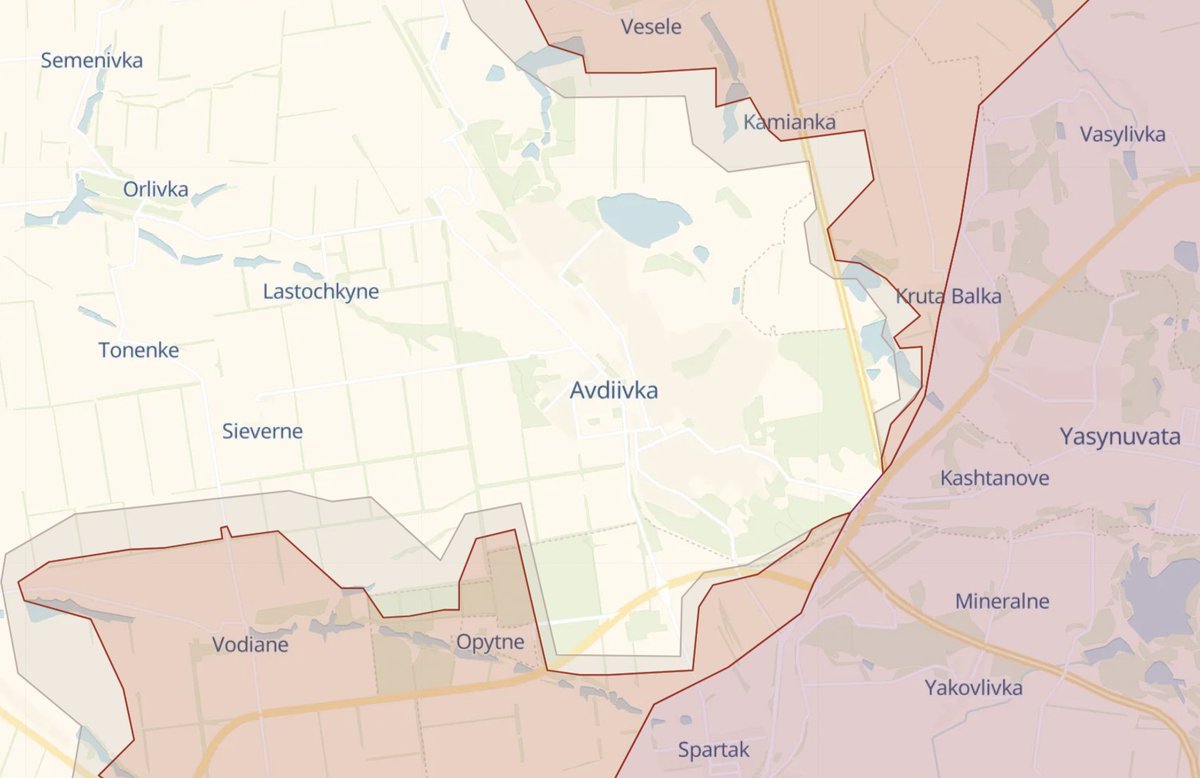
5/ The Moscow region men were part of the first wave of mobilisation, in September 2022. They were designated to serve as artillerymen and were sent to the Serpukhov Military Academy south of Moscow, where they studied gunnery for three months.

6/ In December 2022, the men were sent to the 'Donetsk People's Republic' (DNR), where they spent two months waiting for their artillery pieces. They were not even fed – "we did not eat or drink. There was no food, we had to buy everything ourselves." The weapons never turned up.
7/ The men were transferred to the DNR People's Militia on 1 March 2023 – in their own words, their army commanders "sold them to the DNR". The commanders said it was only for a month to give them some combat experience and that they wouldn't go to he front line.
8/ The three howitzer batteries were reorganised into 50-man companies and assault groups were formed from the mobilised men, despite their lack of infantry training. They were mingled with forcibly mobilised convicts from the DNR who were of very variable fighting quality.
9/ "Half of them are normal, half are inadequate," says the wife of one of the Moscow mobiks concerning the DNR convicts. "But my husband got some good ones. Sasha told them thanks for showing him how to [fight]. The commanders were not involved."
10/ On the night of 9-10 March, the men were given three days' worth of food and water and sent to the front line near Avdiivka. They were ordered to capture a Ukrainian-held piece of territory, but the operation turned into a bloody exercise in futility.
11/ "It was impossible to capture anything there," says another wife. "On our side were guys with submachine guns, in small groups of 15 to 45 people. And on the other side there was artillery. What can one do with a submachine gun against a tank?"
12/ The men made no progress in the attempted offensive and spent 12 days, rather than the planned 3, on the front line. "They sat in a trench and didn't even fire a single shot. There were only convicts and mobiks in the trench. Who cares about them, in short."
13/ "Everything is shot at there: you put your hand out of a trench and you are already without an arm. One guy from Dmitrov got his arm shot off like that when he stuck it out of a trench. Another one got hit by a tank, his head flew off. There was nothing left to collect".
14/ The soldiers say they had no artillery or reconnaissance support. "A lot of guys died, they were lost very stupidly. As my husband said, you can't beat a mortar shell with a helmet."
https://twitter.com/i/status/1638222876057673745/video/1
15/ They also had no food or water after the third day and had to scavenge both to stay alive. "When they ran out of food, they had to climb into the cellars of abandoned houses," says a wife. "They ate pickled cucumbers and tomatoes they found there."
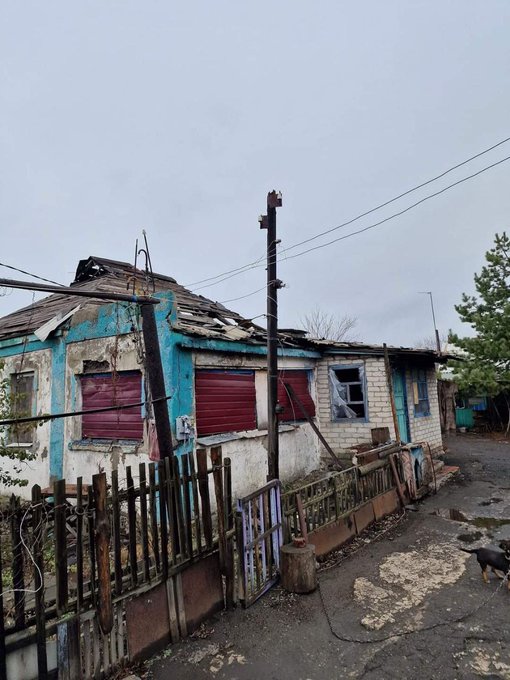
16/ The men drank water from a well where two corpses were floating, as there was nothing else to drink. "They defined it this way: if the water is salty, it means someone is swimming there".
17/ Requests to evacuate the seriously wounded were ignored – likely leading to many unnecessary deaths. (Similar complaints have been made before about the DNR forces refusing to evacuate wounded Russians.)
https://twitter.com/ChrisO_wiki/status/1634304214313648128
18/ Tensions with DNR commanders are also evident from the men's accounts. "The DNR commanders say: 'We have conquered our own [territory], our men have all died. Now our men will sit and you will fight. It's your war, it's not our war."
19/ Corpses piled up around the Russians. "At night you change your position, you run. You lie down to take cover, and there lies a corpse, black already. They are at every turn. The convicts clean them out. They take off their clothes, armour, take things out of their pockets."
20/ It took months for the bodies of the fallen, lying in the open, to be recovered. According to one soldier, men killed in November were only removed in March. "They were wrapped in bags and taken away in cars. Our guys fought literally surrounded by corpses.
21/ "If possible, the dead were stacked in a forest belt and covered so that dogs and rats wouldn't eat them. One guy was killed by a drone; his body was taken to an abandoned school building. He's probably still lying there."
22/ The soldiers' orders seem to have had no regard for the safety of civilians living near the front line. One soldier says that their orders were that before entering a Ukrainian house, you had to throw a grenade and fire a shotgun round inside. But he claims they refused.
23/ "Our people didn't do that. Once we opened the door and there was a family with a child inside. They are civilians. Well, we violated the order and took the people out at night. Because they are human beings."
24/ Despite their predicament, the men still made time for looting in the apparent hope of being able to take 'souvenirs' home. "They take televisions and household appliances from abandoned houses and put them all in empty houses," says a wife.
25/ On 22 March, the mobiks abandoned their positions and retreated, leaving the DNR convicts in the trenches. "The Donetsk convicts were there and they said: 'Go away. We understand why we are here. We can't go back - our own people will shoot us. What are you here for?"
26/ By this time they had sustained about 35% casualties in only 12 days. The dead were buried in a trench and the seriously wounded were left behind. The retreating mobiks had to cross open ground under fire, but were provided with covering fire by the DNR convicts.
27/ The mobiks "moved by running, occasionally rolling to the side of the road into the bushes, then climbing up and running again, bouncing back, running again," before finally making it back to their headquarters.
28/ A wife says that "at the headquarters they called them cowards. This is the level of insanity." After an interrogation, the platoon leaders were immediately taken to the military commandant's office and arrested. The other men were taken away and detained.
29/ More artillery-trained mobiks were sent in to replace the men who had retreated. They took part in a fresh assault during the week after 22 March, which was equally unsuccessful. "The only survivors were those who came back from the first battle wounded and went to hospital."
30/ Each artillery battery had about 50 people in it. Of those in the battery that went into battle after 22 March, the wife of one soldier says, "within three weeks, four men ... were left in the ranks" – a 92% casualty rate. The rest were all listed as missing rather than dead.
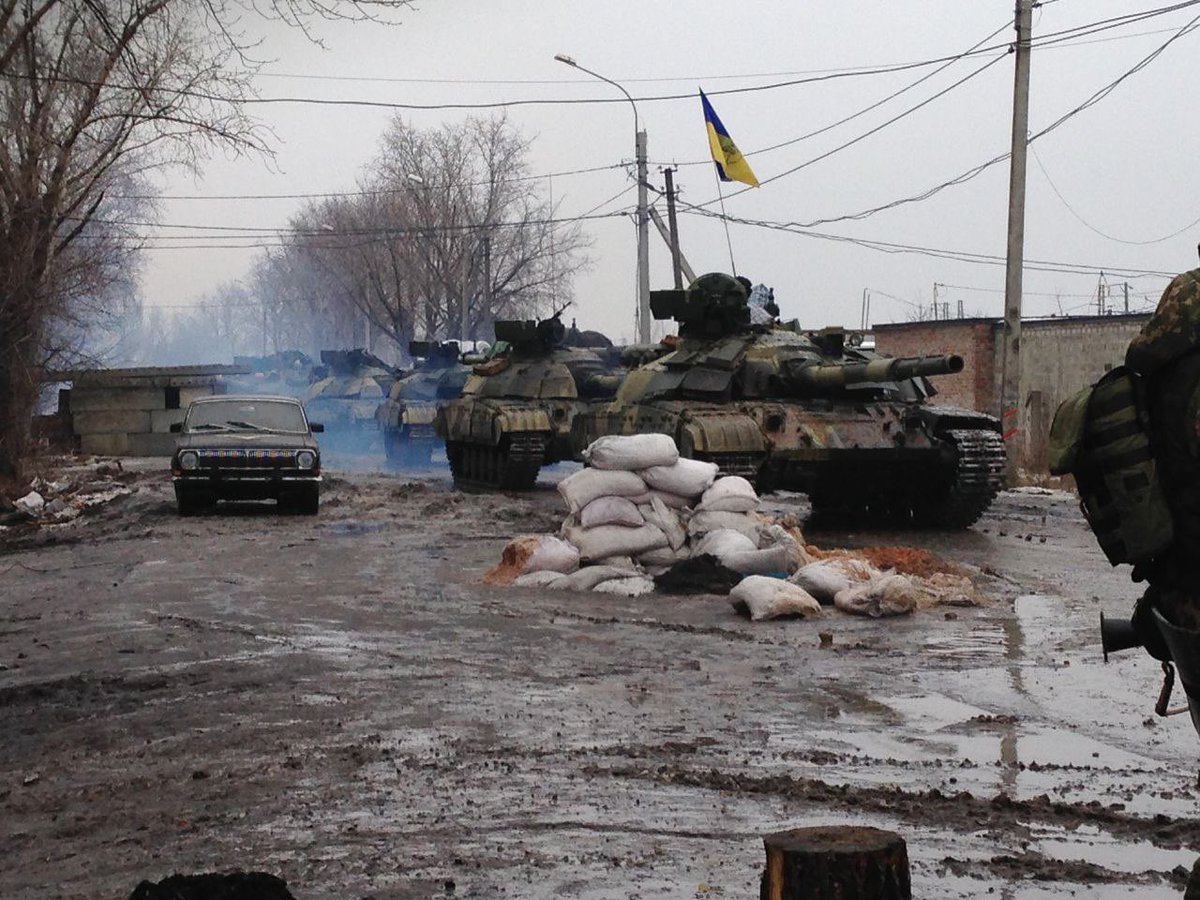
31/ In April, the Ukrainians completely destroyed the Russian front line. "The tanks flattened the houses to the ground. Some of the guys stayed there. Apparently, some are alive, some are not. One girl received a telephone call from her husband in the basement.
32/ "He said a friend was sitting nearby, he was shell-shocked and did not understand what was happening. He told her they had no food or water."
The men's relatives are lobbying for their return. "We now have two tasks: to take out those who are alive and to take out the dead.
The men's relatives are lobbying for their return. "We now have two tasks: to take out those who are alive and to take out the dead.
33/ "Our men are followed by other mobilised people. They are sent there in exactly the same way, and exactly the same way they will lie down there. It's an endless meat grinder."
34/ However, their appeals to the Russian government have gone nowhere; all the paperwork is forwarded to the DNR and disappears into a bureaucratic void. "Everywhere I was told that my husband was assigned to the second howitzer battery," says a wife.
35/ "Officially, there is no paperwork that they were assigned to the DNR regiment, it's all based on some verbal orders. It is impossible to prove anything, but the guys keep being sent to assaults. It's unclear why they're being sent to certain death."
36/ Even seriously wounded men are being sent back to the fighting without being treated. In an assault on 15 April, five of ten men from one company were wounded and two were killed; only three were left uninjured. One of the injured was taken to hospital with shrapnel wounds.
37/ He has been unable to get an operation to remove the shrapnel from his body. His sister says: "They told us: if it gets in the way, then you take it out. Their attitude is that they don't care whether he dies with or without shrapnel. They send the shrapnel survivors back."

38/ After the publication of the men's videos caused a controversy, some of them were allowed to take leave on condition that they return to the front line. Despite their terrible experiences, at least some of them remain motivated and willing to keep fighting.
39/ One man's wife says that her husband "is very responsible, he has a heightened sense of justice. He also said during his leave that he was going back to die, as he could not survive in such conditions. He will not allow any of his comrades to die while he sits on his ass.
40/ "They are like brothers among themselves, even closer than family."
She is now deeply disillusioned about the war. "Why do we need this war?", she asks. "Is this our territory? We don't need it! No one needs it.
She is now deeply disillusioned about the war. "Why do we need this war?", she asks. "Is this our territory? We don't need it! No one needs it.
41/ "Our men wanted to help, they went like normal people, no one went into hiding. They went for their country, thinking that the enemy is attacking us. That the enemy is at our borders, that we are defending our country. As our propaganda says, everywhere and everywhere.
42/ So people give their lives for no one knows who. And the DNRites do not give them up at all. There is a part of the population there, the old school, who remember that it was a united country. And the young people are zombified and think that our people made this war.
43/ I conclude that all our government knows about this lawlessness and turns a blind eye. And the guys continue to die for nothing, for no one". /end
Source:
baikal-journal.ru/2023/05/08/u-n…
Source:
baikal-journal.ru/2023/05/08/u-n…
• • •
Missing some Tweet in this thread? You can try to
force a refresh