PHYS003: Fission bomb design & history
In this short thread, we're going to learn about "critical mass", timing circuits and with them, we'll combine what we learn in PHYS001 & PHYS002 to learn how the ultimate weapon was created:
The nuclear bomb!
Let's discuss how it works too!
In this short thread, we're going to learn about "critical mass", timing circuits and with them, we'll combine what we learn in PHYS001 & PHYS002 to learn how the ultimate weapon was created:
The nuclear bomb!
Let's discuss how it works too!


In the previous instalment, we learnt about conventional bomb design and the importance of casing, timing and symmetry.
As it were, this is even *more* important for nuclear bombs. But keep it in mind as well as the principle of fission as we move forward.
As it were, this is even *more* important for nuclear bombs. But keep it in mind as well as the principle of fission as we move forward.
https://twitter.com/cirnosad/status/1659806111296536576
Nuclear fission is a chain reaction, but it exhibits an interesting phenomenon. For each type of reaction (slow, fast neutron etc.),there is a probability of the reaction taking place. We call the total reaction rate area as the "cross-section".
Every atom/reactant pair has one!
Every atom/reactant pair has one!

Just like decay rate, lifetimes of daughter particles and time to fission, there is no physics model that predicts cross-sections.
They MUST be measured experimentally, across all energies and relative velocities of incoming neutrons.
Apparatus used is out of our current scope.
They MUST be measured experimentally, across all energies and relative velocities of incoming neutrons.
Apparatus used is out of our current scope.


[Aside: You'll note, there are resonances and different cross-sections depending on whether you want fission or capture. This can be exploited, for example, to filter out neutrons from a neutron source that aren't of a certain energy.]
[Aside: accurate cross-sections are secret.]
[Aside: accurate cross-sections are secret.]

Let's look at the fission cross-sections of Plutonium-239 and Uranium-235. We can note some things:
* Uranium "prefers" slow ("thermal") neutrons.
* Plutonium "prefers" neutrons of a certain energy.
* Plutonium has a higher fission probability (cross-section) than Uranium.
* Uranium "prefers" slow ("thermal") neutrons.
* Plutonium "prefers" neutrons of a certain energy.
* Plutonium has a higher fission probability (cross-section) than Uranium.

These cross-sections are still relatively small compared to the very high probability of a reaction in a chemical explosives.
Neutrons can actually move some distance away from the fissile material without reacting.
Each materials also generate a different average # of neutrons!
Neutrons can actually move some distance away from the fissile material without reacting.
Each materials also generate a different average # of neutrons!

When the total number of neutrons escaping our fissile material ("pit") is equal to the fission event neutrons generated inside, we call this a "critical mass".
We are in fact interested more in a super-critical mass because it means generating exponentially more energy!
We are in fact interested more in a super-critical mass because it means generating exponentially more energy!

In summary, each fissile material has a fission cross-section, and if shaped as a sphere, each material under normal atmospheric conditions has a certain critical mass requirement to undergo a sustained chain reaction.
You need ~5 times more Uranium than Plutonium.
You need ~5 times more Uranium than Plutonium.

Great, so let's just get a critical mass going... oh wait. That's not a very good idea is it?
Of course not, baka! It'll produce a huge amount of radiation or may even explode the moment it gets a neutron event. Not like a nuke but enough to kill, wound and sicken you.
Of course not, baka! It'll produce a huge amount of radiation or may even explode the moment it gets a neutron event. Not like a nuke but enough to kill, wound and sicken you.

We conclude that it's important to keep the fissile material as a sub-critical mass, until we want to detonate the bomb.
Also, just like the chemical explosive, conservation of momentum will tend to want to blow the critical mass apart -- stopping the reaction.
We need a casing.
Also, just like the chemical explosive, conservation of momentum will tend to want to blow the critical mass apart -- stopping the reaction.
We need a casing.
The most primitive design takes the above experiment and puts it into a chamber. This is known as a "gun-type" assembly and was dropped on Hiroshima.
It was inefficient, produced lots of fall out, as most of the material didn't undergo fission before it blew through its casing.
It was inefficient, produced lots of fall out, as most of the material didn't undergo fission before it blew through its casing.

A far better design was the very first one detonated: The implosion type design. A sub-critical mass and neutron source (initiator) are surrounded by electronically detonated explosives.
With precise timing, all charges detonate, compression the material into super-critical mass.
With precise timing, all charges detonate, compression the material into super-critical mass.


The higher compression meant the effective critical mass was lower than required. In fact, Fat Man used 6.4kg, not the 10kg required at normal pressures as a result.
The precision timed deformation and strong casing (bomb weighted 6 tons) itself caused the super-criticality.
The precision timed deformation and strong casing (bomb weighted 6 tons) itself caused the super-criticality.

The casing/assembly keeps the detonation focused on the fission material, generating a huge shockwave internally, imploding. This creates a critical mass which then more rapidly undergoes fission.
Thus, this nuclear bomb is essentially an amplifier of a chemical explosive!
BOOM!
Thus, this nuclear bomb is essentially an amplifier of a chemical explosive!
BOOM!

It is important to note the presence of a Uranium-238 casing around the plutonium. This acts as an "inner-casing", holding the supercritical mass together.
It also provides it with fast neutrons, and reflects the fission generated neutrons back, creating a smaller critical mass!
It also provides it with fast neutrons, and reflects the fission generated neutrons back, creating a smaller critical mass!

This is known as a "tamper" and it is very important in nuclear weapon design. This "neutron reflector" demonstrates how efficiency can be increased using static material in a clever manner.
Note also, "merely" a change in geometry caused this massive nuclear explosion to happen.
Note also, "merely" a change in geometry caused this massive nuclear explosion to happen.

What happens to the energy produced by the nuke? It depends on the surrounding material.
In air, the energy is absorbed by the atmosphere. This strips them of electrons, creating a plasma. This extremely hot plasma expands, creating a deadly shockwave!
In air, the energy is absorbed by the atmosphere. This strips them of electrons, creating a plasma. This extremely hot plasma expands, creating a deadly shockwave!
It also produces thermal energy (heat), x-rays (same thing as heat but higher energy/frequency) and residual radiation in the form of short-lived isotopes/fallout.
The latter is either desirable if vou want to render an area uninhabitable or undesirable if you don't.
The latter is either desirable if vou want to render an area uninhabitable or undesirable if you don't.
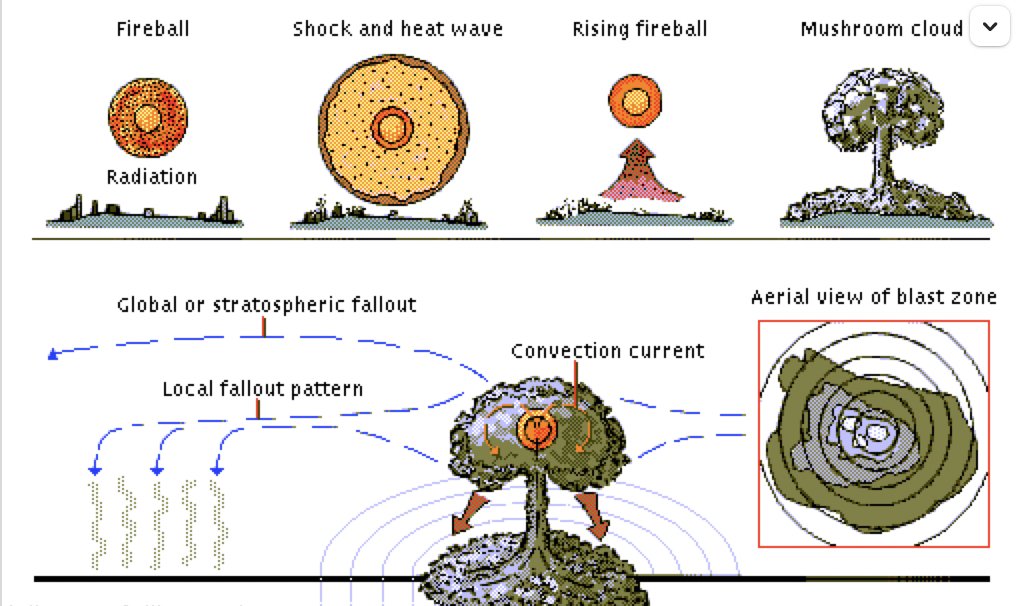
Distinctive to nukes is the creation of a plasma, which is also centred on a point.
You see, a chemical explosion can never do this, the energy produced can only ionise a small percentage of atoms. Most of what's generated is heat and a shockwave!
[Aside: Plasmas carry charge!]
You see, a chemical explosion can never do this, the energy produced can only ionise a small percentage of atoms. Most of what's generated is heat and a shockwave!
[Aside: Plasmas carry charge!]


Another tell, everyone knows hot air rises due to buoyancy... but there's a limit as it will encounter more and more cold and lower pressure air as it does.
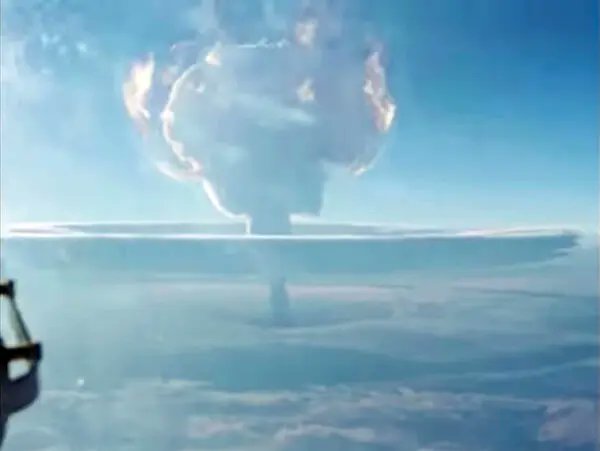
Due to the extreme temperatures involved, nuclear bombs will create mushroom clouds that rise rapidly and to a tall height!
Due to the extreme temperatures involved, nuclear bombs will create mushroom clouds that rise rapidly and to a tall height!

They are also far less susceptible to wind, drift and the smoke is generated mostly below the luminous parts, not mostly above as combustion particles.
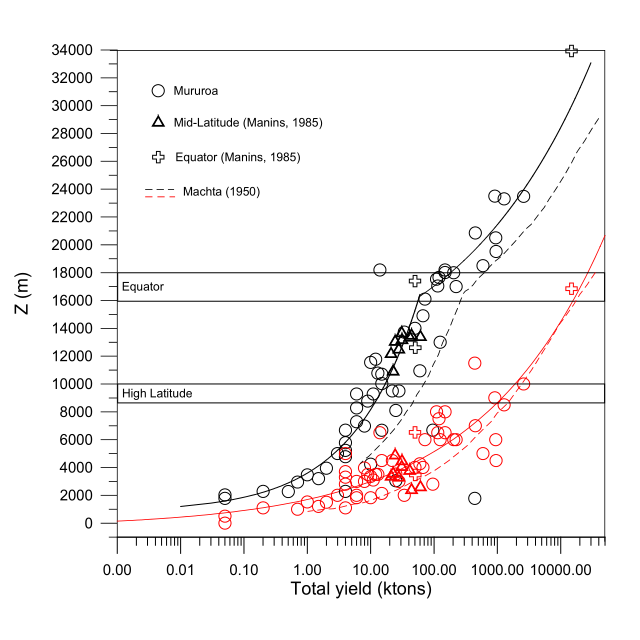
[As shown above, the cloud isn't just fascinating, we can in fact estimate the yield of a nuclear explosion by its height!]
[As shown above, the cloud isn't just fascinating, we can in fact estimate the yield of a nuclear explosion by its height!]

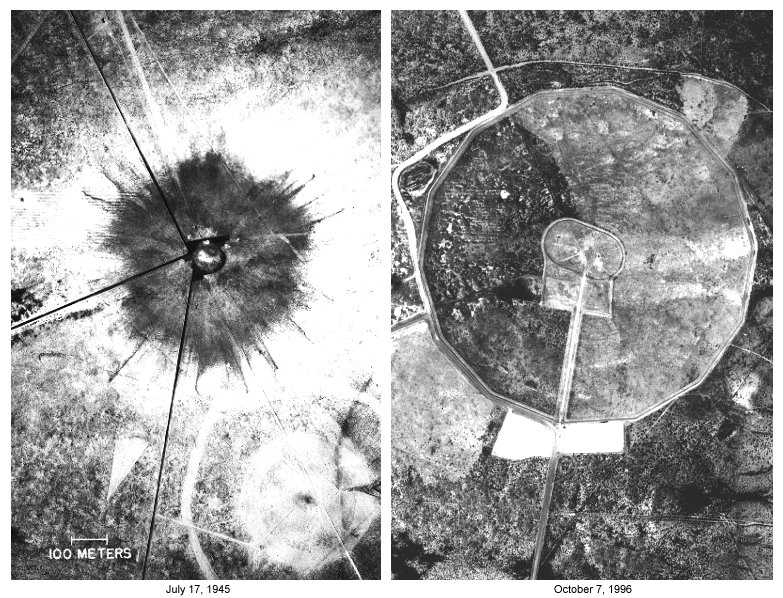
There is another important distinction due to creation of a plasma: The explosion, depending on its height, through both the action of the shockwave and the plasma, will create a large crater and crack/ pulverise the soil around ground zero.
Site access is a must for assessment!
Site access is a must for assessment!
Depending on the yield and either surface depth or elevation of the nuclear explosion, the soil can also remain hot for a lot longer than a conventional explosion, which only reaches ~3000-4000 deg C in the very initial phase.
Nukes reach tens of millions of degrees with ease.
Nukes reach tens of millions of degrees with ease.

That's it for PHYS003! Key take aways:
Nuclear bombs do not detonate on their own, require precise timing of explosives.
Critical mass is not an intrinsic figure to a material but a result of environmental conditions and geometry, cross-section.
Next PHYS004: Fusion bombs + more!
Nuclear bombs do not detonate on their own, require precise timing of explosives.
Critical mass is not an intrinsic figure to a material but a result of environmental conditions and geometry, cross-section.
Next PHYS004: Fusion bombs + more!

Of* a material
• • •
Missing some Tweet in this thread? You can try to
force a refresh