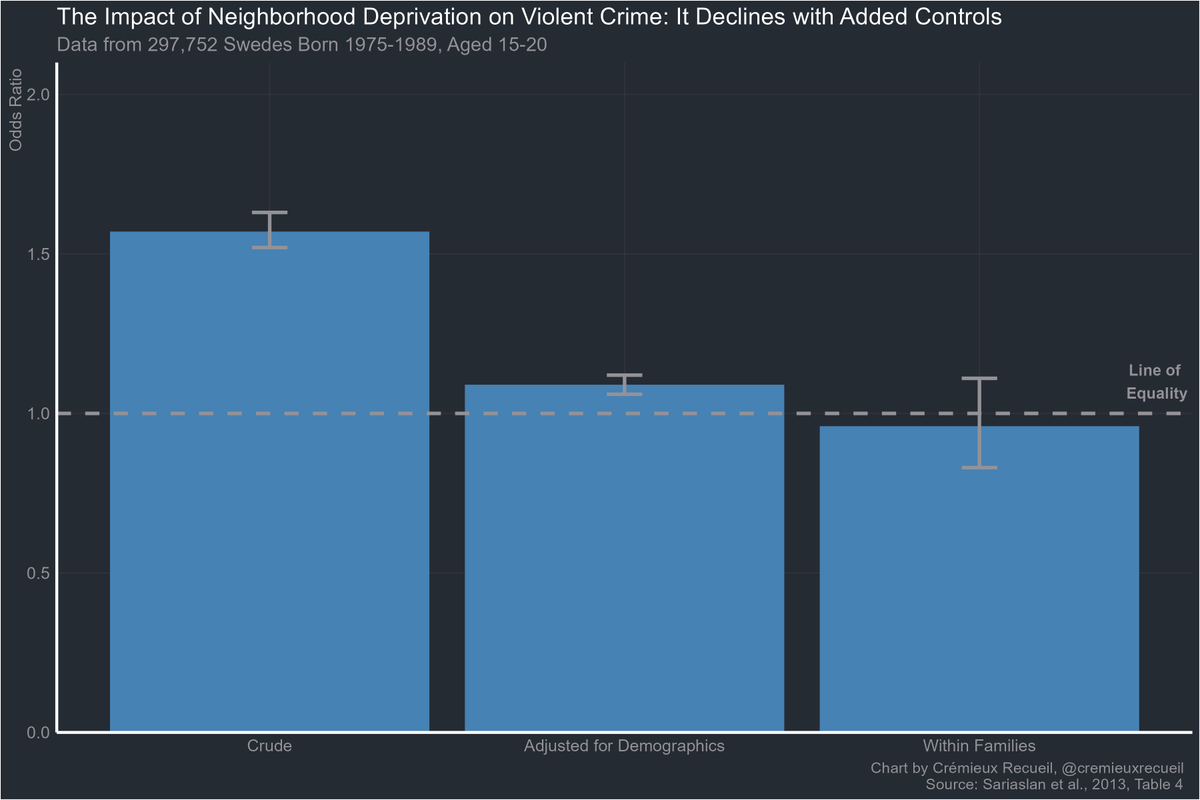
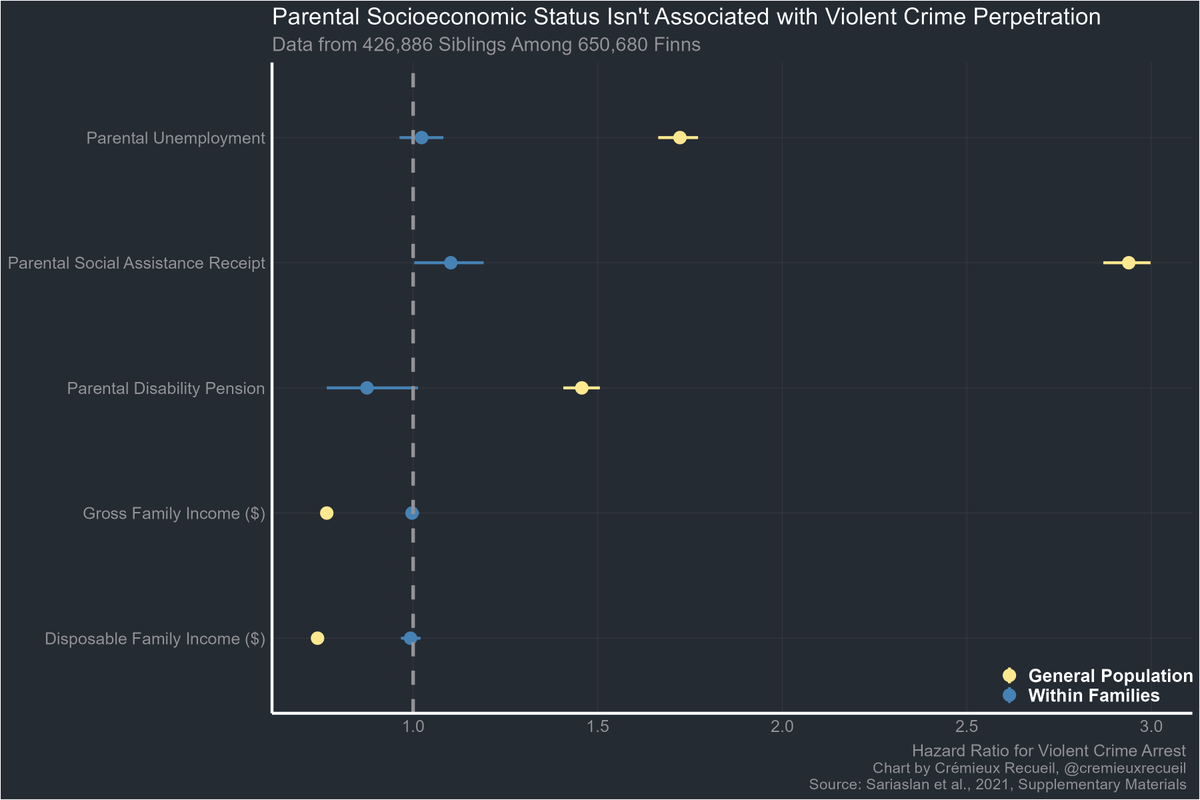
"[Scholars] argued... poor structural factors—poverty, ethnic heterogeneity, population mobility—cause crime.... Our first lesson is that the relationship between structural factors and crime may be spurious."
Yes. Neighborhood deprivation does not appear to cause violent crime.
But sometimes you get something like the publication bias pattern with data where
- Preregistration is required
- Reporting is required
- Analyses are evaluator-independent
- Samples are realistic
Ed studies that received grants from the Education Endowment Foundation and the
National Center for Educational Evaluation have those requirements. For realistic sampling, the NCEE imposes the requirement and the EEF only uses it for categorization.
The results for these agencies do seem to show larger effects -> larger SEs: the classic pattern
American researchers are really only getting huge Census data recently, whereas Scandinavians and Dutchmen have been using theirs for a while.
Americans can learn a lot from the excellent reporting practices that seem to be common with Scandinavian register study researchers.
Causal inference can be done in the same ways on the data from these places, but if you perform the same analyses and you don't report your results clearly enough to interpret them or use the provided statistics so the results can be qualified, your results are almost useless.
With Chetty, I know he can do good reporting. In fact, I've seen it! I also know that in his most popular papers, his reporting is undergraduate-quality and he knows better. I don't know why this happens; he is so clearly brilliant and when he wants to, he can do some of the best
A new NBER preprint by @brittanyrstreet and @Econ_Mike includes one of the first U.S. sibling control estimates of the effects of neighborhoods on kids'
- crime
- employment
- teen parenthood
- death
But we don't know the descriptives, so it's unclear how to interpret coefs!
For criminal charges by age 26, the coefs are all null within sibling pairs, but they're also similar in size or larger than the other results, which do not appear to just be between-pair ones
Suggestive: maybe no effect, or at least not one that's large enough to show up in 99k
pairs? individuals? It's not clear what the observation number refers to, but I would really like to find out so I can at least figure out the power with different possible variances.
For W2 employment, there's a possible effect with young exposures. It's not clear how large
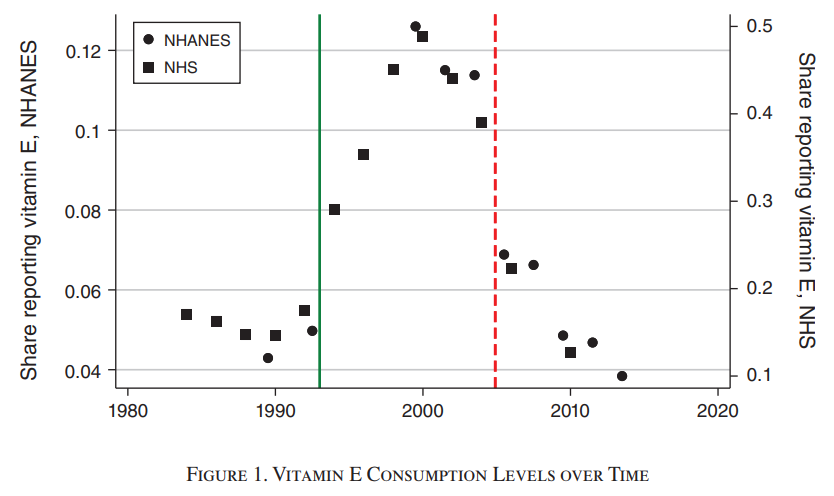
She exploited the fact that a NEJM piece published in 1993 showed vitamin E had major health benefits and another article published in 2004 showed that vitamin E's benefits were overstated and it might actually be harmful. twitter.com/i/web/status/1…
Not everyone jumped on board the vitamin E train.
In fact, it was educated, high-income people who exercise, don't smoke, and have good diets who jumped aboard.
The effect on the relationship between vitamin E consumption and heart health was that the newly-introduced, highly selective uptick in vitamin E consumption created a correlation between vitamin E consumption and heart health and bolstered one with mortality risk.
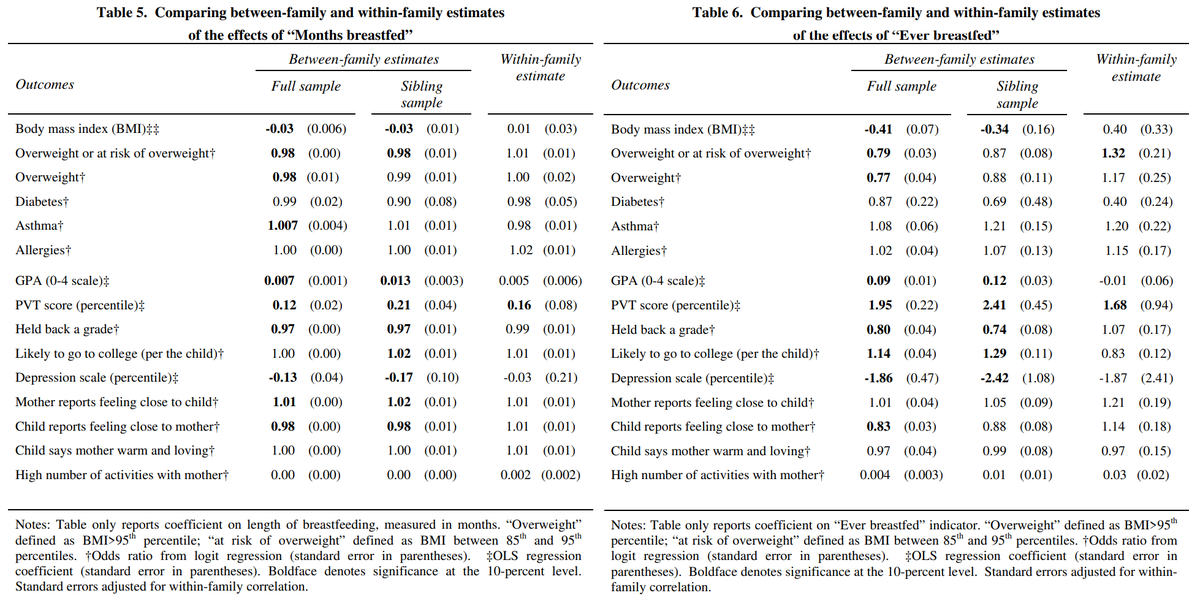
The argument that breastfeeding has major benefits is based on little evidence and the continued insistence it matters so much does little more than shame women who struggle to breastfeed.
But you may object, we need replications. I agree. There was a replication of Der, Batty & Deary's result (bmj.com/content/333/75…).
The replication by Evenhouse & Reilly was an almost-explicit fishing expedition where they just tested the sibling control effect on everything.
They ended up finding a p = 0.04 effect on Peabody score using the variable "Months Breastfed" and a p = 0.07 for "Ever Breastfed".
There was no correction for the multiple comparisons they sought to engage in, so obviously this is a nothingburger (ncbi.nlm.nih.gov/pmc/articles/P…).