Patricia Marins Profile picture
May 31, 2023 14 tweets 4 min read Read on X
🧵1/9
Kinzhal and Iskander missiles, something similar, but different.

Both missiles reach hypersonic speed, it means above mach 5.
The Kinzhal is air launched, while the Iskander has ground launchers.

But there is a big difference between them: the flight altitude.
Image
Image
2/9
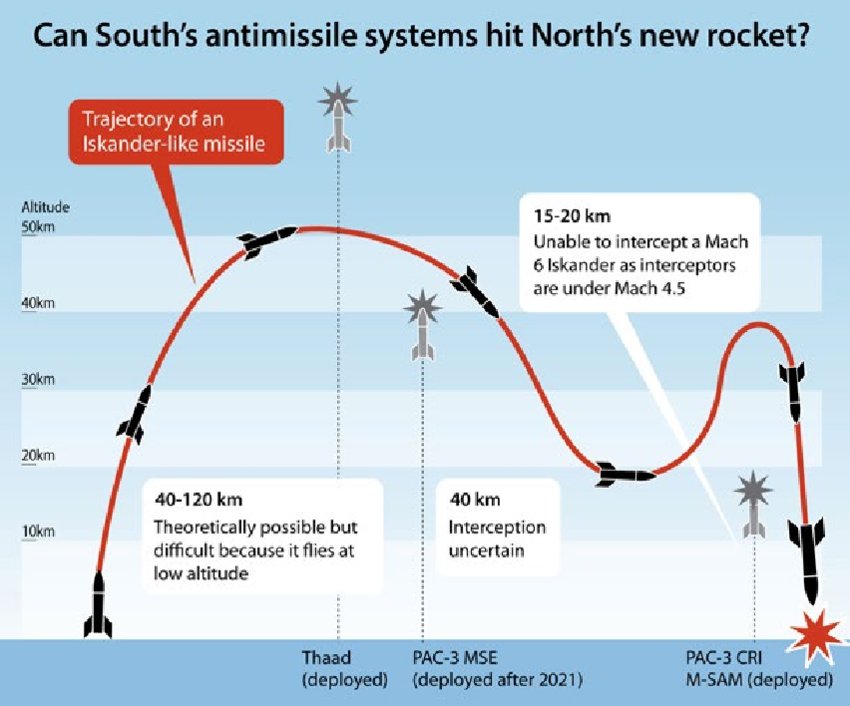
While the Kinzhal is launched at 20km altitude and keep it's flight maneuvering at that zone, the Iskander fly at 40-50km altitude. It makes the missiles completely different and in distinct levels of interceptions.
E.g the Pac-3 has 35km altitude range; Pac-2 (24km) alt. Image
3/9
Is true that the whole flight of a Kinzhal can be tracked by a Patriot Pac-2/Pac-3, and the system analyze it's maneuvers, creating a prediction, but the same can't be done against a Iskander, which can be seen only when the missile directly downards to the target.
4/9
For a Pac-3 it means 35km, or 13-15 seconds considering the speed 2-2.8km/s.
The Pac-3 has 7 seconds of reaction time. So, would left 7-8 to reach the target, counting the flying time. It's really short time because we don't know the distance from the launcher to the target.
5/9
And we are talking about a target maneuvering and releasing decoys.
It's why the Iskander is much more dangerous than a Kinzhal.

The Iskander:

The flight lasts up to 6 min/ distance of 575 km, which is due to the fact that the Iskander maintains Mach 7 in the middle phase. Image
6/9

It doesn't maneuver during the boost phase because leads to a loss of speed, and the control of the rocket is based on programmable control over the entire length of the flight and self-guidance using the proportional navigation method only in the terminal phase.
7/9
The midcourse phase is a transition period where the rocket moves mainly in a ballistic trajectory.
The maneuvers there do not significantly change the trajectory of the flight in the midcourse phase, but it is enough to change the projectile's range by up to 50 km. Image
8/9
The Iskander achieves its greatest maneuverability in the terminal phase, where aerodynamic control is used.

This phase is the period when the missile returns to the denser parts of the atmosphere, which allows it to maneuver using aerodynamic forces and loss of speed. Image
9/9
During the flight, it uses gyros, accelerometers and the GPS module, etc.
During the terminal phase, it changes and the optoelectronic or radar head on board the rocket compares digital maps of the terrain surface with the real image of the terrain, correcting its trajectory.
Note:
The best chances against this kind of missile is if the launcher is <5 sec distance to the target.
During it's terminal phase, depending of the maneuvers, it loss speed, but due to the short time to predictions and still a high speed, the interception remain at a low rate.
Note 2:
Can a Pac-2 Gem intercept a Iskander? Obviously yes, but it's more rare. And an Iris-T SLM? Less chances.

Actually the AD layers in Ukraine put the Pac-3 as the first choice for ballistic missiles in general. The other systems are for cruise and the last layer for drones
Note 3
How many RU has?
Before the war they were manufacturing 60 yearly, but now I think they can reach 80-90 if they solve the INS.
The navigation for this missile had imported components, but recently some monopolies were broken and maybe they solved this problem. Or MAYBE not
Note 4
The Iskander is the most dangerous Russian missile. Later the Kalibr due to it multi speed.
Untill the allies bring a 360 GAN Radar into a ICBS, the Iskander keep being extremely dangerous, and with few true cases of interceptions, differently from the propaganda.
Note 5:
The Ukrainian Grom 2 is similar to the Iskander, but smaller. Months ago the Russian MoD accuse Ukraine of using the Grom 2. For me the Grom 2 was the response for the attack on Crimes bridge. The only thing able to by pass all the ADs on the way.

• • •

Missing some Tweet in this thread? You can try to force a refresh

 

Keep Current with Patricia Marins

Patricia Marins Profile picture

Stay in touch and get notified when new unrolls are available from this author!

Read all threads

This Thread may be Removed Anytime!

PDF

Twitter may remove this content at anytime! Save it as PDF for later use!

Try unrolling a thread yourself!

how to unroll video
  1. Follow @ThreadReaderApp to mention us!

  2. From a Twitter thread mention us with a keyword "unroll"
@threadreaderapp unroll

Practice here first or read more on our help page!

More from @pati_marins64

Feb 10
China Intensifies Support for Iran and Could Change the Game

After sending a Type 055 destroyer and a Type 052 to the Sea of Oman region to escort the Ocean No. 1 intelligence ship, the Chinese are stepping up intelligence support to Iran.

The Ocean No. 1 is likely monitoring all movements of U.S. Navy ships and submarines and passing the information to Iran. But in an increasingly bold move, the Chinese are photographing U.S. bases and making the photos public, and this time they photographed a newly installed THAAD battery and posted the images with location data online.

Many people, including me, see this as a sign that the Chinese will not hesitate to provide full support to Iran, which appears to have turned to the Chinese after realizing that Russia’s ties with Israel were limiting the desired support.

With two modern destroyers and the Ocean No. 1 in the region providing data to Iran, there is no chance of a surprise attack, making a zero-casualty strike even more difficult for US-Israel.

Today alone, multiple Iranian facilities were hit by explosions, bringing the total to more than ten successful sabotage operations against the Iranian government in just the last ten days, including military targets.

Yes, I’m raising the hypothesis that the Chinese are giving Iran something similar to what they gave Pakistan in the last conflict with India, even though they deny it.

The Chinese support obviously goes beyond radars, which they know were easy targets last June. Those flights from China to Iran in the last two months, sometimes multiple times a day, didn’t have the capacity to carry anti-aircraft batteries, but they certainly had the capacity to carry a lot of integration equipment, including for ground BeiDou stations.

It seems to me that after Iran migrated almost its entire arsenal to BeiDou and acquired more Chinese radas, they are either already operating or planning to operate something similar to Pakistan’s Link 17.
If this happens, it would mean the Chinese are directly involved in target acquisition for the Iranians, completely preventing the kind of blackout that occurred last June.

That would be a game-changer almost impossible to overcome at this moment.

Iran’s C4ISR capabilities have received major investment in the last seven months, and China’s release of photos of U.S. bases clearly shows they intend to supply Iran with as much intelligence as possible.Image
The Ocean No. 1 is China's first modern, comprehensive oceanographic research vessel, launched for deep-sea scientific exploration.

It is equipped with advanced seabed imaging and mapping systems, as well as extensive capabilities for collecting environmental data over wide ranges.

Here, I’ll put forward my own hypothesis: the ship is also capable of functioning in a way very similar to the American RC-135 aircraft.

With the sensors the Chinese have at their disposal, it can capture electronic emissions (RF, radar, communications) from nearby ships and aircraft, including COMINT (communications intelligence) and ELINT (electronic intelligence on non-communication signals).

This vessel is much more than a research platform, and the proof is that it has been sent to an area of imminent conflict, closely monitoring U.S. naval forces in the Arabian Sea.

Both the positions of the American fleet, including submarines, and their communications could be intercepted and relayed to Iran.
The first image was of the Patriots. Yeah, the Chinese also exposed the patriots online. Now this one is of the THAAD systems Image
Read 6 tweets
Jan 25
Billions in Arms, Training, and Diplomacy: How China and U.S Bought Pol Pot's Impunity for the Deadliest Genocide of the Century

The Khmer Rouge, led by Pol Pot, ruled Cambodia from 1975 to 1979, imposing one of the most brutal dictatorships in modern history.
The result was a genocide that killed between 1.7 and 2 million people, approximately 21–25% of the country’s population of 7.5-8 million, through executions, starvation, disease, and forced labor.

The violence was systematic and ideological. Immediately after seizing power, the Khmer Rouge forcibly evacuated cities, marching millions into the countryside in what became known as death marches. Any sign of education, wearing glasses, speaking foreign languages, or having a professional occupation, was grounds for investigation and summary execution.

Specific ethnic and religious groups were targeted, including ethnic Vietnamese, Cham Muslims, ethnic Chinese, and Buddhist monks.

Torture centers like Tuol Sleng (S-21) in Phnom Penh became symbols of the regime’s terror: between 14,000 and 20,000 prisoners passed through it, with only about a dozen survivors.

Torture methods, as whips, electric shocks, waterboarding, nail extraction, and starvation were used to extract absurd “confessions” of treason, often claiming victims were CIA or KGB agents.

After producing detailed and fabricated confessions, prisoners were executed with blows to the neck to conserve bullets.

The regime finally collapsed when Vietnam invaded Cambodia in 1979 and overthrew the Khmer Rouge.

Yet, in an absurd twist, after being driven from power, the Khmer Rouge survived as a guerrilla force for nearly two decades and received substantial international support.

China was the primary backer, providing billions of dollars in weapons, tanks, military training, and advisors.

The United States, providing financial aid to the Khmer Rouge itself, also imposed sanctions on Vietnam, and supported keeping the Pol Pot coalition’s diplomatic seat at the United Nations until 1993.

Other countries also contributed:
the United Kingdom trained some Pol Pot guerrilla, Singapore supplied arms, and Thailand provided border bases, training camps, and facilitated illegal trade in timber and gems that generated millions for the guerrillas.
European nations were divided but generally voted in line with the U.S. at the UN.

Romania was the only Warsaw Pact country to condemn the Vietnamese invasion and openly support the Khmer Rouge guerrilla. Other ASEAN members offered logistical assistance to the Pol Pot coalition.

The guerrilla war dragged on until the late 1990s, allowing Pol Pot, the century’s most prolific genocida, to die in 1998 without ever facing trial.

Nearly 40,000 Vietnamese soldiers and civilians died fighting the Khmer Rouge remnants, which were financed and armed primarily by China and indirectly sustained by U.S. policy.

Frustrated by the fall of its ally, China launched a brief punitive invasion of Vietnam in 1979 but was repelled and forced to withdraw.

Today, sites like Tuol Sleng and Choeung Ek serve as memorials to ensure the horror is never forgotten.
In fact, the US had been secretly funding Pol Pot in exile since January 1980. The extent of this support – $85m from 1980 to 1986 – was revealed in correspondence to a member of the Senate Foreign Relations Committee. On the Thai border with Cambodia, the CIA and other intelligence agencies set up the Kampuchea Emergency Group, which ensured that humanitarian aid went to Khmer Rouge enclaves in the refugee camps and across the border. Two American aid workers, Linda Mason and Roger Brown, later wrote: “The US government insisted that the Khmer Rouge be fed . . . the US preferred that the Khmer Rouge operation benefit from the credibility of an internationally known relief operation.”

geopoliticaleconomy.com/2015/05/29/wik….
Read 4 tweets
Jan 10
Solid-State Batteries: Wolfpacks of Small UUVs Will Dominate the Seas

UUVs are currently the most dangerous threat to submarines and military surface ships. Their development is accelerating rapidly, and I would argue that the smallest ones are the most dangerous.

This week, the first solid-state battery ready for mass production was announced, with an energy density of 400 Wh/kg. By 2028, several companies are promising to reach 600 Wh/kg , roughly 3–4 times the density of today’s lithium-ion batteries.

This will completely transform naval warfare.  
It not only renders conventional diesel-electric submarines obsolete but also creates an entirely new category of UUVs: small, mini, and extremely fast.

I’m talking about UUVs in the 250–350 kg weight, capable of sprint speeds of 45–50 knots.

They would carry a compact 50 kg warhead using modern explosives, including CL-20-based mixtures, inside a fuselage largely composed of solid-state battery cells, supplemented by a small 2.5 kVA gasoline generator with a snorkel for recharging.

These UUVs could be air-dropped, ships, submarines, from aircraft or larger drones, and operate in Wolfpack, sprinting up to 35 km to engage targets.

If the target pulls out of range, the onboard AI calculates that interception is no longer feasible and switches to recharge mode, surfacing discreetly, running the generator, and continuing to track the target via periscope or mast-mounted sensors. It analyzes surface images, estimates target course and speed, and calculates the exact energy needed for a new high-speed intercept, also getting data from satellites or drones, composing a versatile kill web.

A true high-tech wolfpack: persistent, autonomous, and capable of engaging both surface ships and submerged submarines (by forcing them to surface or detecting them when they snorkel).

Warhead design is evolving toward combined shaped charge + blast configurations: an initial shaped charge penetrates the outer hull or Kevlar spall liners (creating a breach and injecting energy), followed immediately by the main high-explosive blast that causes flooding, shock damage to equipment, and internal compartment failure. 

This mirrors the mechanism of modern lightweight torpedoes.

A UUV carrying just 50 kg of advanced explosive in such a warhead would be capable of breaching the pressure hull of a Virginia-class submarine or the hull of an Arleigh Burke-class or Type 055 destroyers, causing serious flooding and likely achieving at least a mission kill. In successive impacts from a wolfpack, the damage would be catastrophic, comparable to that inflicted by an Mk 54 or MU90 torpedo.

Another key development is the refinement of UUV AI to prioritize initial strikes against propulsion systems (shafts, propellers, reduction gears, or waterjets), maximizing the chance of immobilizing the target early.

These are fully autonomous units that can loiter for weeks, hunting targets, making independent decisions, and even receiving software updates while recharging on the surface.

They fit into a broader ecosystem of UUVs,  primarily propeller-driven, torpedo-shaped vehicles weighing 250–350 kg with warheads of 50–100 kg,  but the range of designs and capabilities is expanding fast.

Their cost is orders of magnitude lower than any manned ship or submarine, and effective countermeasures do not yet exist. We are talking about a technology that could put billions of dollars in naval investments at risk.

The trend is clear: UUVs will continue to get cheaper, faster, longer-ranging, and smarter, while traditional platforms (surface ships and submarines) only become more expensive and vulnerable.

These wolfpacks will be supported and coordinated by drones, satellites, and motherships.

Just as drones have reshaped land warfare, UUV swarms are doing the same at sea.
@podernaval @NavyLookout want to hear you.
One major issue when I write about new technologies is that there is a group of people, who often claim to be experts but don’t actually keep up with technological progress, who immediately say things like “That’s impossible” or “That’s nonsense.”

The reason is simple: these people are decades out of date and seem incapable of studying or learning anything new. These days, they just follow whatever trend is popular. Sometimes I only need to read one of them to know exactly what all the others are going to say.
But not all, I know really good and updated analysts here and I’m proud to have them in my circle.

It’s regrettable that these individuals, sometimes already older, end up reflecting the same problems we see in Western youth. And then they demand: “Show me the proof.”

I don’t pull anyone out of ignorance. It’s up to each person to study, stay updated, and avoid embarrassing themselves.
Read 4 tweets
Dec 7, 2025
The era of monsters like AUKUS is over.

When the AUKUS program – which I will discuss in the coming days – was designed, it was already obsolete. Its most likely future is cancellation as many US programs during the last years.

Just as drones in Ukraine dominated the battlefield in Ukraine, and proved that anything big and slow becomes vulnerable and almost useless, the same fate now reaches submarines.

Hundreds of underwater drones will hunt submarines for hours or days until they find them, and China leads these breakthrough technologies.

Two stand out:

- Magnetic Wake Detection: developed by Northwestern Polytechnical University (NPU), it tracks magnetic disturbances left by moving submarines, even stealth Seawolf-class ones. Chinese UUVs already integrate this with existing MAD systems, mapping persistent wakes in real time. In 2025 tests, it merged with acoustic networks and AI to form a vast detection grid.

- CPT Atomic Magnetometer (quantum sensor): the most promising, it eliminates low-latitude blind spots with extreme precision. Initially tested on tethered aerial drones, it is now being adapted for submerged UUVs using rubidium for omnidirectional anomaly detection. CASC researchers are miniaturising and mass-producing it; in simulations, AI-equipped UUVs distinguished real targets from false positives (e.g. whales) with 95% accuracy.

None of this is theoretical – it is already part of China’s Underwater Great Wall, a mobile sensor network fusing magnetic, passive sonar and AI data.

This is exactly why Japan’s new submarine - using lithium batteries- program draws so much attention: excellent cost, real innovation, and units entering service before 2032 will also be modern long-range (1,000-3,000km) missile platforms even for hypersonic missiles.

They are cheap enough that the AUKUS budget could hypothetically buy hundreds of them.

The future lies in smaller, cheaper, more numerous units – never the opposite. Modern warfare is entering the age of decentralisation, and programs like AUKUS are its exact antithesis.
So someone comes along and says: “The era of submarines is over because drones will now hunt them down?”

No. Just as the era of armored vehicles didn’t end. But you’re no longer going to sink hundreds of billions into a submarine program or pay billions for a single boat, because every day the odds of losing it being lost in combat grow higher.

The logic of warfare hasn’t changed: it has to be cheap, mass-produced, easily replaceable, and simple to maintain. Today’s nuclear submarines are none of those things. This is why the Japanese show a new horizon.
China’s new technologies are a trend that will soon spread. They pose a serious threat to submarines and will quickly enter the arsenals of many nations.

1. The future belongs to hybrid designs with micro-reactors charging batteries – cheap, modular, extremely quiet, and far easier to maintain.

2. Large ICBM-carrying platforms will struggle to operate near coasts but will still have a role when hidden far offshore, away from regular routes.

3. Smaller, cheaper submarines will inevitably dominate the market. Any nation that ignores this logic will become obsolete – spending fortunes on few, hard-to-replace hulls while adversaries spend little and field far more efficient forces.
Read 4 tweets
Jan 5, 2024
The Russians pay half the amount for a 152mm shell compared to what the Germans pay for a 30mm ammo.

A while back, I wrote a post about Rheinmetall selling their Caracal 4x4 to the German government for over $600,000. Recently, I've been looking into the variations in ammunition costs among Western companies.

Rheinmetall is asking for over $600 for a Gepaed 35mm round, which is the same price the Russians are paying for a 152mm artillery round. But it doesn't stop there. Rheinmetall also sold 600,000 30mm rounds to be used in the PUMA IFV for $1,000 each.

In all three of these overpriced sales, the client was the German government. To put it in perspective, the US ordered and paid $108 for each round back in 2017. Obviously, costs vary depending on the type of ammo, but $1,000 for a single 30mm round? This puts a burden on the German taxpayers.

There's a concern that Europe wouldn't be able to sustain a war with these prices. They could bankrupt any country before troops are even prepared for combat. The focus here is not on the quality, but rather the sustainable cost during a real war.
A single medium Cal cannon can fire 5,000 rounds in less than one minute. How can pay that bill?Image
Image
Just s personal feeling.

Countries with a smaller industry, mainly light armored vehicles, like the Baltics, had no chance to sell anything. The big sharks just eat the EU budget with high costs, collaborating to a higher concentrated market.
Read 5 tweets
Aug 13, 2023
Yesterday, a video was released on some Russian channels, supposedly recorded in Omsk.

Omsktransmash doesn't work with any MLRS except the TOS-1.

Since June, they haven't been producing new batches of tanks anymore.
Is it now KBTM refurbishing Uragans? Highly unlikely.

These… https://t.co/HZHNgaJR7atwitter.com/i/web/status/1…
This potential military collaboration between former Soviet republics and Russia holds significant importance for the outcome of war.

These nations possess a wide range of armored vehicles, hundreds of artillery systems, and Multiple Launch Rocket Systems (MLRS).

They boast a… twitter.com/i/web/status/1…
More about the Russian and the former Soviet central republics.

Russia continues importing military equipment despite Western sanctions:


Russia supplies military equipment to Uzbekistan:

https://t.co/kYLUoAeuEU

Russia supplies military technical… https://t.co/rGbNtRi6v5novastan.org/en/non-classe/…
kun.uz/en/news/2021/1…
twitter.com/i/web/status/1…
Read 4 tweets

Did Thread Reader help you today?

Support us! We are indie developers!


This site is made by just two indie developers on a laptop doing marketing, support and development! Read more about the story.

Become a Premium Member ($3/month or $30/year) and get exclusive features!

Become Premium

Don't want to be a Premium member but still want to support us?

Make a small donation by buying us coffee ($5) or help with server cost ($10)

Donate via Paypal

Or Donate anonymously using crypto!

Ethereum

0xfe58350B80634f60Fa6Dc149a72b4DFbc17D341E copy

Bitcoin

3ATGMxNzCUFzxpMCHL5sWSt4DVtS8UqXpi copy

Thank you for your support!

Follow Us!

:(