Read on Twitter
While $FND has a fragmented base of over ~240 suppliers, many be unaware of $FND's largest & most important supplier & its high concentration in a particularly key flooring category
Some key notes...
Some key notes...

Per industry calls, $FND's largest supplier is Creative Flooring Solutions (CFL Flooring), previously known as China Floors
CFL serves as $FND's primary supplier of LVT making key private label brands like Nucor, AquaGuard and DuraLux. These are exclusive to $FND
CFL serves as $FND's primary supplier of LVT making key private label brands like Nucor, AquaGuard and DuraLux. These are exclusive to $FND

Per the 10-K, CFL makes up ~16% of $FND sales
CFL only manufactures/sells LVT product. With LVT at ~28%/sales, this implies CFL supplies around ~60% of $FND's LVT
CFL only manufactures/sells LVT product. With LVT at ~28%/sales, this implies CFL supplies around ~60% of $FND's LVT

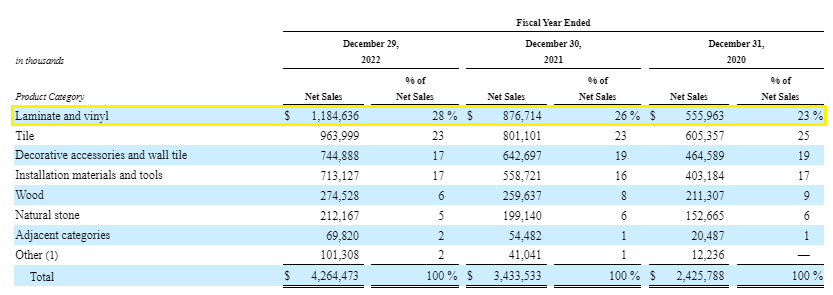
Implied est. from the 10-K of CFL at ~60% of LVT sales aligns with industry call commentary
While high, CFL used to make up nearly all of $FND's sourced LVT at initial product launch – $FND now has at least ~3-4 suppliers for its LVT
While high, CFL used to make up nearly all of $FND's sourced LVT at initial product launch – $FND now has at least ~3-4 suppliers for its LVT

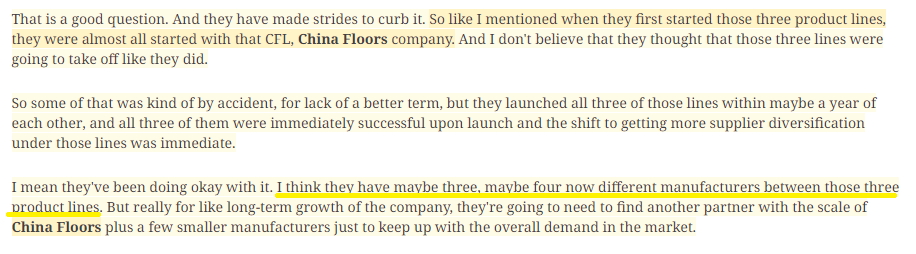
important to note here – $FND partnered with CFL to develop its private label LVT product lines (Nucor, AquaGuard, DuraLux, etc.) – while CFL is the manufacturer – $FND owns the IP, making the product lines exclusive to $FND
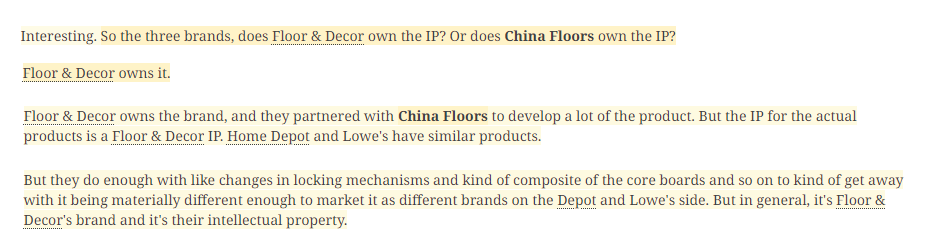
In addition, IP ownership allows $FND to contract with multiple other mfg. to make/source their private label LVT products

Some more background on CFL
- founded in 2004 in Shanghai by a group of European entrepreneurs
- while many $FND suppliers are small, CFL is large – having ~4,500 employees & five mfg. facilities that generate 70mln sq meters of flooring output
- founded in 2004 in Shanghai by a group of European entrepreneurs
- while many $FND suppliers are small, CFL is large – having ~4,500 employees & five mfg. facilities that generate 70mln sq meters of flooring output

While initially a fully China based business, CFL began diversifying its manufacturing footprint in 2018, with two new facilities operational in Vietnam and Taiwan in 2019 and a US based facility (Dalton, GA) operational in 2021
floorcoveringweekly.com/main/topnews/c…
floorcoveringweekly.com/main/topnews/c…
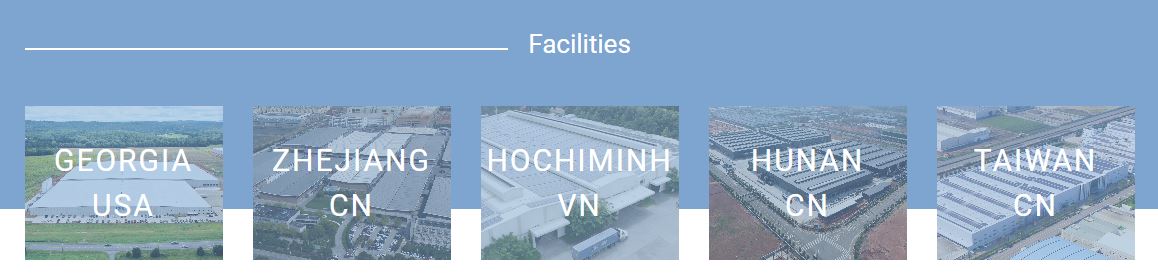
In total, CFL has five mfg, facilities:
China – 2
Taiwan – 1
Vietnam – 1
US – 1
China – 2
Taiwan – 1
Vietnam – 1
US – 1
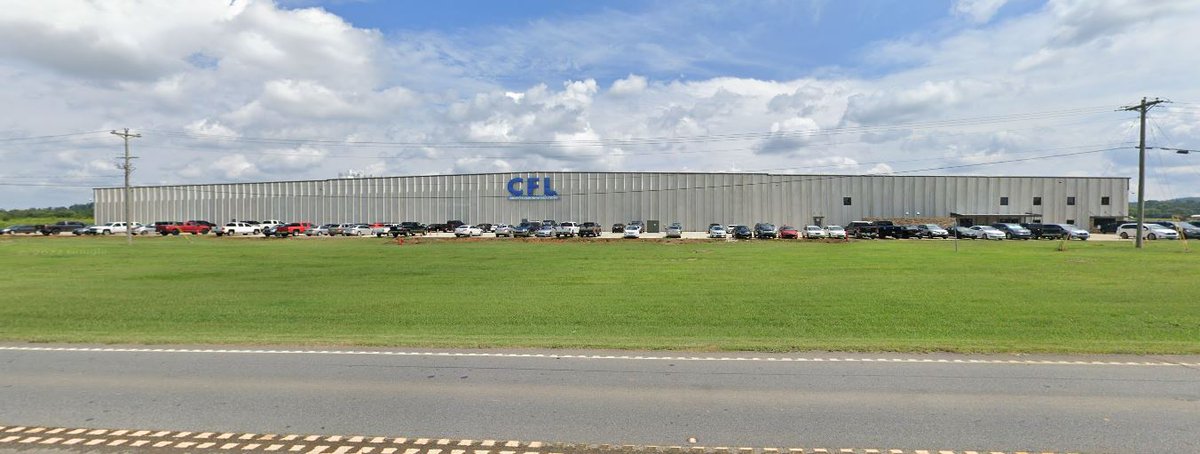
Sources for the Calhoun, GA plant below
an interesting note is its about ~5mi down the road from a key $MHK plant & close to other flooring manufacturers facilities like Novalis (Dalton, GA)
gov.georgia.gov/press-releases…
an interesting note is its about ~5mi down the road from a key $MHK plant & close to other flooring manufacturers facilities like Novalis (Dalton, GA)
gov.georgia.gov/press-releases…
another item – for those unaware, LVT mfg. is more intense/complex then you may realize
CFL has several video snips of their plants in the US & Vietnam that provide some good visuals - see link
(sorry cannot link direct to each one)
vimeo.com/user16440064
CFL has several video snips of their plants in the US & Vietnam that provide some good visuals - see link
(sorry cannot link direct to each one)
vimeo.com/user16440064
CFL continues to scale alongside $FND – recently CFL raised capital from private equity (’21) and noted additional expansions of its Vietnam and US mfg. facilities back in April
cflflooring.com/cfl-flooring-e…
cflflooring.com/cfl-flooring-e…
So, to wrap up, why is the detail on CFL so important – why should you care?
LVT is the most important and fastest growing flooring category – both for $FND and the industry at large
LVT is the most important and fastest growing flooring category – both for $FND and the industry at large
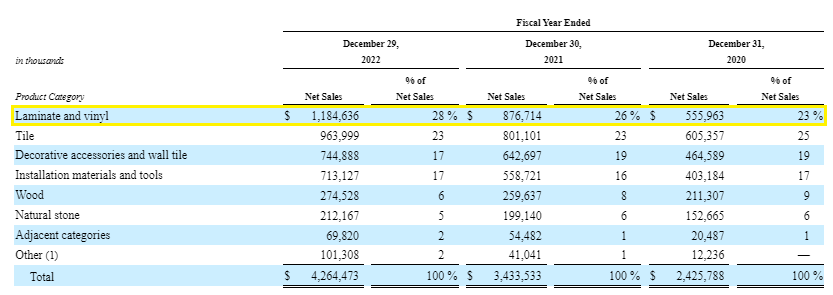
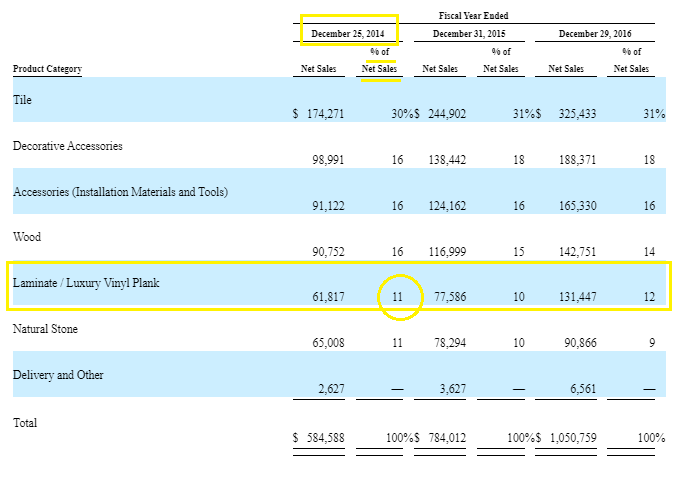
For example, over 2014-2022, $FND LVT sales grew +45%/yr., nearly 2x +25%/yr. growth for all other categories.
As a percent of sales, $FND LVT sales increased from 11% to 28% of sales over 2014-2022
As a percent of sales, $FND LVT sales increased from 11% to 28% of sales over 2014-2022
For the industry as a whole – over 2014-2021 – LVT sales grew +31%/yr – ~10x faster than +3%/yr growth in all other categories, going from ~5% to ~22% of total industry sales
Based on industry data from Floor Covering Weekly (FCW Statistical Reports)
floorcoveringweekly.com/main/research
Based on industry data from Floor Covering Weekly (FCW Statistical Reports)
floorcoveringweekly.com/main/research
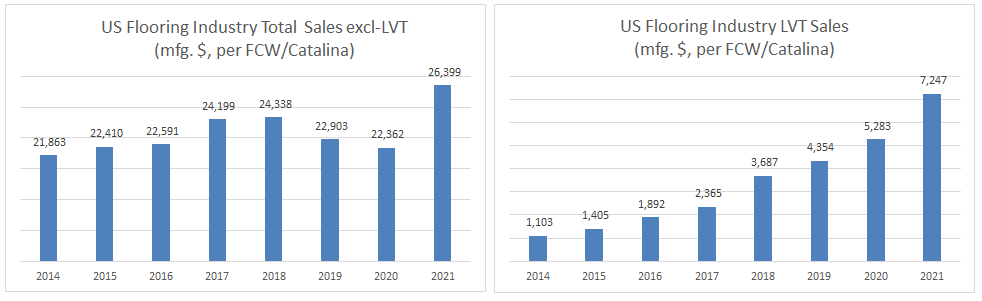
LVT’s rapid rise is due to a superior value proposition for consumers:
- half the cost of wood/engineered flooring
- comparable in price to carpet
- attractive aesthetics vs. other categories
- easier to install
- innovative features like waterproofing
- half the cost of wood/engineered flooring
- comparable in price to carpet
- attractive aesthetics vs. other categories
- easier to install
- innovative features like waterproofing
All in, the LVT category is mission critical for a growth retailer like $FND
$FND's reliance and high concentration with a single supplier in the category is an important risk that investors should be fully aware of
$FND's reliance and high concentration with a single supplier in the category is an important risk that investors should be fully aware of
While $FND has diversified exposure to some extent, ~60% category exposure remains high
it seems highly unlikely that CFL would voluntarily drop $FND as a customer, given its rapid growth and LT potential in flooring,
it seems highly unlikely that CFL would voluntarily drop $FND as a customer, given its rapid growth and LT potential in flooring,
nonetheless – replacing lost supply from CFL with $FND's other LVT category suppliers would undoubtedly take substantial time and cause material disruption
• • •
Missing some Tweet in this thread? You can try to
force a refresh