(1/16) Today, let's talk about something truly unique about the T-64 as far as tanks go: its tracks. 

(2/16) @Chieftain_armor has an excellent video on the basics of tank track design, and I recommend watching it to understand some of the terms.
(3/16) The T-64 was the first Soviet tank to use double-pin tracks. They are also 'live' tracks, with rubber bushings on the track pins (right).


(4/16) Incidentally, books on Soviet tanks will often refer to 'RMSh tracks'. RMSh is just an abbreviation of резинометаллический шарнир ('rubber-metal joint' i.e. 'live'), not an 'official' designation of the tracks. So saying 'RMSh rubber bushed tracks' is kind of redundant.

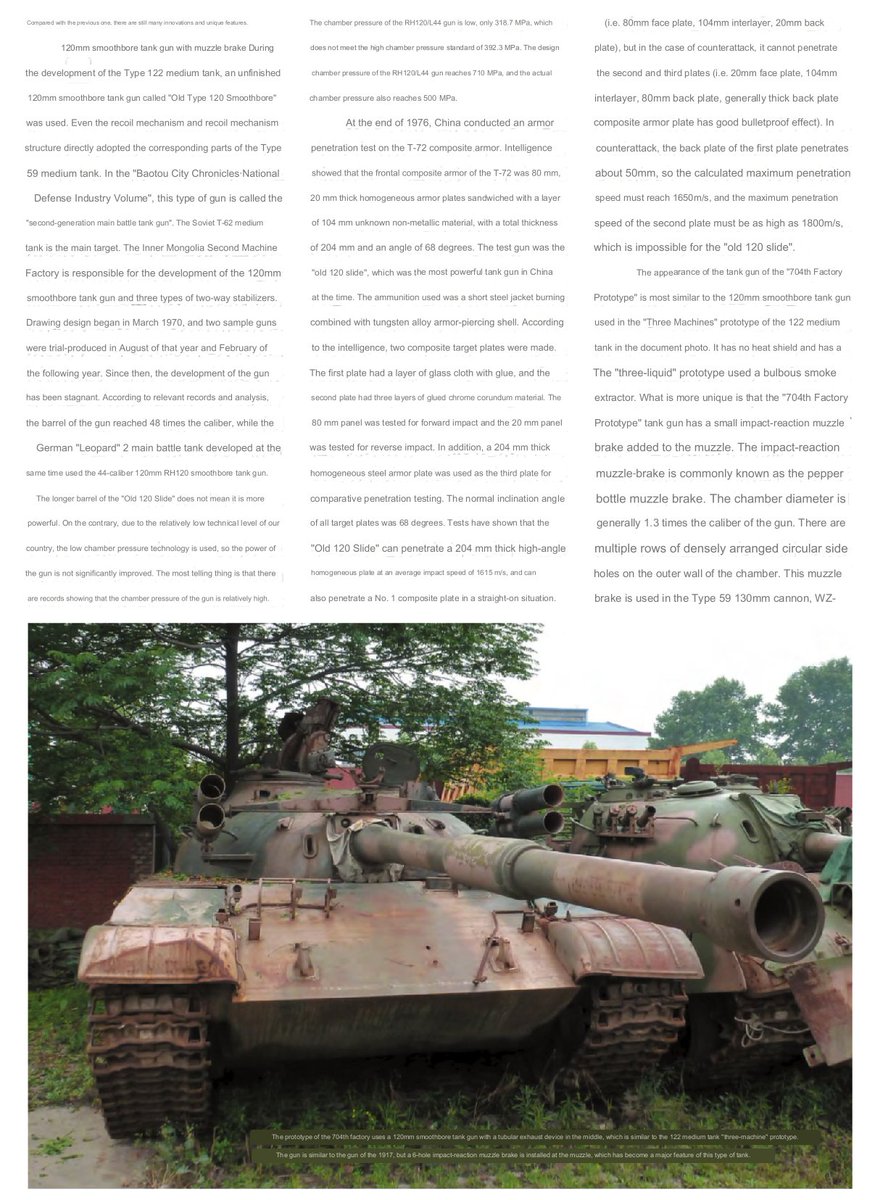
(5/16) Anyway, the first thing you'll notice about the T-64's tracks is that there are an awful lot of holes and gaps in the tracks. Why does it have these?

(6/16) In his video, @Chieftain_armor rightly points out that tracks primarily serve to reduce ground pressure by increasing the surface area in contact with the ground, allowing better cross-country capability compared to wheeled vehicles.
(7/16) However, ground pressure isn't everything. Let's consider the T-72 (with the original single-pin 'live' tracks). It has a similar ground pressure to the T-64A (0.83 kg/cm²).

(8/16) Yet, in testing, the T-72 gets stuck in mud more often than the T-64A. Like in the 1974 Yakubovsky Commission test...
btvt.info/4ourarticles/1…
btvt.info/4ourarticles/1…


(9/16) ... or these Soviet-era test results cited in 2007 by the Ukrainian 'Integrated Technology and Energy Efficiency' journal about picking a suspension for a future Ukrainian tank...

(10/16) Part of the secret to the T-64's great cross-country ability in mud comes from the holes in its tracks. These holes allow mud, soil, and snow to pass through, giving the tracks better grip in these conditions, as 'Shawshank' describes here.
(11/16) Chobitok gives an analogy: skis can bear a lot of weight without sinking in deeply, but they slide in the snow.
Lattice snowshoes cannot take as much weight, but they do not slip in the snow, held in place by snow squeezed through the holes.
dzen.ru/a/ZHESaIKU1iuN…
Lattice snowshoes cannot take as much weight, but they do not slip in the snow, held in place by snow squeezed through the holes.
dzen.ru/a/ZHESaIKU1iuN…

(12/16) The T-64's tracks are thus a compromise between the two. The T-72's tracks are closer to skis, and their mud performance is imaginatively described by the Ukrainian tanker Aleksandr Dominikanets (aka Khercrit on YouTube), who has crewed both the T-64 and T-72.

(13/16) The holes also make the suspension lighter, which means a lighter tank, as well as less energy wasted actually moving the tracks.
Incidentally, the KV/IS heavy tanks also had openworks in their tracks, though they are single-pin instead of double-pin.
Incidentally, the KV/IS heavy tanks also had openworks in their tracks, though they are single-pin instead of double-pin.

(14/16) No design is perfect, and there are always tradeoffs. One is that the T-64's tracks have considerably worse traction in loose sand than the T-72. Of course, fortunately for the T-72, it's fought most of its battles in deserts.

(15/16) The double-pin T-64 tracks are also a bit more complicated to produce and maintain than the simpler single-pin T-72 tracks, reflected by the longer time needed for maintenance and slightly higher cost.


(16/16) Then again, the T-72/90 family would also eventually adopt double-pin tracks, and this simplicity advantage was more or less eliminated. Even so, as this war has clearly shown, they've never been able to match the T-64 in mud.


• • •
Missing some Tweet in this thread? You can try to
force a refresh